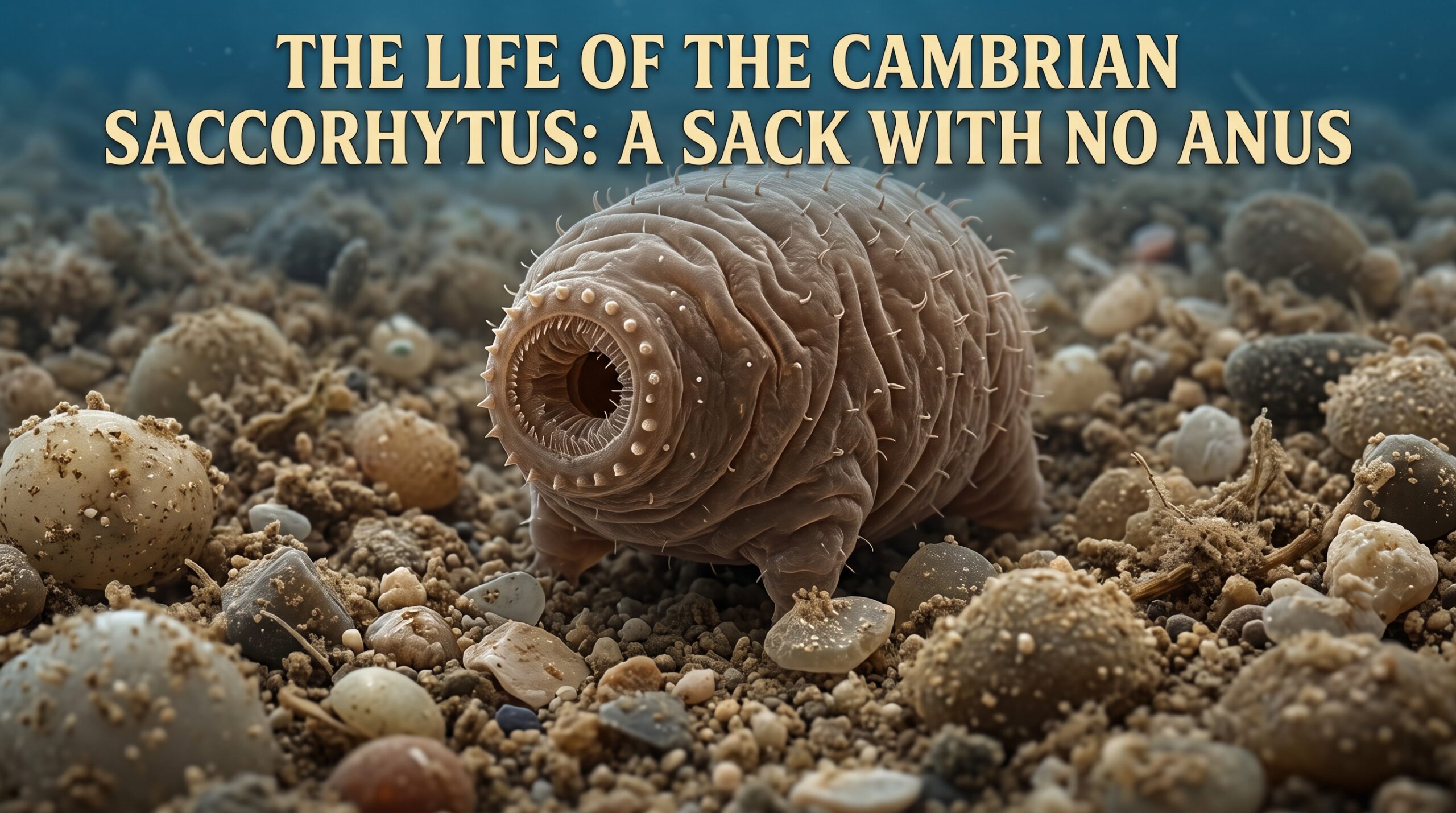
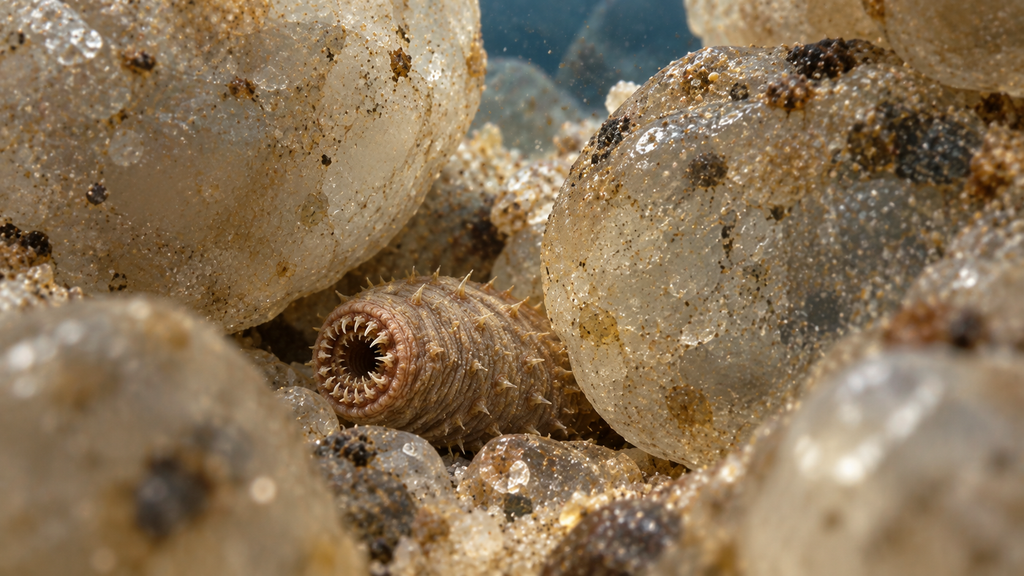
| Name | Saccorhytus coronarius, from the Latin saccus (sack) and the Greek rhytis (wrinkle). The species name coronarius means “crown-like,” referring to the mouth ringed by projections |
| Classification | An early member of the ecdysozoans (the group including arthropods and nematodes). At its description in 2017 it was placed among the deuterostomes |
| Age | Earliest Cambrian (Fortunian), about 535 million years ago |
| Found in | The Kuanchuanpu Formation, Xixiang County, Shaanxi Province, China |
| Size | About 1 mm long. An oval, sack-like body |
Saccorhytus was a tiny animal about 1 mm long that lived on the seafloor in the earliest Cambrian. Its body is an oval, wrinkled sack with a mouth disproportionately large for its size, and no anus. Announced in 2017 as the oldest known ancestor of the deuterostomes, the group containing humans, it was reported worldwide — and in 2022 a re-study moved it into an entirely different group.
A sack of mouth, living between grains of sand
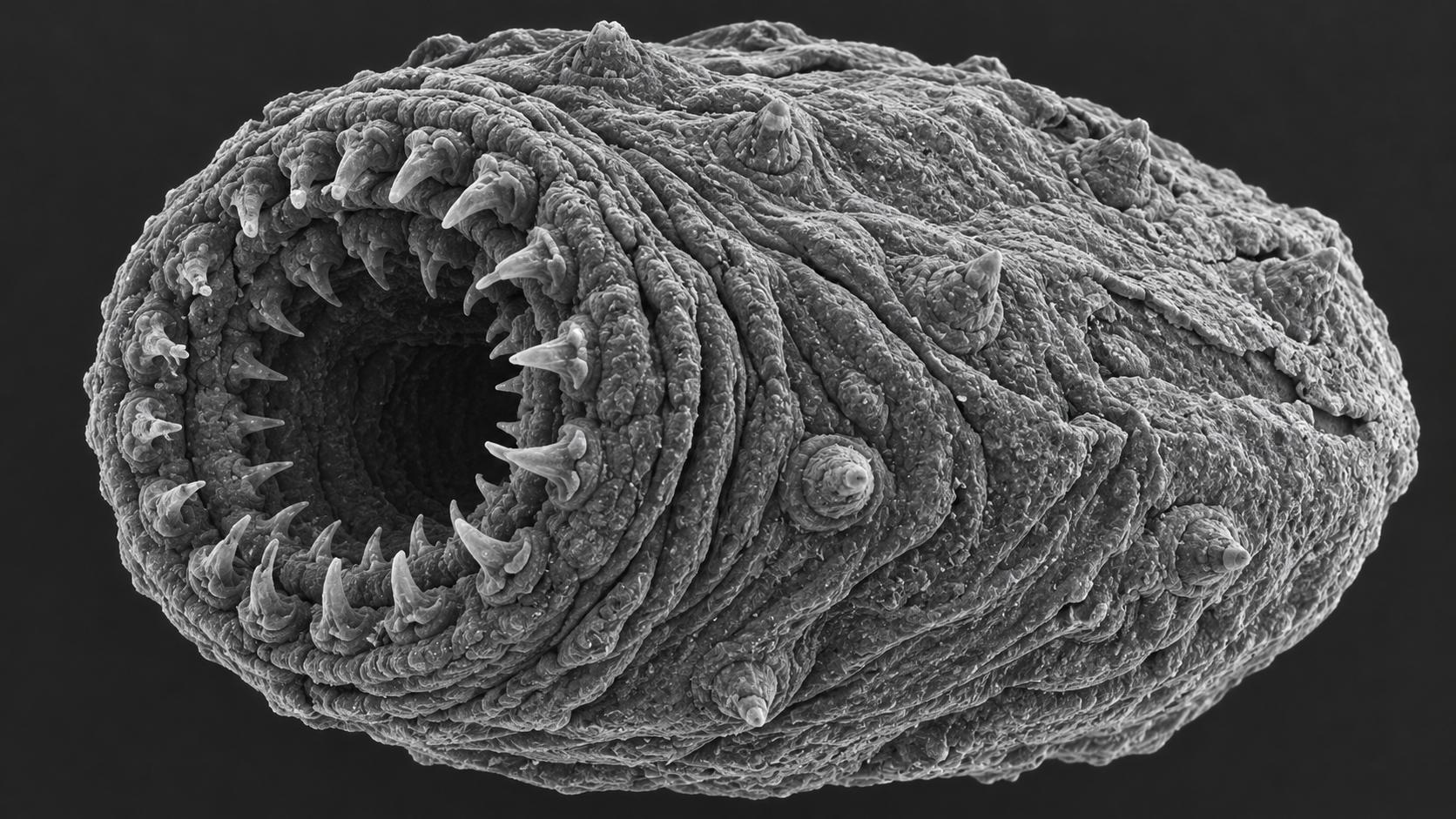
Saccorhytus fossils are recovered as minute grains by dissolving the rock in acid. To the naked eye they look like nothing but black sand, but because the body tissue was replaced by phosphate and preserved in three dimensions, an electron microscope reveals the surface wrinkles and even the projections around the mouth. The 2017 description used 45 specimens; the 2022 re-study added several hundred more.
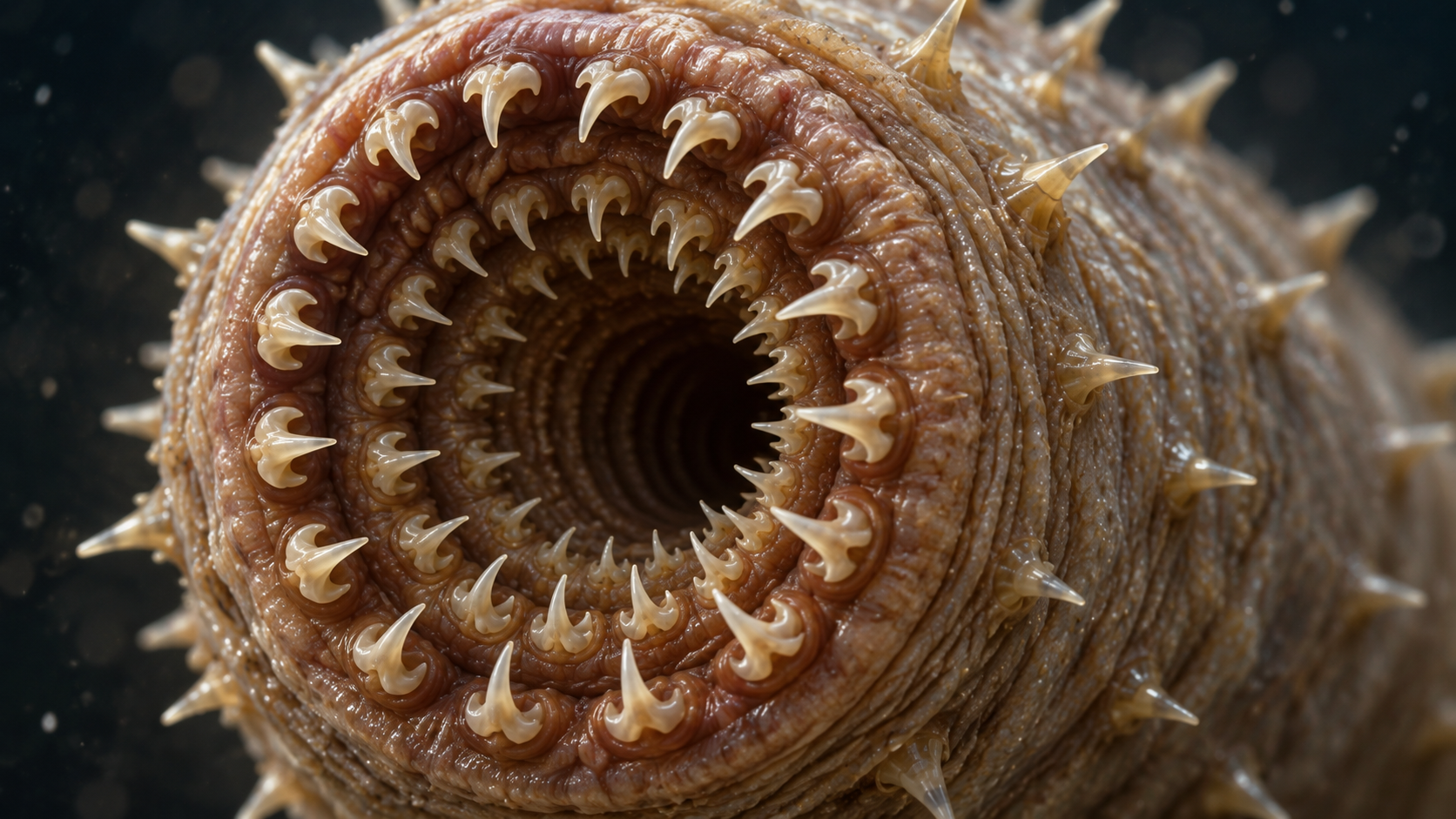
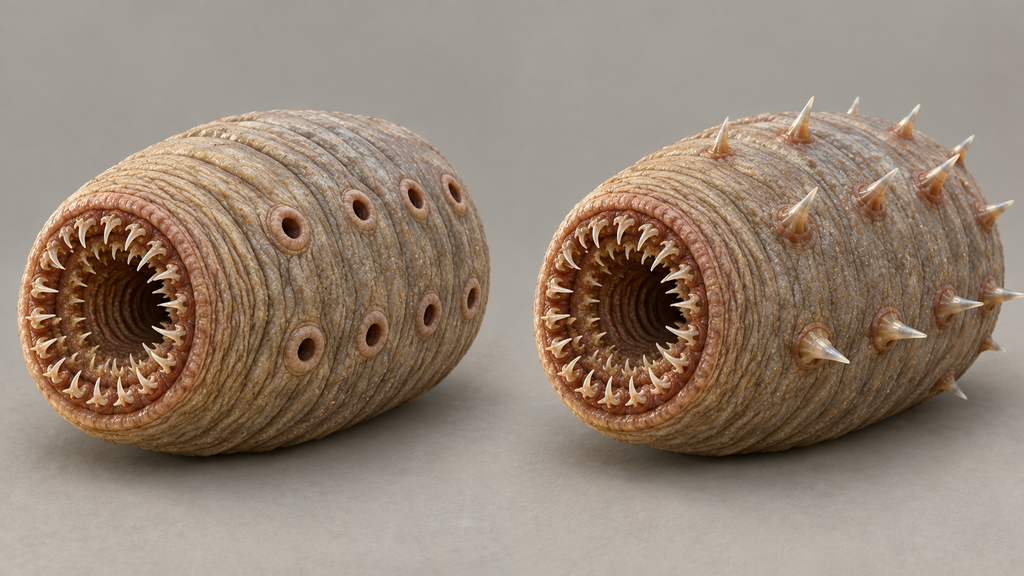
The body is oval, with a large mouth opening at one end. Around the mouth, projections with three-pronged tips are arranged in a ring, with radial wrinkles running outside them. The body surface was thin and soft, and because the fossils are preserved strongly folded, it is thought to have been a stretchable skin in life. Conical bulges are arranged along both sides of the body, and at the apex of each there appeared to be a round opening. What those openings actually were would later determine the classification of the animal.
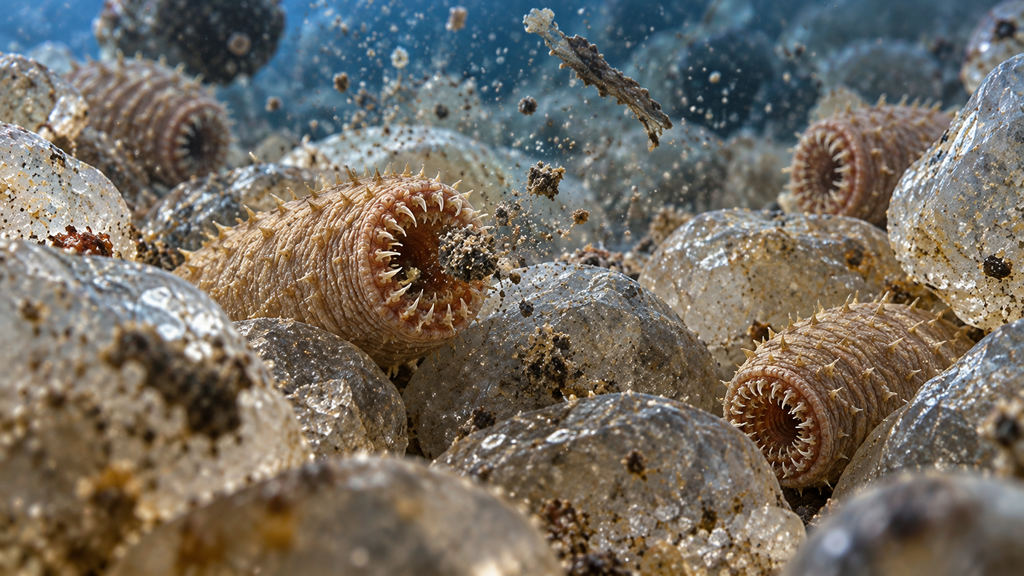
It had no eyes, no limbs and no anus. Waste from what it ate is thought to have been expelled through the mouth. At only about 1 mm in size, it is inferred to have lived tucked into the spaces between grains of sand on the seafloor, moving by flexing its body and swallowing particles of organic matter and small organisms whole through its large mouth. It had no dedicated respiratory organ; at that size, taking gas in directly through the body surface sufficed.
The Kuanchuanpu Formation, where Saccorhytus was found, dates to shortly after the Cambrian began, and the same rock yields many fossils of small shelled organisms and phosphatized larvae and embryos of cnidarians. Neither trilobites nor Anomalocaris had yet appeared; this was a time when animals too small to see had spread across the seafloor first.
From “oldest human ancestor” to ecdysozoan
Saccorhytus was described as a new species in Nature in January 2017 by Han Jian of Northwest University in China, Simon Conway Morris of the University of Cambridge and colleagues. The team placed the animal at the most primitive position within the deuterostomes, the group gathering vertebrates, echinoderms and hemichordates. Their grounds were the round openings arranged along the sides of the body, interpreted as pharyngeal openings passing water from inside the body to the outside — that is, the prototype of the gill openings characteristic of deuterostomes. Since humans belong to the deuterostomes, the description was reported around the world under headlines calling it the oldest known human ancestor, and describing our distant forebear as a sack that was mostly mouth.
This interpretation was also expected to help with a problem about evolutionary dates. Working backward from the amount of DNA change to when the major animal groups diverged gives dates considerably older than the times at which they appear as fossils. If ancestors 1 mm in size like Saccorhytus were living within the sand, then it follows naturally that they fossilize poorly and leave a blank in the record.
Five years later, in August 2022, an international team including Liu Yunhuan of Chang’an University in China, Zhang Huaqiao of the Nanjing Institute of Geology and Palaeontology, Shuhai Xiao of Virginia Tech and Philip Donoghue of the University of Bristol published a re-study in the same journal. The team imaged several hundred newly collected specimens at a synchrotron facility in Switzerland — taking hundreds of X-ray images while shifting the angle slightly each time, and assembling them by computer into 3D models including the interiors of the fossils.
Those 3D models showed that inside the round openings taken for gill pores, another layer of the body reached up from beneath and closed them off. What looked like openings were the bases of spines that had projected from the body surface and broken off during fossilization. The openings, in other words, did not exist in life, and the body of Saccorhytus was covered in an armor of spines. The grounds for calling it a deuterostome were an apparent structure produced by how the fossils formed.
The team then ran a fresh phylogenetic analysis, comparing the arrangement of the spines around the mouth and the structure of the body surface against every major group of living animals. A relationship with sea anemones and jellyfish, which also have a mouth and no anus, was considered, but every analysis supported the same result: an early member of the ecdysozoans, the group including arthropods, nematodes and priapulid worms. Neither the deuterostome nor the cnidarian hypothesis was supported.
Since ecdysozoans are a group with a gut running from mouth to anus, Saccorhytus belonging there means it lost an anus its ancestors had had, somewhere along the way. And while the earliest ecdysozoans have been assumed to have had long, worm-like bodies, placing a sack-bodied Saccorhytus near the base of that group means the ancestral form itself needs reconsidering. Its precise position within the ecdysozoans is not yet settled.
With Saccorhytus vacating the position of human ancestor five years after its discovery, the oldest fossil record of the deuterostomes returned to a blank. The problem of how to explain the gap between divergence dates estimated from DNA and the dates of fossils must now be solved with other evidence, not this animal. Seen from the ecdysozoan side, however, it means a sack-bodied member was already present in the earliest Cambrian, making that group more varied than had been supposed.
Sources
Han, J. et al. (2017). Meiofaunal deuterostomes from the basal Cambrian of Shaanxi (China). Nature, 542, 228–231.
https://www.nature.com/articles/nature21072
Liu, Y. et al. (2022). Saccorhytus is an early ecdysozoan and not the earliest deuterostome. Nature, 609, 541–546.
https://www.nature.com/articles/s41586-022-05107-z
University of Cambridge (2017). Bag-like sea creature was humans’ oldest known ancestor.
https://www.cam.ac.uk/research/news/bag-like-sea-creature-was-humans-oldest-known-ancestor
University of Bristol (2022). Scientists relieved to discover ‘curious’ creature with no anus is not earliest human ancestor.
https://www.bristol.ac.uk/news/2022/august/saccorhytus–.html
Nanjing Institute of Geology and Palaeontology, CAS (2022). New evidence proves Saccorhytus is ecdysozoan (EurekAlert!).
https://www.eurekalert.org/news-releases/961928
コメント