This article contains affiliate links. As an Amazon Associate I earn from qualifying purchases.
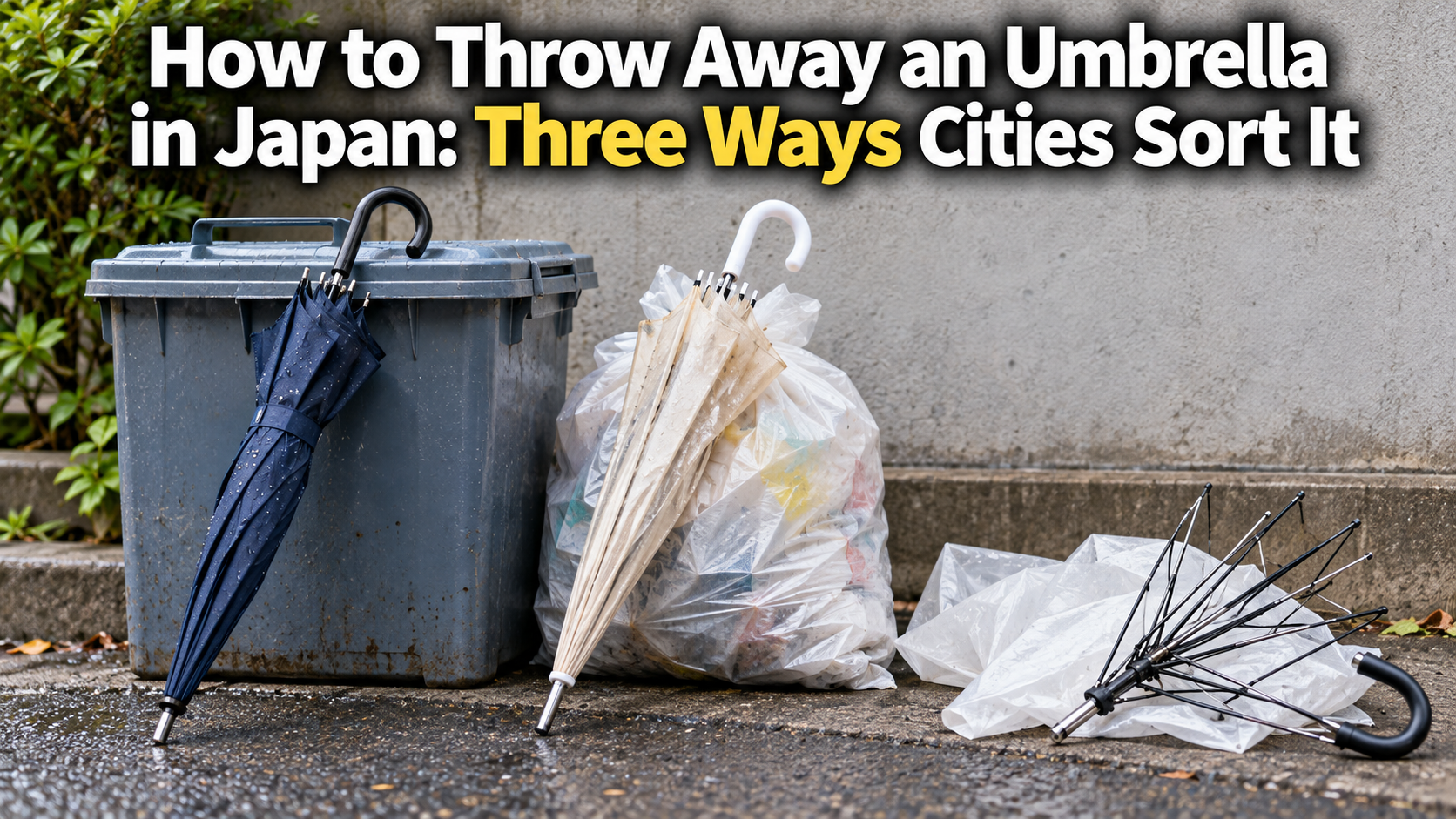
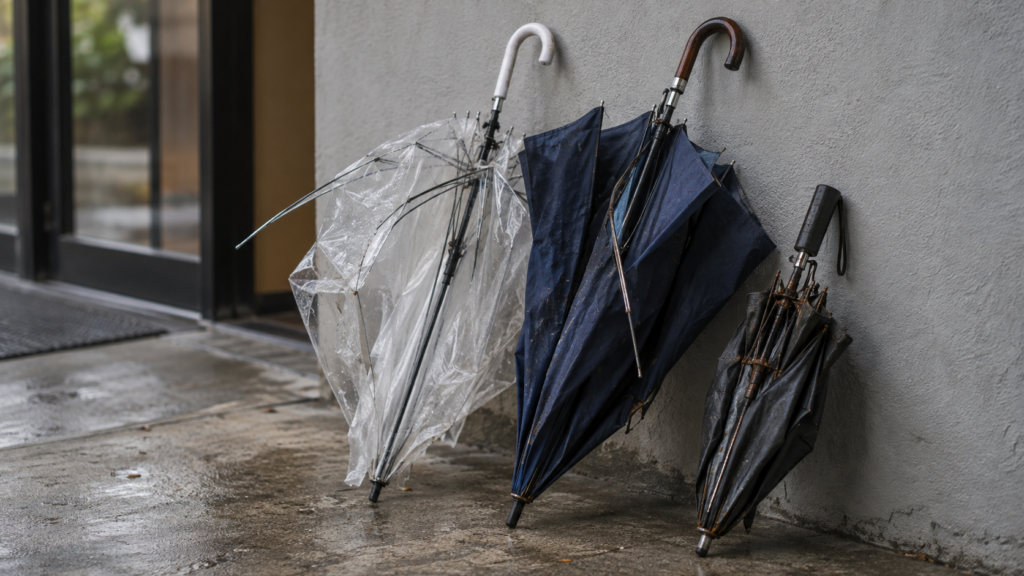
A broken umbrella or a rusty clear plastic one is one of the harder items to sort in Japan: does it go out as burnable or non-burnable garbage? The answer depends on the city or ward you live in. The same umbrella can go out whole in one city and must be split into fabric and frame in another. This article compares the official guidance of several local governments, explains how the rules differ and lists what to check before you put an umbrella out.
Three Ways Japanese Cities Sort Umbrellas
An umbrella combines a frame of metal or fiberglass ribs, a canopy of fabric or vinyl, and a handle of plastic or wood. Because each local government decides which material counts, the rules are not the same everywhere. Official guidance falls into roughly three patterns.
Whole, as non-burnable garbage
Fukuoka City puts umbrellas in non-burnable garbage (moenai gomi). Items up to about 1 m long and 5 cm in diameter can stick out of the designated bag, as long as the bag is tied firmly shut. Anything longer than 1 m is oversized garbage (sodai gomi). Funabashi in Chiba Prefecture also treats umbrellas as non-burnable garbage and lists them as an exception that may stick out of the designated bag. Shinjuku Ward in Tokyo lists umbrellas under “metal, ceramic and glass garbage,” which is collected twice a month.
Whole, as ordinary garbage
In Osaka City, umbrellas go out with “ordinary garbage” (futsu gomi), collected twice a week. Ordinary garbage covers items whose longest side or diameter is up to 30 cm, or rod-shaped items up to 1 m long, and umbrellas count as rod-shaped. If an umbrella does not fit in the bag, put one end into the bag or mark it with a note such as “不用品” (unwanted item).
Split into fabric and frame
Yokohama City asks residents to take umbrellas apart. The metal frame goes out as “small metal items” (chiisana kinzoku-rui), and the fabric goes out as burnable garbage. Small metal items are normally limited to things whose longest side is under 30 cm, but metal umbrella frames are accepted as small metal items even if they are 30 cm or longer. Small metal items are collected once a week, on the same day as cans, bottles and PET bottles, in a separate bag from those.
Three Things to Check Before You Put It Out
To find out which pattern your city follows, look up “傘” (umbrella) in the garbage sorting dictionary on your city or ward website, or in your local garbage sorting app. Many cities also publish sorting guides in English and other languages. When you look it up, check the following three points as well as the category name, so you do not have to put it out again.
The first is the length limit. Some cities treat umbrellas longer than 1 m, or items over 30 cm, as oversized garbage, and like Osaka, many local governments require you to book oversized garbage collection in advance and pay a fee. The second is whether the umbrella may stick out of the designated bag. Some cities make umbrellas an exception, while others treat anything that does not fit in the bag as oversized garbage. The third is whether you need to take it apart. In cities that require splitting, like Yokohama, you put the fabric and the frame out separately, in different categories, rather than the whole umbrella.
How to Separate the Fabric From the Frame
In cities that ask you to split the umbrella, start by opening it and removing the small caps at the rib tips that hold the fabric in place. If the caps do not come off, or the fabric is sewn on, cut the fabric away from the ribs with scissors. You can also cut through the part that holds the fabric at the top of the central shaft. If the plastic or wooden handle comes off, remove it and put it out according to your city’s categories.
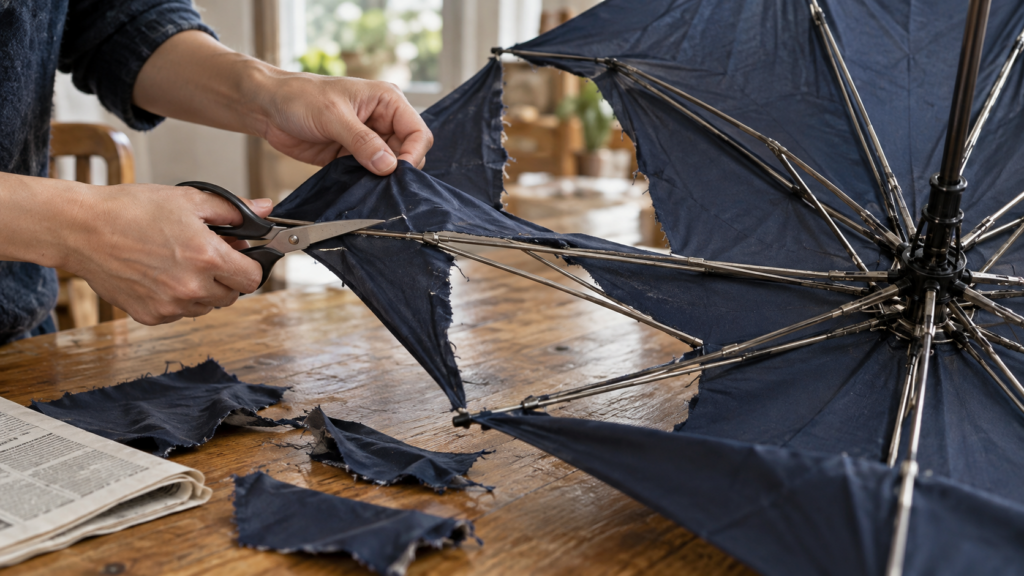
Once the fabric is off, as in the image above, the rib tips are exposed. They are sharp and can injure collection workers. Shinjuku Ward asks residents to wrap dangerous items such as blades and needles in thick paper and mark them “危険” (danger) before putting them out. Wrapping the rib tips of an umbrella frame in newspaper or thick paper and bundling them together is a safe way to do the same.
Summary
Umbrellas in Japan usually go out in one of three ways: whole as non-burnable garbage, whole as ordinary garbage, or split into fabric and frame. Which one applies depends on the rules where you live. If you have just moved, the way you put umbrellas out in your previous city may not work in the new one. Before putting one out, look up “傘” in your local garbage sorting dictionary and check the category, the length limit and whether you need to take it apart.
Related products
You can find books and products related to this article on Amazon.
If you buy through the links above, this blog may earn a commission.
About the images
The images in this article are illustrations created with AI (ChatGPT), and you are welcome to use them. If you do, we would appreciate a link back to this article as the source.
Sources
Fukuoka City, “燃えないごみの出し方” (How to put out non-burnable garbage) https://www.city.fukuoka.lg.jp/kankyo/jigyokeigomi/life/katei-bunbetsu/moenaigomi.html
Funabashi City, “不燃ごみの出し方” (How to put out non-burnable garbage) https://www.city.funabashi.lg.jp/kurashi/gomi/001/p001543.html
Shinjuku City, “金属・陶器・ガラスごみの出し方” (How to put out metal, ceramic and glass garbage) https://www.city.shinjuku.lg.jp/seikatsu/file09_01_00003.html
Shinjuku City, “危険物の出し方” (How to put out dangerous items) https://www.city.shinjuku.lg.jp/seikatsu/seiso01_001030.html
Osaka City, “普通ごみ収集(収集日:週2回)” (Ordinary garbage collection, twice a week) https://www.city.osaka.lg.jp/kankyo/page/0000009139.html
Yokohama City, “小さな金属類” (Small metal items) https://www.city.yokohama.lg.jp/kurashi/sumai-kurashi/gomi-recycle/gomi/shushu/das8.html


コメント