This article contains affiliate links. As an Amazon Associate I earn from qualifying purchases.
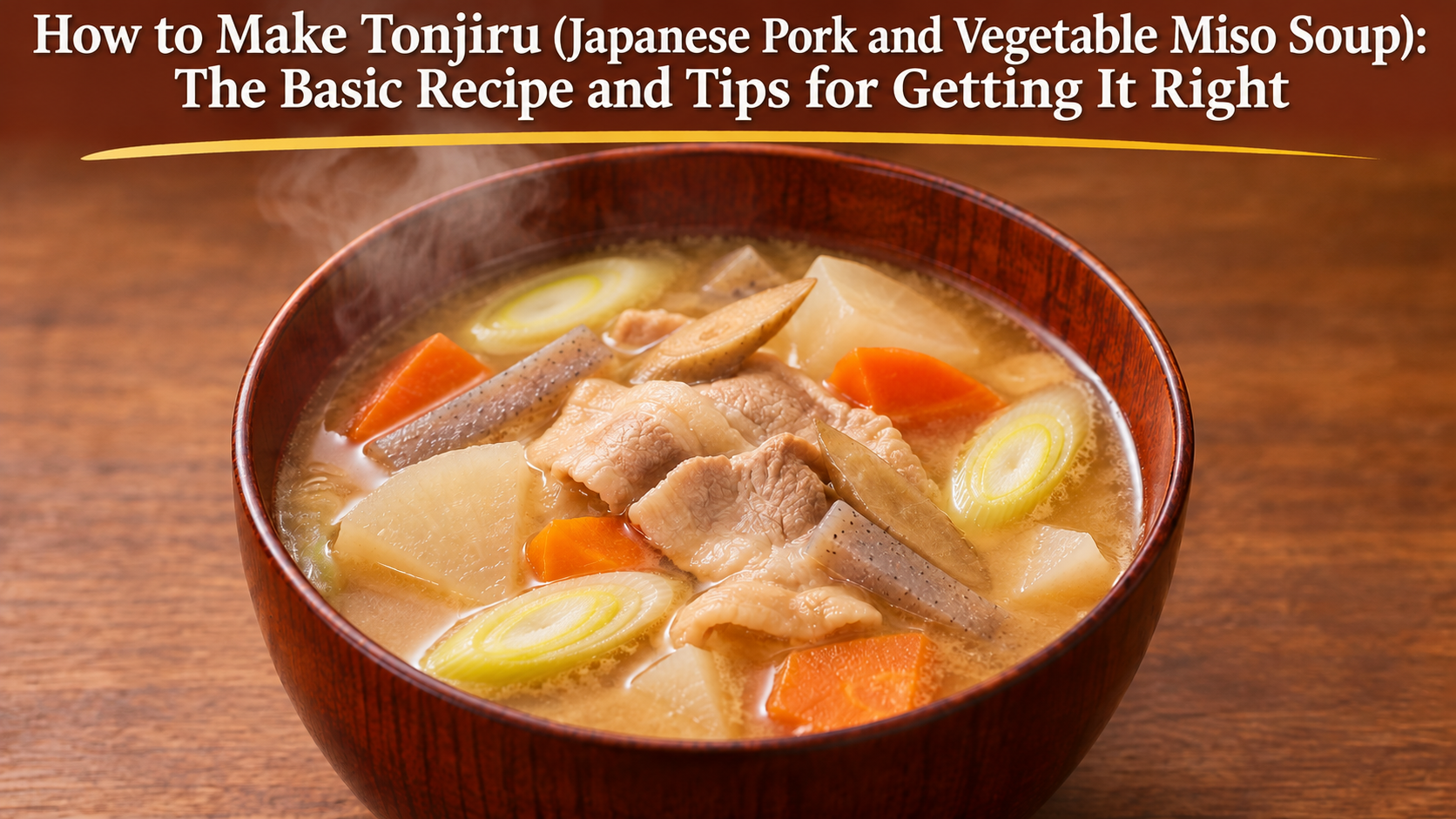
Tonjiru, a Japanese miso soup with pork and root vegetables, depends on two things: stir-frying the pork and vegetables in oil before simmering them, and adding the miso only once the vegetables are tender. This is the basic recipe for four servings, made with pork belly and root vegetables, along with tips for getting it right.
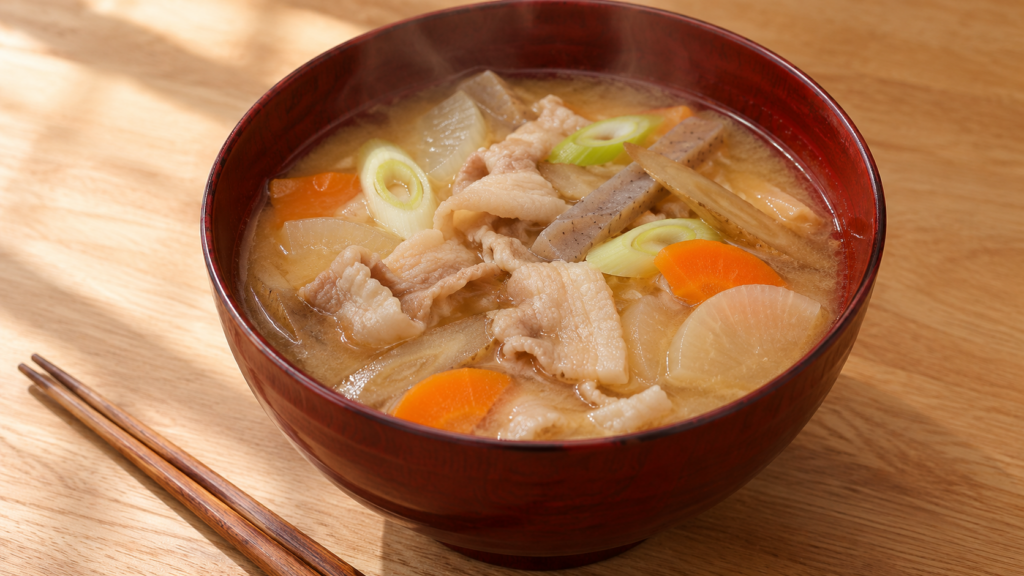
Ingredients (Serves 4)
- 150 g thinly sliced pork belly
- 150 g daikon radish
- 1/2 carrot (about 80 g)
- 1/2 burdock root, also sold as gobo (about 90 g)
- 1/2 block konnyaku, a firm jelly made from konjac (about 125 g)
- 1/2 Japanese long onion (naganegi)
- 1/2 tbsp vegetable oil
- 800 ml dashi (Japanese soup stock)
- 4 tbsp miso
For the dashi, you can use 800 ml of water with 1 tsp of granulated dashi. Other cuts of thinly sliced pork work too, and sesame oil can replace the vegetable oil.
Instructions
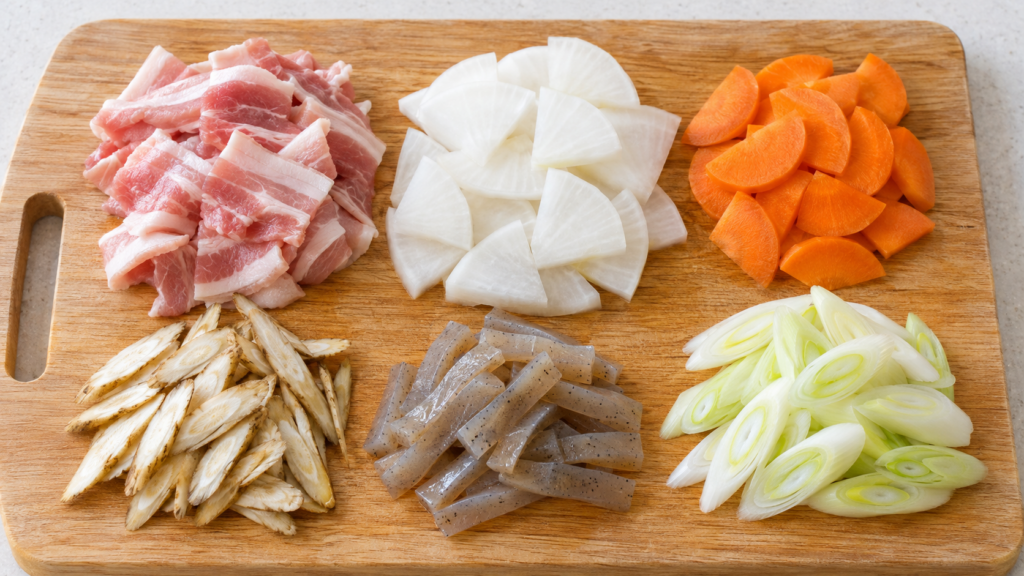
1. Cut the ingredients
Cut the pork into 3 cm pieces. Cut the daikon into quarter-rounds 5 mm thick and the carrot into quarter-rounds 3 mm thick. Scrape the skin off the burdock, slice it thinly on the diagonal, soak it briefly in water, and drain. Slice the long onion thinly on the diagonal.
2. Parboil the konnyaku
Cut the konnyaku into short strips. Put it in a pot, cover with water, and heat. Once it boils, cook over medium heat for 2 to 3 minutes, then drain in a colander.
3. Stir-fry the pork and vegetables
Heat the oil in a pot over medium heat and stir-fry the pork. When it changes color, add the daikon, carrot, burdock, and konnyaku, and stir-fry for about 2 minutes, until everything is coated with oil.
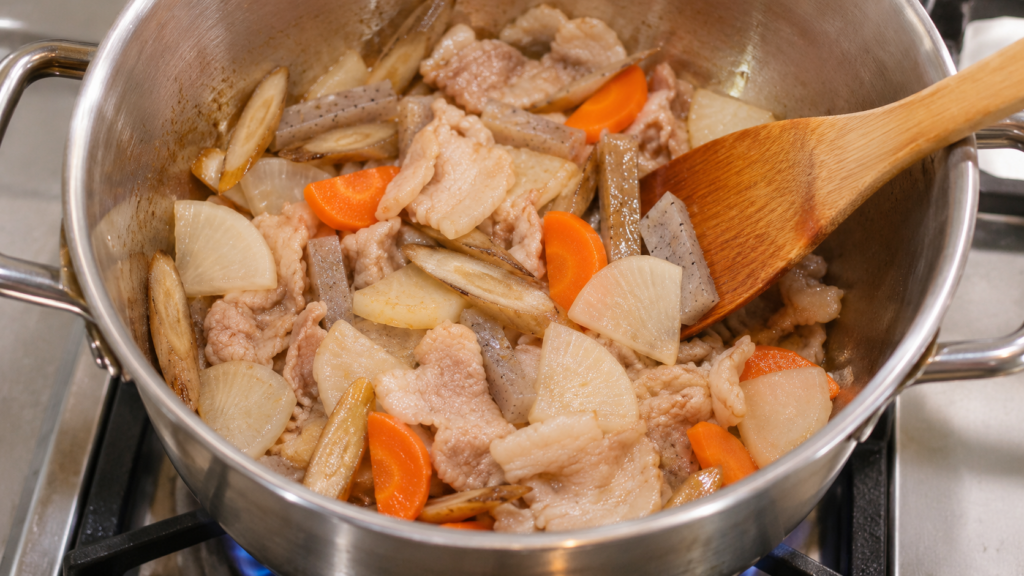
4. Add the dashi and simmer
Add the dashi and bring it to a boil over medium heat. Skim off the foam, turn the heat to low, and cover. Simmer for about 10 minutes, until the daikon is tender.
5. Stir in the miso
Scoop the miso into a ladle, thin it with some of the hot broth, and stir it into the pot. Add the long onion, bring the soup just back to a boil, turn off the heat, and serve.
Tips for Getting It Right
Stir-fry before simmering
Some recipes simply simmer everything, but stir-frying the pork and vegetables first builds savory flavor and depth. Cook the pork first so that it releases its fat, then let that fat and the oil coat the vegetables.
Cut the root vegetables thin and even
Thin slices cook faster, and pieces of the same size cook at the same pace.
Parboil the konnyaku
Parboiling removes its smell. You can also dry-cook it in an unoiled pot with a little sake until no liquid remains, which also keeps its odor down.
Add the miso after the vegetables are tender
Miso loses its aroma when it cooks too long. Check that the daikon is tender before adding it, and turn off the heat as soon as the soup returns to a boil. Some cooks divide the miso, simmering half of it with the vegetables and adding the rest at the end.
If Something Goes Wrong
It tastes too mild. Miso varies in saltiness from one product to another. Stir in a little more, a small amount at a time, and taste as you go.
It’s too salty. There was too much miso, or the soup reduced too far. Add more dashi or water and reheat.
The daikon is still hard after the miso went in. Keep simmering over low heat until it softens, adding dashi or water if the soup reduces, then taste at the end. Next time, test the daikon with a skewer before adding the miso.
The konnyaku smells. It wasn’t parboiled long enough. Boil it for 2 to 3 minutes.
The broth looks murky. There is foam left in the pot. Skim it off when the soup first comes to a boil.
Related products
You can find books and products related to this article on Amazon.
If you buy through the links above, this blog may earn a commission.
About the images
The images in this article are illustrations created with AI (ChatGPT), and you are welcome to use them. If you do, we would appreciate a link back to this article as the source.
Sources
- Kikkoman Home Cooking, basic tonjiru (in Japanese)
- Marukome, classic tonjiru (in Japanese)
- Ajinomoto Park, tonjiru with plenty of vegetables (in Japanese)
- Minna no Kyou no Ryouri, tonjiru by Nobuko Shimizu (in Japanese)
- Minna no Kyou no Ryouri, tonjiru by Masako Kono (in Japanese)
- Minna no Kyou no Ryouri, tonjiru by Tokiko Suzuki (in Japanese)
- Minna no Kyou no Ryouri, simple basic tonjiru by Kaoru Ariga (in Japanese)
- Delish Kitchen, basic tonjiru (in Japanese)


コメント