This article contains affiliate links. As an Amazon Associate I earn from qualifying purchases.
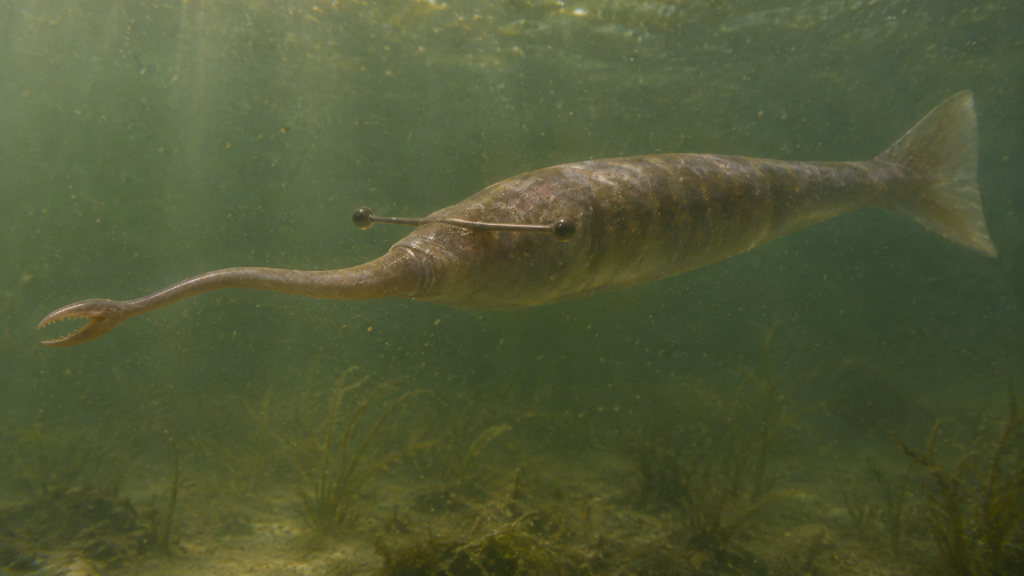
| Name | Tully monster, scientific name Tullimonstrum gregarium. The genus combines the name of its discoverer, Francis Tully, with the Latin word for “monster” |
| Classification | Unresolved. Researchers remain divided over whether it was a vertebrate |
| Age | Late Carboniferous (about 309–307 million years ago) |
| Found in | Illinois, United States, only in the Mazon Creek fossil beds |
| Length | About 8–35 cm, with an average of about 15 cm |
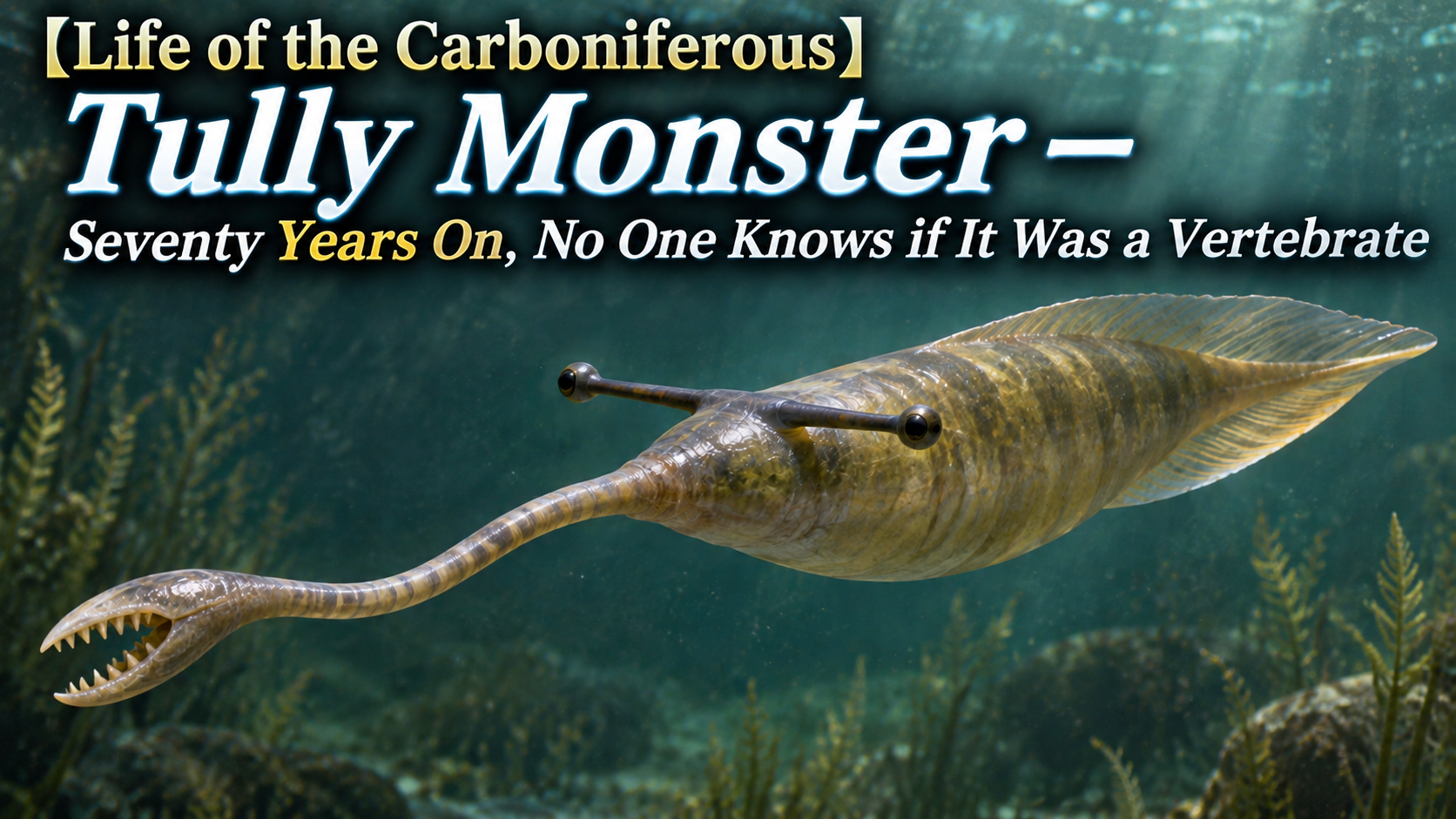
The Tully monster was a soft-bodied animal that lived in the seas of North America during the Late Carboniferous. A long, thin tube extended from its cigar-shaped body, ending in a jaw-like organ. Seventy years after its discovery, researchers still disagree on whether it was a vertebrate.
Appearance and Life
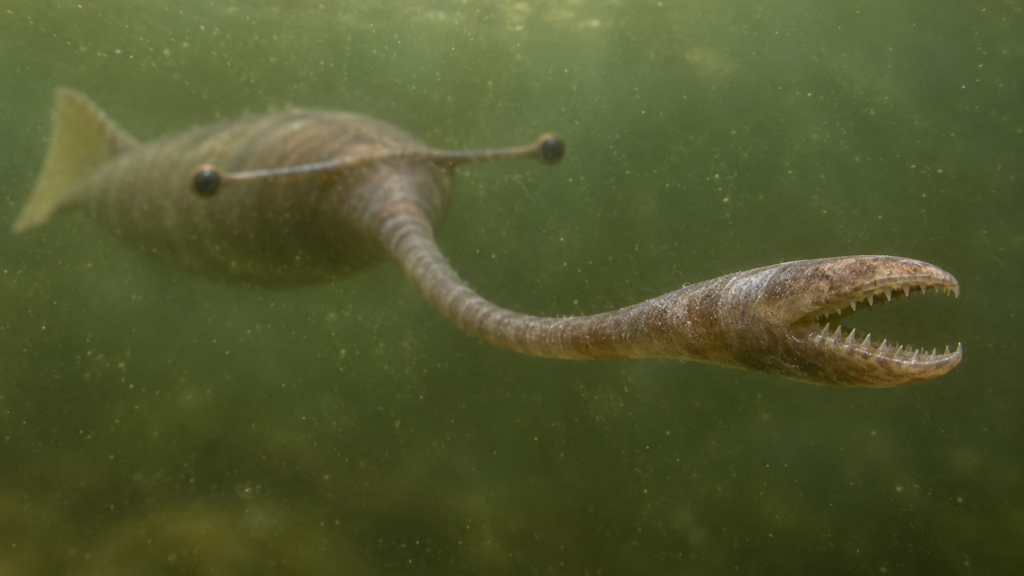
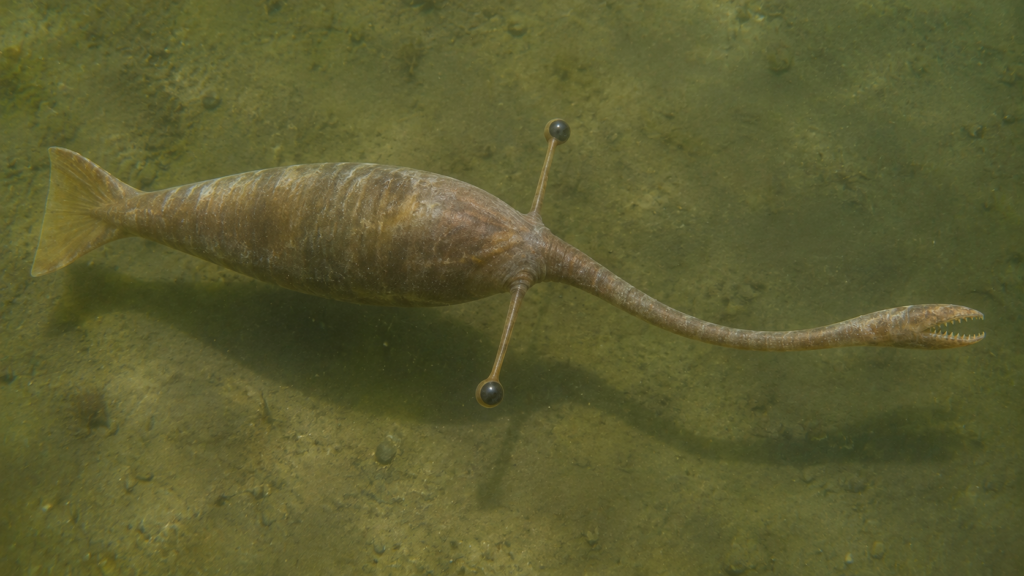
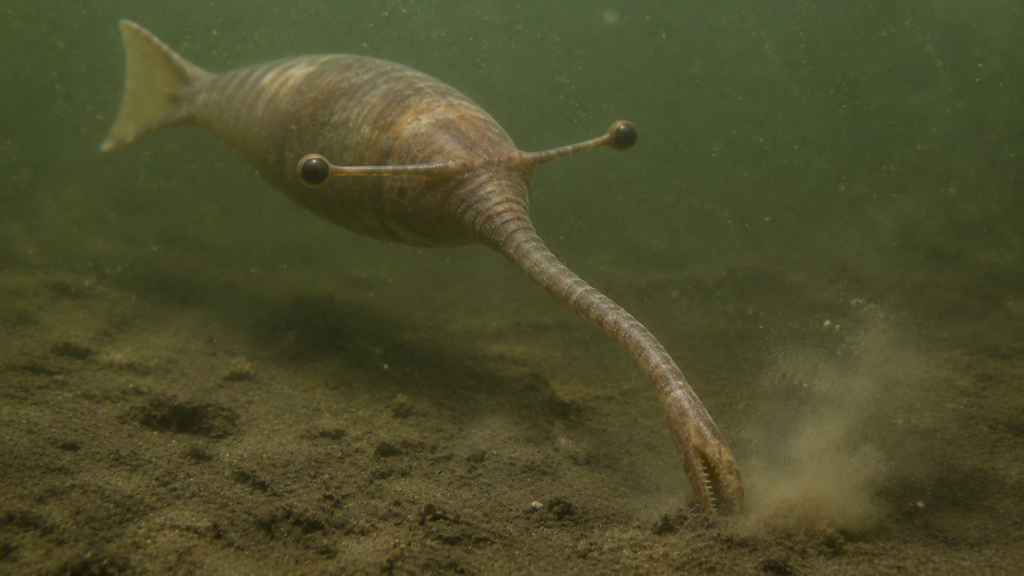
The body was long and cigar-shaped, with a triangular fin at the rear. A long, thin tube ran out from the front, and the jaw-like organ at its tip carried up to about eight small, sharp teeth on each side. A slim bar stuck out sideways near the front of the body, with a round organ at each end. A 2016 study identified those organs as eyes.
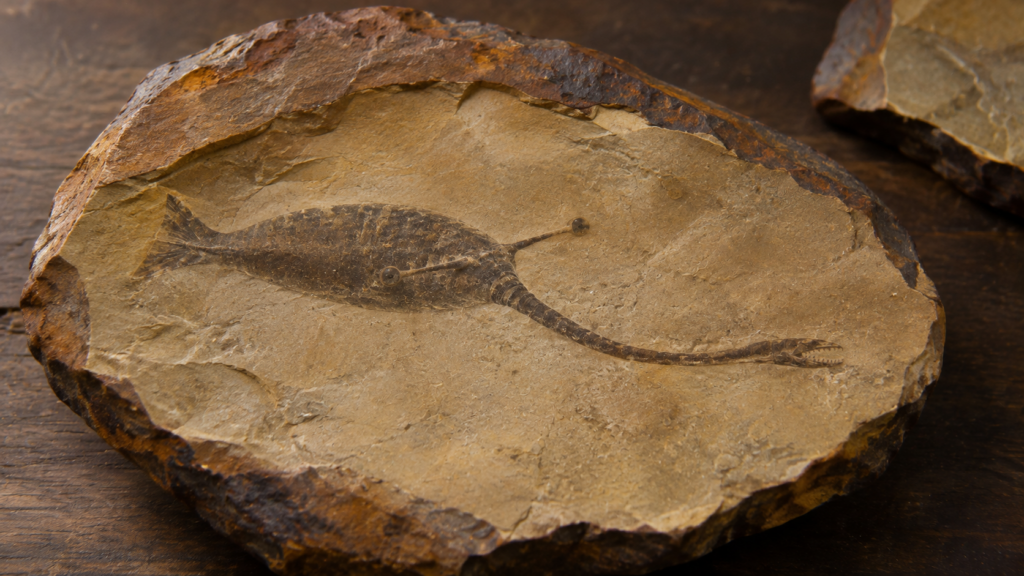
The animal had no hard bones or shell, so its fossils are impressions of soft tissue. Even so, it is common: a 2016 study examined more than 1,200 specimens. In 1989 it was designated the state fossil of Illinois.
The fossils come from Mazon Creek, in sediments laid down in shallow offshore waters. Mud washed in by rivers buried dead animals quickly, and bacteria helped form siderite nodules around them, sealing in the traces of their soft bodies. The same deposits also contain jellyfish, shrimp, and early lamprey relatives.
One view has the animal swimming in open water and catching small prey with the jaw at the end of its tube. Another has it probing the muddy bottom. Its body shape and tail fin suggest a swimming life.
Seventy Years Without a Place
The amateur collector Francis Tully found the first fossil in 1955. He took it to the Field Museum in Chicago, but no one there could say what kind of animal it was. In 1966, the museum’s Eugene Richardson described it in Science as an invertebrate with a toothed proboscis and a mobile tail. Over the following half-century it was compared with nemerteans, polychaetes, gastropods, conodonts, and the stem arthropod Opabinia.
In 2016, two papers made the case for a vertebrate. A team led by Victoria McCoy examined more than 1,200 specimens, reported a notochord, cartilaginous arcualia, and gill pouches, and placed the Tully monster on the lineage leading to lampreys. The same issue of Nature carried a paper by Thomas Clements of the University of Leicester and colleagues. They reported spheroidal and cylindrical melanosomes, or pigment granules, arranged in separate layers in the eyes, a trait they described as unique to vertebrates.
In 2017, Lauren Sallan of the University of Pennsylvania and colleagues disputed the claim. They argued that the supposed notochord extended in front of the eyes, that the structures read as gills and muscle blocks did not match those of vertebrates, and that the thin, jointed proboscis did not fit vertebrate feeding.
The evidence from the eyes weakened as well. In 2019, a team led by Rogers showed that the eyes of living squid and cuttlefish also partition melanosomes by shape. The chemistry of the fossil eyes was closer to that of modern cephalopods than to vertebrates. Then in 2020, McCoy and colleagues compared soft tissues from Mazon Creek fossils by spectroscopy and found that the Tully monster grouped with the vertebrates. Studies of the same fossils, a year apart, pointed in opposite directions.
Japanese research joined the debate in 2023. A University of Tokyo team led by Tomoyuki Mikami examined more than 150 Tully monsters and over 70 other Mazon Creek fossils with a 3D laser scanner, and imaged the proboscis with X-ray micro-CT. They found segmentation extending from the body into the head, a feature unknown in any vertebrate lineage. The team called the vertebrate hypothesis untenable but could not place the animal in a group, naming a nonvertebrate chordate or some sort of protostome as possibilities.
McCoy responded that tissues in Mazon Creek fossils can shift and overlap, which could produce the appearance of segmentation. A 2025 review offered yet another view, comparing the animal to a pelagic sea snail. The most basic division in animal classification, vertebrate or invertebrate, remains undecided for this fossil.
Related products
You can find books and products related to this article on Amazon.
If you buy through the links above, this blog may earn a commission.
About the images
The images in this article are illustrations created with AI (ChatGPT), and you are welcome to use them. If you do, we would appreciate a link back to this article as the source.
Sources
Richardson, E. S. (1966). Wormlike fossil from the Pennsylvanian of Illinois. Science 151(3706), 75–76. https://doi.org/10.1126/science.151.3706.75-a
McCoy, V. E. et al. (2016). The ‘Tully monster’ is a vertebrate. Nature 532, 496–499. https://doi.org/10.1038/nature16992
Clements, T. et al. (2016). The eyes of Tullimonstrum reveal a vertebrate affinity. Nature 532, 500–503. https://doi.org/10.1038/nature17647
Sallan, L. et al. (2017). The ‘Tully Monster’ is not a vertebrate: characters, convergence and taphonomy in Palaeozoic problematic animals. Palaeontology 60(2), 149–157. https://doi.org/10.1111/pala.12282
Rogers, C. S. et al. (2019). Synchrotron X-ray absorption spectroscopy of melanosomes in vertebrates and cephalopods: implications for the affinity of Tullimonstrum. Proceedings of the Royal Society B. https://doi.org/10.1098/rspb.2019.1649
McCoy, V. E. et al. (2020). Chemical signatures of soft tissues distinguish between vertebrates and invertebrates from the Carboniferous Mazon Creek Lagerstätte of Illinois. Geobiology 18(5), 560–565. https://doi.org/10.1111/gbi.12397
Mikami, T. et al. (2023). Three-dimensional anatomy of the Tully monster casts doubt on its presumed vertebrate affinities. Palaeontology 66(2), e12646. https://doi.org/10.1111/pala.12646
University of Tokyo (2023), New details of Tully monster revealed https://www.u-tokyo.ac.jp/focus/en/press/z0508_00286.html
Scientific American, Was the Tully Monster a Fish, a Worm, a Giant Slug with Fangs? https://www.scientificamerican.com/article/was-the-tully-monster-a-fish-a-worm-a-giant-slug-with-fangs/
Wikipedia, Tullimonstrum (1955 discovery, tooth count, length range) https://en.wikipedia.org/wiki/Tullimonstrum
Braddy, S. J. (2025). The Tully monster remains an evolutionary enigma. Geology Today. https://doi.org/10.1111/gto.12501

コメント