This article contains affiliate links. As an Amazon Associate I earn from qualifying purchases.
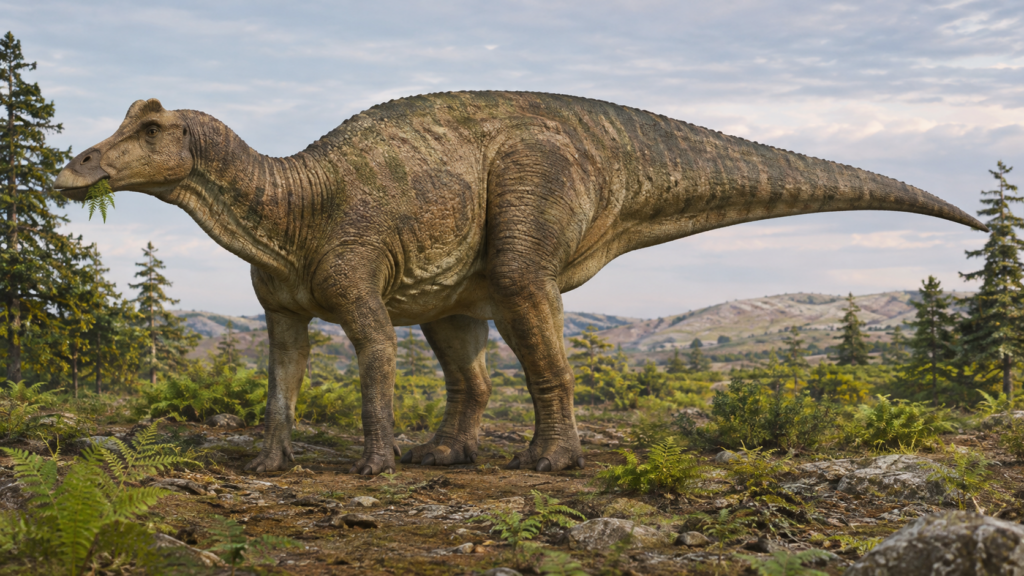
| Name | Maiasaura peeblesorum. Greek for “good mother lizard.” The species name honors the Peebles families, on whose land the fossils were found |
| Classification | Dinosaur, Ornithischia, Hadrosauridae (duck-billed dinosaurs) |
| Age | Late Cretaceous. Found in the Two Medicine Formation (about 86.3 to 70.6 million years ago) |
| Found in | Montana, United States. It is also thought to have ranged into Alberta, Canada |
| Length | Up to about 9 m |
| Weight | Up to about 4 t |
| Described | 1979, by Jack Horner and Robert Makela |
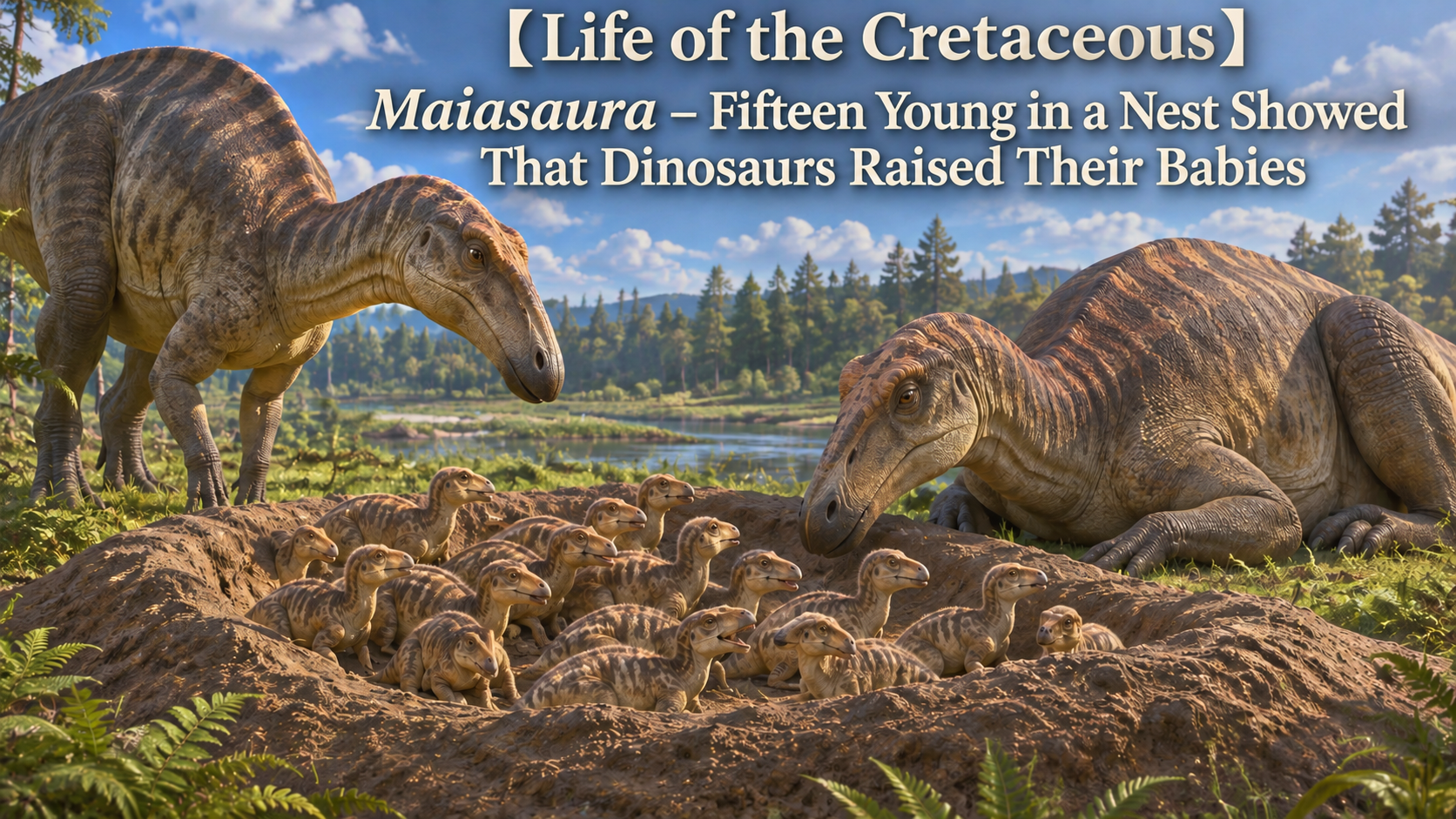
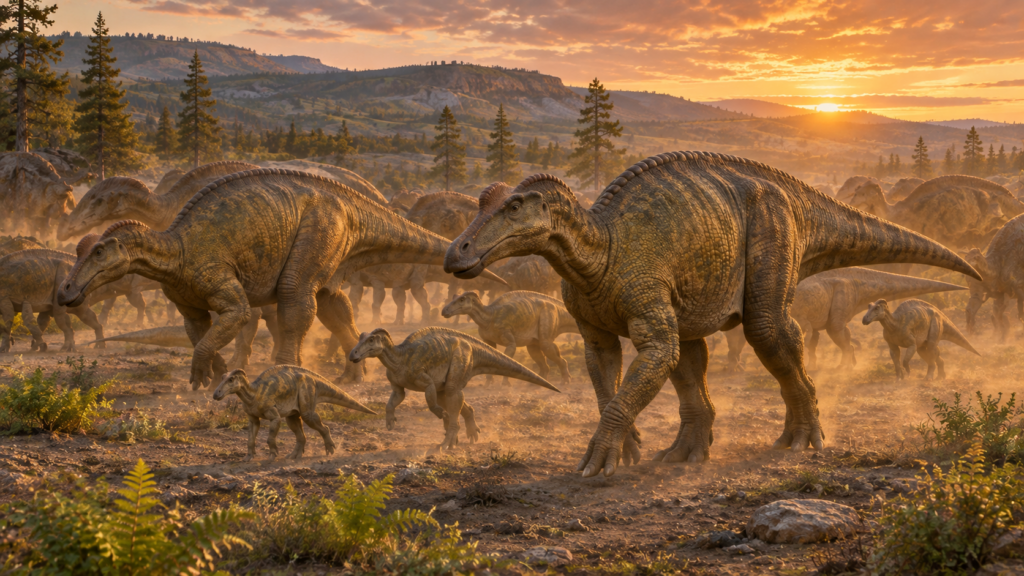
Maiasaura was a plant-eating dinosaur of Late Cretaceous North America, one of the hadrosaurs with a broad, duck-like bill. Several young were found together in a nest, and the find was reported as evidence that dinosaurs cared for their hatchlings in the nest for a time. In 1985 it became Montana’s state fossil.
Appearance and Life
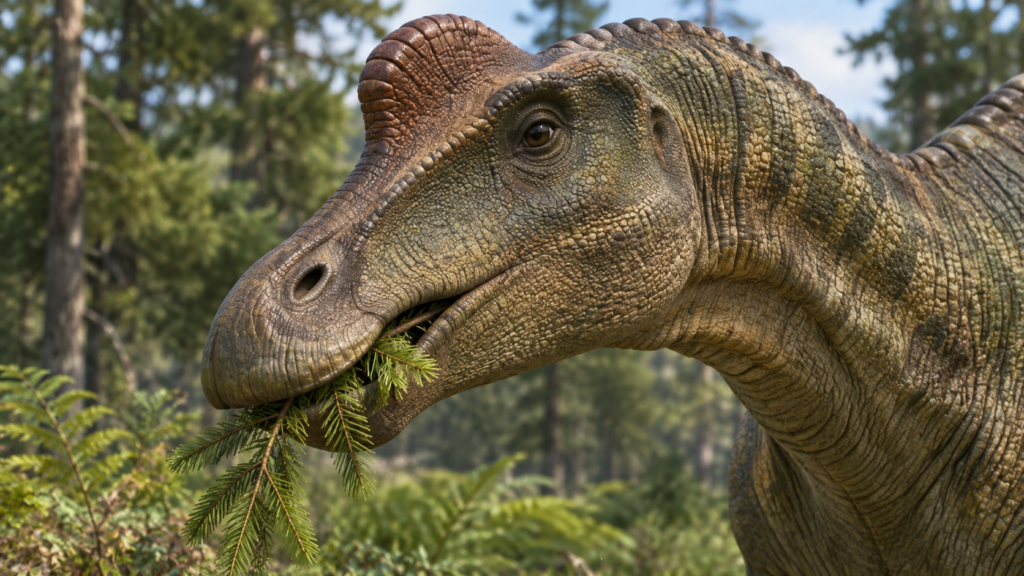
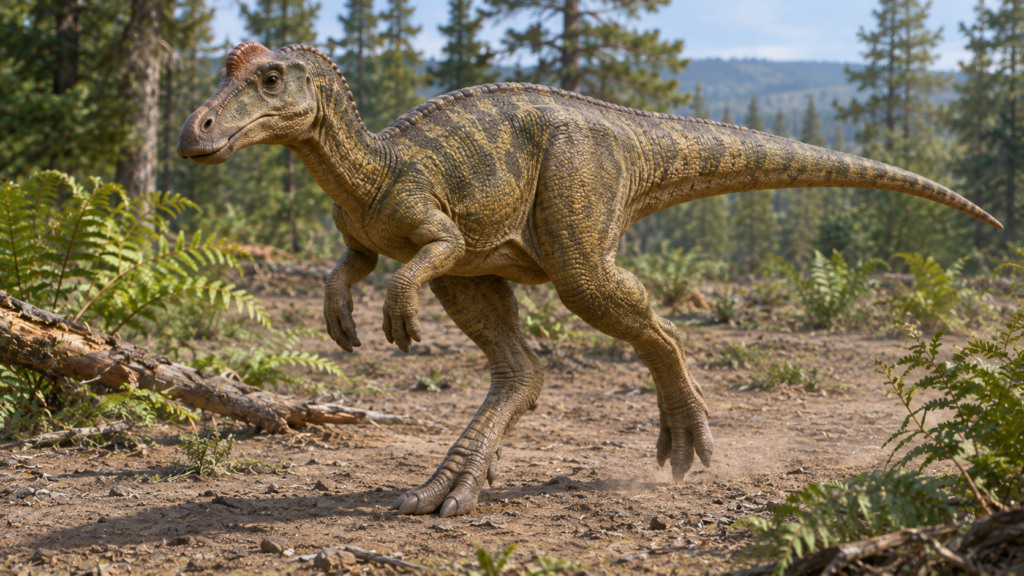
The mouth was a broad bill, behind which hundreds of teeth were packed in rows for grinding plants. A short, solid crest-like bump sat between the eyes. Large adults could walk on four legs or on two. Analysis of healed fractures suggests that individuals younger than about four walked mainly on two legs and switched to four as they grew.
More than 200 specimens of every age have come from the Two Medicine Formation in Montana. In 2015 Holly Woodward and colleagues studied cross-sections of shin bones from many of these animals to estimate how fast they grew and how often they died. Within the first year, the bone had grown to more than half its adult thickness. By the third year an animal reached 36 percent of adult body mass, about 1,260 kg, and the skeleton matured only after eight years. Mortality in the first year was as high as 89.9 percent; the survivors then died at an average rate of only about 12.7 percent a year over the next seven years or so.
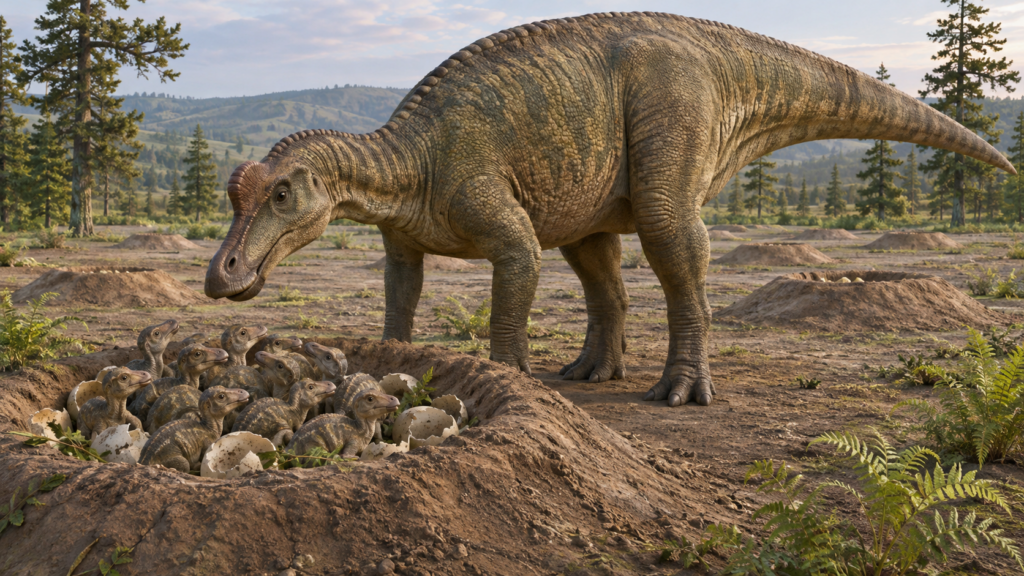
The same rocks also hold dense bonebeds that hint at large herds. The hill where the nests lie is called “Egg Mountain” for the abundance of hadrosaur eggs and eggshell fragments.
The Young in the Nest
The discovery began with Marion Brandvold, who ran a rock shop in Bynum, Montana. In 1978, when the palaeontologist Jack Horner and his friend Robert Makela visited the shop, she showed them small dinosaur bones kept in a coffee can. They belonged to at least four individuals, all very young.
Two weeks later the pair visited the site near Choteau, and that summer they excavated a nest with the bones of 15 young still inside. The site went on to yield more nests and juveniles.
In a 1979 paper in Nature, Horner and Makela reported the nest as evidence of family structure among dinosaurs. The teeth of the young in the nest showed wear from use, which meant they had stayed in the nest for some time after hatching and had been eating there. Their legs were not yet fully developed, and they were thought unable to walk far on their own. The two concluded that the parents brought food to the nest to raise their young, and gave the dinosaur the name “good mother lizard.”
The report showed, with fossils, the possibility that dinosaurs looked after their young in the nest. Estimates of how long the young stayed there still vary, from a few dozen days to about a year.
In 1985 a bone from a young Maiasaura and fragments of eggshell were carried into space aboard the space shuttle Challenger. They were the first dinosaur fossils to go to space.
Related products
You can find books and products related to this article on Amazon.
If you buy through the links above, this blog may earn a commission.
About the images
The images in this article are illustrations created with AI (ChatGPT), and you are welcome to use them. If you do, we would appreciate a link back to this article as the source.
Sources
Horner, J. R. & Makela, R. (1979). Nest of juveniles provides evidence of family structure among dinosaurs. Nature 282, 296–298. https://doi.org/10.1038/282296a0
Woodward, H. N. et al. (2015). Maiasaura, a model organism for extinct vertebrate population biology: a large sample statistical assessment of growth dynamics and survivorship. Paleobiology 41(4), 503–527. https://doi.org/10.1017/pab.2015.19
Wikipedia, Maiasaura (size, history of discovery, nests, posture) https://en.wikipedia.org/wiki/Maiasaura
Wikipedia, STS-51-F (fossils carried into space) https://en.wikipedia.org/wiki/STS-51-F
Wikipedia, List of U.S. state fossils (state fossil) https://en.wikipedia.org/wiki/List_of_U.S._state_fossils

コメント