This article contains affiliate links. As an Amazon Associate I earn from qualifying purchases.
| Name | Nipponites, “stone of Japan.” The best-known species is N. mirabilis, whose species name means “remarkable” |
| Classification | Cephalopod, ammonite, family Nostoceratidae. One of the “heteromorph” ammonites, whose shells do not coil into an ordinary spiral |
| Age | Late Cretaceous (Turonian to Coniacian) |
| Found in | Hokkaido, Japan (the type specimen is from Obira), Sakhalin and Kamchatka. A separate species is known from Oregon in North America |
| Described | 1904, by Hisakatsu Yabe |
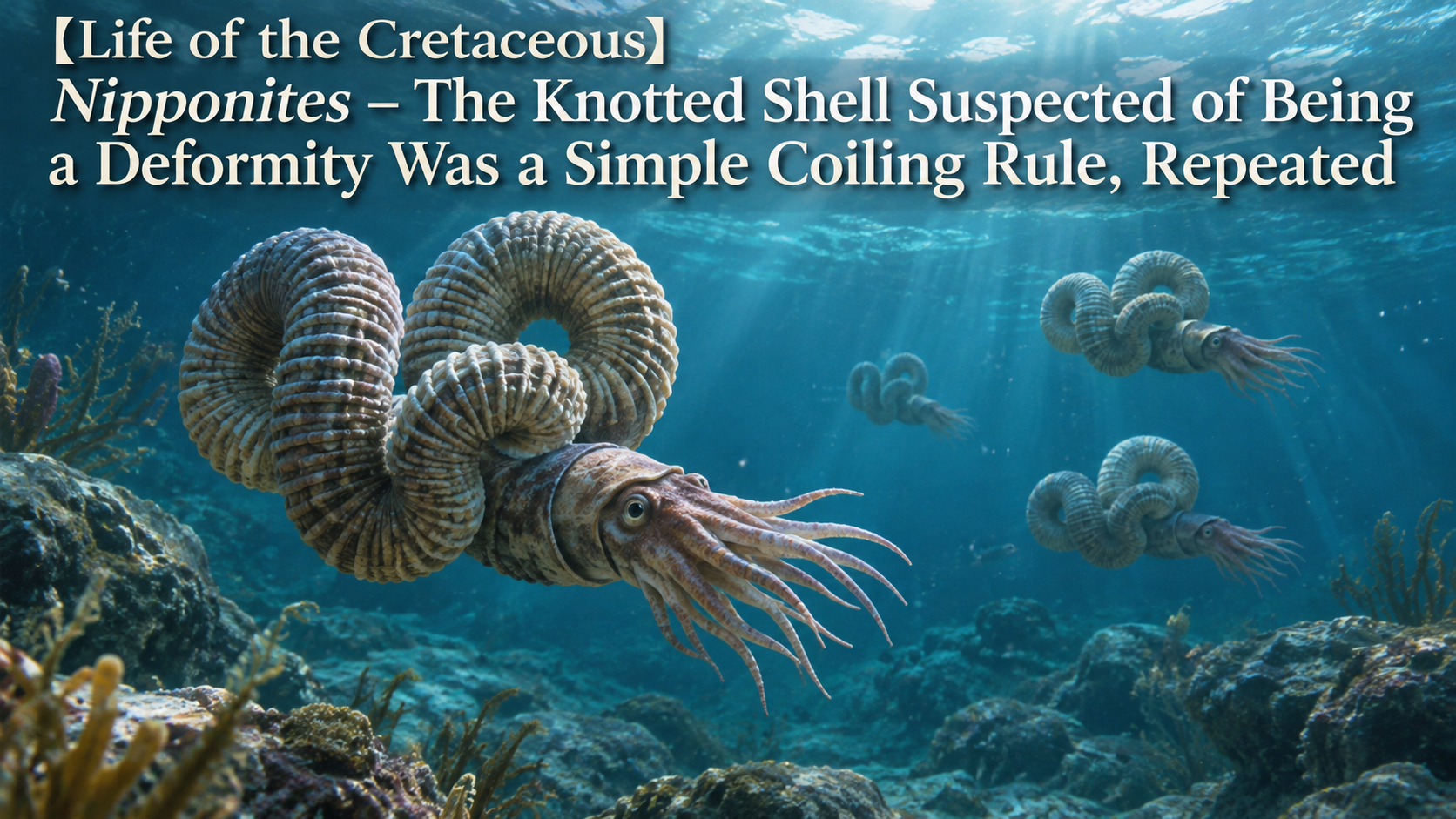
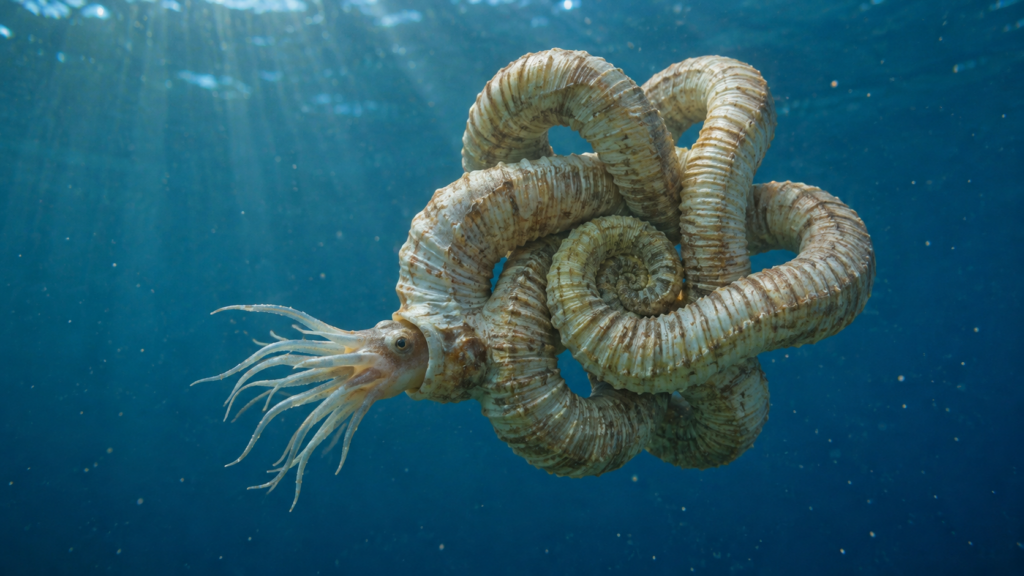
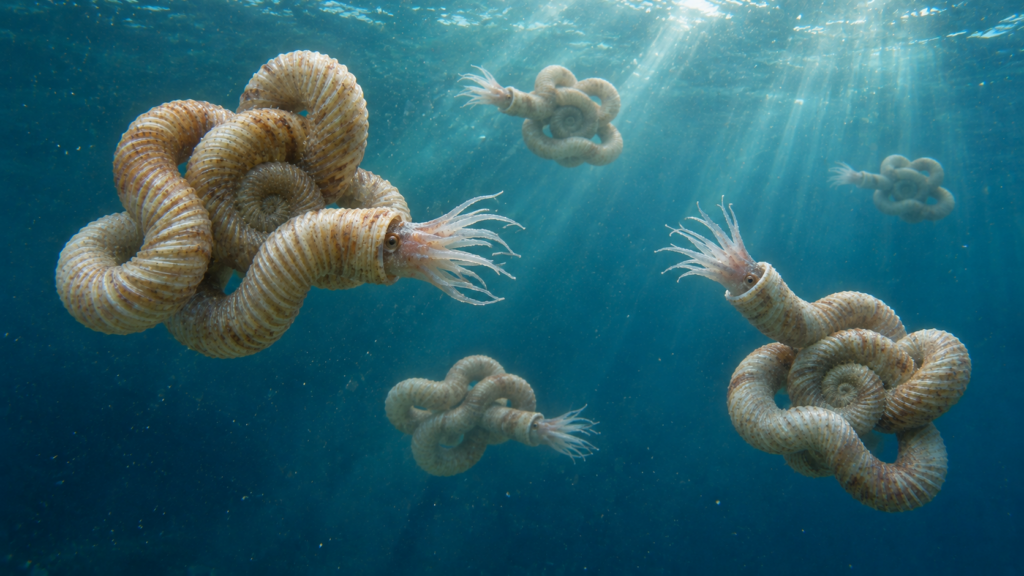
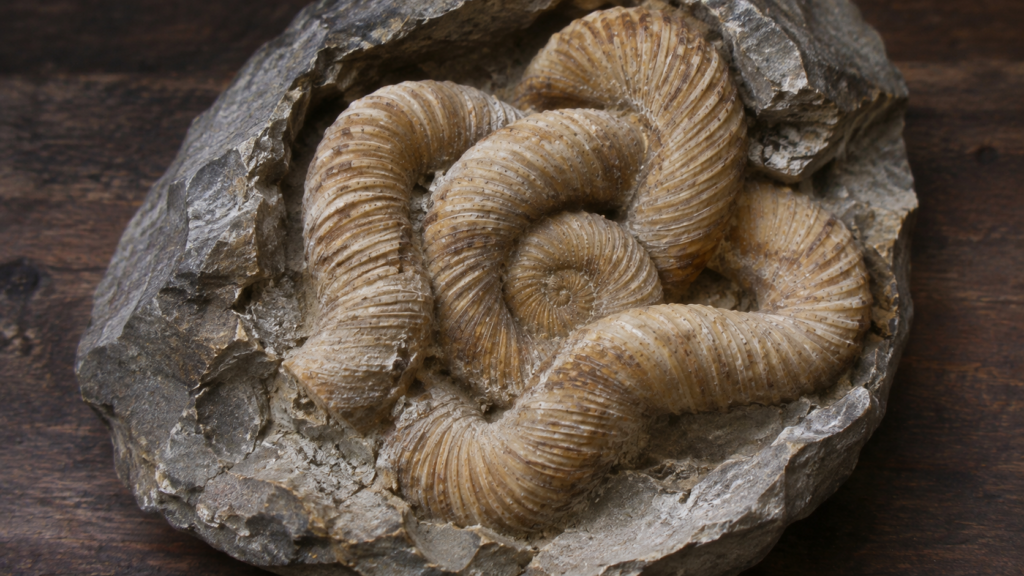
Nipponites was an ammonite of the Late Cretaceous seas. Its shell does not coil into a neat spiral. Instead it bends into U-shapes, changing direction back and forth until it looks like a loose knot. When it was first found it was suspected of being a deformed animal, but the shape turns out to be drawn by repeating a simple coiling rule.
Appearance and Life
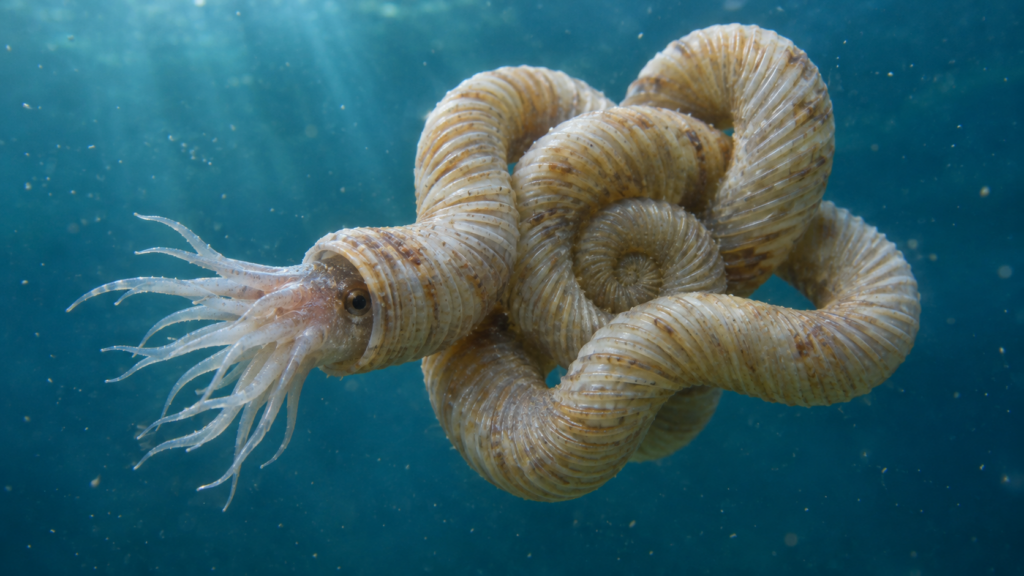
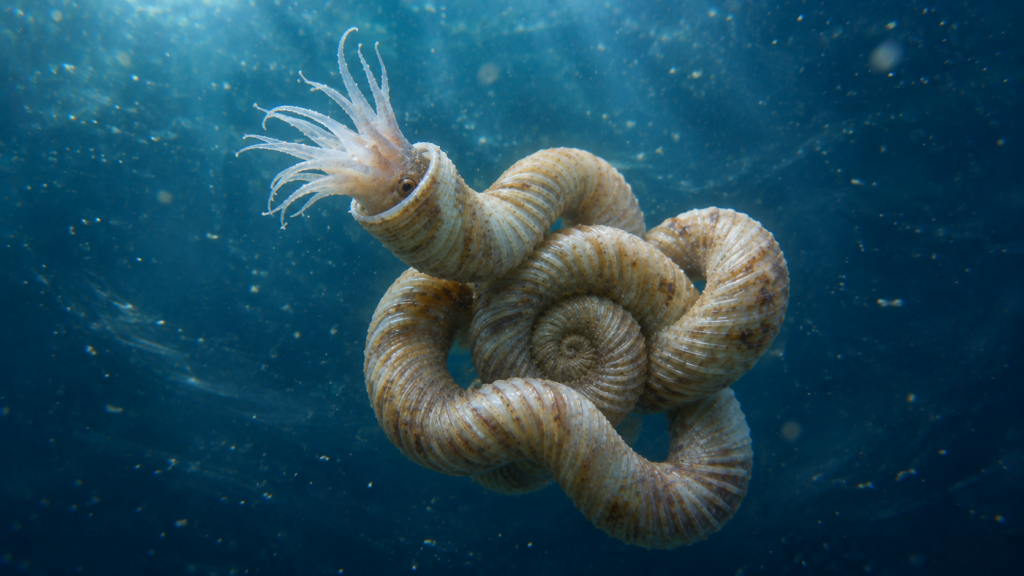
Early in growth, the shell forms a loose, open flat spiral. After that it wraps around the earlier shell with U-shaped bends that alternate from side to side. Fine ribs run obliquely across the surface. Many specimens have come from the Cretaceous rocks of Hokkaido. Besides N. mirabilis, the known species include N. bacchus from Hokkaido, N. sachalinensis from Sakhalin and Kamchatka, and N. occidentalis from Oregon.
Ammonites divided their shells into chambers with internal walls and adjusted their buoyancy by moving gas and liquid in and out of them. Because such a complicated shell seems poorly suited to swimming, some researchers proposed that Nipponites sat attached to the seafloor, or lived in partnership with sponges. Others argued that it drifted in the water.
In 2020, David Peterman and colleagues rebuilt the shell of N. mirabilis as a 3D model, based on a specimen at the Ibaraki Nature Museum, and calculated its buoyancy and posture at 14 stages of growth. At every stage the shell could stay neutrally buoyant in the water, so the animal was not tied to the seafloor. At rest, the body faced somewhere between sideways and upward. As the U-shaped bends were added, the animal became better able to rotate around a vertical axis. The researchers suggest that Nipponites led a low-energy life, slowly turning in the water as it searched for small, plankton-sized prey.
A Coil That Was Not a Deformity
The geologist Hisakatsu Yabe described Nipponites mirabilis in 1904 from fossils found in Hokkaido. Most ammonites coil their shells in a flat spiral, and this one was so irregular by comparison that it was suspected of being a single deformed individual. In 1926 Saburo Shimizu found a second specimen with the same coiling, and the species gradually came to be accepted.
Even so, how the shape came about went unexplained for a long time. In the 1980s the palaeontologist Takashi Okamoto studied Nipponites with a method that describes shells mathematically as a tube that widens, bends and twists as it grows. When shell growth is expressed by three numbers, for widening, bending and twisting, an ordinary ammonite is the special case in which the twist is zero.
Okamoto’s analysis showed that, after the first flat spiral, the shell of Nipponites was built by regularly alternating a left-handed helix, a flat coil and a right-handed helix. The complex-looking form can be approximated just by joining a few simple equations together. Okamoto also showed that the shape of Nipponites can arise from that of its helically coiled relative Eubostrychoceras through only a slight change in the rules of growth.
Heteromorph ammonites are now regarded as neither deformed nor diseased. The Palaeontological Society of Japan has adopted Nipponites as its symbol, and it marks October 15, the date on which Yabe described the new species, as “Fossil Day.”
Related products
You can find books and products related to this article on Amazon.
If you buy through the links above, this blog may earn a commission.
About the images
The images in this article are illustrations created with AI (ChatGPT), and you are welcome to use them. If you do, we would appreciate a link back to this article as the source.
Sources
Peterman, D. J., Mikami, T. & Inoue, S. (2020). The balancing act of Nipponites mirabilis (Nostoceratidae, Ammonoidea): Managing hydrostatics throughout a complex ontogeny. PLOS ONE 15(8), e0235180. https://doi.org/10.1371/journal.pone.0235180
Okamoto, T. (1988). Developmental regulation and morphological saltation in the heteromorph ammonite Nipponites. Paleobiology 14, 272–286. https://doi.org/10.1017/S0094837300012008
The University Museum, the University of Tokyo, holotype of Nipponites mirabilis (UMUT MM7560) https://www.um.u-tokyo.ac.jp/UMUTopenlab/en/library/b_12.html
Palaeontological Society of Japan, 3D atlas of ammonoids (in Japanese) http://www.palaeo-soc-japan.jp/3d-ammonoids/index.html
Wikipedia, Nipponites (species, distribution, age) https://en.wikipedia.org/wiki/Nipponites
Wikipedia (Japanese), Nipponites (history of description, society symbol and Fossil Day) https://ja.wikipedia.org/wiki/ニッポニテス

コメント