This article contains affiliate links. As an Amazon Associate I earn from qualifying purchases.
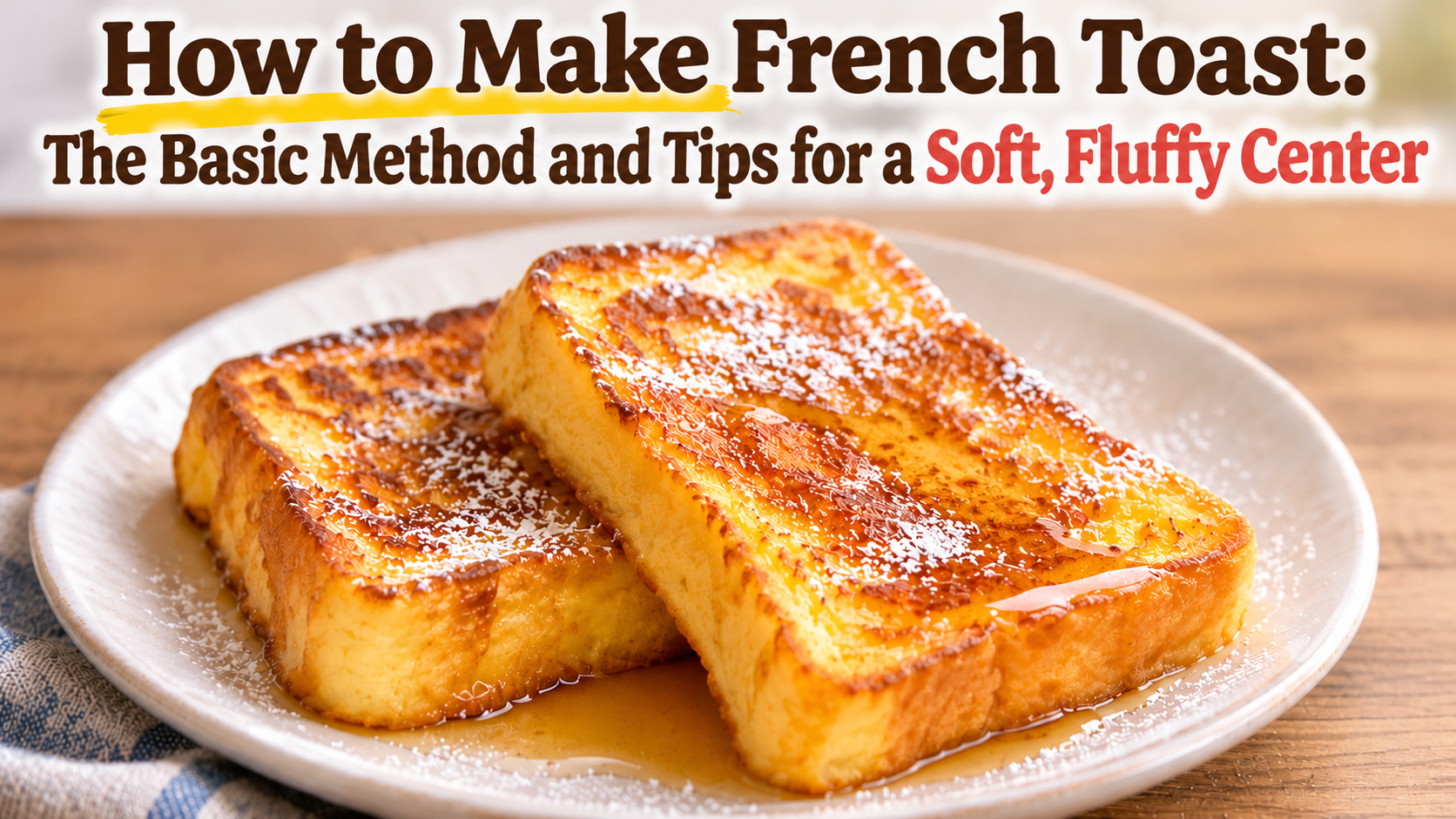
French toast is sliced bread soaked in a mixture of egg, milk and sugar, then fried in butter. Two things decide how it turns out: letting the egg mixture soak all the way into the bread, and cooking it slowly over gentle heat so the middle sets. If the soak is shallow, the center stays dry; if the heat is too high, the outside burns while raw egg mixture is left inside.
Ingredients (serves 2)
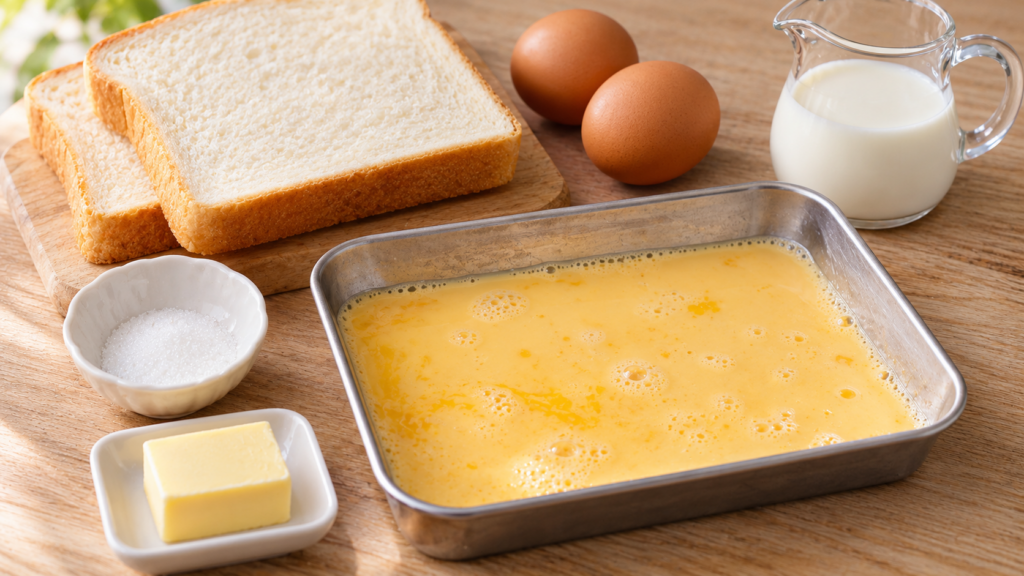
- Thick-sliced white sandwich bread (about 2–2.5 cm thick): 2 slices
- Eggs: 2
- Milk: 150 ml
- Sugar: 2 tbsp
- Butter: 20 g
- To finish: maple syrup and powdered sugar, to taste
The mixture is 2 eggs, 150 ml milk and 2 tbsp sugar for 2 slices of bread. For extra-thick slices of about 3 cm, increase the milk to 200 ml. You can use honey instead of maple syrup; do not give honey to children under one year old.
Method
1. Make the egg mixture
Beat the eggs in a bowl, add the sugar and mix. Add the milk, mix again, and pour the mixture through a sieve.
2. Soak the bread
Cut each slice of bread in half. Lay the pieces in a shallow tray, pour the egg mixture over them and leave for 10–20 minutes, turning them once or twice so both sides soak. Start cooking when almost all of the mixture has been absorbed and the bread feels moist and heavy.
3. Cook the first side
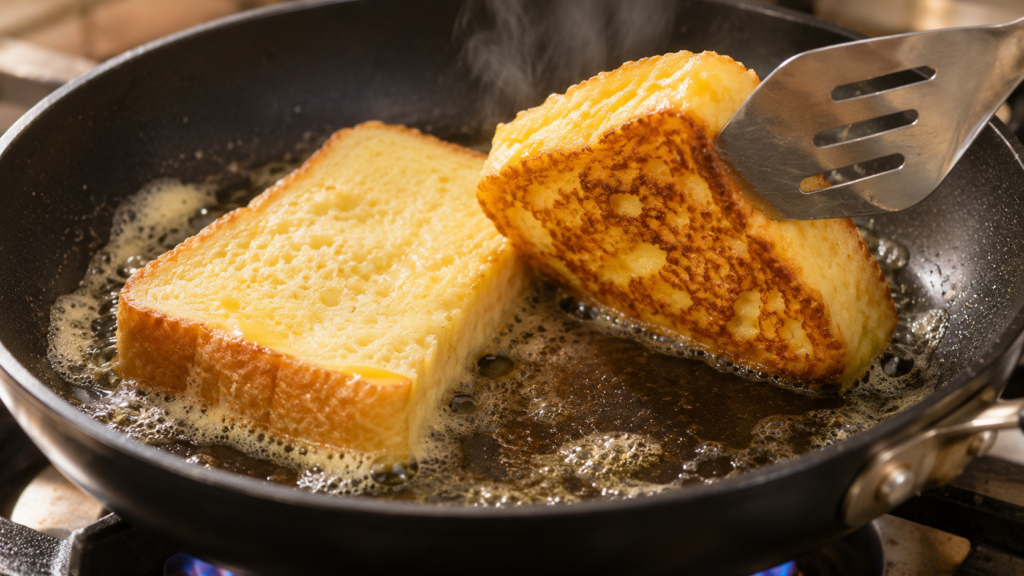
Put half the butter (10 g) in a frying pan over medium-low heat. When it has melted and starts to foam, add the bread. Leave it without moving it until the underside is a deep golden brown.
4. Turn and cook the other side
Turn the bread over, supporting it with a spatula and a pair of chopsticks or a fork. Add the rest of the butter around the bread and cook until the second side is golden brown too. It is done when no egg mixture seeps out when you press it.
5. Serve
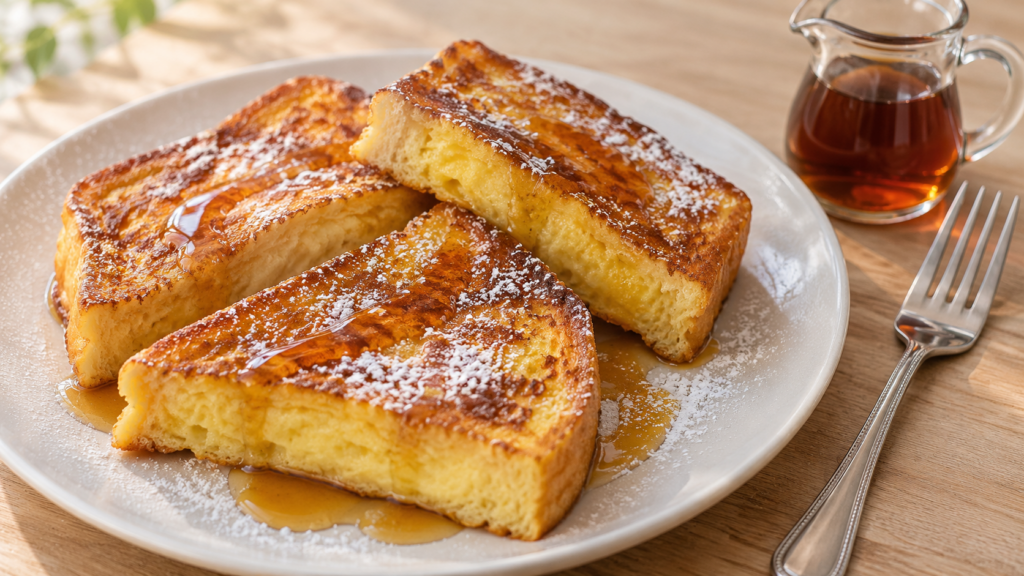
Put the French toast on plates, drizzle with maple syrup and dust with powdered sugar.
Tips for good results
Strain the egg mixture
Lumps of egg white do not soak into the bread; they set as white patches on the surface. Straining the mixture through a sieve lets it soak in evenly.
Turn the bread so it soaks from both sides
Bread absorbs the mixture through the side that touches it. If you leave it on one side only, the top stays dry. For thick bread or firm crusts, poke a few holes with a fork so the mixture reaches the middle more easily.
Slightly stale bread absorbs more
Very fresh, soft bread takes up the mixture poorly and tends to fall apart when soaked. Bread that has dried out a little absorbs the mixture better.
Cook over gentle heat and leave it alone
The egg on the surface of soaked bread burns quickly. Cooking over medium-low heat gives the middle time to set while the outside browns, and the result is soft and fluffy. Moving the bread while it cooks makes the browning patchy, so leave each side until it is done.
For an even softer result, soak it overnight
A longer soak makes the inside moist and soft all the way through. Put the bread and the egg mixture in a sealed plastic bag and leave it in the fridge for 2 hours to overnight. This works best with thick bread.
If things go wrong
The outside is burnt but the inside is still wet
The heat was too high. If it looks like it is about to burn, turn the heat down and cover the pan with a lid so the middle cooks through in the steam. Next time, start over medium-low heat.
The inside is dry, not soft
The bread did not absorb enough of the mixture. Next time, soak it longer and turn it halfway. If you used very fresh bread, try bread that is a little older.
It falls apart when you turn it
Bread full of egg mixture is very soft, and a single spatula cannot hold it. Slide the spatula underneath and steady the top with chopsticks or a fork as you turn it. Waiting until the underside is well browned also helps it keep its shape.
White lumps of egg stick to the surface
The egg was not mixed well. Next time, beat the eggs thoroughly and strain the mixture through a sieve.
Related products
You can find books and products related to this article on Amazon.
If you buy through the links above, this blog may earn a commission.
About the images
The images in this article are illustrations created with AI (ChatGPT), and you are welcome to use them. If you do, we would appreciate a link back to this article as the source.
Sources
Minna no Kyou no Ryouri (NHK), “French toast” by Yoshiko Fujino (Japanese) https://www.kyounoryouri.jp/recipe/600187_フレンチトースト.html
Minna no Kyou no Ryouri (NHK), “French toast” by Hiromi Sekioka (Japanese) https://www.kyounoryouri.jp/recipe/31829_フレンチトースト.html
Minna no Kyou no Ryouri (NHK), “French toast” by Shima Tassin (Japanese) https://www.kyounoryouri.jp/recipe/605253_フレンチトースト.html
Minna no Kyou no Ryouri (NHK), “French toast” by Junko Takagi (Japanese) https://www.kyounoryouri.jp/recipe/16527_フレンチトースト.html
Lettuce Club, Hotel Okura-style French toast by Naoko Ogita (Japanese) https://www.lettuceclub.net/recipe/dish/27667/
Yamazakitchen (Yamazaki Baking), “Fluffy French toast” (Japanese) https://recipe.yamazakipan.co.jp/recipe.html?id=837


コメント