This article contains affiliate links. As an Amazon Associate I earn from qualifying purchases.
| Name | Liopleurodon, “smooth-sided tooth.” The species name of the type species, Liopleurodon ferox, means “ferocious” |
| Classification | Reptilia, Sauropterygia, Plesiosauria, Pliosauridae |
| Age | Latest Middle Jurassic to earliest Late Jurassic (Callovian to early Oxfordian, around 165 million years ago) |
| Found in | England (the Oxford Clay around Peterborough), France, Germany, Switzerland, Russia |
| Length | A maximum of just over 8 m, according to a 2026 reassessment of every known specimen. Estimates of 18–25 m circulated for decades |
| Skull | About a quarter of total body length |
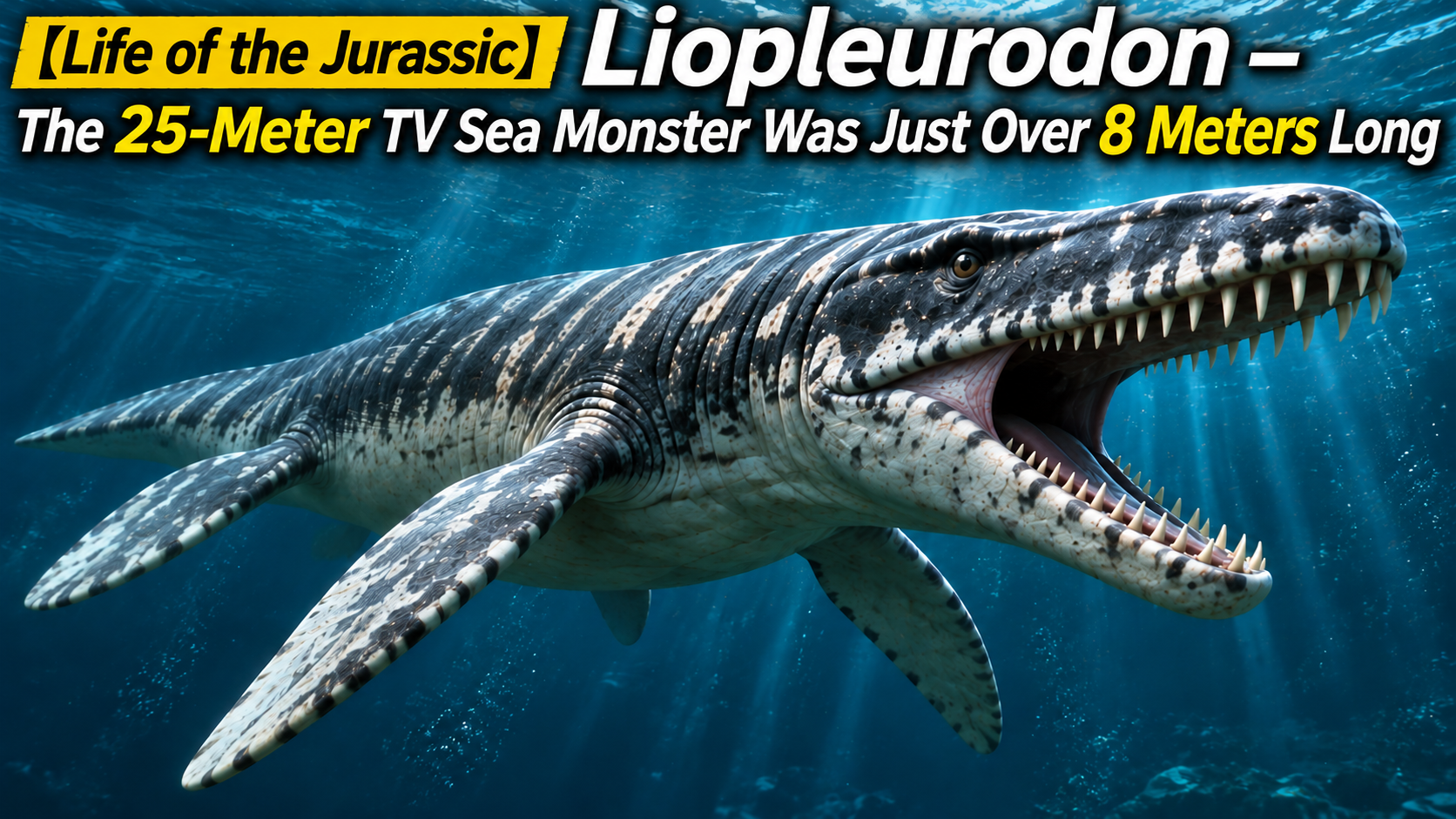
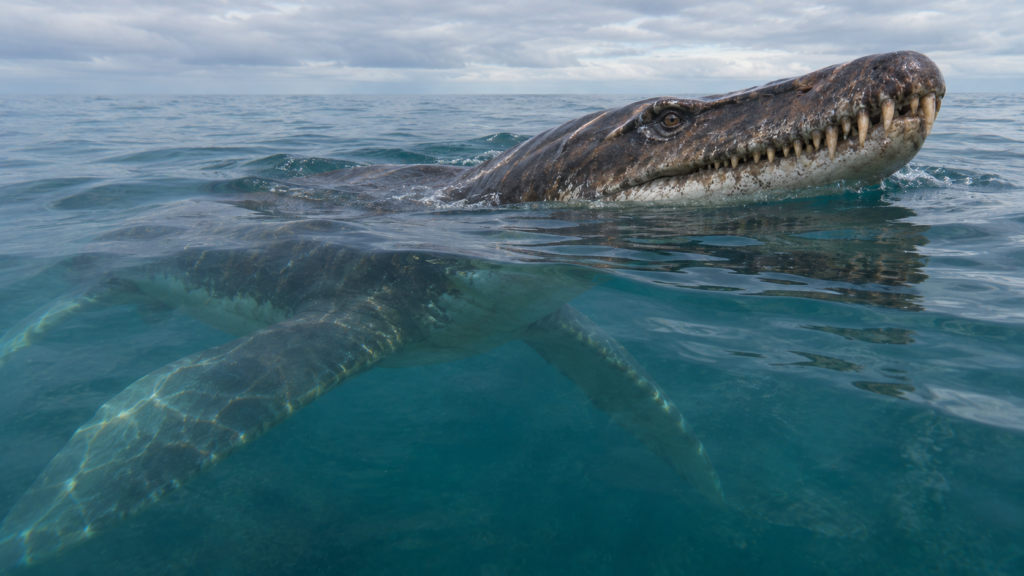
Liopleurodon was a plesiosaur that lived in the Jurassic seas. It belonged to the pliosaurs, the short-necked, big-headed branch of the group, and sat at the top of the food chain in the seas around what is now Britain. A 1999 television series made it famous as a 25-meter giant, but a 2026 study that re-examined every specimen concluded that it reached at most a little over 8 meters.
Appearance and Life
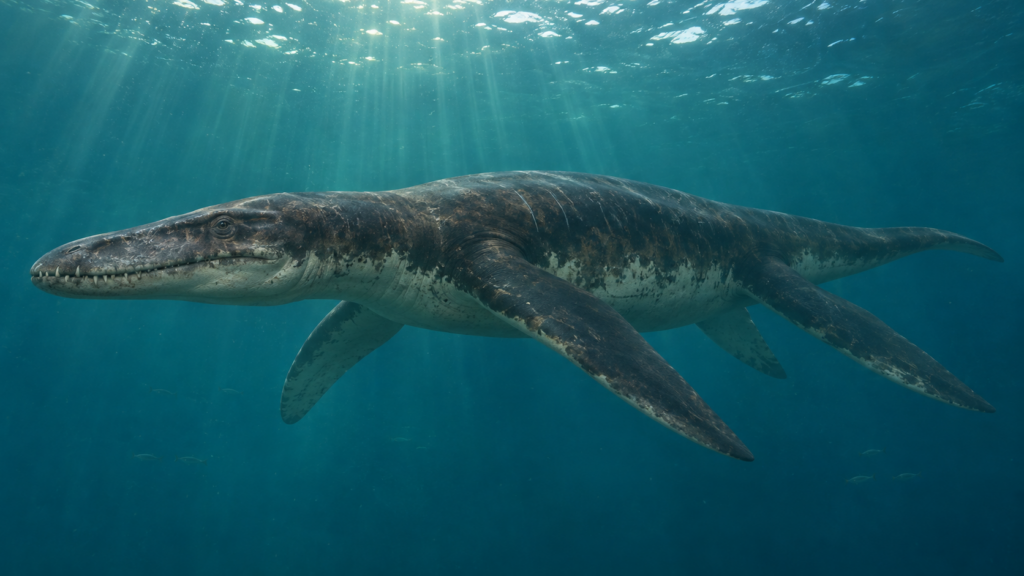
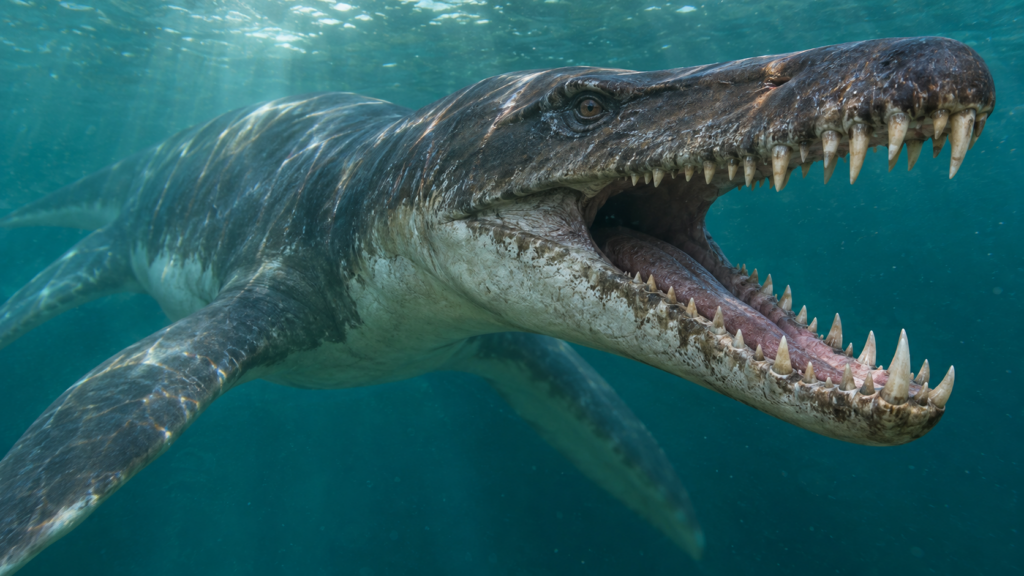
Liopleurodon had a large head on a short neck and four long flippers extending from its body. The tail was short, and most of the swimming power came from the flippers. The skull made up about a quarter of the animal’s total length, a larger share than in the other pliosaurs that lived in the same sea. The jaws held rows of thick, conical teeth.
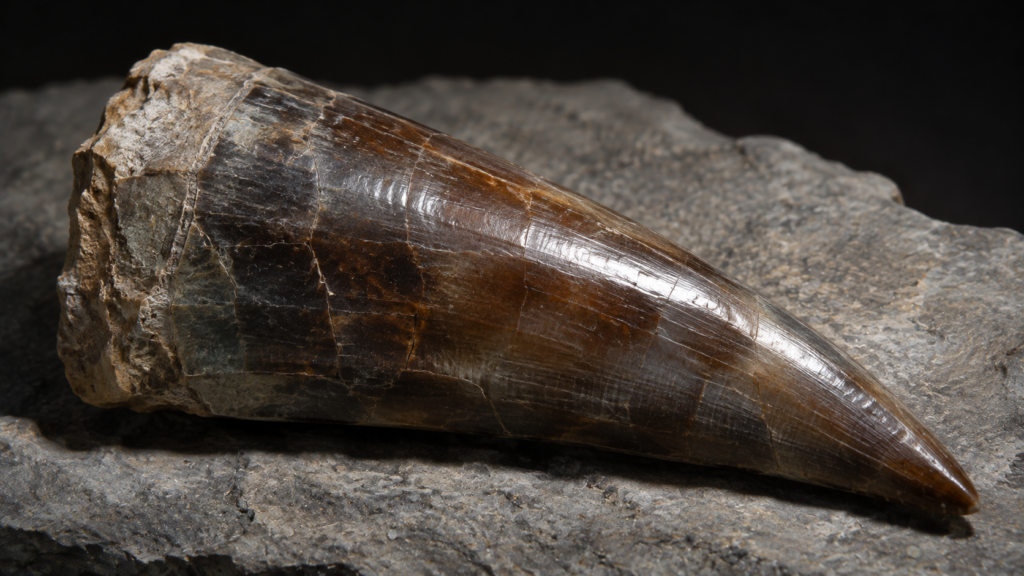
The genus was named in 1873 by the French paleontologist Henri Émile Sauvage. His only material was a single large tooth found at Le Wast, near Boulogne-sur-Mer in northern France. The tooth is still kept at the Natural History Museum of Lille.
The rest of the animal became known from the clay pits around Peterborough in England. In the late nineteenth and early twentieth centuries, hundreds of brickworks sprang up there to dig the Oxford Clay. Fossils could damage bricks during firing, so workers were paid to pull them out. The local farmer Alfred Leeds took an interest in these finds, and his collections included nearly complete Liopleurodon skeletons and skulls. Those specimens are now spread among museums in Britain, Europe and America. The University of Tübingen in Germany also has a mounted skeleton.
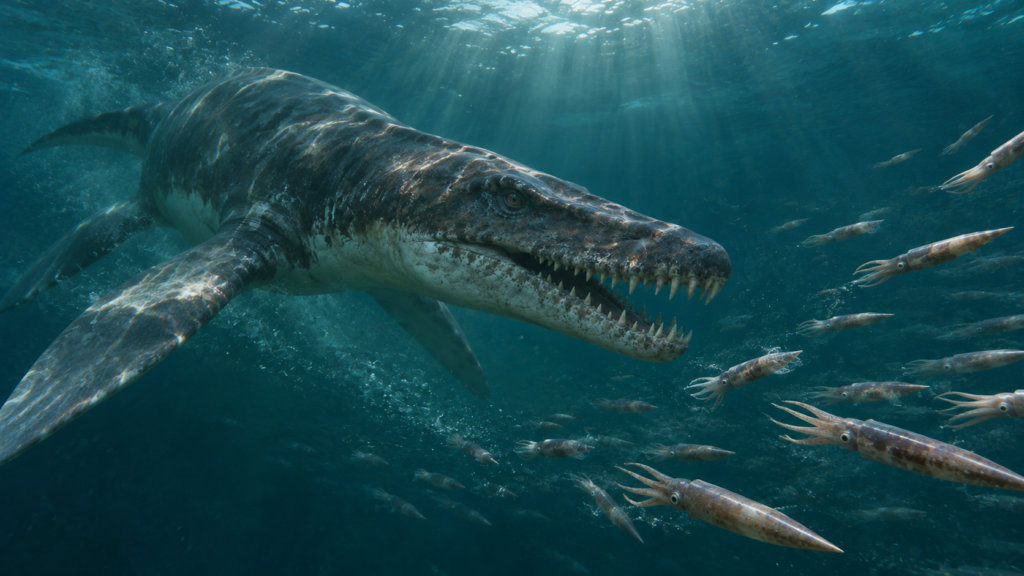
The Oxford Clay is mud that settled on the floor of a Jurassic sea. The same rocks have produced the smaller pliosaur Peloneustes, long-necked plesiosaurs, ichthyosaurs, marine crocodile relatives, sharks and fish. Liopleurodon was the largest aquatic vertebrate among them and stood at the top of that sea’s food chain.
A 1991 study proposed that the arrangement of plesiosaur nostrils let water flow through the nose as the animals swam, allowing them to pick up scents underwater. Liopleurodon may have tracked its prey by smell in the same way.
From 25 Meters to 8
Liopleurodon owes its worldwide fame to the BBC series Walking with Dinosaurs, broadcast in 1999. In the episode “Cruel Sea,” it appeared as a 25-meter predator. The figure was repeated in books and online for years and made the animal a byword for the monsters of the Jurassic seas.
The program’s adviser was the British paleontologist David Martill. He later explained that fragmentary remains of enormous pliosaurs were known at the time, so it seemed reasonable that Liopleurodon might have reached extraordinary sizes. The 25-meter figure, in other words, reflected the understanding of the day plus a degree of informed speculation.
In 2026, Edward Bartlett and colleagues at the University of Portsmouth reassessed every specimen assigned to Liopleurodon ferox in a single study. Working from a nearly complete skull, two well-preserved skeletons and a large amount of other skeletal material, they rebuilt the animal’s body proportions. They found that Liopleurodon ferox reached a maximum length of just over 8 meters. The 18–25 meter estimates that had circulated for decades, they wrote, rested on isolated giant fossil fragments that cannot confidently be assigned to Liopleurodon. Martill is a co-author of the study.
Smaller as it now is, Liopleurodon remains the largest aquatic vertebrate known from the Oxford Clay seas. A skull a quarter of the body’s length suggests a predator able to take unusually large prey for its size. Applying the new proportions to larger pliosaurs from later in the Jurassic, the team estimates that some of them reached about 12 meters.
Related products
You can find books and products related to this article on Amazon.
If you buy through the links above, this blog may earn a commission.
About the images
The images in this article are illustrations created with AI (ChatGPT), and you are welcome to use them. If you do, we would appreciate a link back to this article as the source.
Sources
Bartlett, E. O., Martill, D. M. & Smith, R. E. (2026). Re-evaluating body size in the Middle Jurassic pliosaur Liopleurodon ferox Sauvage, 1873. Journal of Vertebrate Paleontology 46(4), e2691149. https://doi.org/10.1080/02724634.2026.2691149
University of Portsmouth (2026), Jurassic sea monster was smaller than once thought, but no less formidable https://www.port.ac.uk/news-events-and-blogs/news/jurassic-sea-monster-was-smaller-than-once-thought-but-no-less-formidable
Vincent, P. et al. (2024). New remains of Liopleurodon (Reptilia, Plesiosauria) from the Middle Jurassic of western France and paedomorphosis within pliosaurids (type tooth, localities and ages, records by country). Palaeontologia Electronica. https://doi.org/10.26879/1280
Ketchum, H. F. & Benson, R. B. J. (2011). The cranial anatomy and taxonomy of Peloneustes philarchus (Sauropterygia, Pliosauridae) from the Peterborough Member (Callovian, Middle Jurassic) of the United Kingdom. Palaeontology 54, 639–665. https://doi.org/10.1111/j.1475-4983.2011.01050.x
Cruickshank, A. R. I., Small, P. G. & Taylor, M. A. (1991). Dorsal nostrils and hydrodynamically driven underwater olfaction in plesiosaurs. Nature 352, 62–64. https://doi.org/10.1038/352062a0

コメント