This article contains affiliate links. As an Amazon Associate I earn from qualifying purchases.
| Name | Megalodon (Otodus megalodon). The species name means “big tooth” in Greek |
| Classification | Chondrichthyes, Lamniformes, Otodontidae |
| Age | Neogene, Miocene to Early Pliocene (extinct by about 3.6 million years ago) |
| Where found | Marine deposits around the world (most fossils are teeth) |
| Length | Most estimates put the largest individuals at 15 to 20 m. A 2025 study estimated a maximum of about 24.3 m |
| Weight | Estimates include about 103 tonnes for a 20.3 m individual and about 94 tonnes for a 24.3 m individual (2025). Both are calculations based on assumptions |
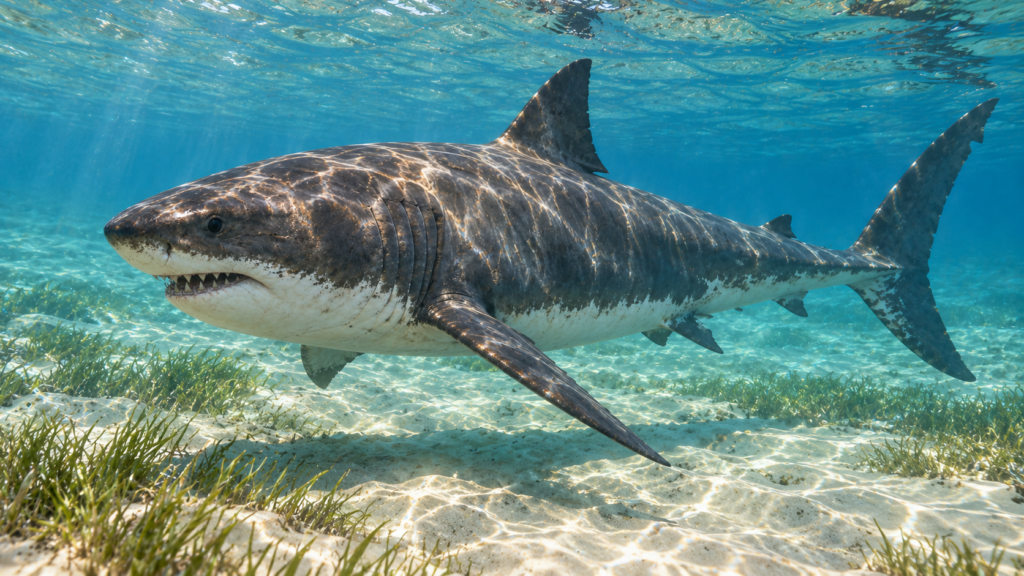
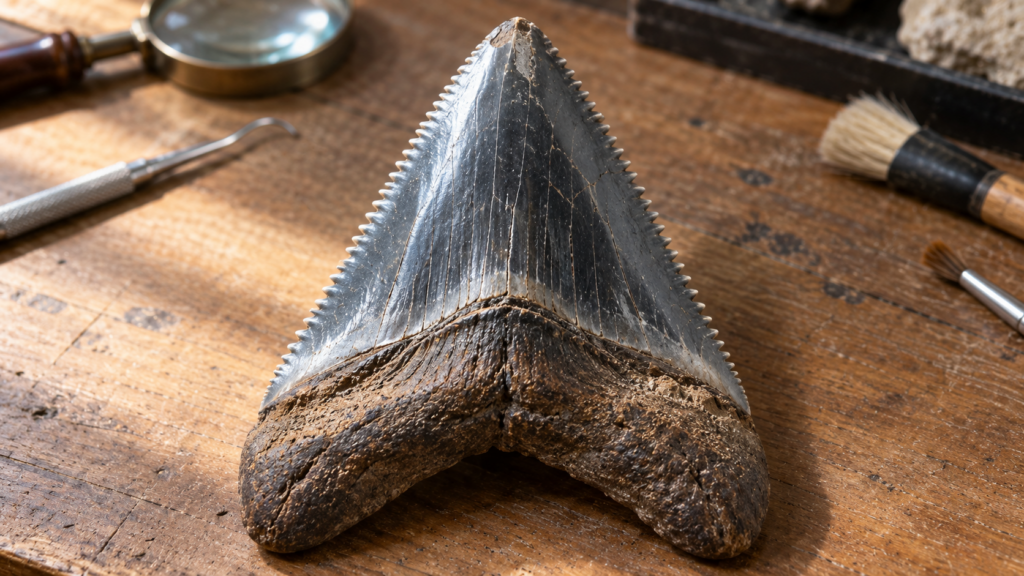
Megalodon was a giant shark that lived in the seas of the Miocene and Early Pliocene. Almost all of its fossils are teeth, and the largest are more than 16 cm tall, with some approaching 20 cm. A shark’s skeleton is made of cartilage, which rarely fossilizes, and no complete skeleton of megalodon has been found. Its size can only be estimated from its teeth and from the few pieces of backbone that survive.
Form and Life
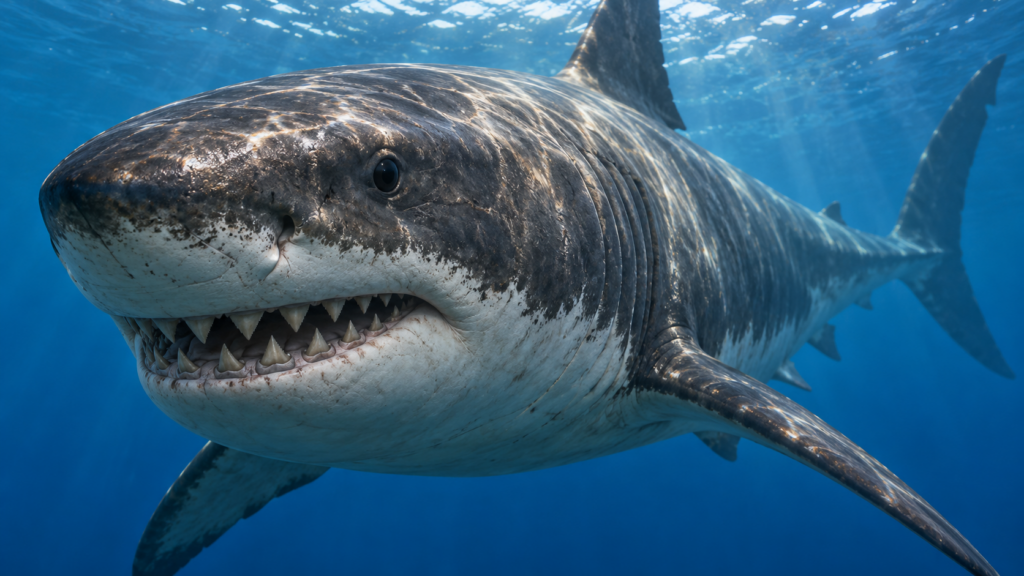
Megalodon’s teeth are broad triangles with fine serrations along the edges. Because they look like the teeth of the great white shark, the species was placed in the great white’s genus, Carcharodon, when it was described in the 19th century, and it was long thought to be the great white’s direct ancestor or a very close relative. Today it is usually placed in the genus Otodus in the extinct family Otodontidae. Despite the similar teeth, it belonged to a different lineage from the great white.
Besides teeth, the known remains include a number of vertebrae, small skin scales (placoid scales) and fragments of cartilage. The best known is specimen IRSNB P 9893 from the Miocene of Belgium, which preserves a single individual’s vertebrae together. Laid end to end, the vertebrae measure about 11.1 m. In 2022, a study used this backbone to build the first three-dimensional model of megalodon’s body and estimated that an adult could swallow whole prey the size of today’s top ocean predators.
Megalodon is thought to have been a big shark from birth. A 2025 study that recounted the growth bands in the vertebrae estimated its length at birth at 3.6 to 3.9 m, up from an earlier estimate of about 2 m. Megalodon disappeared in the Early Pliocene, by about 3.6 million years ago.
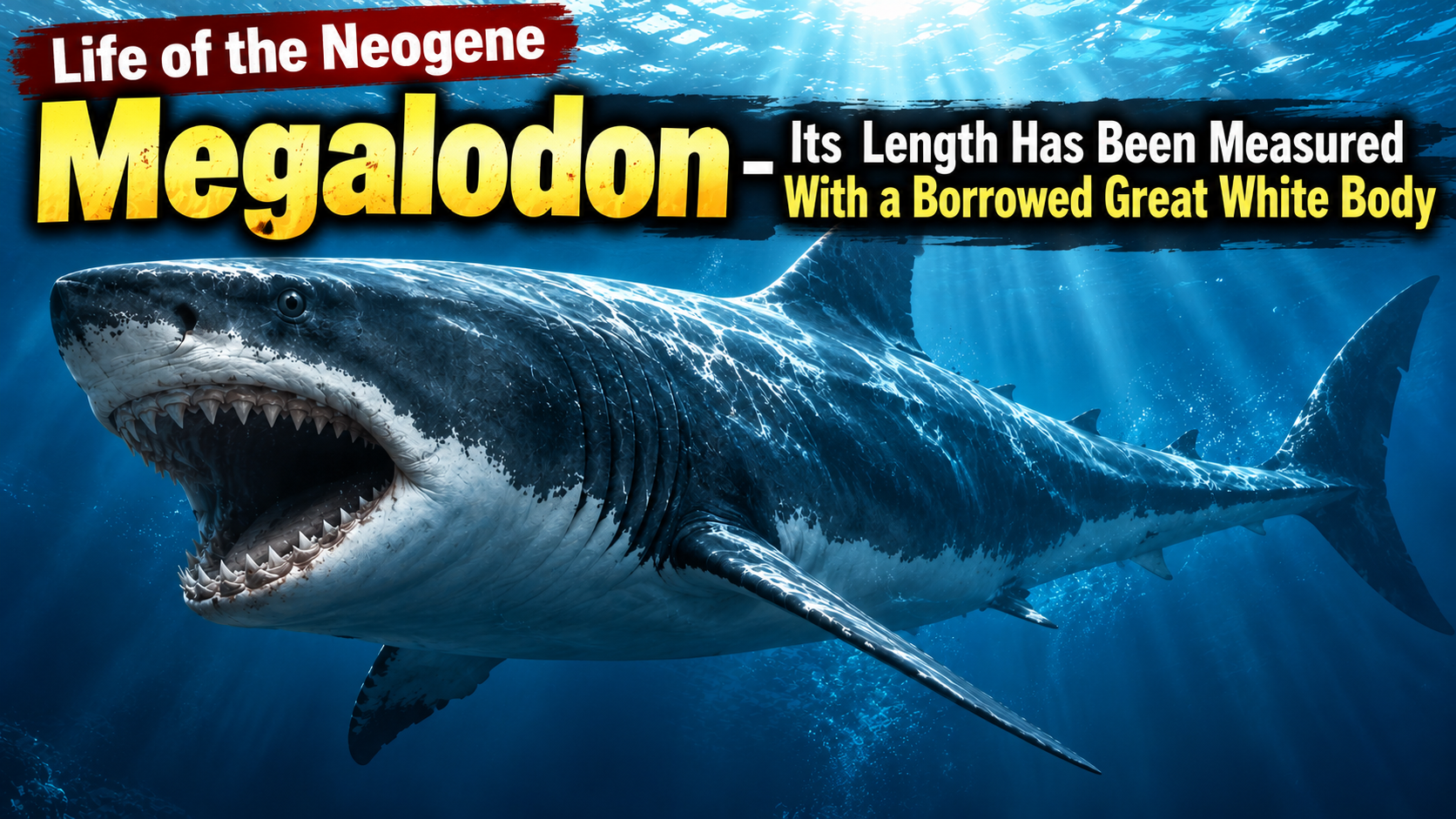
Its Length Has Been Measured With a Borrowed Great White Body
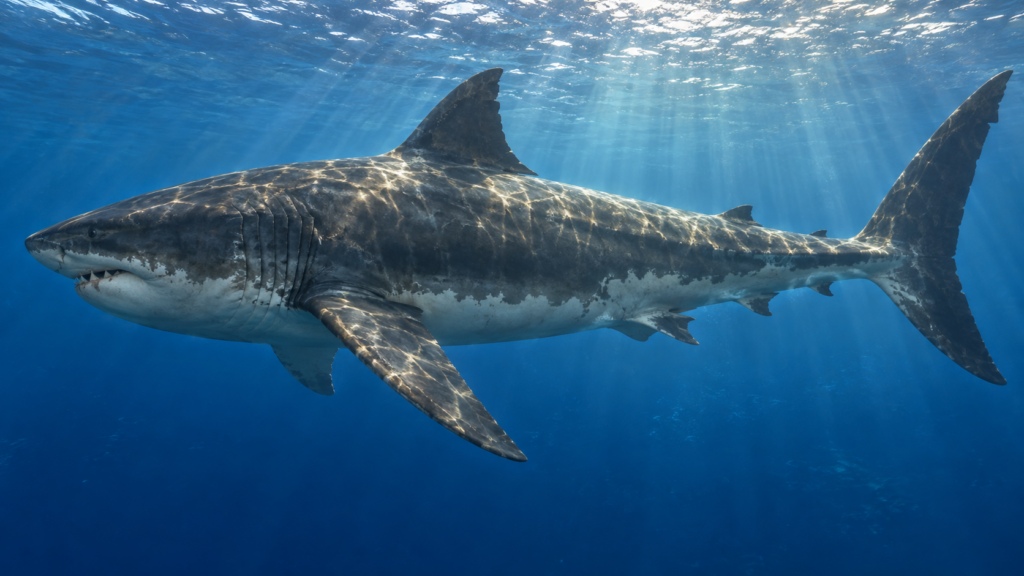
Without a complete skeleton, megalodon’s length has to be calculated by applying the body proportions of a living shark. The yardstick used for a long time was the great white, whose teeth look similar. By combining tooth size or vertebra diameter with great white proportions, researchers have estimated the largest individuals at a minimum of 15 m and, at the upper end, around 20 m.
Change the yardstick, and the numbers move a lot. For the owner of the Belgian backbone, a 1996 study used great white proportions to estimate a length of about 9.2 m. Weight estimates rest on the same proportions; a figure of about 103 tonnes for a 20.3 m individual is widely cited.
The assumption began to slip because the classification changed. If megalodon was not the great white’s ancestor but a shark from a different lineage, there is no reason its body shape should match. In 2025, a team of 30 researchers led by Kenshu Shimada of DePaul University compared the proportions of the head, trunk and tail across living and extinct sharks, and concluded that megalodon may have had a more slender body than the great white. One of their reasons was that a stocky, great-white-like body would have created too much drag in the water.
Recalculated with these proportions, the owner of the Belgian backbone came out at about 16.4 m instead of about 9.2 m, and the largest individuals at about 24.3 m and about 94 tonnes. Because the body is longer and thinner, the length went up while the weight came out lower than the earlier calculation. The estimated cruising speed was 2.1 to 3.5 km per hour, which suggests a slow swimmer. The team states explicitly that all of these figures are working hypotheses.
Estimates of megalodon’s size vary from study to study because all that is in hand is teeth and part of a backbone, and the answer depends on which shark’s body is used to fill in the rest. Today the 15 to 20 m range is the one most often cited, and if the body was slender, it may have been longer than that.
Related products
You can find books and products related to this article on Amazon.
If you buy through the links above, this blog may earn a commission.
Sources
Shimada, K. et al. (2025). Reassessment of the possible size, form, weight, cruising speed, and growth parameters of the extinct megatooth shark, Otodus megalodon (Lamniformes: Otodontidae), and new evolutionary insights into its gigantism, life history strategies, ecology, and extinction. Palaeontologia Electronica 28(1), a12. https://doi.org/10.26879/1502
Cooper, J. A. et al. (2022). The extinct shark Otodus megalodon was a transoceanic superpredator: inferences from 3D modeling. Science Advances 8, eabm9424. https://doi.org/10.1126/sciadv.abm9424
Cooper, J. A. et al. (2020). Body dimensions of the extinct giant shark Otodus megalodon: a 2D reconstruction. Scientific Reports 10, 14596. https://doi.org/10.1038/s41598-020-71387-y
Boessenecker, R. W. et al. (2019). The Early Pliocene extinction of the mega-toothed shark Otodus megalodon: a view from the eastern North Pacific. PeerJ 7, e6088. https://doi.org/10.7717/peerj.6088
Gottfried, M. D., Compagno, L. J. V. & Bowman, S. C. (1996). Size and skeletal anatomy of the giant “megatooth” shark Carcharodon megalodon. In Klimley, A. P. & Ainley, D. G. (eds), Great White Sharks: The Biology of Carcharodon carcharias, 55–66. Academic Press.

コメント