This article contains affiliate links. As an Amazon Associate I earn from qualifying purchases.
| Name | Archaeopteryx, meaning “old wing” in Greek. The species name of the best-known species, A. lithographica, refers to the lithographic limestone the fossils come from |
| Classification | Saurischia, Theropoda, Avialae (Archaeopterygidae) |
| Age | Late Jurassic (about 150 million years ago) |
| Where found | Around Solnhofen in Bavaria, southern Germany |
| Length | About 50 cm in the largest specimens. Size varies between specimens |
| Weight | Earlier estimates ranged from 200 to 600 g. A 2009 study estimated adults at about 0.8 to 1 kg, roughly the size of a common raven |
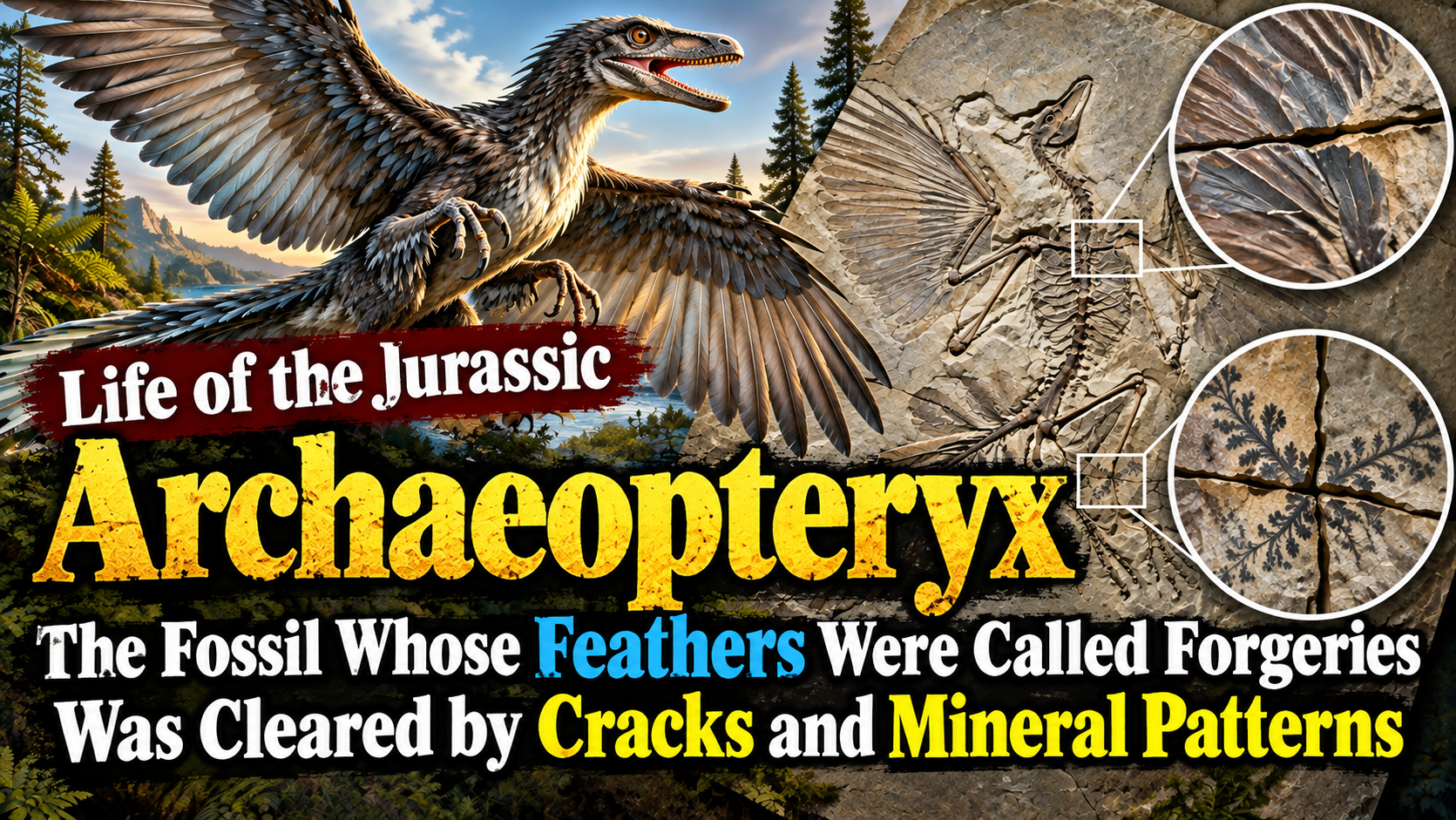
Archaeopteryx was a small feathered, winged theropod that lived in Late Jurassic Europe. It is known as an animal close to the root of the bird lineage, combining dinosaur features such as toothed jaws, claws at the ends of its fingers and a long tail with a bony core, with wings bearing a full set of flight feathers. In 1985, the feathers on its most famous specimen were accused of being a later fabrication.
Form and Life
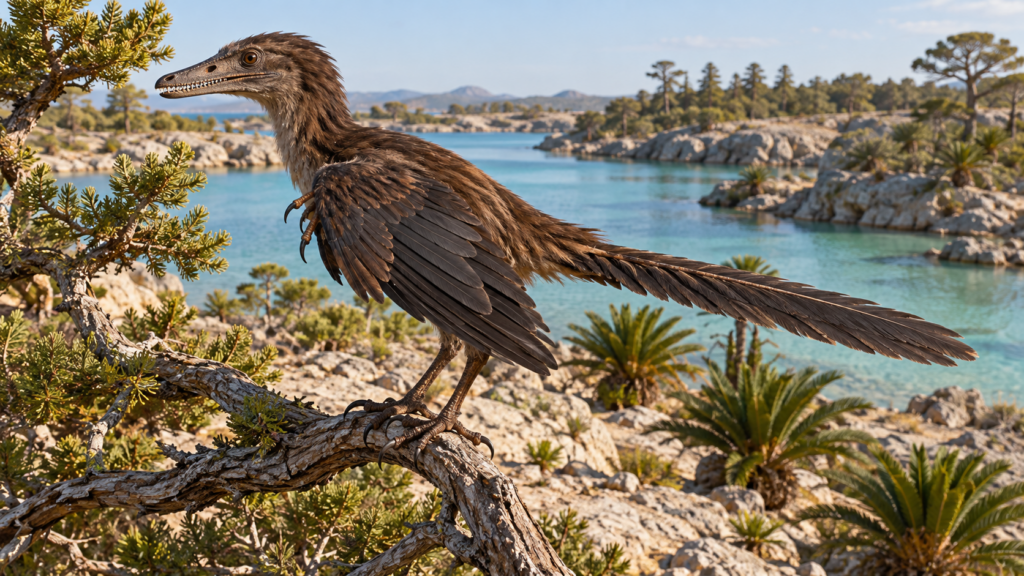
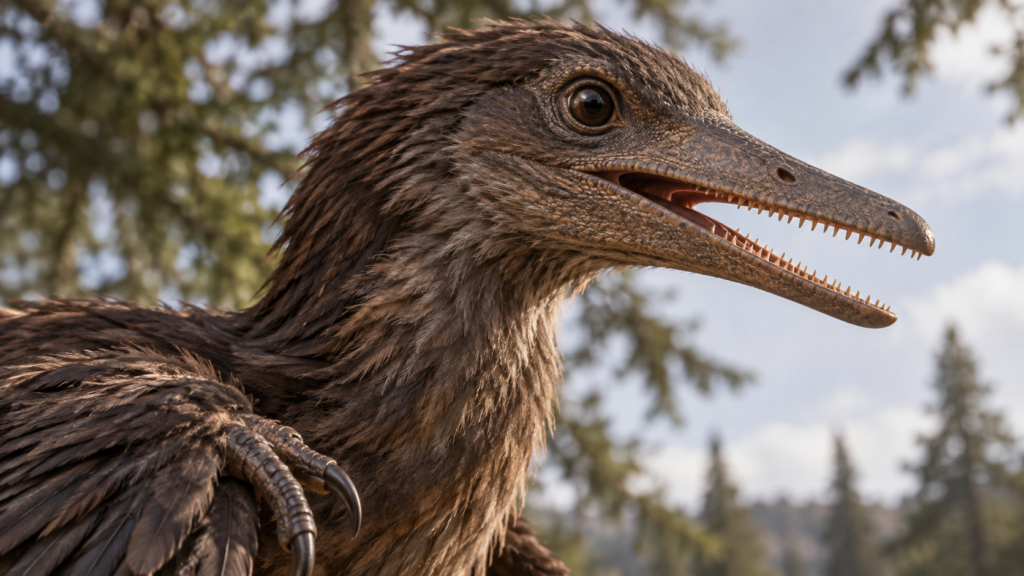
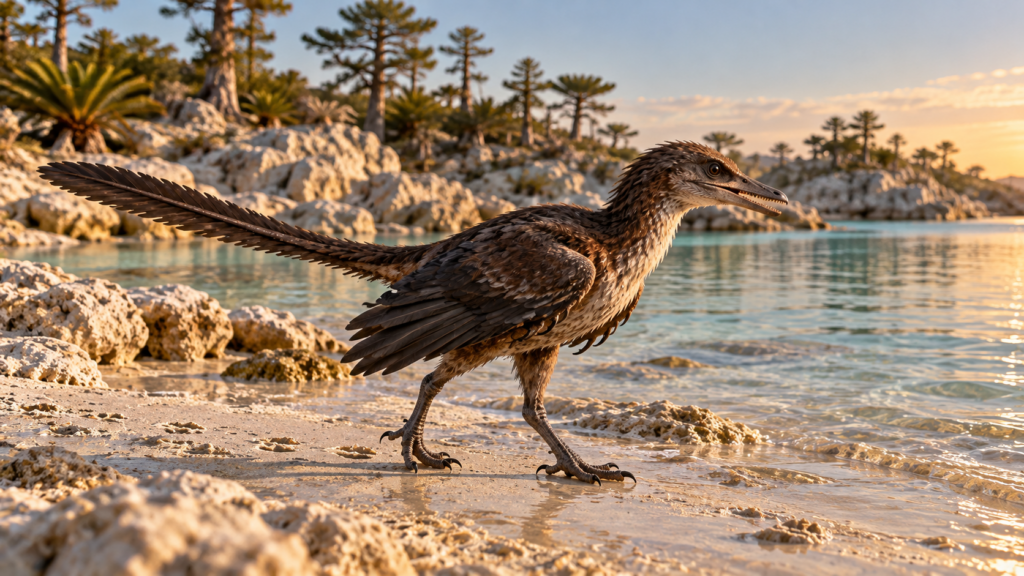
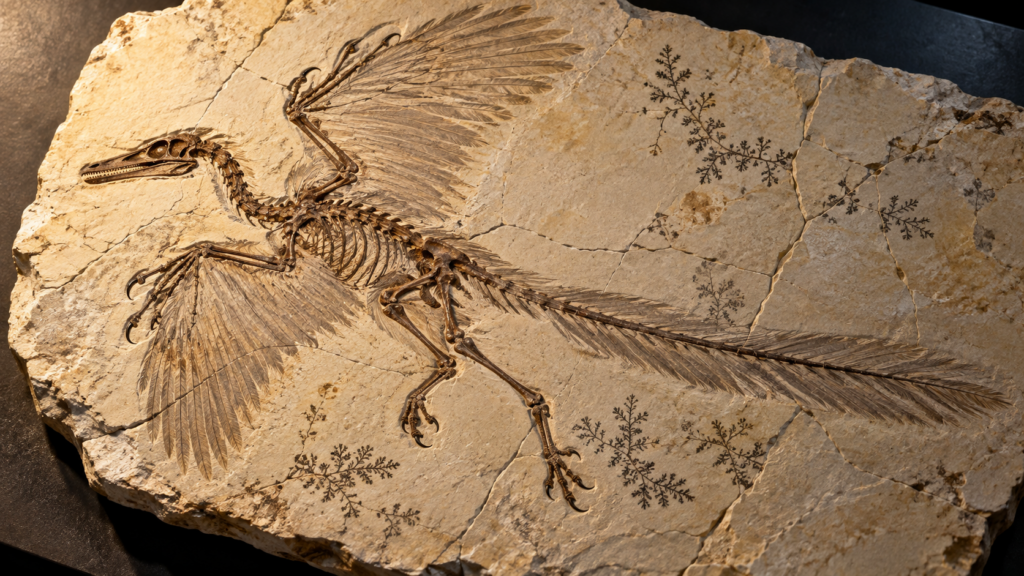
The body of Archaeopteryx is built like that of a small feathered theropod. Small teeth lined its upper and lower jaws, and the three fingers of each forelimb were separate, each ending in a curved claw. The tail was long, with bones running all the way to the tip and a single row of feathers along each side. In living birds, the tail feathers fan out from a short block of fused bones (the pygostyle), but Archaeopteryx had no such block.
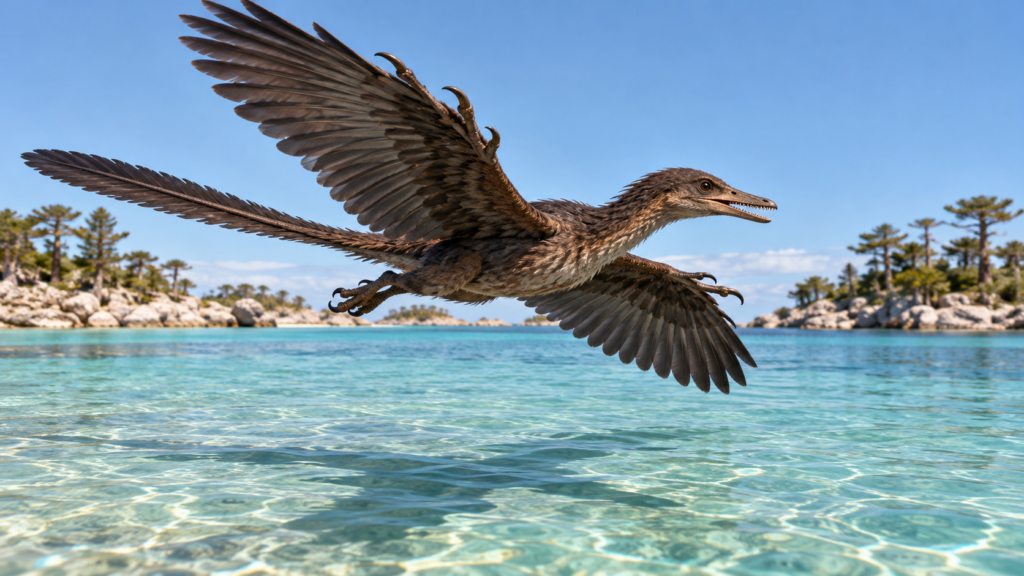
At the same time, its arms carried asymmetrical flight feathers, giving it well-formed wings. The 14th specimen, the “Chicago Archaeopteryx” described in 2025, showed feathers called tertials growing along the upper arm bone on both wings. These feathers fill the gap between the wing and the body, and they have not been found in feathered dinosaurs closely related to birds. The same study showed that the pads on the soles of its feet were shaped for walking on the ground rather than for gripping prey.
The Solnhofen limestone that holds the fossils formed from fine mud that settled on the floor of a salty lagoon. At the time, the area was a scatter of dry islands in a shallow sea, with low conifers and cycad relatives growing on the islands. Because the lagoon floor was a hostile place for life, carcasses that sank there were left undisturbed, and even the impressions of feathers were preserved. The same limestone has also yielded pterosaurs and the small dinosaur Compsognathus.
Its growth rate differed from that of living birds. In 2009, Gregory Erickson of Florida State University and colleagues examined cross sections of its bones and found that its leg bones were made of a slow-growing tissue with few blood vessels. They estimated that it took at least 970 days to reach adult size, a growth rate similar to that of dinosaurs close to birds and about a third of that of living birds whose chicks walk soon after hatching.
The Fossil Whose Feathers Were Called a Forgery
The discovery of Archaeopteryx overlapped with the history of evolutionary theory. In 1860, a fossil of a single feather was found near Solnhofen, and the paleontologist Hermann von Meyer reported it the following year, 1861. Also in 1861, a skeleton with feather impressions was dug out of a quarry near Langenaltheim, two years after Darwin’s On the Origin of Species was published. The specimen passed to a local doctor, Karl Häberlein, and in 1862 the British Museum bought it together with more than 1,900 other Solnhofen fossils for 700 pounds. The purchase was championed by the anatomist Richard Owen, who published a description the following year, 1863. This is the “London specimen,” now in the Natural History Museum in London. In 1877, a second skeleton, this one with its skull preserved, was found near Blumenberg and went to Berlin.
More than 120 years later, in 1985, a group including the astronomer Fred Hoyle and Chandra Wickramasinghe published a series of articles in the British Journal of Photography claiming that the feathers on the London and Berlin specimens were forged. In their scenario, a thin cement made from powdered limestone had been spread around the skeleton of a small dinosaur, and the feathers of a modern bird had been pressed into it. As evidence, they pointed out that the feather impressions were clear on the main slab but only faint on the counterpart slab from the other side of the split, and that the rock surface looked different in areas with and without feathers.
Alan Charig and four colleagues at the Natural History Museum re-examined the specimen and, in 1986, published a paper in Science titled “Archaeopteryx Is Not a Forgery.” Photographs taken under ultraviolet light shone at a low angle revealed fine hairline cracks running across both the feathers and the skeleton, and those cracks continued in the same positions on the counterpart slab. Branching patterns of manganese dioxide that had grown within the rock (dendrites) overlay the feather impressions, and these patterns also matched on both slabs. No layer of cement or seam was found, even in cross section. The faintness of the impressions on the counterpart slab, they explained, reflects the ordinary way Solnhofen fossils split. In another specimen, the feather impressions run underneath the bones and are overlain by dendrites, an arrangement that could not have been produced by pressing feathers in afterward.
Hoyle’s group continued to publish rebuttals, but the forgery claim has not been accepted among paleontologists. In 1987, the Natural History Museum opened an exhibition setting out both sides’ claims alongside the results of its investigation. Archaeopteryx specimens kept turning up throughout the 20th century, and many of them preserve feather impressions. The Chicago specimen of 2025 is the 14th; it was prepared while its interior was scanned by CT, revealing feathers that had never been seen before.
Its position on the family tree has not been entirely stable. In 2011, an analysis that added the Chinese feathered dinosaur Xiaotingia placed Archaeopteryx not with birds but closer to Deinonychus. Today the view that places it at the root of the bird lineage is widely used, but as more and more bird-like feathered dinosaurs are found, the boundary of what counts as “the first bird” keeps being examined in detail.
Related products
You can find books and products related to this article on Amazon.
If you buy through the links above, this blog may earn a commission.
Sources
Charig, A. J., Greenaway, F., Milner, A. C., Walker, C. A. & Whybrow, P. J. (1986). Archaeopteryx is not a forgery. Science 232, 622–626. https://doi.org/10.1126/science.232.4750.622
O’Connor, J. et al. (2025). Chicago Archaeopteryx informs on the early evolution of the avian bauplan. Nature. https://doi.org/10.1038/s41586-025-08912-4
Erickson, G. M. et al. (2009). Was dinosaurian physiology inherited by birds? Reconciling slow growth in Archaeopteryx. PLoS ONE 4, e7390. https://doi.org/10.1371/journal.pone.0007390
Xu, X., You, H., Du, K. & Han, F. (2011). An Archaeopteryx-like theropod from China and the origin of Avialae. Nature 475, 465–470. https://doi.org/10.1038/nature10288
TalkOrigins Archive. On Archaeopteryx, Astronomers, and Forgery. https://www.talkorigins.org/faqs/archaeopteryx/forgery.html
TalkOrigins Archive. All About Archaeopteryx. https://www.talkorigins.org/faqs/archaeopteryx/info.html


コメント