This article contains affiliate links. As an Amazon Associate I earn from qualifying purchases.
| Name | Microraptor (Microraptor zhaoianus; the genus name means “small plunderer”) |
| Classification | Dinosauria, Theropoda, Dromaeosauridae |
| Period | Early Cretaceous (about 120 million years ago) |
| Found in | Liaoning Province, China (Jiufotang Formation) |
| Length | About 77–80 cm |
| Weight | Estimated at about 1 kg |
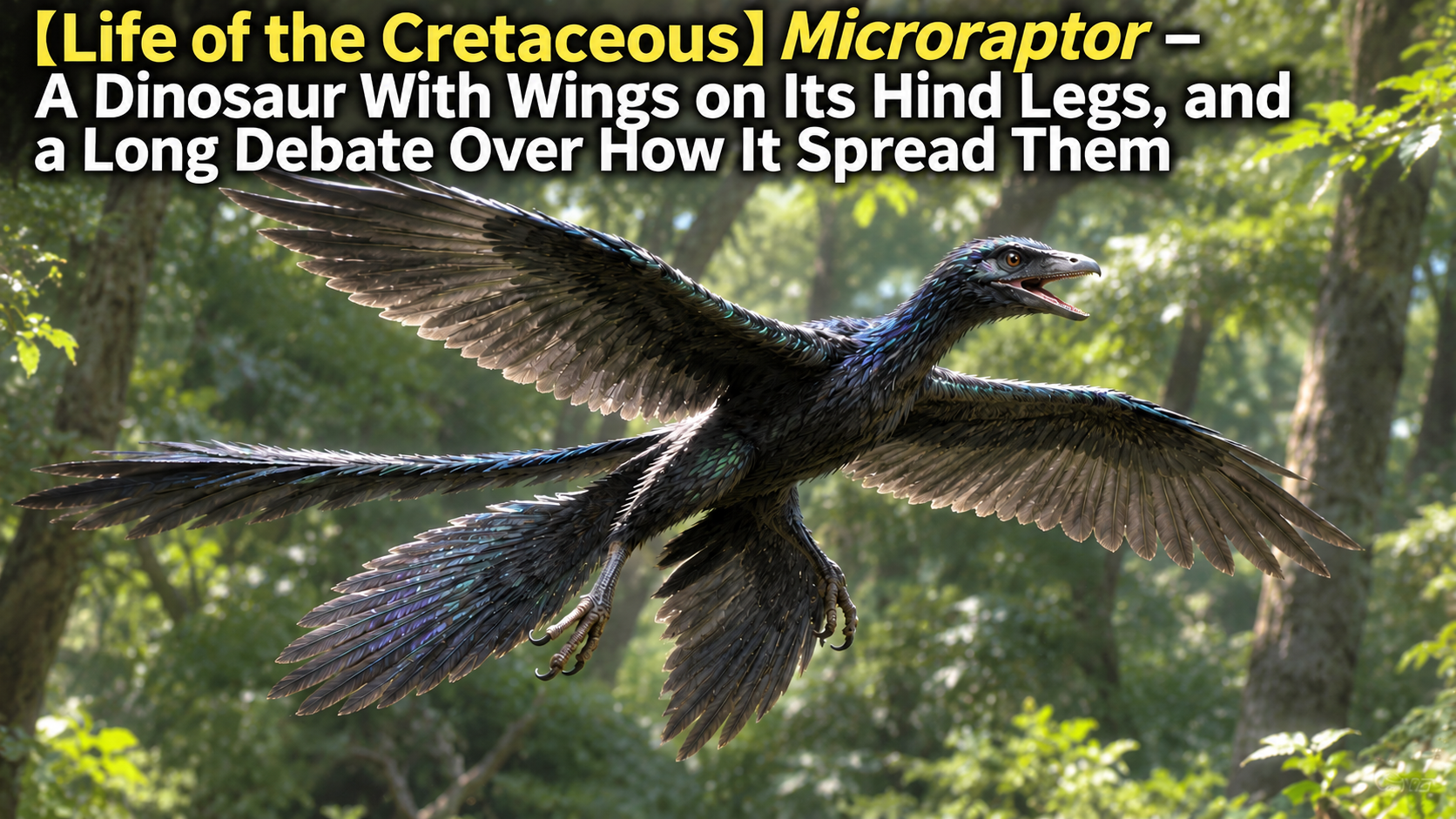
Microraptor was a small meat-eating dinosaur that lived in China about 120 million years ago. It belonged to the Dromaeosauridae, the same family as Velociraptor, and carried long flight feathers not only on its arms but also on its hind legs. With four wings it is thought to have glided through the air, but how it held the wings on its legs is still disputed more than twenty years after it was first reported.
Appearance and life
Microraptor was described in 2000 as Microraptor zhaoianus by Xu Xing, Zhou Zhonghe and Wang Xiaolin of the Institute of Vertebrate Paleontology and Paleoanthropology in Beijing. The skeleton came from the Jiufotang Formation of Liaoning Province. Although it was an adult, it was smaller than Archaeopteryx, and it was presented as the smallest adult non-avian dinosaur then known. The paper also noted that its toes were shaped like those of birds that live in trees.
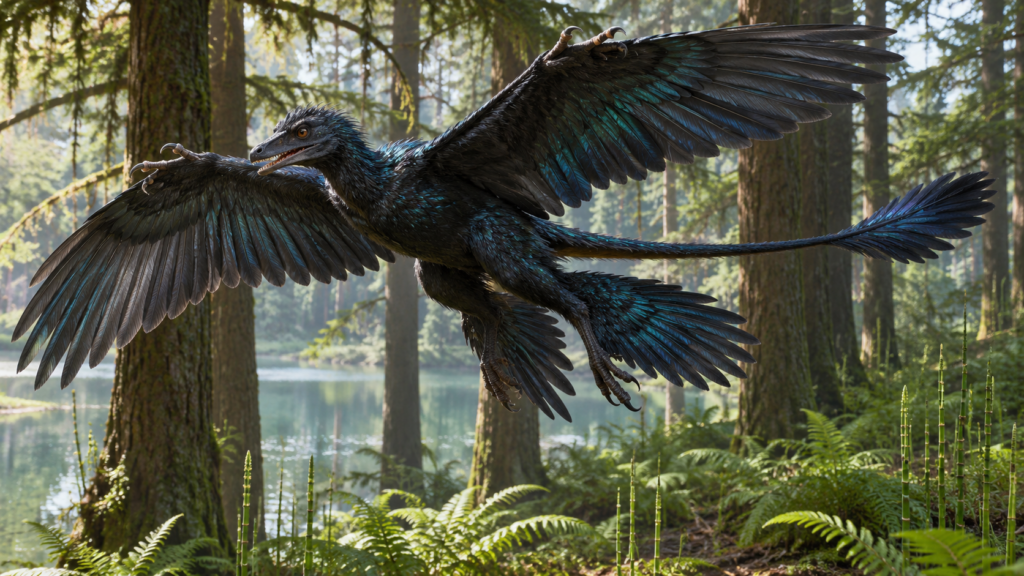
In 2003, Xu and colleagues reported more specimens from the same rocks as a separate species, Microraptor gui. The specimens preserved feathers: long flight feathers lined the arms, and long flight feathers also grew from the shins down to the upper feet. The Natural History Museum in London gives a length of about 80 cm and a weight of about 1 kg, and a 2007 flight study gives about 77 cm and about 1 kg for the type specimen of M. gui. Studies in 2012 and 2014 treated M. gui as the same species as M. zhaoianus, and most researchers now combine them, though some still keep them apart.
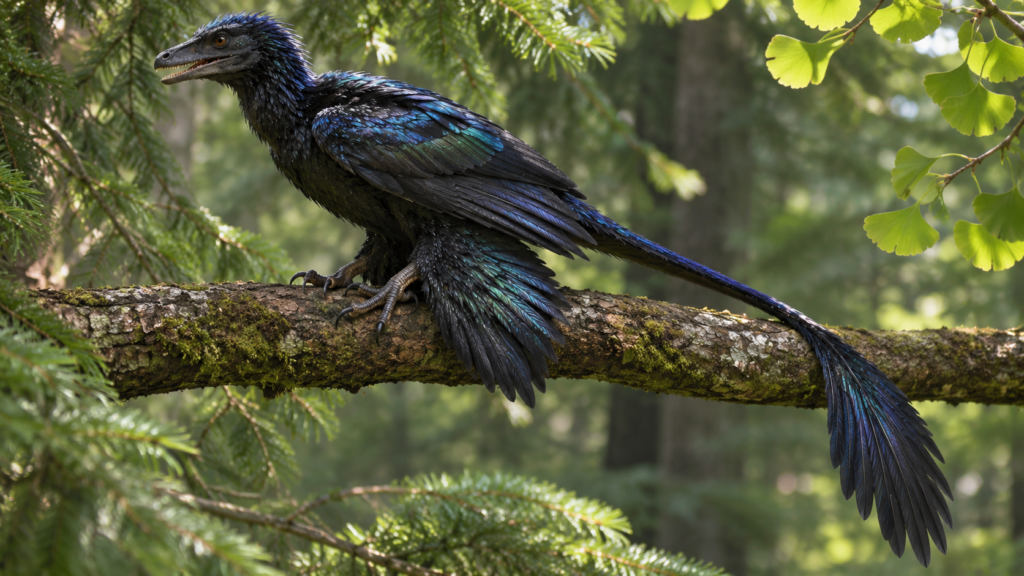
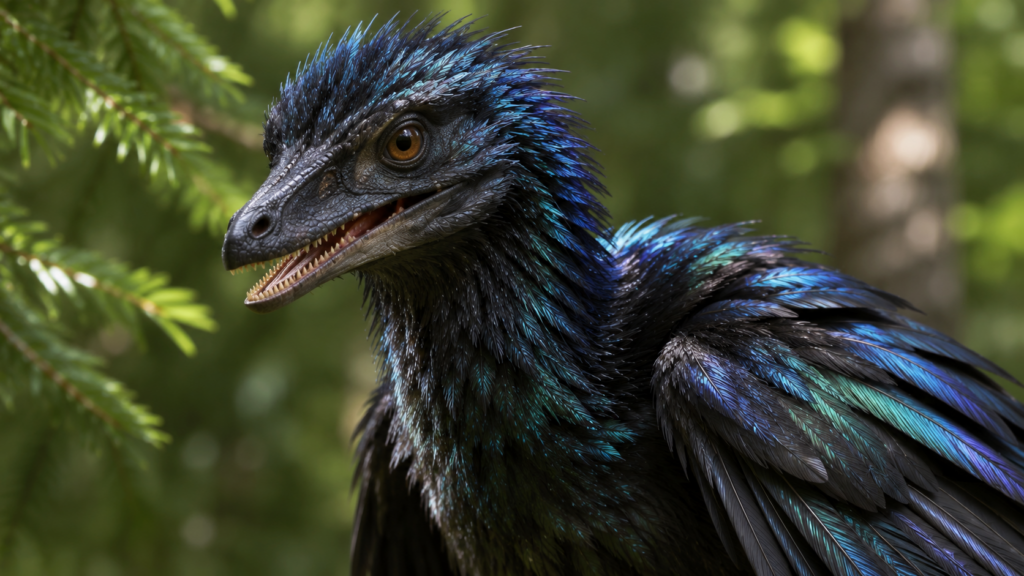
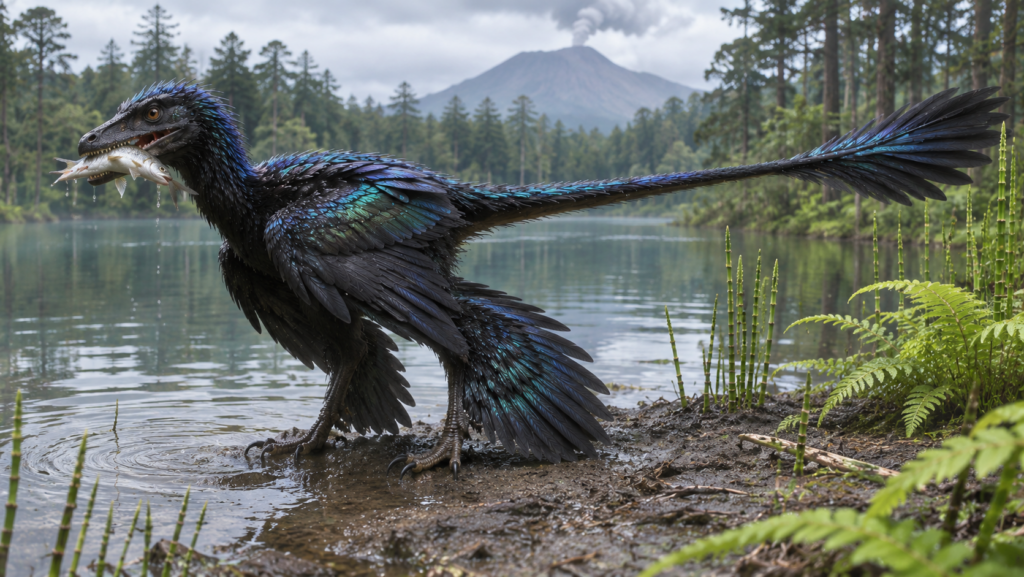
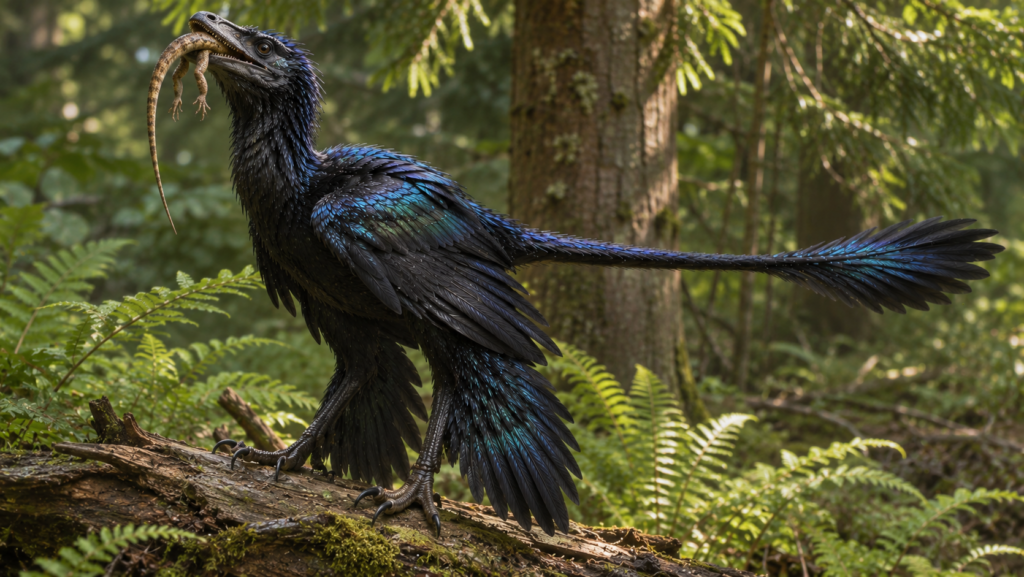
Its mouth was lined with small teeth, and each hand had three fingers with claws. The long tail had a bony core, with long feathers toward its end. In 2012, a team from China and the United States studied the shape and arrangement of pigment granules (melanosomes) preserved in the fossil feathers and concluded that Microraptor’s plumage was glossy and iridescent, changing color with the angle of the light. They suggested that the tail feathers may have been more for display than for flight.
What it ate is known from prey preserved where its stomach used to be. A bird (an enantiornithine) was reported in 2011, fish in 2013, and a whole lizard in 2019. The lizard was described as a new species, Indrasaurus, and had been swallowed head first. Because its prey included animals of the trees and of the water’s edge, Microraptor is thought to have been an opportunistic hunter that ate whatever it could catch.
Microraptor lived on the shores of lakes inhabited by the animals and plants known as the Jehol Biota. Active volcanoes stood nearby, and the ash that fell and settled on the lake floors produced fossils fine enough to preserve feathers and stomach contents.
How were the hind wings held?
In their 2003 report, Xu and colleagues called Microraptor a “four-winged dinosaur.” In 1915, the American naturalist William Beebe had proposed that the ancestors of flapping birds went through a stage in which they had wings on both arms and legs and glided from tree to tree. Microraptor fitted this “tetrapteryx” stage and was treated as evidence for the idea that bird flight began in the trees. The problem was the orientation of the wings on the legs.
The reconstruction in the 2003 paper showed the hind legs spread horizontally out to the sides, with the arm wings and the leg wings at the same level. In 2007, Sankar Chatterjee of Texas Tech University and a colleague rejected this posture, because a theropod’s hip joint does not allow the legs to be splayed straight out sideways. They proposed instead that the legs hung down beneath the body while the leg feathers spread out to the sides. That would put the arm wings above and the leg wings below, in a two-tier layout like a biplane. In their calculations, Microraptor could glide from tree to tree along an undulating path, rising and falling as it went.
In 2010, David Alexander of the University of Kansas and colleagues built a full-scale model and flew it with the hind wings set in different orientations. The model glided stably in every configuration, covering about four times as much distance as it lost in height, at a speed of about 10.6 m per second. The biplane configuration, however, needed an extremely heavy head to stay balanced, and Alexander’s team considered a posture with the leg feathers spread out sideways more plausible. They also pointed out that long feathers running from the shin to the foot would have seriously hampered walking and running on the ground.
In 2013, Gareth Dyke and colleagues in the UK tested a model in a wind tunnel. Microraptor’s wings suited gliding from a low launch point with high lift and high drag. Changing the position of the arm wings or the legs made little difference to how well it glided. The argument over the legs was not settled; the result was that it could glide in any of the postures.
Since then, attention has shifted to whether it could fly by flapping. A 2020 study, using the wing area and body weight of theropods, calculated that some of Microraptor’s close relatives were near the values needed for powered flight. A 2024 study showed that the shape of Microraptor’s flight feathers falls within the range of birds that fly today. Most studies agree that it could at least glide, and a growing number suggest it came close to powered flight. How it used its hind wings, and whether it lived mainly in the trees or on the ground, remain open questions.
Related products
You can find books and products related to this article on Amazon.
If you buy through the links above, this blog may earn a commission.
About the images
The images in this article are illustrations created with AI (ChatGPT), and you are welcome to use them. If you do, we would appreciate a link back to this article as the source.
Sources
Xu, X., Zhou, Z. & Wang, X. (2000). The smallest known non-avian theropod dinosaur. Nature 408, 705–708. https://doi.org/10.1038/35047056
Xu, X. et al. (2003). Four-winged dinosaurs from China. Nature 421, 335–340. https://doi.org/10.1038/nature01342
Chatterjee, S. & Templin, R. J. (2007). Biplane wing planform and flight performance of the feathered dinosaur Microraptor gui. Proceedings of the National Academy of Sciences 104, 1576–1580. https://doi.org/10.1073/pnas.0609975104
Alexander, D. E. et al. (2010). Model tests of gliding with different hindwing configurations in the four-winged dromaeosaurid Microraptor gui. Proceedings of the National Academy of Sciences 107, 2972–2976. https://doi.org/10.1073/pnas.0911852107
O’Connor, J. et al. (2011). Additional specimen of Microraptor provides unique evidence of dinosaurs preying on birds. Proceedings of the National Academy of Sciences 108, 19662–19665. https://doi.org/10.1073/pnas.1117727108
Li, Q. et al. (2012). Reconstruction of Microraptor and the evolution of iridescent plumage. Science 335, 1215–1219. https://doi.org/10.1126/science.1213780
Xing, L. et al. (2013). Piscivory in the feathered dinosaur Microraptor. Evolution 67, 2441–2445. https://doi.org/10.1111/evo.12119
Dyke, G. et al. (2013). Aerodynamic performance of the feathered dinosaur Microraptor and the evolution of feathered flight. Nature Communications 4, 2489. https://doi.org/10.1038/ncomms3489
Pei, R. et al. (2014). A new specimen of Microraptor (Theropoda: Dromaeosauridae) from the Lower Cretaceous of western Liaoning, China. American Museum Novitates 3821. https://doi.org/10.1206/3821.1
O’Connor, J. et al. (2019). Microraptor with ingested lizard suggests non-specialized digestive function. Current Biology 29, 2423–2429. https://doi.org/10.1016/j.cub.2019.06.020
Pei, R. et al. (2020). Potential for powered flight neared by most close avialan relatives, but few crossed its thresholds. Current Biology 30, 4033–4046. https://doi.org/10.1016/j.cub.2020.06.105
Kiat, Y. & O’Connor, J. K. (2024). Functional constraints on the number and shape of flight feathers. Proceedings of the National Academy of Sciences 121, e2306639121. https://doi.org/10.1073/pnas.2306639121
Natural History Museum, London. Microraptor. https://www.nhm.ac.uk/discover/dino-directory/microraptor.html

コメント