This article contains affiliate links. As an Amazon Associate I earn from qualifying purchases.
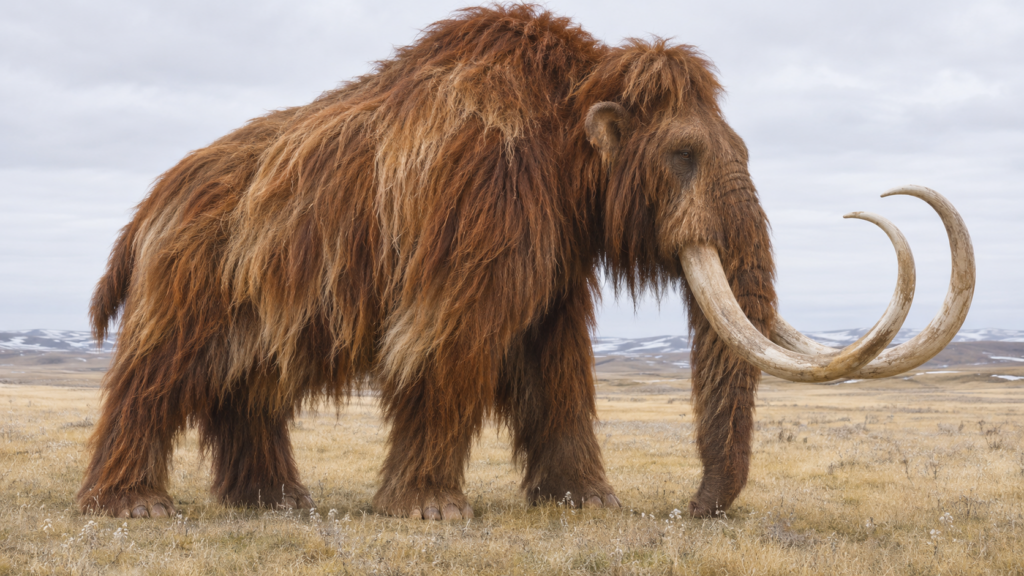
| Name | Woolly mammoth (Mammuthus primigenius). The species name means “first-born” |
| Classification | Mammal, order Proboscidea, family Elephantidae, genus Mammuthus |
| Age | Quaternary, Middle Pleistocene to Holocene (about 400,000 to 4,000 years ago) |
| Found in | Northern Eurasia and northern North America. Bodies with flesh and hair still attached have come out of the permafrost in Siberia and Alaska |
| Shoulder height | Males 2.67–3.49 m, females 2.3–2.6 m |
| Weight | Males 3.9–8.2 t, females 2.8–4 t |
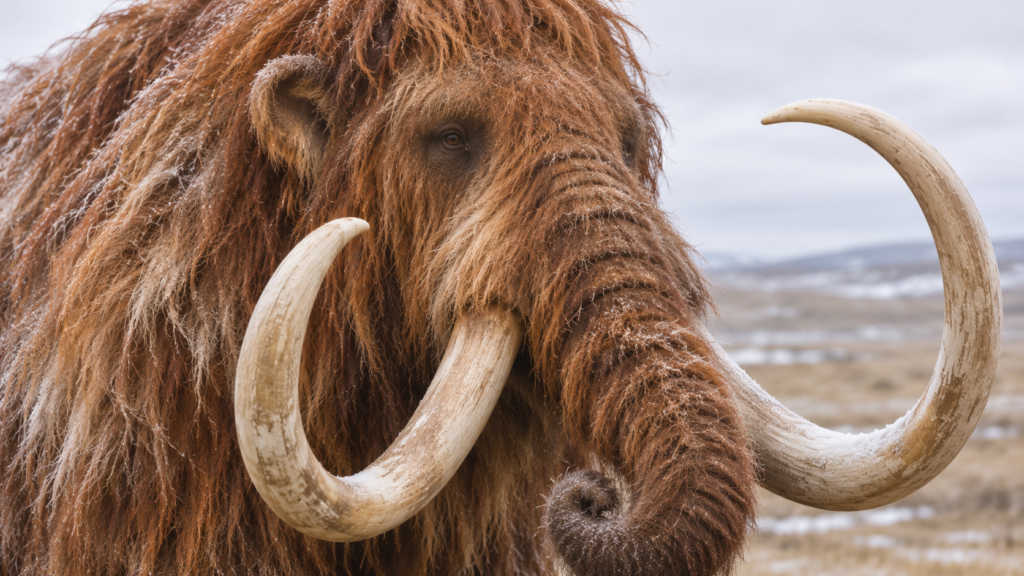
| Tusk length | Usually 2.4–2.7 m in males. The longest on record is 4.05 m |
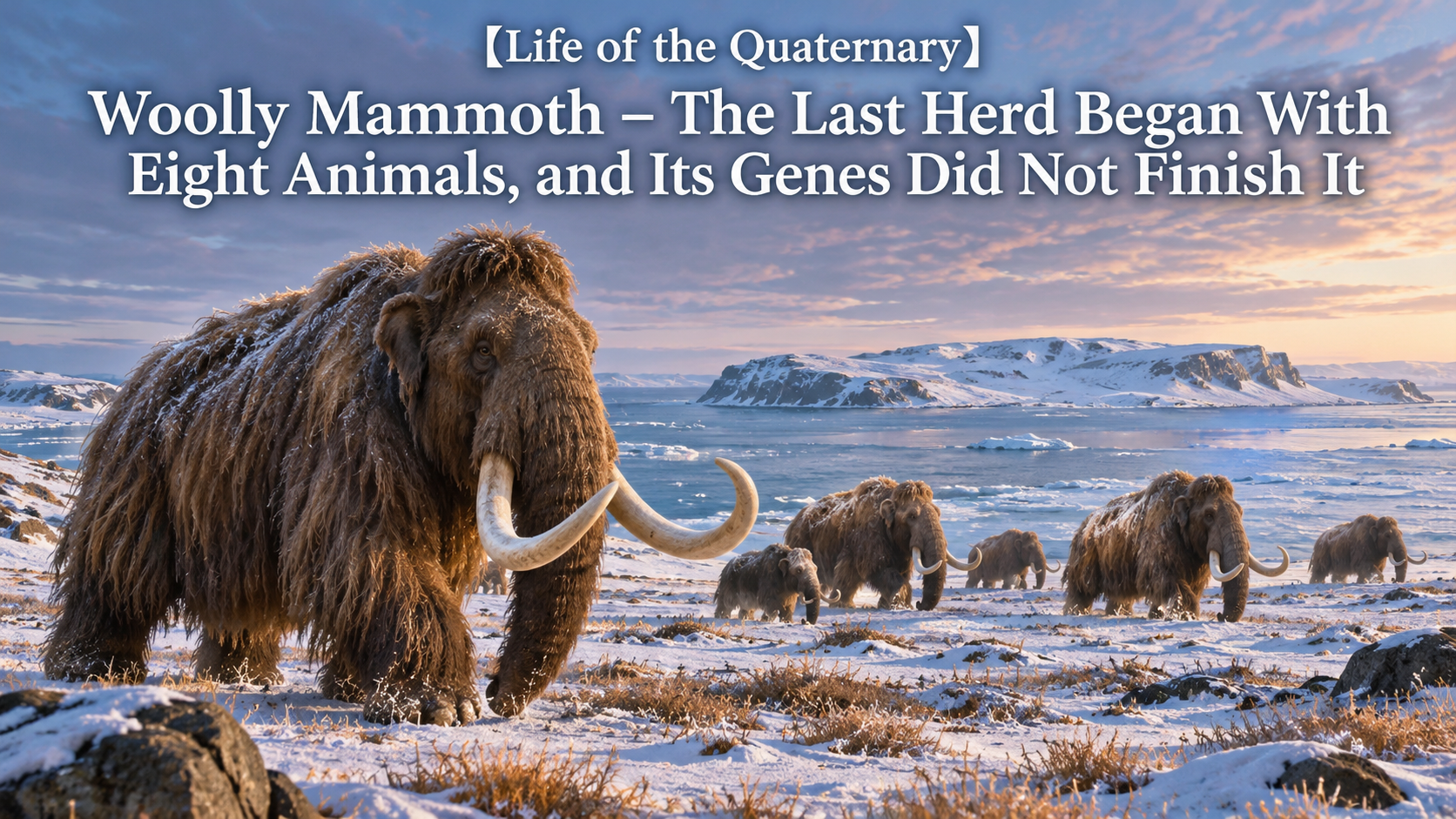
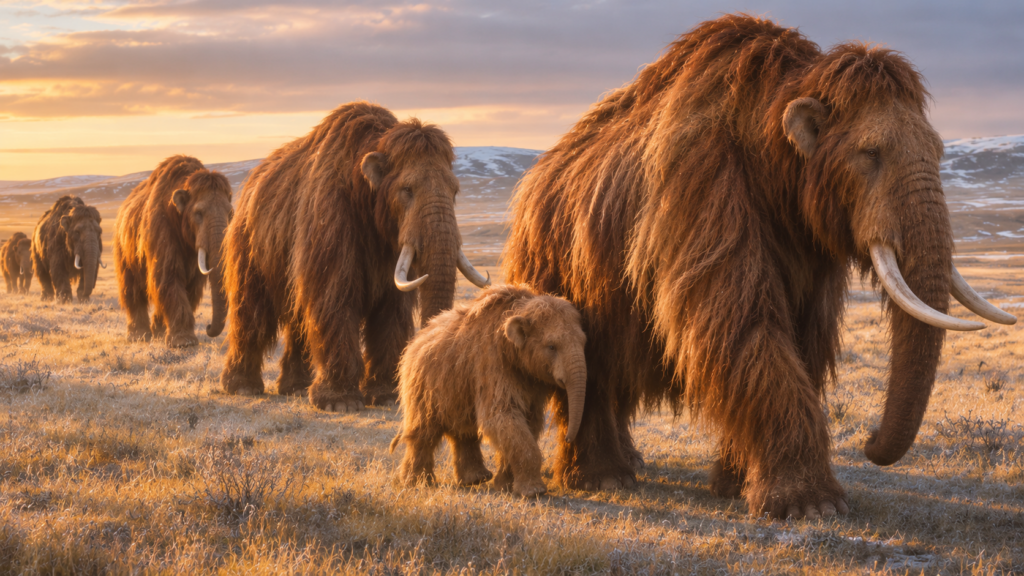
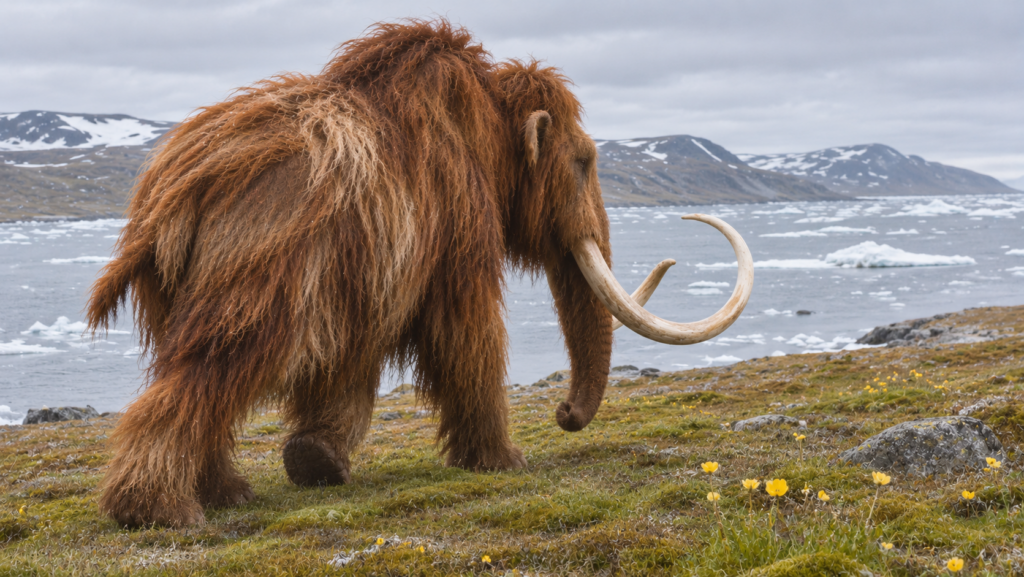
The woolly mammoth was an elephant of the Ice Age grasslands of the Northern Hemisphere, covered in long hair and carrying huge curved tusks. After it vanished from the mainland about 10,000 years ago, a herd trapped on an Arctic Ocean island carried on for roughly 6,000 years, descended from no more than eight animals.
Appearance and Life
The body wore a double coat: long outer guard hairs over a short woolly undercoat. Guard hairs could reach about 90 cm, and the color ranged from dark to light. Under the skin lay a layer of fat up to 10 cm thick. The ears were small and the tail short, both shapes that limit heat loss and frostbite. The back rose to a high shoulder hump and sloped down toward the hips.
The diet was mainly herbaceous plants, with plenty of grass. A 2014 study of dung found about 63 percent forbs and 27 percent grasses. The teeth worked the way a living elephant’s do: only four large molars were in use at any time, one in each half of each jaw, and they were replaced six times over a lifetime. Individuals probably lived to about 60.
The animal’s home was the “mammoth steppe,” a vast cold, dry grassland reaching from northern Eurasia into North America and richer in grass than today’s Arctic tundra. The lineage split from the steppe mammoth about 800,000 years ago in Siberia, and the many-ridged molars typical of the woolly mammoth were in place by about 400,000 years ago.
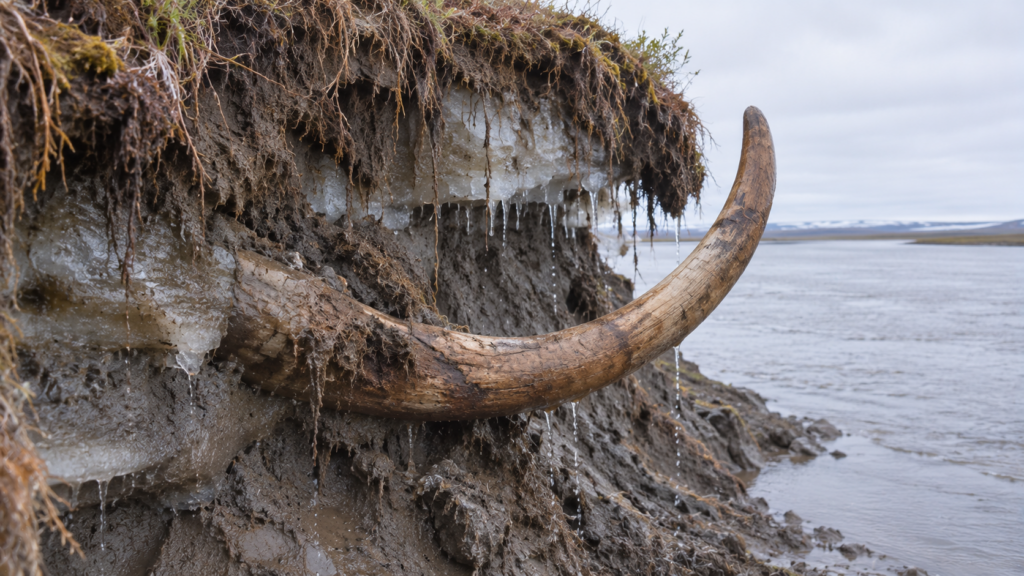
Humans shared this land with it for a long time. More than 500 cave paintings and engravings of mammoths are known, 159 of them in Rouffignac Cave in France alone. The scientific name goes back to Elephas primigenius, given in 1799 by the German naturalist Johann Friedrich Blumenbach, and the species was later moved to the genus Mammuthus. The first frozen carcass was recorded in Siberia that same year, and in 1806 Mikhail Adams collected its bones and skin and took them to St. Petersburg. The stomach of Lyuba, a calf found in the permafrost, still held its mother’s milk.
Six Thousand Years From Eight Founders
On the continents the woolly mammoth was gone by about 10,000 years ago. The youngest dated fossil from mainland Siberia is about 9,650 years old. Herds survived, however, on islands cut off from the mainland by rising seas: until about 5,600 years ago on St. Paul Island off Alaska, and until about 4,000 years ago on Wrangel Island off Siberia.
Sergey Vartanyan and colleagues reported the Wrangel Island animals in Nature in 1993. Their paper was titled “Holocene dwarf mammoths from Wrangel Island,” and the population was taken to be a lineage that had shrunk on the island. Later work showed that these animals fall within the size range of mainland Siberian woolly mammoths, and they are no longer regarded as dwarfs.
In 2017 a study found harmful mutations piled up in the genome of a Wrangel Island individual, and the idea spread that genetic collapse had caused the extinction. The reasoning is that in a small population, natural selection is too weak to clear harmful mutations away.
A study by Marianne Dehasque and colleagues, published in Cell in 2024, reexamined this over time. It compared 21 genomes spanning the last 50,000 years, 14 from the island and 7 from the mainland. The island population began with at most eight animals, soon grew to 200 to 300, and stayed at about that size for roughly 200 generations.
Inbreeding had indeed advanced, but it could not be shown to have destroyed the herd. Genetic diversity kept falling slowly across the 6,000 years, while the most harmful mutations became rarer over time, because animals carrying them were less likely to survive and were weeded out of the population. Within the period analyzed, the number of animals did not fall much either.
The direct cause of the extinction remains unknown. The researchers point to a chance event such as disease or environmental change as a possible final blow. The genomes analyzed do not cover the last 300 years or so, about five generations, and what happened then is still an open question. Humans reached Wrangel Island about 400 years after the last mammoth died.
Related products
You can find books and products related to this article on Amazon.
If you buy through the links above, this blog may earn a commission.
About the images
The images in this article are illustrations created with AI (ChatGPT), and you are welcome to use them. If you do, we would appreciate a link back to this article as the source.
Sources
Dehasque, M. et al. (2024). Temporal dynamics of woolly mammoth genome erosion prior to extinction. Cell 187, 3531–3540.e13. https://doi.org/10.1016/j.cell.2024.05.033
Rogers, R. L. & Slatkin, M. (2017). Excess of genomic defects in a woolly mammoth on Wrangel island. PLOS Genetics 13, e1006601. https://doi.org/10.1371/journal.pgen.1006601
Vartanyan, S. L. et al. (1993). Holocene dwarf mammoths from Wrangel Island in the Siberian Arctic. Nature 362, 337–340. https://doi.org/10.1038/362337a0
Science News, The last woolly mammoths offer new clues to why the species went extinct https://sciencenews.org/article/last-woolly-mammoths-species-extinct
National Geographic (article of July 11, 2024) https://www.nationalgeographic.com/science/article/woolly-mammoth-last-extinction-genetics
Wikipedia, Woolly mammoth (size, anatomy, diet, history of discovery) https://en.wikipedia.org/wiki/Woolly_mammoth
Wikipedia, Wrangel Island (size of the island animals, dates) https://en.wikipedia.org/wiki/Wrangel_Island

コメント