This article contains affiliate links. As an Amazon Associate I earn from qualifying purchases.
| Name | Elasmosaurus, Greek for “thin-plate lizard” |
| Classification | Reptilia, Plesiosauria, Elasmosauridae (not a dinosaur) |
| Age | Late Cretaceous (Campanian, about 80 million years ago) |
| Found in | Western Kansas, USA (Pierre Shale) |
| Length | About 10 m (1952 estimate; the neck alone about 7 m) |
| Neck vertebrae | 72 |
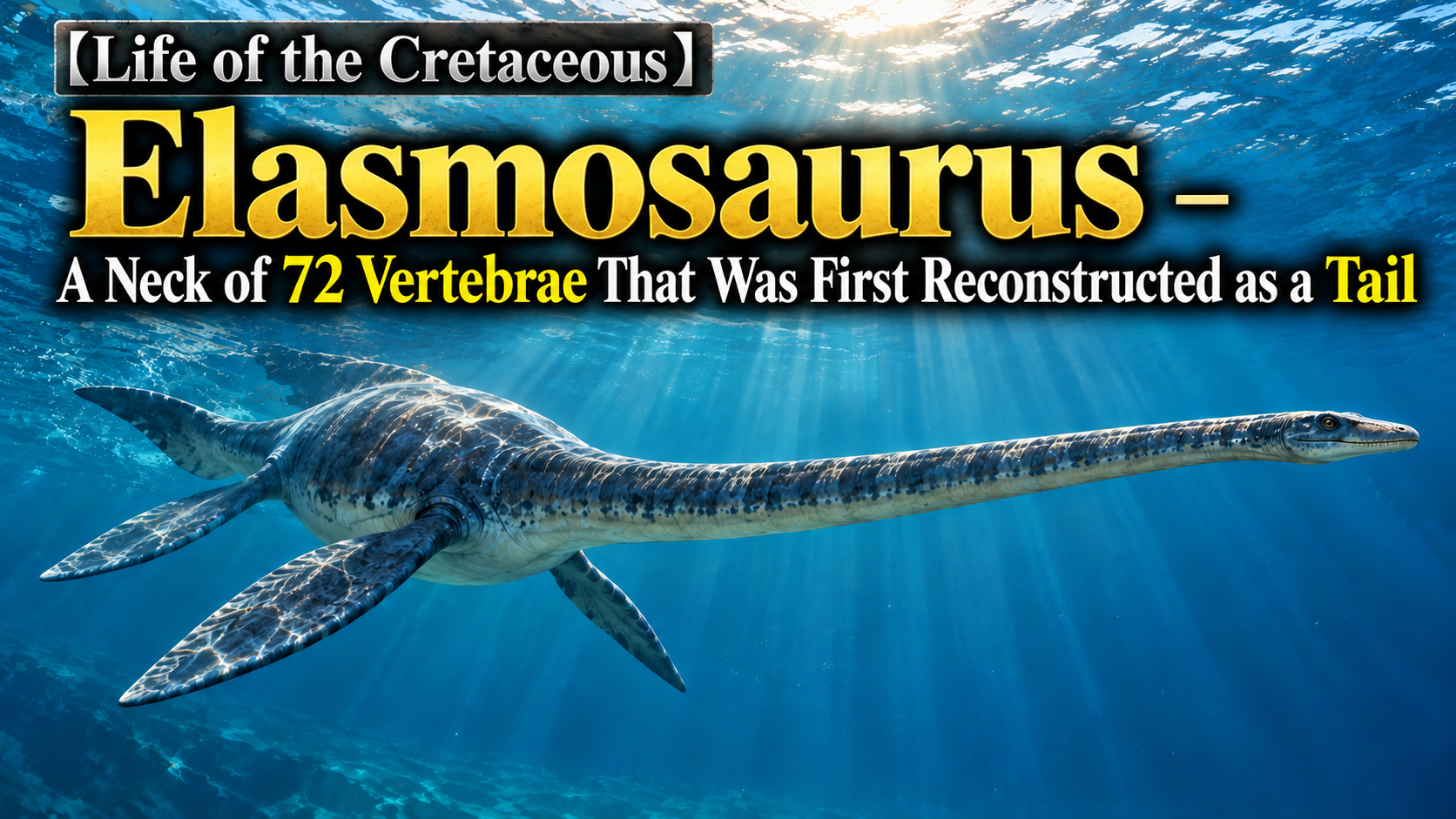
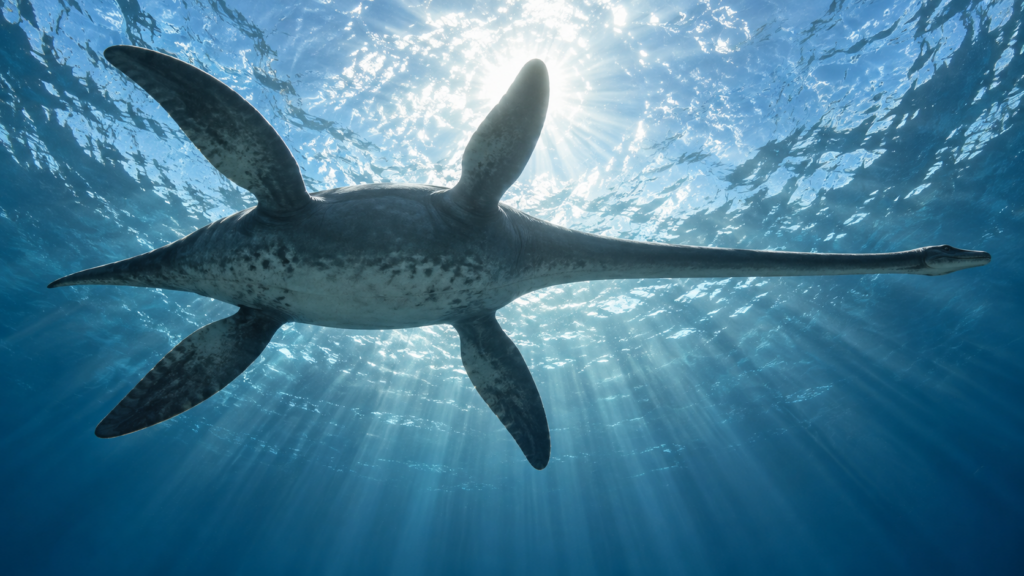
Elasmosaurus was a plesiosaur that lived in the inland sea of Late Cretaceous North America. The neck makes up about two thirds of its length and contains 72 vertebrae, placing it among the longest-necked animals known. Edward Drinker Cope, the palaeontologist who named it in 1868, put the head on the end of the tail in his first reconstruction.
Appearance and Way of Life
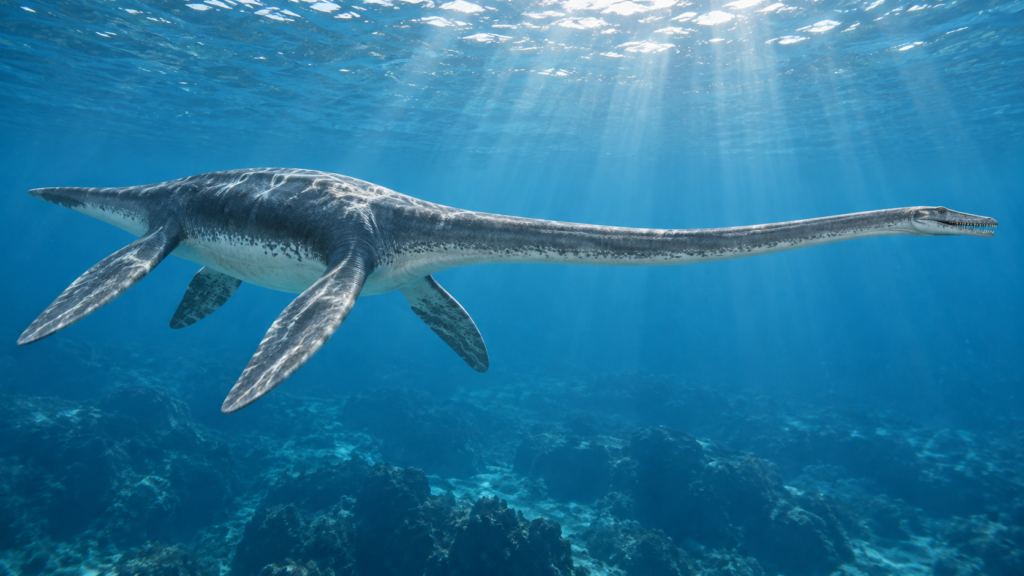
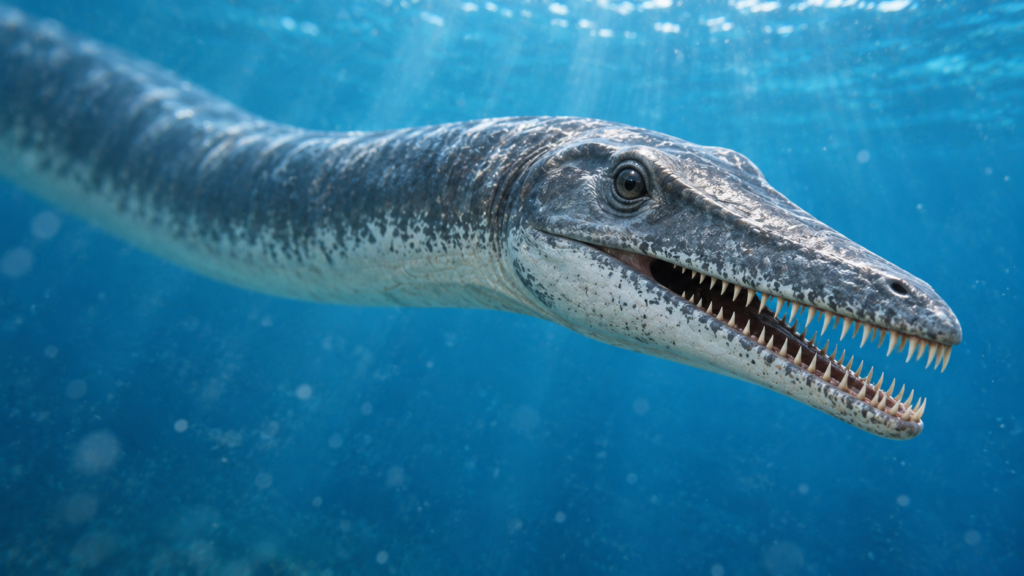
The body of Elasmosaurus was a flat trunk with four large flippers, from which a long, slender neck stretched out to a small head. The tail was short compared with the neck, and the animal is thought to have moved through the water by beating its flippers like a bird’s wings. The type specimen is a single skeleton at the Academy of Natural Sciences of Philadelphia, preserving part of the skull and vertebrae from the neck through the trunk and tail.
In 1869 Cope added up the lengths of the vertebrae and estimated a total length of about 13 m, but in 1952 Samuel Welles revised this to about 10.3 m, the figure still used today. The neck is estimated at about 7 m. Published counts of the neck vertebrae varied slightly from report to report; in 2013 Sven Sachs and colleagues recounted the type specimen and, adding a partial vertebra rediscovered in storage, arrived at 72. The only plesiosaur known with more neck vertebrae is Albertonectes, reported from Canada in 2012 with at least 75.
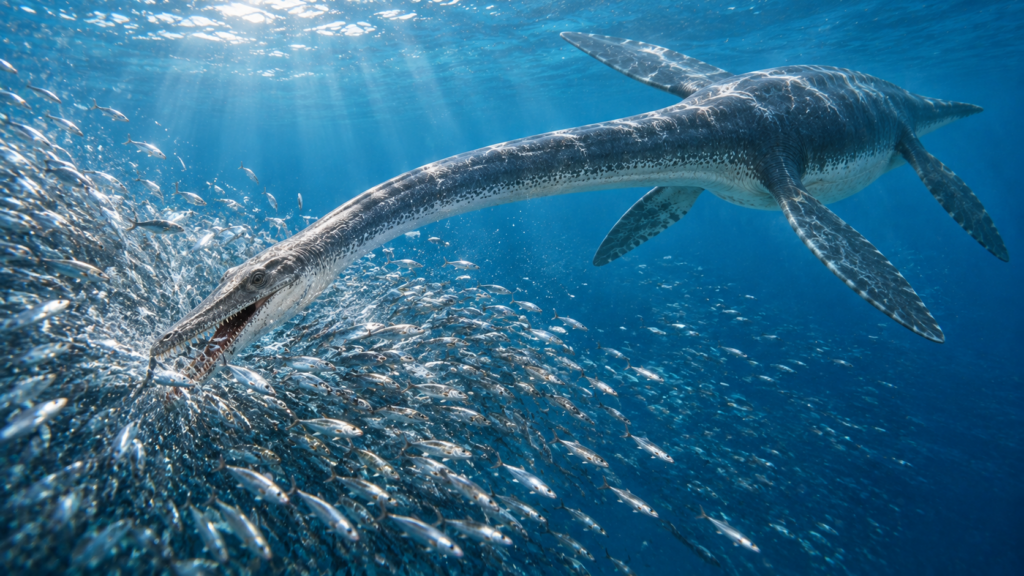
Elasmosaurus lived in the Western Interior Seaway, a shallow sea that split North America in two. The same waters held large marine lizards (mosasaurs), sea turtles and sharks. It is thought to have caught small fish and squid relatives with the head at the end of its long neck.
The neck has often been drawn raised high out of the water and bent into an S-curve like a swan’s. A 2017 study of plesiosaur neck movement found that the neck bent readily downward, while upward and sideways movement was limited. The neck is thought to have been used in front of and below the body, as a tool for catching prey in the water column or near the sea floor.
The Head Was on the Tail
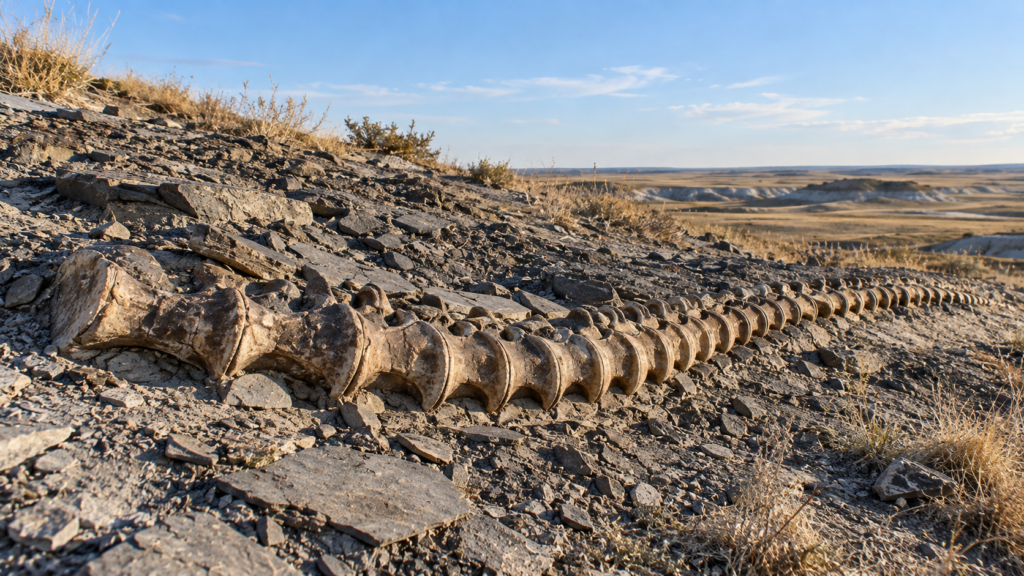
In 1867, near Fort Wallace in western Kansas, the army surgeon Theophilus Turner found the bones of a large reptile on the slope of a ravine. Turner sent some of them east, and they reached Cope in Philadelphia. Cope recognized a large plesiosaur, asked Turner to dig out and send the rest of the skeleton, and named it Elasmosaurus platyurus at a meeting of the Academy of Natural Sciences of Philadelphia in March 1868. The species name means “flat tail.”
In 1868–69, in a review of extinct North American reptiles for the Transactions of the American Philosophical Society, Cope published a detailed description of Elasmosaurus and a reconstruction of the skeleton. It showed an animal with a short neck and a long tail with the head at its tip. The jaws had been found near one end of the vertebral column, so Cope took that end to be the neck and reconstructed the other end as the tail. In fact it was the other way around: the long row of vertebrae that Cope took for a tail was the neck.
In March 1870 Joseph Leidy, an anatomist who had been Cope’s mentor, pointed out at a meeting of the same Academy that Cope had described the skeleton in reverse. His evidence was that the end Cope had treated as the tail tip ended in the first two neck vertebrae, the atlas and axis, fused together, the bones that join the skull. Leidy accepted that the skeleton was a plesiosaur; the dispute was only about which way it faced.
Cope is said to have recalled the copies of the paper already printed and tried to replace them with a version with the head on the neck. Some copies of the erroneous version survived, and Othniel Charles Marsh of Yale, Cope’s bitter rival, brought up the mistake for years. When their feud became public in the newspaper the New York Herald in 1890, Marsh raised the episode again. The Elasmosaurus reconstruction is still told as one of the anecdotes of the “Bone Wars,” the fight between the two men over the fossils of the American West in the late 19th century.
The missing parts of the type specimen have never been found. Turner searched the site again, but most of the skull, part of the trunk vertebrae and the flippers did not turn up. A 2018 study reported that within four years of the discovery, even the shoulder and hip bones that had been received disappeared with no official explanation.
Related products
You can find books and products related to this article on Amazon.
If you buy through the links above, this blog may earn a commission.
About the images
The images in this article are illustrations created with AI (ChatGPT), and you are welcome to use them. If you do, we would appreciate a link back to this article as the source.
Sources
Sachs, S., Kear, B. P. & Everhart, M. J. (2013). Revised Vertebral Count in the “Longest-Necked Vertebrate” Elasmosaurus platyurus Cope 1868, and Clarification of the Cervical-Dorsal Transition in Plesiosauria. PLoS ONE 8, e70877. https://doi.org/10.1371/journal.pone.0070877
Davidson, J. P. (2002). Bonehead mistakes: The background in scientific literature and illustrations for Edward Drinker Cope’s first restoration of Elasmosaurus platyurus. Proceedings of the Academy of Natural Sciences of Philadelphia 152, 215–240. https://doi.org/10.1635/0097-3157(2002)152[0215:HPOVBM]2.0.CO;2
Davidson, J. P. & Everhart, M. J. (2018). The Mystery of Elasmosaurus platyurus Cope 1868 – Where is the Rest of the Type Specimen? Transactions of the Kansas Academy of Science 121. https://doi.org/10.1660/062.121.0403
Noè, L. F., Taylor, M. A. & Gómez-Pérez, M. (2017). An integrated approach to understanding the role of the long neck in plesiosaurs. Acta Palaeontologica Polonica 62. https://doi.org/10.4202/app.00334.2016

コメント