This article contains affiliate links. As an Amazon Associate I earn from qualifying purchases.
| Name | Gigantopithecus (Gigantopithecus blacki; the genus name combines the Greek words for “giant” and “ape”) |
| Classification | Primates, Hominidae, Ponginae |
| Period | Quaternary, Pleistocene (about 2 million years ago to about 295,000–215,000 years ago) |
| Found in | Southern China (caves in Guangxi and neighboring areas) |
| Height | Estimated at about 3 m (some studies give a range of 1.8–3 m) |
| Weight | Estimated at 200–300 kg (some studies allow up to 500 kg) |
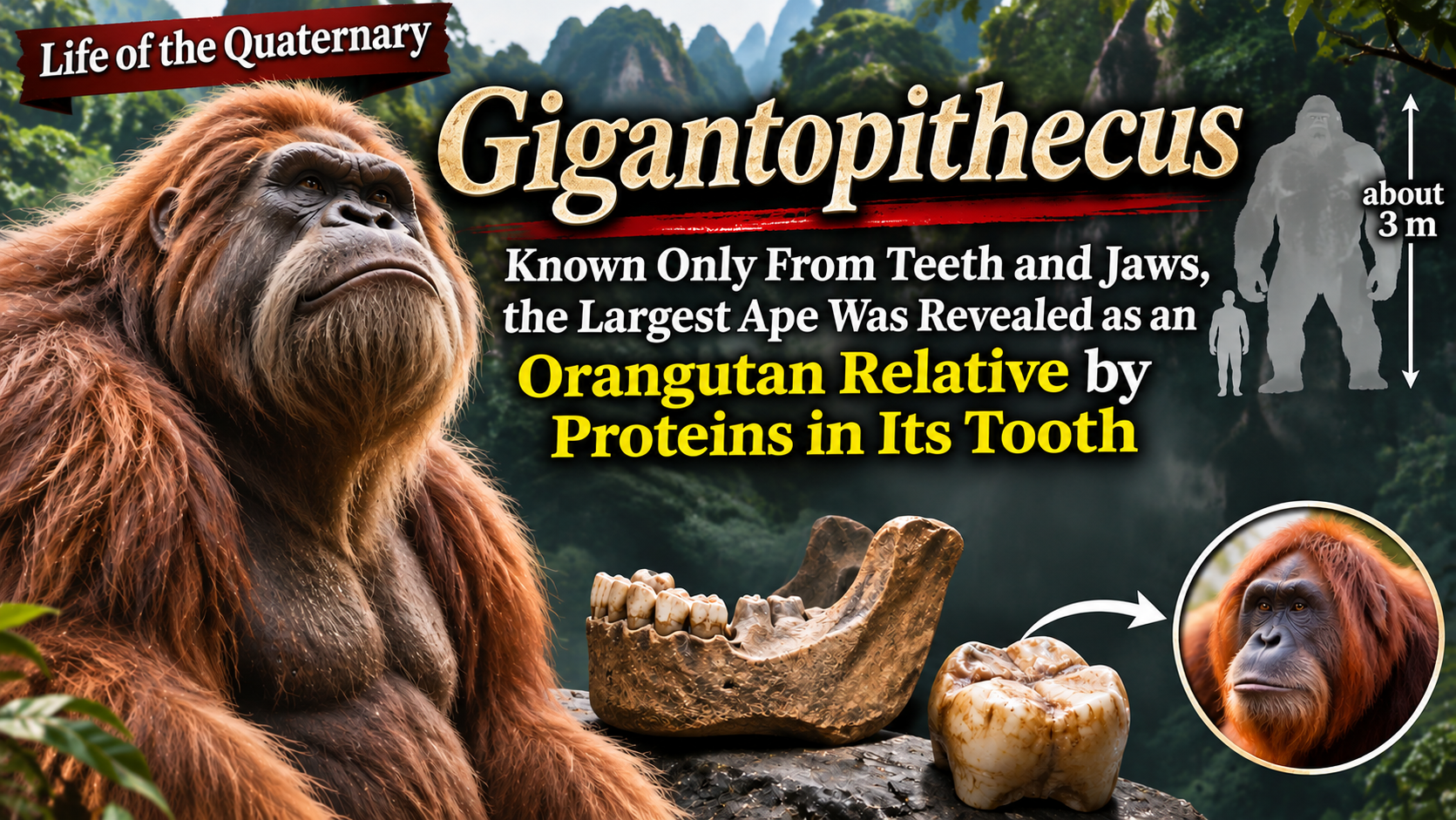
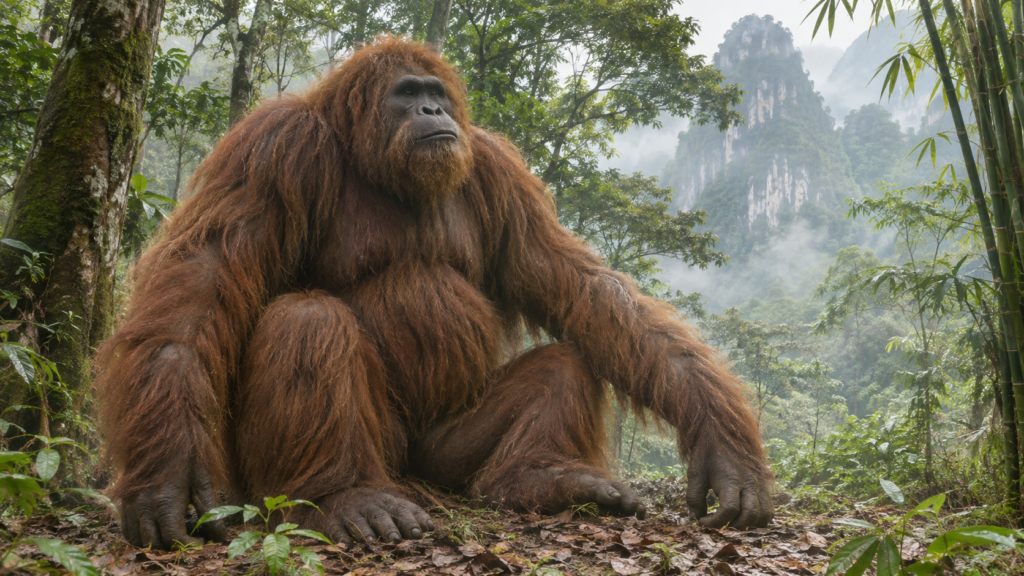
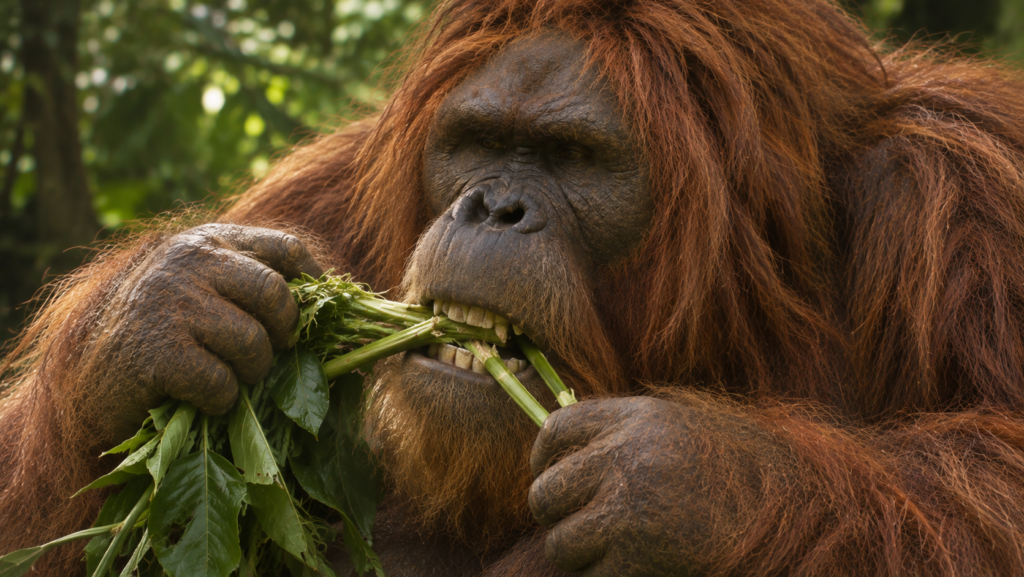
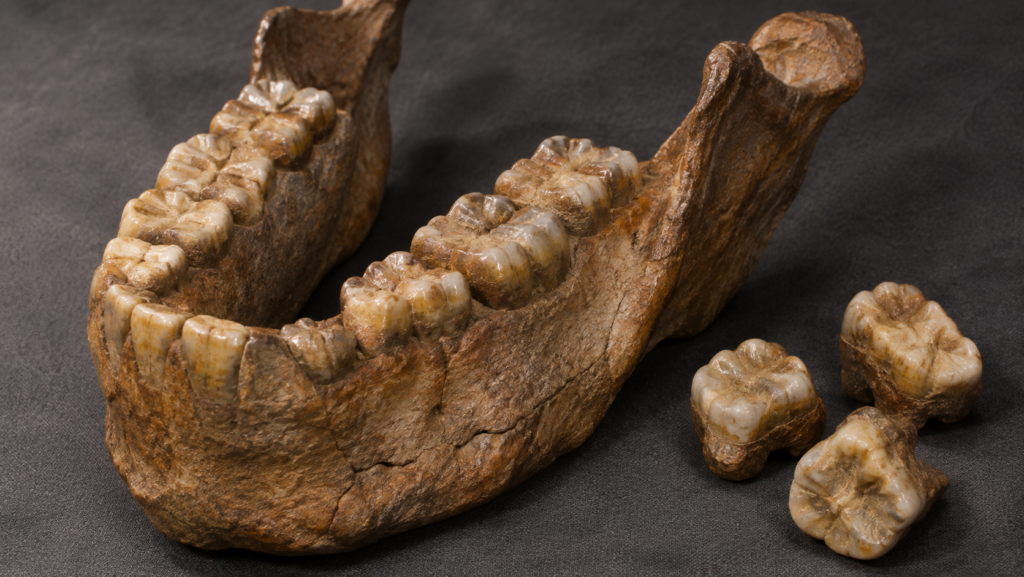
Gigantopithecus was a large ape related to the orangutans. It lived in the forests of southern China from about 2 million to about 300,000 years ago and is considered the largest primate known. Its only fossils are lower jaws and teeth, and it was proteins preserved inside a tooth that showed which apes it was closest to.
Appearance and life
The first fossil turned up in a pharmacy. In China, old animal bones and teeth have long been sold as medicine under the names “dragon bones” and “dragon teeth.” In 1935, the paleontologist Ralph von Koenigswald found a large molar being sold as a dragon tooth in a Hong Kong apothecary shop and described it as a new ape.
Fossils later began to come out of cave deposits in southern China. All the sites lie between the Yangtze River and the South China Sea, and the main ones are caves in the Chongzuo and Bubing Basin areas of Guangxi. According to a 2024 study, 85 years of searching have produced just four lower jaws and nearly 2,000 isolated teeth. No skull and no bones from below the neck have been found.
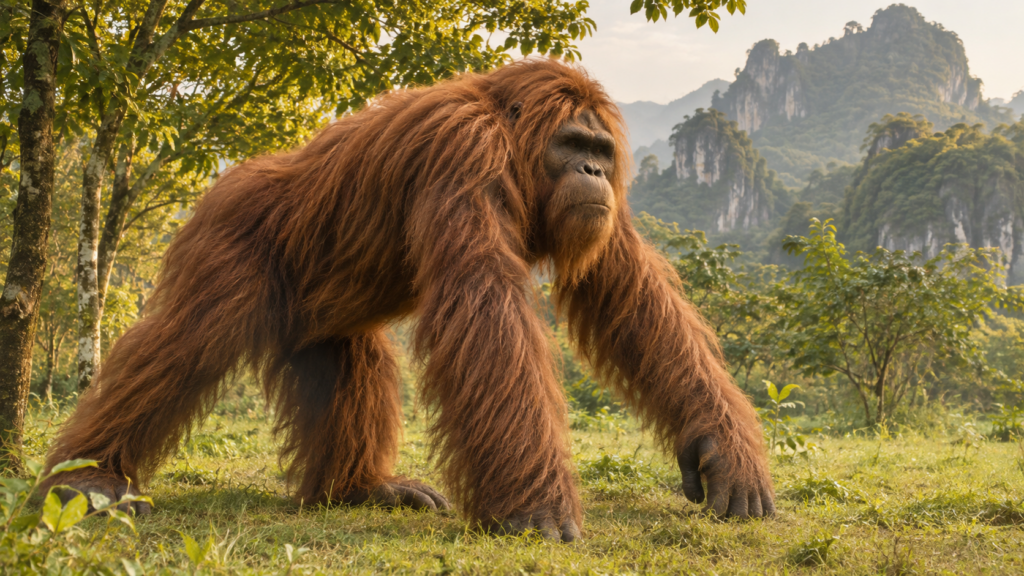
The height of about 3 m and weight of 200 to 300 kg are estimates based on the size of these teeth and jaws. Because there are no bones from below the neck, its build, and whether it walked upright or on all fours, are unknown. The estimates also vary widely; some put the height at 1.8 to 3 m and the weight at 200 to 500 kg.
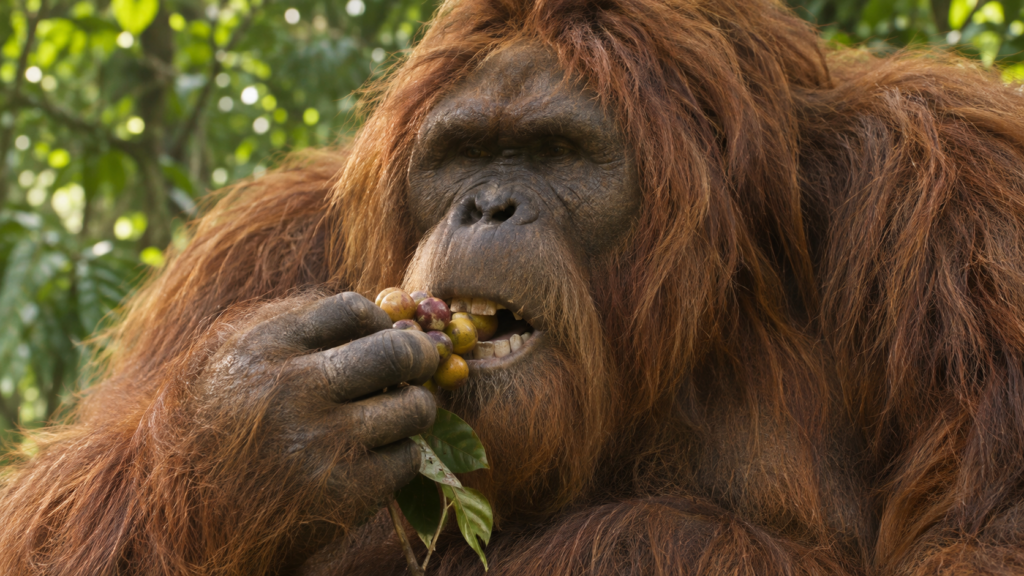
Its molars were large, with thick enamel. Wear on the teeth points to a plant diet rich in fruit, along with plenty of chewing on tough, fibrous vegetation. A study announced in 2016 by Hervé Bocherens and colleagues at the University of Tübingen in Germany examined carbon isotopes in the tooth enamel and concluded that Gigantopithecus was a strict plant eater that lived only in forests and did not specialize in bamboo.
It lived in subtropical country where forest and grassland were mixed. An orangutan species, Pongo weidenreichi, lived in the same region. In 2024, Zhang Yingqi of the Institute of Vertebrate Paleontology and Paleoanthropology, Chinese Academy of Sciences, and colleagues obtained 157 dates from 22 caves in southern China and reported that Gigantopithecus disappeared about 295,000 to 215,000 years ago. During that time the seasons became more pronounced, the forests gave way to more open woodland, and fruit became scarcer. The orangutans of the time changed their diet and behavior and survived, but Gigantopithecus came to rely on fibrous fallback foods; its teeth show signs of chronic stress, and its numbers declined.
Proteins inside a tooth revealed an orangutan relative
Working out the relationships of an animal with no skull and no body bones, using only the shapes of its teeth and jaws, was difficult. Its teeth resembled those of various apes in one way or another, and their shape did not settle which lineage it was closest to.
In 2019, Frido Welker of the University of Copenhagen in Denmark and colleagues looked at the molecules inside a tooth rather than its shape. They used a molar about 1.9 million years old from Chuifeng Cave in Guangxi, a site that has yielded 92 Gigantopithecus teeth. The team extracted proteins preserved in the molar’s enamel and read their amino acid sequences using mass spectrometry.
Comparing these sequences with those of living apes showed that Gigantopithecus was the sister group of the orangutan genus, and that the two shared a common ancestor about 12 to 10 million years ago. Gigantopithecus branched off early from the orangutan lineage.
Adjusted for the effects of temperature, the tooth is about five times older than any mammal sample whose proteins or genome had been read before. DNA is hard to recover from old fossils in warm regions, and the study showed that the relationships of such fossils can still be studied using enamel proteins.
Related products
You can find books and products related to this article on Amazon.
If you buy through the links above, this blog may earn a commission.
About the images
The images in this article are illustrations created with AI (ChatGPT), and you are welcome to use them. If you do, we would appreciate a link back to this article as the source.
Sources
Welker, F. et al. (2019). Enamel proteome shows that Gigantopithecus was an early diverging pongine. Nature 576, 262–265. https://doi.org/10.1038/s41586-019-1728-8
Zhang, Y., Westaway, K. E. et al. (2024). The demise of the giant ape Gigantopithecus blacki. Nature 625, 535–539. https://doi.org/10.1038/s41586-023-06900-0
Southern Cross University (2024). Disappearance of giant apes solved. https://scu.edu.au/news/2024/disappearance-of-giant-apes-solved
Universität Tübingen (2016). King Kong war unflexibel (press release in German on the study by Bocherens et al. in Quaternary International). https://uni-tuebingen.de/universitaet/aktuelles-und-publikationen/pressemitteilung/king-kong-war-unflexibel-1/
Bocherens, H. et al. (2017). Flexibility of diet and habitat in Pleistocene South Asian mammals: Implications for the fate of the giant fossil ape Gigantopithecus. Quaternary International 434, 148–155. https://doi.org/10.1016/j.quaint.2015.11.059

コメント