This article contains affiliate links. As an Amazon Associate I earn from qualifying purchases.
| Name | Diplodocus (Diplodocus; “double beam,” after the shape of the bones under the tail) |
| Classification | Reptilia, Saurischia, Sauropoda, Diplodocidae |
| Period | Late Jurassic (about 152 to 145 million years ago) |
| Found in | Western USA (Morrison Formation; Colorado, Wyoming, Utah and other states) |
| Length | About 26 m |
| Weight | Estimated at about 15 tonnes |
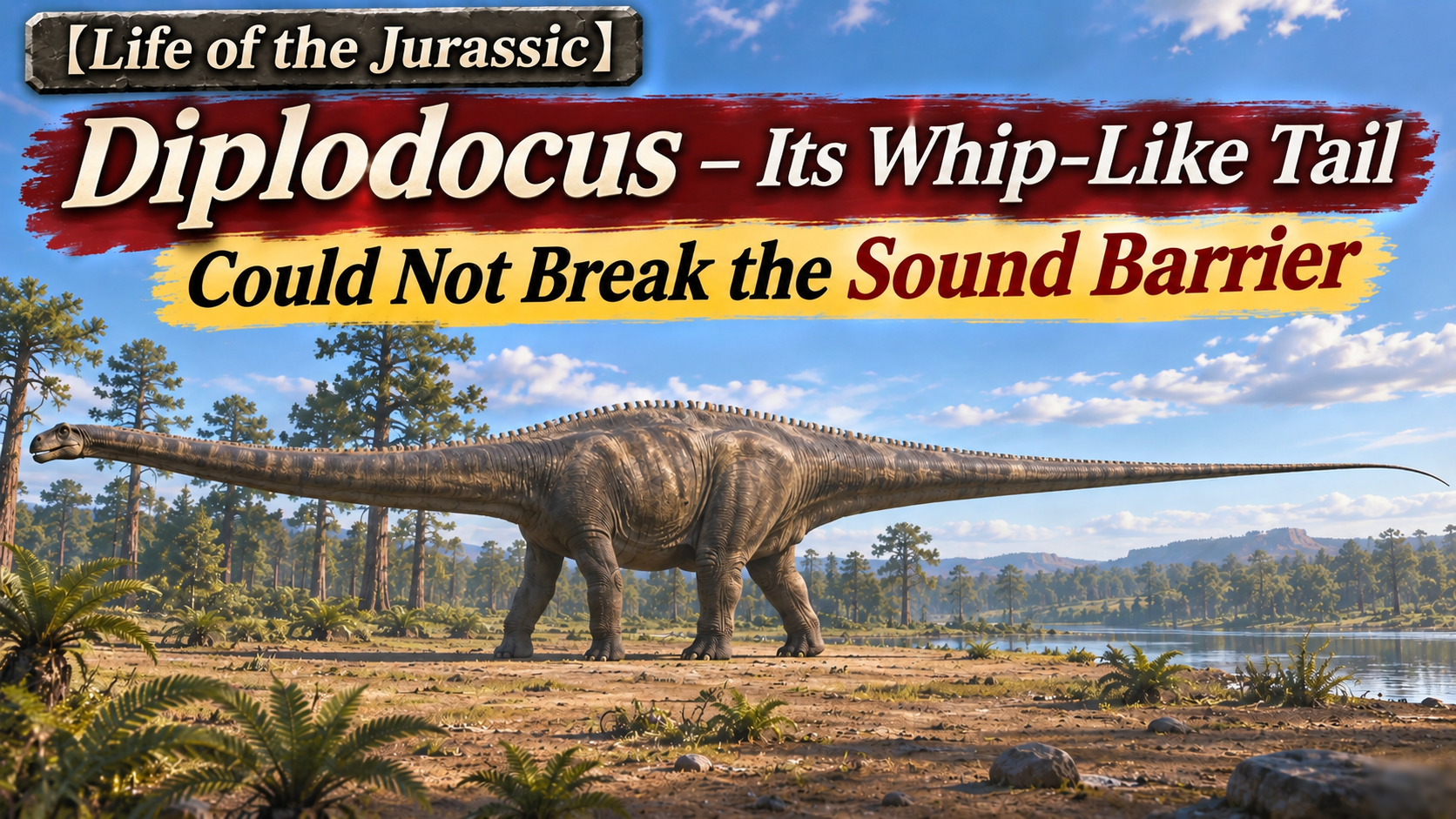
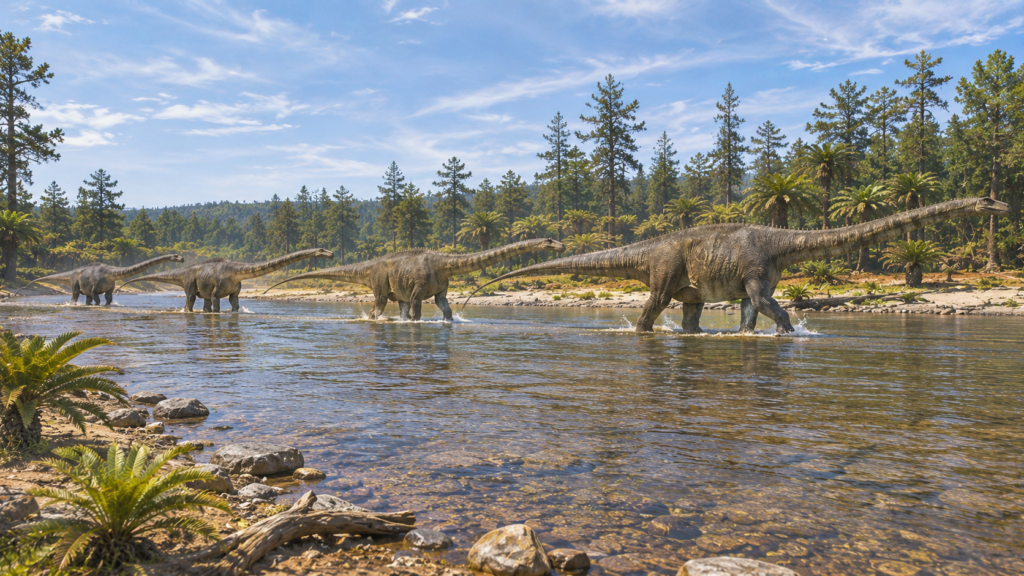
Diplodocus was a long-necked, long-tailed sauropod that lived in North America in the Late Jurassic. Most of its length was neck and tail, and the tail narrowed toward the end into a long string of slender, rod-like bones. In 1997 a calculation was published suggesting that, swung like a whip, the tip of this tail could break the speed of sound.
Appearance and Way of Life
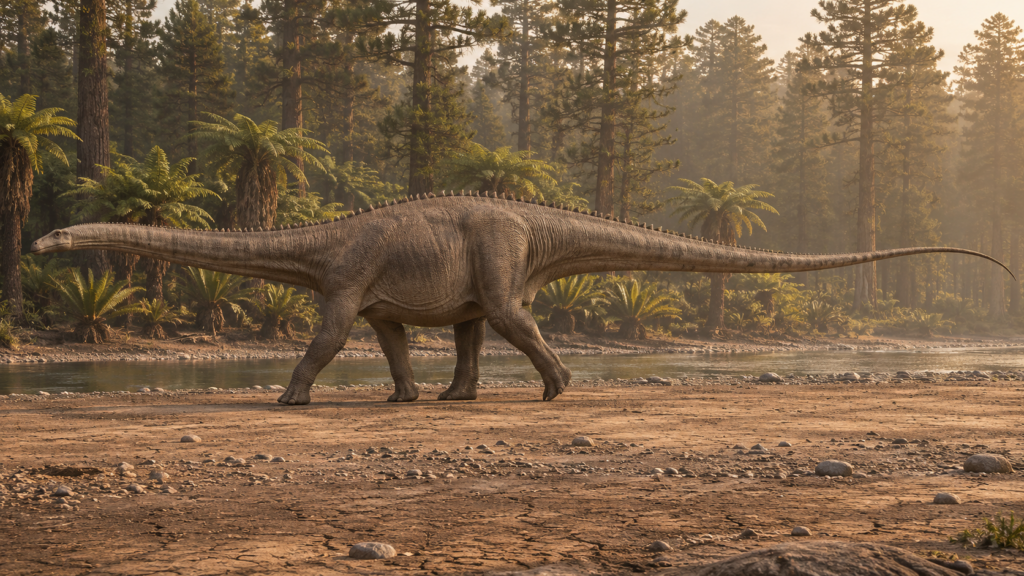
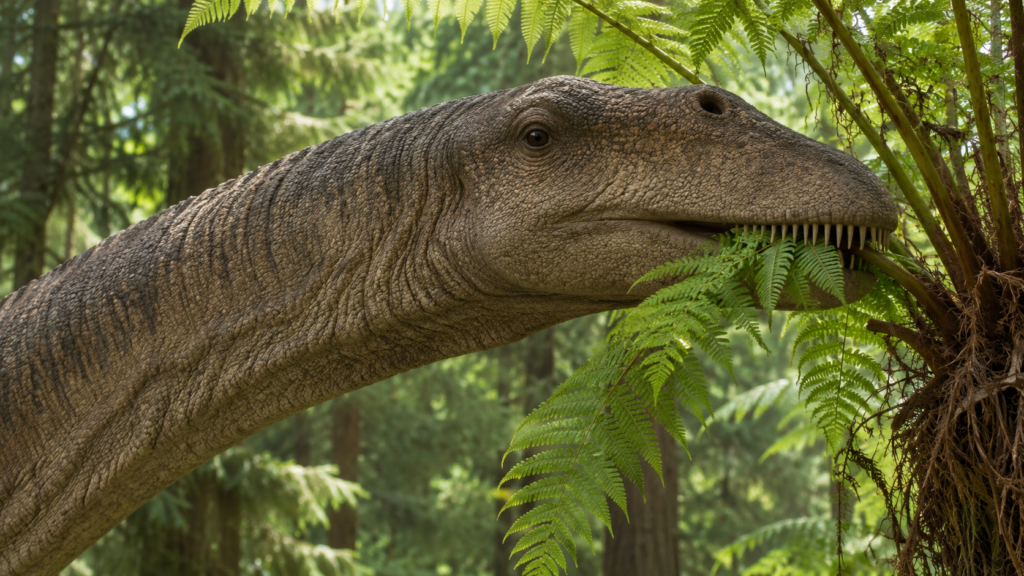
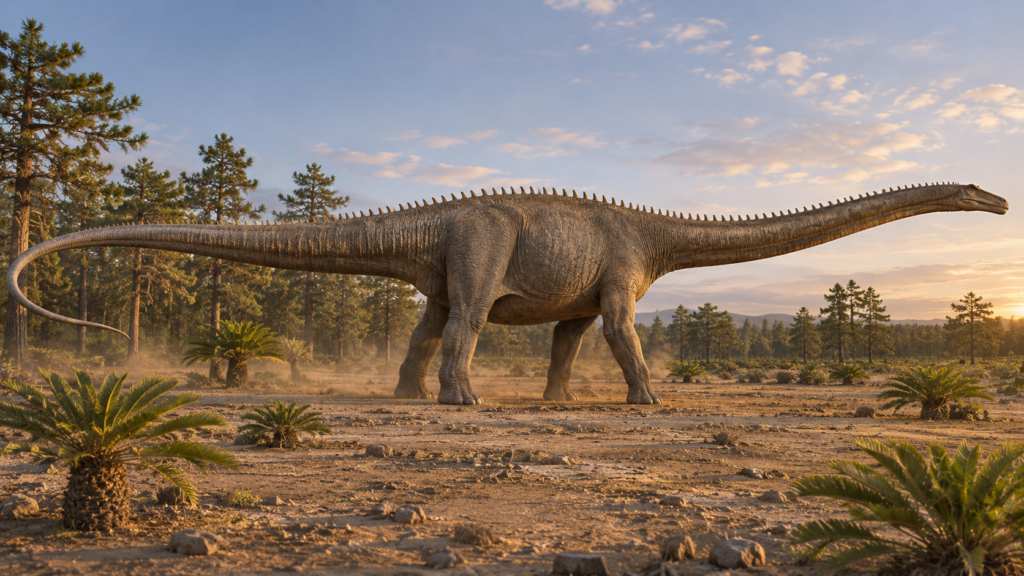
Diplodocus stood on four pillar-like legs, with its long neck stretched out in front and its long tail behind. Its head was small for its body, and the front of its mouth held thin, peg-like teeth set in a row like the teeth of a comb. It is thought to have used them to strip soft plants and leaves, both low to the ground and up in the trees. A row of narrow, pointed bony spines may have run along the midline of its back.
The view now favored is that the neck was held roughly level, supported by a ligament running from the hips to the back of the neck. The upper parts of the backbones are split down the middle, and the ligament is thought to have run through that gap. The tail did not drag on the ground either; it was held up. “Dippy,” the cast of a complete skeleton long displayed at the Natural History Museum in London, was remounted in 1993 with its tail lifted off the floor in light of this research.
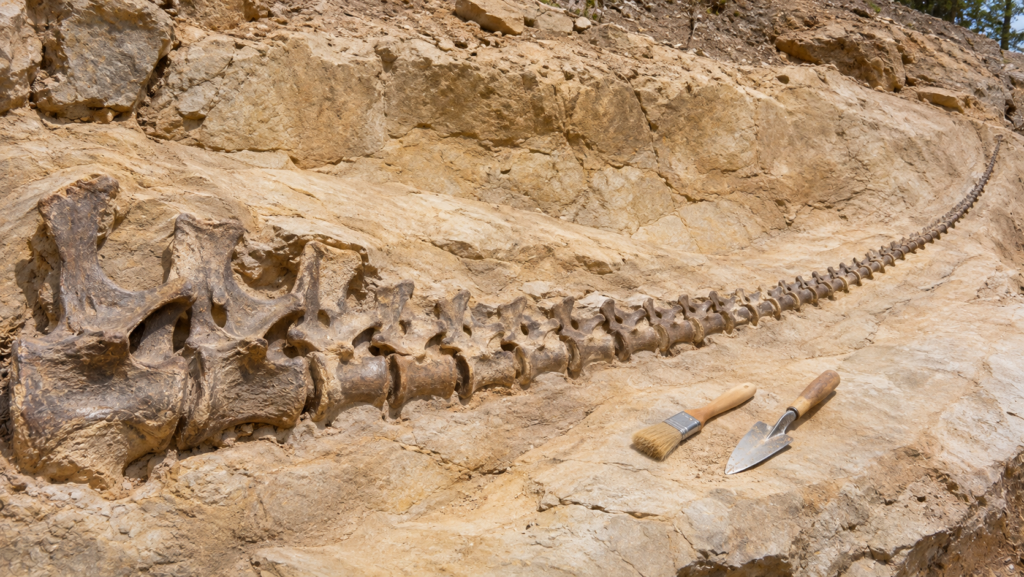
The name “double beam” refers to the chevrons, small bones attached to the underside of the tail vertebrae. In many other dinosaurs these bones are straight and pointed, but in Diplodocus they have two beams running forward and backward. Othniel Marsh of Yale named the animal Diplodocus longus in 1878, based on fossils found in 1877. Marsh thought this shape was unique to Diplodocus, but it was later found in many other sauropods as well.
All Diplodocus fossils so far come from the Morrison Formation, which spans several states in the western United States. At the time the land was a hot, dry plain with tree ferns and cycads, and the same rocks have yielded Allosaurus, Brontosaurus and Stegosaurus. Frogs, lizards, turtles and pterosaurs lived there too.
Diplodocus is also a dinosaur whose full skeleton can be seen, as a cast, in museums around the world. In 1899 a Carnegie Museum expedition funded by the industrialist Andrew Carnegie dug up a well-preserved skeleton at Sheep Creek, Wyoming. Carnegie had casts made of it and, in the early twentieth century, gave them to heads of state and royal courts in several countries. The London Dippy was one of them, donated in 1905.
Did the Whip-Like Tail Break the Sound Barrier?
The tail of Diplodocus and its relatives in the family Diplodocidae was made of roughly 80 vertebrae. About 10 large, complex bones form the base, followed by about 40 intermediate ones and finally about 30 slender, rod-like ones. No complete diplodocid tail has been found yet, and this count is estimated by piecing together partial fossils.
In 1997 Nathan Myhrvold and Philip Currie published a paper in a paleontology journal in which they modeled the motion of this kind of tail on a computer. The tail they modeled was that of Apatosaurus, a close relative of Diplodocus. A swing at the base traveled as a wave toward the thin tip, and the tip went supersonic, able to make a cracking sound like a bullwhip. Because the tails are built alike, they suggested other diplodocids could have done the same. As uses for the sound they proposed defense, communication, rivalry within the species and courtship. They also wrote that such a tail was poorly suited as a weapon for striking an opponent directly.
In 2022 a team including Simone Conti, Emanuel Tschopp and Octávio Mateus built a 3D model of an apatosaurine tail and recalculated its motion joint by joint. Under the same conditions as the 1997 study, a hypothetical soft tassel at the tip, the equivalent of the “popper” at the end of a whip, reached about 560 m/s, beyond the speed of sound of 340 m/s. But once friction in the muscles and joints and air drag were added, the tail tip topped out at 32.7 m/s. That is a little over 100 km/h, nowhere near the speed of sound.
The team also tested whether skin, tendons and ligaments could withstand the forces on a tail moving at the speed of sound. For every tissue and every shape they assumed, the tail could not take it and would have torn apart, with or without a popper-like structure. After this study, the diplodocid tail is thought to have been long and flexible but unable to crack at supersonic speed like a whip. What the tail was used for is still not settled.
Related products
You can find books and products related to this article on Amazon.
If you buy through the links above, this blog may earn a commission.
About the images
The images in this article are illustrations created with AI (ChatGPT), and you are welcome to use them. If you do, we would appreciate a link back to this article as the source.
Sources
Myhrvold, N. P. & Currie, P. J. (1997). Supersonic sauropods? Tail dynamics in the diplodocids. Paleobiology 23, 393–409. https://doi.org/10.1017/S0094837300019801
Conti, S., Tschopp, E., Mateus, O., Zanoni, A., Masarati, P. & Sala, G. (2022). Multibody analysis and soft tissue strength refute supersonic dinosaur tail. Scientific Reports 12, 19245. https://doi.org/10.1038/s41598-022-21633-2
Natural History Museum, London. Diplodocus (Dino Directory). https://www.nhm.ac.uk/discover/dino-directory/diplodocus.html


コメント