| Name | Cloudina (after the geologist Preston Cloud; the type species is Cloudina hartmannae) |
| Classification | Family Cloudinidae (phylum undetermined; the leading view places it among the bilaterians) |
| Age | Late Ediacaran (about 550 to 539 million years ago) |
| Found in | Namibia (Nama Group), plus China, Brazil, Spain, Oman, Canada, the United States and every continent except Antarctica |
| Size | Tube width 0.3 to 6.5 mm; length 1.5 mm to 15 cm. Most are about 1 to 2 cm long |
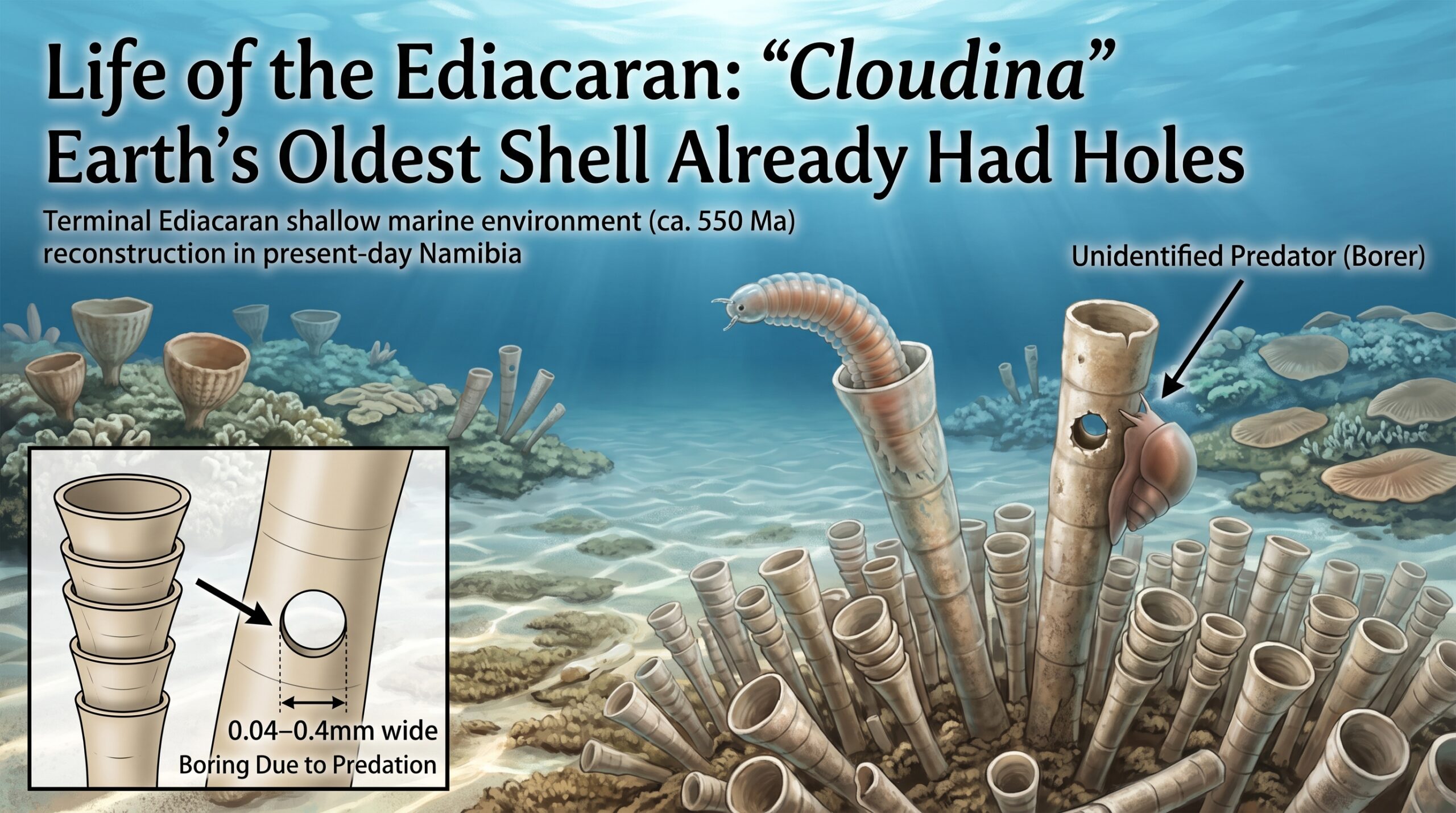
Cloudina was an animal that lived inside a slender tube in the shallow seas toward the end of the Ediacaran. Its tube, made of calcium carbonate, is among the oldest examples of an animal producing minerals with its own body — the first shell on Earth, in effect. And some of those shells survive as fossils with round holes gnawed through them by something else.
Form and way of life
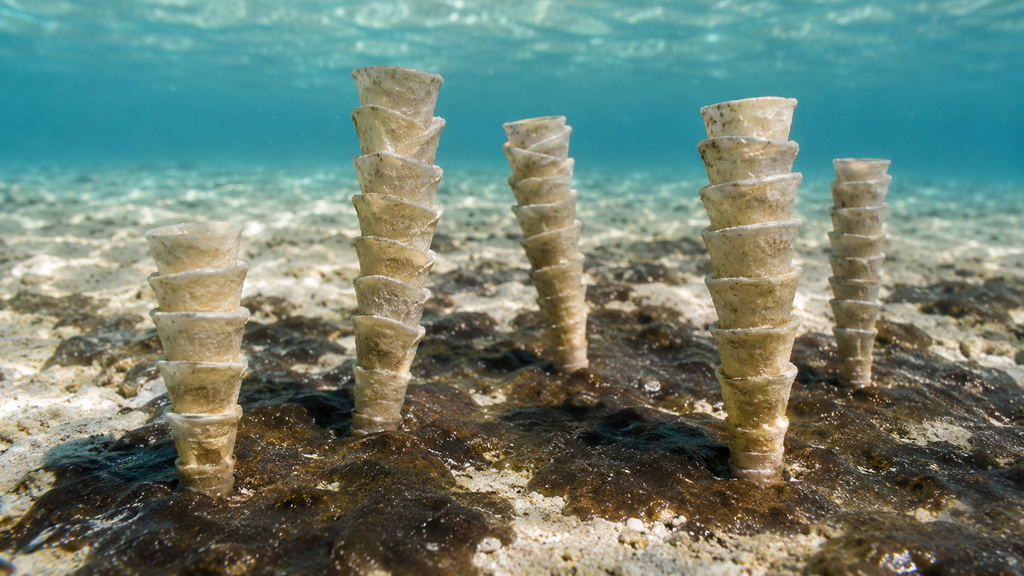
What survives as fossil is the tube alone. It is built from conical parts stacked one on another, like a series of funnels piled upward. The animal is thought to have kept its body inside the topmost funnel, adding a new funnel above each time it grew. The tube wall is extremely thin, only 0.01 to 0.05 mm thick. The material is calcite or aragonite, and it is known to have calcified on a foundation of organic layers secreted by the body while the animal was alive.
What kind of animal owned the tube went without clues for a long time. On the shape of the tube alone, proposals stood side by side: an annelid close to polychaete worms, or a cnidarian close to corals and sea anemones. In 2020, a study using CT to examine fossils of Cloudina-like tubes from strata in Nevada reported an elongate tubular structure preserved inside the tube. The team interpreted this as a gut running continuously from mouth to anus, placing the cloudinids among the bilaterians and, more specifically, close to the annelids. If that interpretation is right, it is also the oldest record of a fossilized gut.
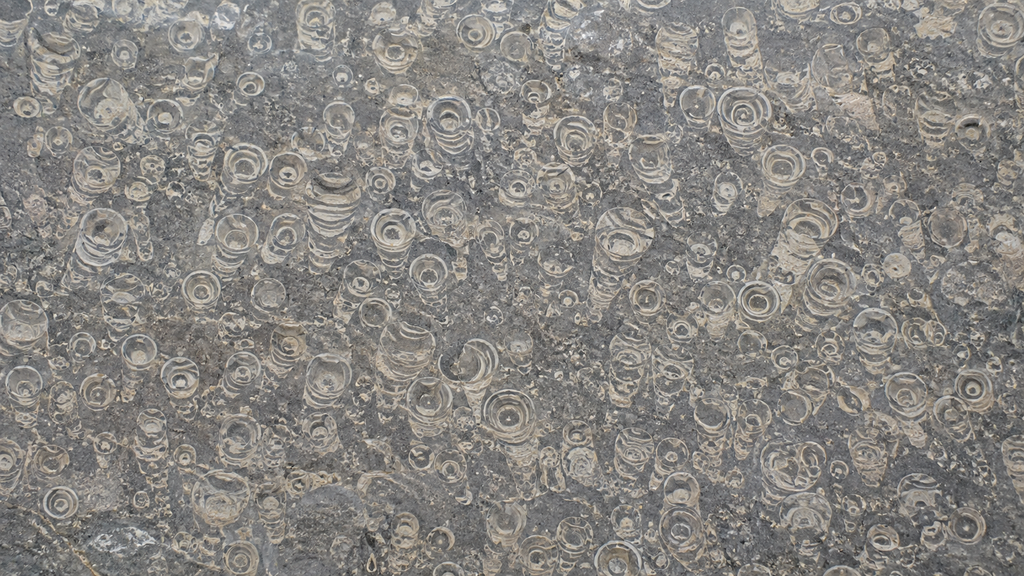
Cloudina lived on carbonate seafloor in shallow water within reach of light. The same strata yield other organisms with calcareous skeletons: Namacalathus, shaped like a wine cup, and Namapoikia, which built sheet-like skeletons. In places they stood densely packed on microbial mats, and in Namibia they occur in great quantity, filling the gaps in reefs built by microbes. It was once proposed that Cloudina itself built reefs, but a 2018 study that reconstructed dense accumulations in three dimensions by grinding the rock thin and photographing each surface concluded that the tubes are not joined to one another and represent drifts of dead material swept together.
Round holes in the shell
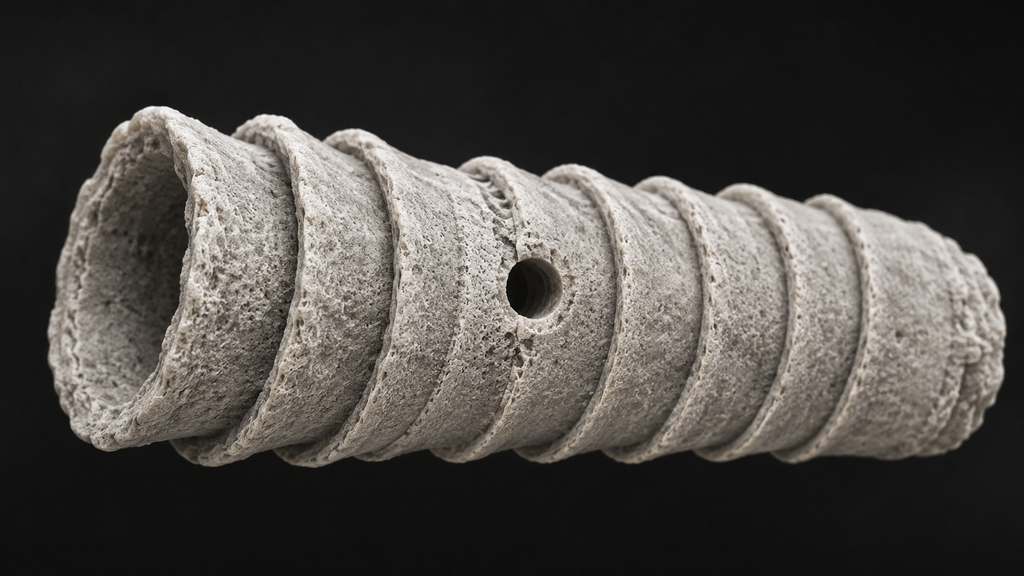
In 1992, Stefan Bengtson of Sweden and Zhao Yue of China examined over 500 Cloudina tubes recovered from strata in Shaanxi Province, China, and reported that 2.7 percent of them had round holes 0.04 to 0.4 mm across. The holes are cleanly circular at the rim, unlike cracks or dissolution marks. And their size was proportional to the width of the tube: small tubes had small holes, large tubes large ones — meaning whatever made them was sizing up its target. The two interpreted these as traces of predation by boring through the shell to eat the contents, and published them as the oldest evidence of predation in the fossil record.
In 2003, more specimens were reported from another site in the same province. There, close to one in five of about 100 Cloudina tubes examined bore holes 0.015 to 0.085 mm across, and the positions of the holes were aligned at roughly a constant distance from the tube’s opening. Meanwhile, Sinotubulites, another tubular organism occurring in the same strata, had no holes at all. The borer was selecting its prey by type, and the researchers who reported it suggest Sinotubulites may have had defenses such as an organic covering or a toxin. No fossil of the borer itself has yet been found. Since living snails have the same habit of drilling shells to eat the contents, a similar mollusk has been proposed, but there is no decisive evidence.
What drew attention to this discovery was the timing of the holes. The interval when animals began having hard shells and the interval when predators able to breach those shells appeared overlap within the same strata. Whether the shells came first on the defending side and the breachers caught up, or whether the pressure of being eaten was precisely what allowed shelled animals to survive, cannot be decided from fossils. But in the Cambrian, immediately after this age, animals with shells and spines appear all at once. The holes in Cloudina are, for now, the oldest trace showing that exchanges between eater and eaten already existed in the sea before that movement began.
Cloudina disappears at the start of the Cambrian, and the range over which these tubes occur in the strata is used as a marker for the close of the Ediacaran.
Sources
Germs, G. J. B. (1972). New shelly fossils from Nama Group, South West Africa. American Journal of Science.
https://doi.org/10.2475/ajs.272.8.752
Bengtson, S. & Zhao, Y. (1992). Predatorial borings in late Precambrian mineralized exoskeletons. Science.
https://doi.org/10.1126/science.257.5068.367
Hua, H., Pratt, B. R. & Zhang, L.-Y. (2003). Borings in Cloudina shells: Complex predator-prey dynamics in the terminal Neoproterozoic. Palaios.
The article page at Palaios (BioOne)
Mehra, A. & Maloof, A. (2018). Multiscale approach reveals that Cloudina aggregates are detritus and not in situ reef constructions. PNAS.
https://doi.org/10.1073/pnas.1719911115
Schiffbauer, J. D. et al. (2020). Discovery of bilaterian-type through-guts in cloudinomorphs from the terminal Ediacaran Period. Nature Communications.
https://doi.org/10.1038/s41467-019-13882-z

コメント