This article contains affiliate links. As an Amazon Associate I earn from qualifying purchases.
| Name | Coelophysis (Coelophysis; “hollow form,” after its hollow limb bones) |
| Classification | Reptilia, Saurischia, Theropoda, Coelophysidae |
| Period | Late Triassic (about 210 million years ago) |
| Found in | New Mexico, USA (Ghost Ranch and other sites) |
| Length | About 2 to 2.7 m |
| Hip height | About 90 cm |
| Weight | Estimated at about 27 kg |
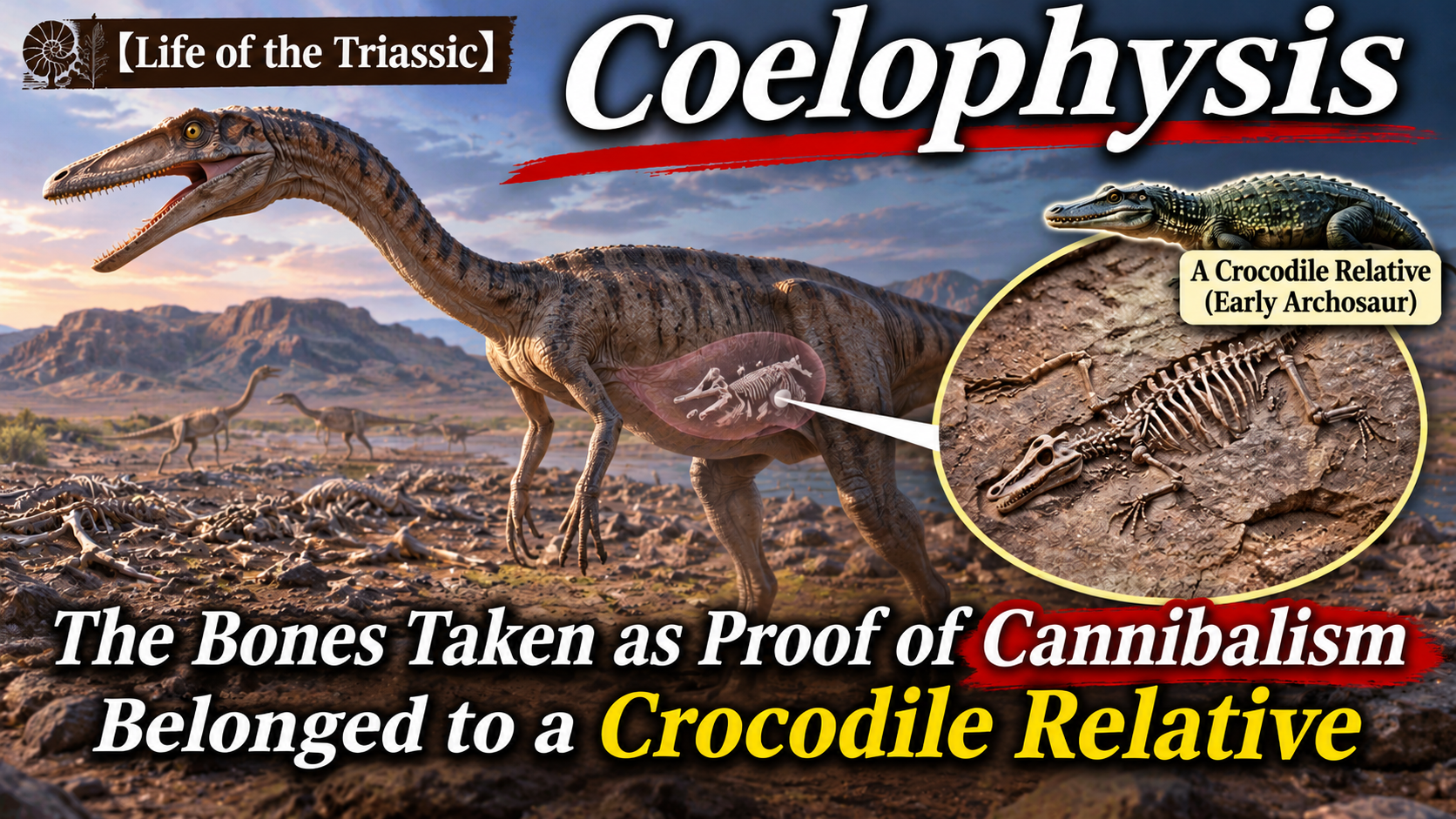
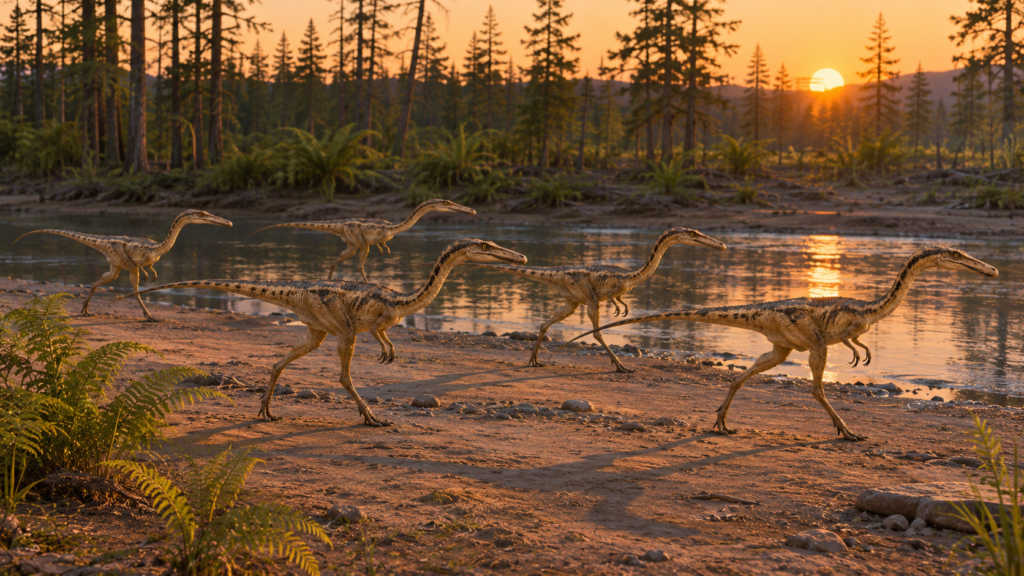
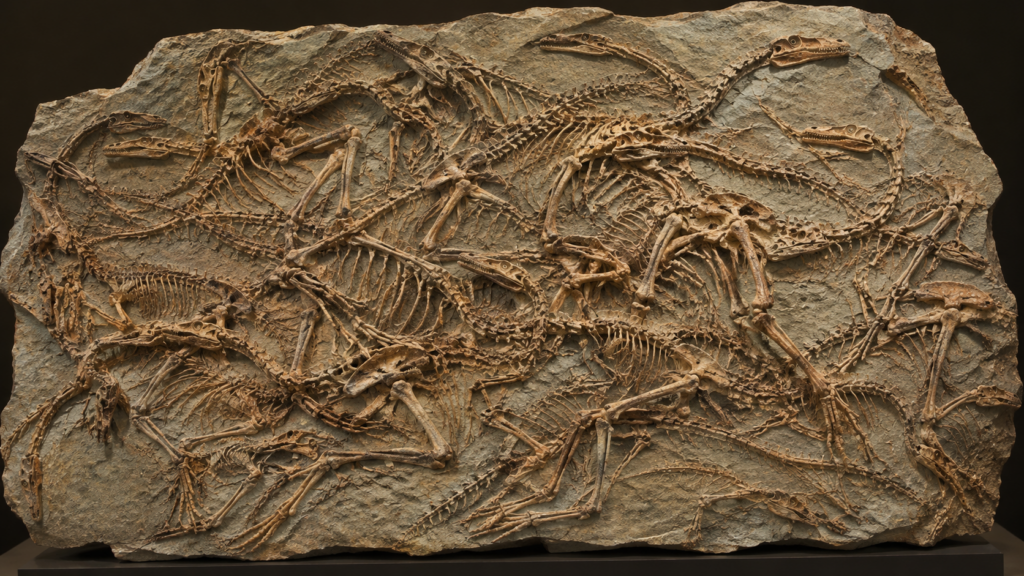
Coelophysis was a slender meat-eating dinosaur that lived in North America in the Late Triassic. At Ghost Ranch in New Mexico, skeletons of what may be more than a thousand individuals have been found piled together in a single spot. Small bones lying in the belly region of two of them were long held up as evidence that Coelophysis ate the young of its own kind.
Appearance and Way of Life
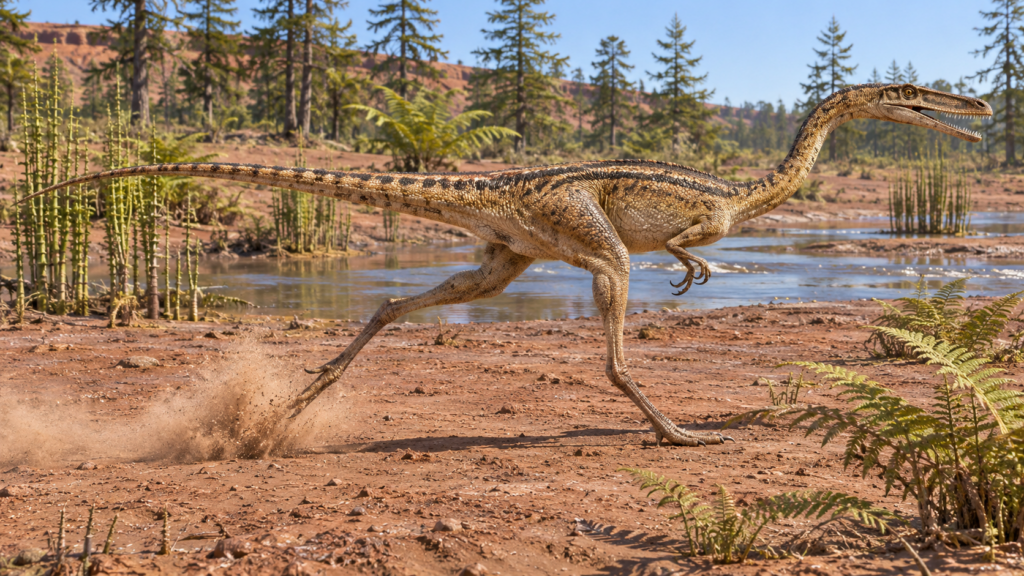
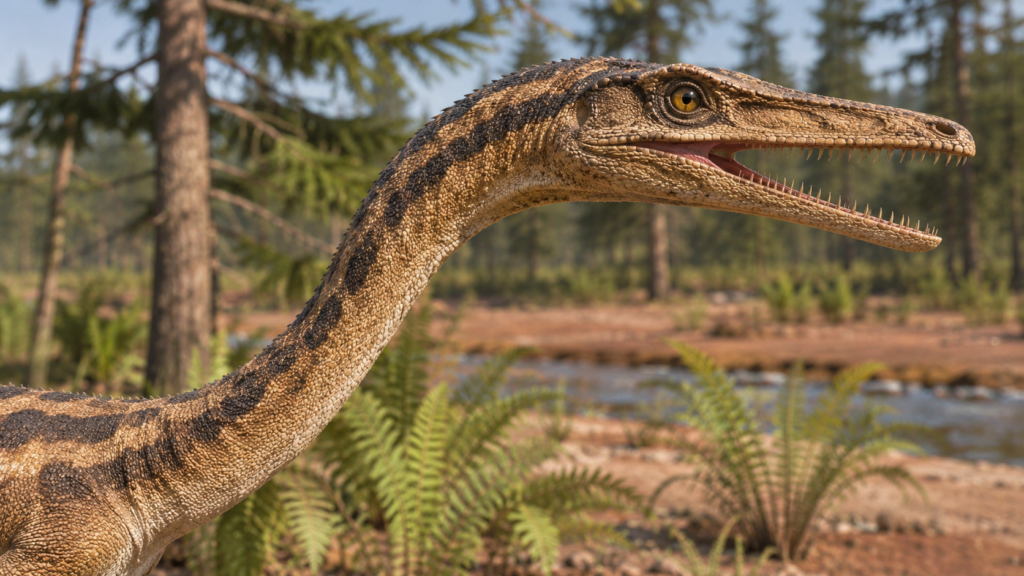
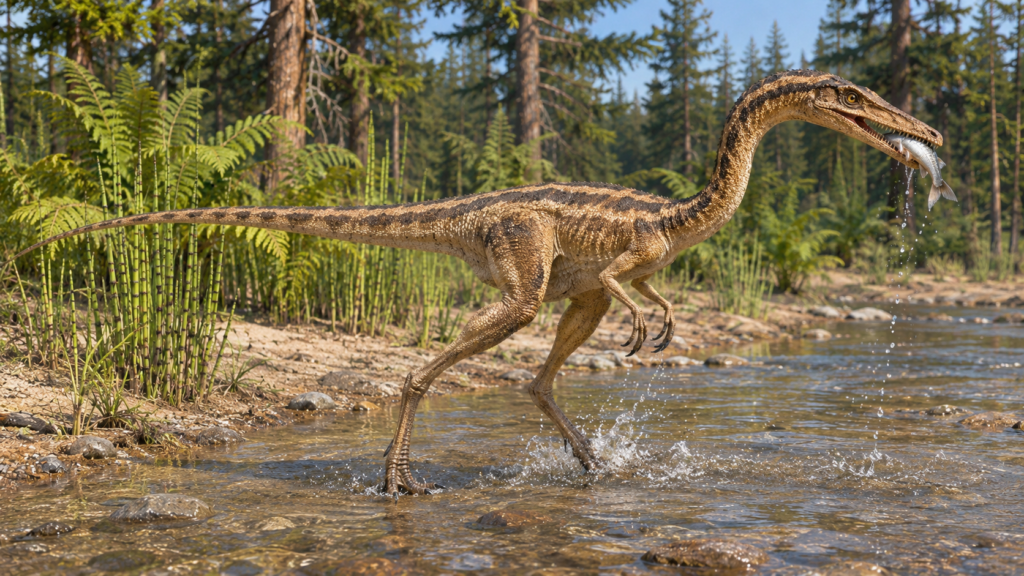
Coelophysis was a theropod that walked on its two hind legs. Its head was long and narrow, and its mouth held small teeth with finely serrated edges. Its long neck curved in an S shape, and its front limbs ended in small grasping hands. Its hind legs were long and slender, and so was its tail. The limb bones were hollow, which kept the body light. It is thought to have chased and eaten small, fast-moving prey.
The first fossils were collected in New Mexico in 1881. Edward Drinker Cope named the species in 1887, placing it in another genus, and created the new genus Coelophysis for it in 1889. Those original fossils were only fragments, however, and it was questioned whether they could be told apart from other dinosaurs. An application was made to replace them with a well-preserved skeleton found later at Ghost Ranch as the name-bearing specimen (the neotype), and the International Commission on Zoological Nomenclature approved it in 1996.
The Ghost Ranch fossils were found in 1947 by a team from the American Museum of Natural History led by Edwin Colbert. Skeletons of at least 1,000 individuals were reported from about 30 cubic metres of rock. The carcasses are thought to have been carried by river currents, piled up in a small channel and buried in mud. Drought and floods have both been suggested as the cause of the mass death, and the leading view is that the animals died in a single catastrophic event.
With so many skeletons, Coelophysis has also been used to study growth and variation. Some individuals are heavily built and others slender, and the two forms were once taken to be males and females. A 2016 study of 174 specimens, however, found that they do not divide into two groups, and that body size does not line up with how far an individual had grown toward maturity.
Coelophysis was named the state fossil of New Mexico in 1981. In 1998 a skull from the Carnegie Museum of Natural History was carried aboard the Space Shuttle Endeavour to the Russian space station Mir, making it the second dinosaur to go into space.
The “Juveniles” in the Belly Were Crocodile Relatives
Two of the Ghost Ranch skeletons at the American Museum of Natural History (specimens AMNH 7223 and 7224) had small bones in the belly region. Colbert took them to be the bones of young Coelophysis and presented them as evidence that Coelophysis ate the young of its own kind. The story spread through books and exhibits, and Coelophysis became the standard example of a cannibal dinosaur.
In 2006, Sterling Nesbitt and colleagues at the American Museum of Natural History and other institutions re-examined the bones of both skeletons. AMNH 7224, which is also the neotype, has an intact belly region, and its contents really do sit where the stomach was. Compared bone by bone, though, they belonged not to Coelophysis but to an early crocodylomorph, a distant relative of crocodiles that lived at the same time. A thin section of a thigh bone viewed under the microscope showed that it had grown the way crocodylomorph bone grows.
In the other skeleton, AMNH 7223, the bones in question lie outside the ribcage, not inside it. The adult skeleton had simply come to rest on top of small bones that were already there, and the team judged that they had not been eaten. The small bones were too poorly preserved to say what animal they came from. Even before this, it had been pointed out that swallowing a juvenile’s entire hind leg whole seemed unlikely.
The study left neither of the two “cannibal” specimens standing. Researchers at the New Mexico Museum of Natural History and Science, however, reported in 2005 that fossil droppings from the same Ghost Ranch rock contained hand bones that appear to belong to young Coelophysis. Whether Coelophysis practised cannibalism is still debated, now over evidence other than the bones in the belly.
Related products
You can find books and products related to this article on Amazon.
If you buy through the links above, this blog may earn a commission.
About the images
The images in this article are illustrations created with AI (ChatGPT), and you are welcome to use them. If you do, we would appreciate a link back to this article as the source.
Sources
Nesbitt, S. J., Turner, A. H., Erickson, G. M. & Norell, M. A. (2006). Prey choice and cannibalistic behaviour in the theropod Coelophysis. Biology Letters 2, 611–614. https://doi.org/10.1098/rsbl.2006.0524
Schwartz, H. L. & Gillette, D. D. (1994). Geology and taphonomy of the Coelophysis quarry, Upper Triassic Chinle Formation, Ghost Ranch, New Mexico. Journal of Paleontology 68, 1118–1130. https://doi.org/10.1017/S0022336000026718
Griffin, C. T. & Nesbitt, S. J. (2016). Anomalously high variation in postnatal development is ancestral for dinosaurs but lost in birds. PNAS 113, 14757–14762. https://doi.org/10.1073/pnas.1613813113
Bugos, J. E. & McDavid, S. N. (2024). Juvenile skulls of Coelophysis bauri from Ghost Ranch, New Mexico. Acta Palaeontologica Polonica 69, 549–564. https://doi.org/10.4202/app.01085.2023
ScienceDaily (2006). Dinosaur cannibalism? Not so fast. https://www.sciencedaily.com/releases/2006/10/061002082945.htm
New Mexico Geological Society. Rinehart, L. F., Hunt, A. P., Lucas, S. G. & Heckert, A. B. (2005). Meeting abstract on coprolites and juvenile Coelophysis bones. https://nmgs.nmt.edu/meeting/abstracts/view.cfm?aid=1055
New Mexico Secretary of State. State Fossil. https://www.sos.nm.gov/about-new-mexico/state-fossil
Carnegie Magazine (1998). Carnegie Museum skull flown to Mir aboard the Space Shuttle. https://carnegiemuseums.org/magazine-archive/1998/marapr/feat1.htm
Natural History Museum, London. Coelophysis (Dino Directory). https://www.nhm.ac.uk/discover/dino-directory/coelophysis.html

コメント