This article contains affiliate links. As an Amazon Associate I earn from qualifying purchases.
| Name | Eurypterus (Eurypterus, meaning “broad wing” or “broad fin”; the species name of the type species, remipes, means “oar foot”) |
| Classification | Arthropoda, Chelicerata, Eurypterida, Eurypteridae |
| Age | Silurian (about 432 to 418 million years ago). The best-known fossil beds date to the very end of the Silurian, about 420 million years ago |
| Where found | Mainly New York State, USA; also Ontario (Canada), Norway, Estonia, Ukraine and elsewhere |
| Length | Usually 13 to 23 cm. The largest individuals are estimated at around 60 cm |
| Known specimens | More than 90 percent of all eurypterid fossils ever found |
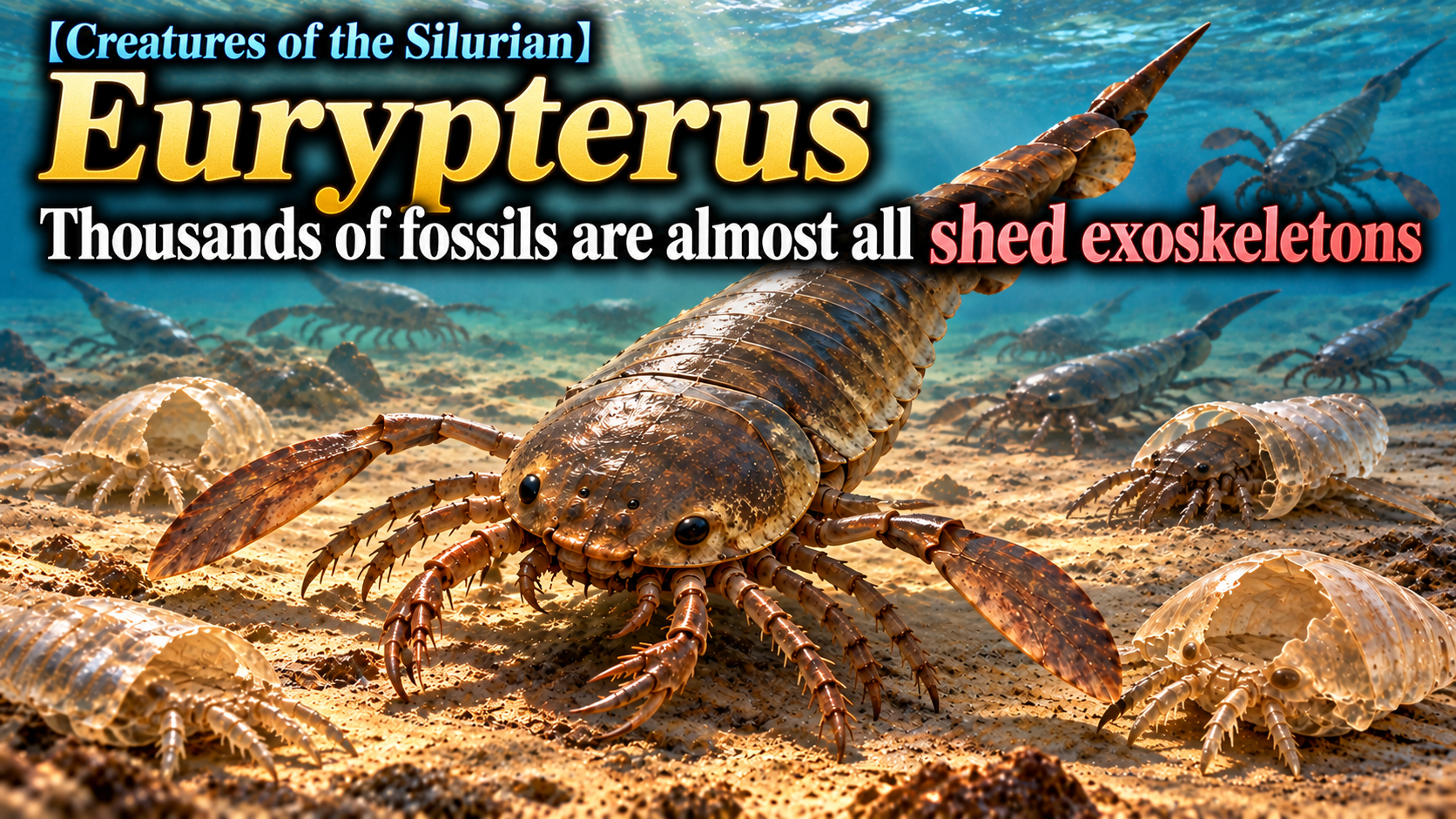
Eurypterus was a sea scorpion that lived in the shallow seas of the Silurian. It has yielded more fossils than any other member of the group known as sea scorpions, and most of the “sea scorpions” drawn in field guides and displayed in museums are based on this genus. In 1984 it was designated the official State Fossil of New York. Rock layers running from New York State into Ontario, Canada, have produced specimens by the thousands, but the great majority of them are not dead animals. They are the shells left behind after molting.
Appearance and Way of Life
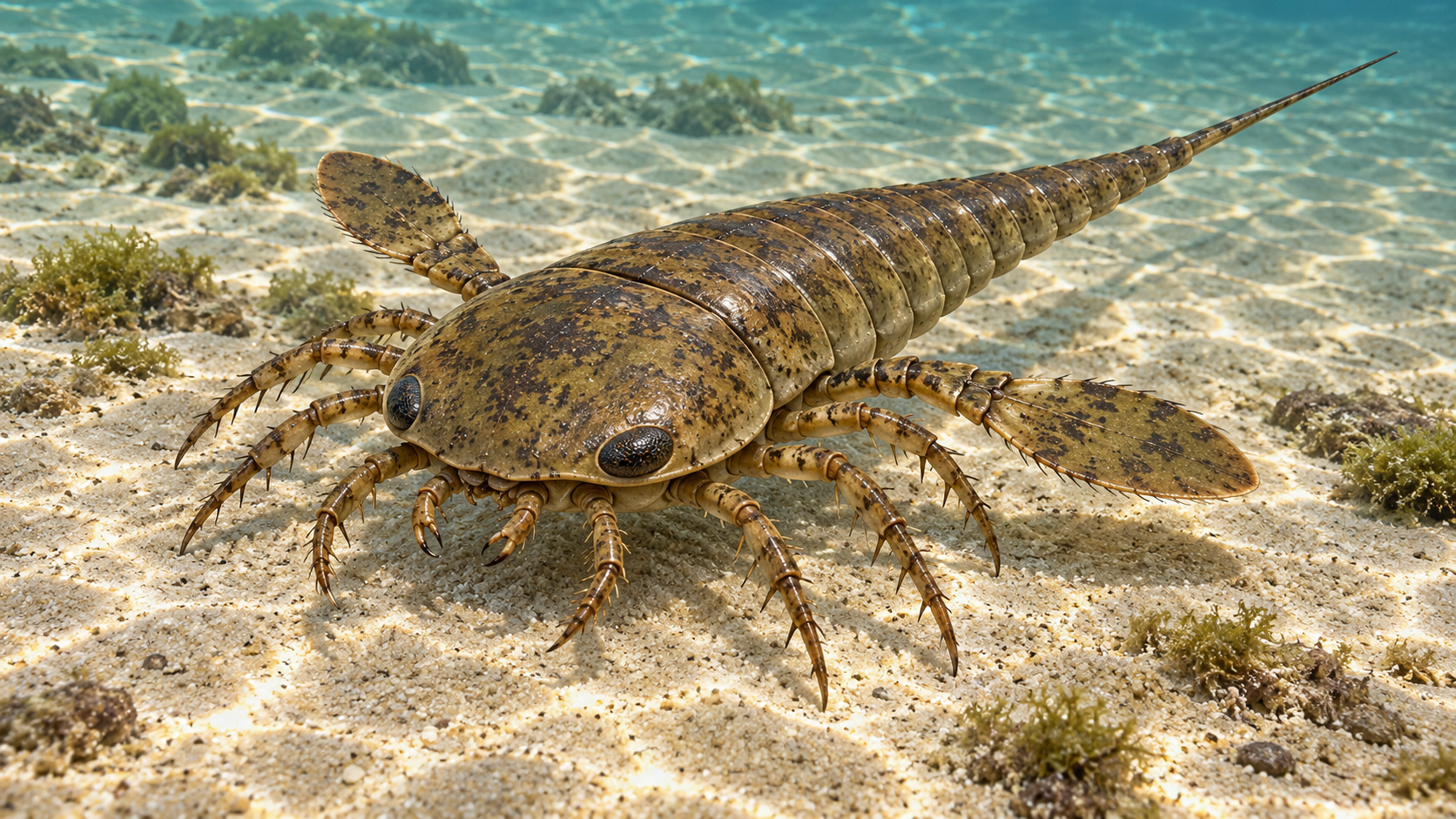
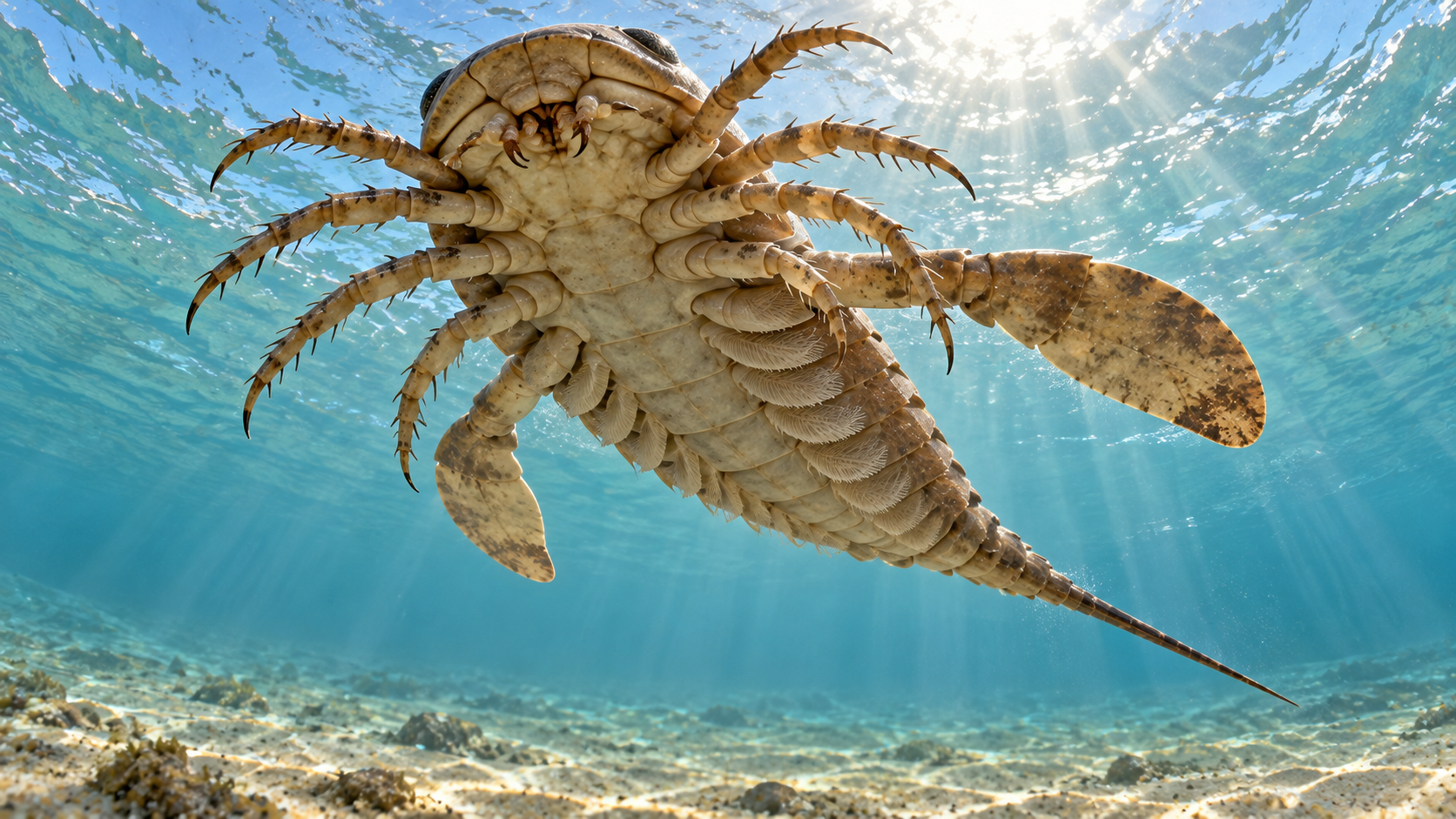
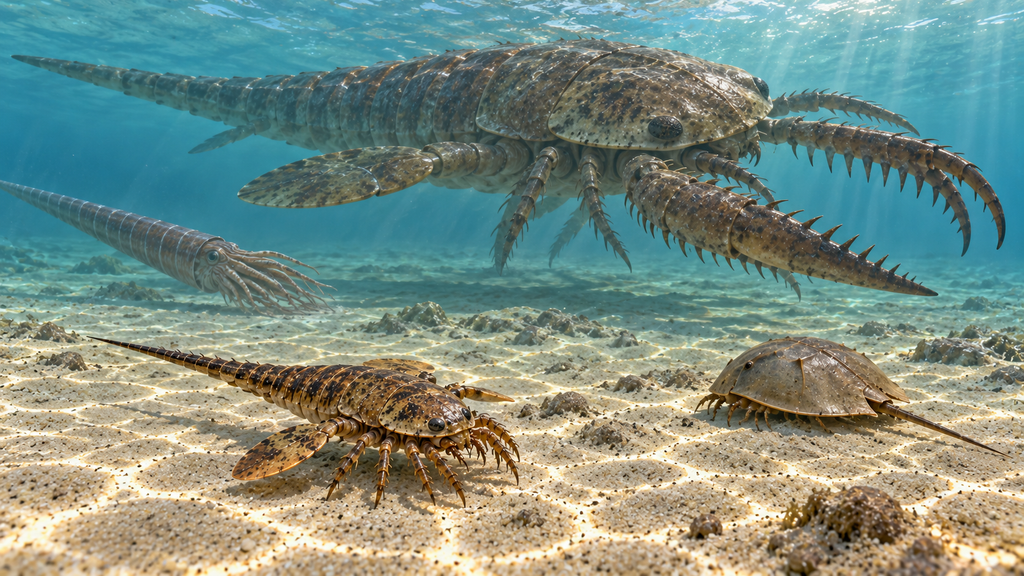
The body looks like a horseshoe crab’s shell stretched out from front to back. The front half, the prosoma, is covered by a semicircular shield that carries a pair of large compound eyes and two small simple eyes. The rear half is an abdomen of twelve segments, broad at the front and tapering toward the back, ending in a spear-like pointed spine called the telson. The shape of this telson, which recalls a scorpion’s tail, is where the name “sea scorpion” comes from. It was not a venomous sting, however; it is thought to have served as a rudder and for keeping the body stable.
Beneath the prosoma are six pairs of appendages. The frontmost pair are small pincers, the chelicerae, used for picking up food at the mouth. The next four pairs are spiny walking legs. The last pair are broad, flat and oar-shaped, and these are the “broad fins” of the scientific name. The animal is reconstructed as rowing itself through the water with these paddles while spending most of its time walking across the sea floor.
Because its chelicerae were small, Eurypterus is not thought to have been a predator that took large prey. The same beds also yield small horseshoe crabs, marine scorpions and algae, and the usual view is that it fed on small invertebrates on the sea floor and on carrion. Other sea scorpions of the same age, such as the pterygotids with their huge claws, were large predators, but Eurypterus belonged to a different, small and very ordinary kind.
Its breathing organs are also distinctive. On the underside of the abdomen it had book gills, gills built like the pages of a book, and some studies conclude that it also had a separate tissue that allowed it to breathe in air for short periods. This double system is taken as evidence that the animal could walk short distances along the water’s edge, which bears on the reconstruction of its behavior described below.
The Shallow Lagoons of New York
The richest source of Eurypterus fossils is the Bertie Group, a set of rock layers that stretches from New York State into Ontario, Canada. They were laid down about 420 million years ago, near the end of the Silurian, when this region lay close to the equator. The rock is mostly dolomite, a carbonate rock, and it contains the imprints of salt crystals and cracks left by drying mud. The setting is interpreted as shallow lagoons and tidal flats under the influence of the tides, where the water sometimes became saltier than the open sea.
This environment has a lot to do with how well Eurypterus is preserved. In very salty water, the bacteria that break down carcasses and shed shells, and the burrowing animals that churn up the sea floor, are held in check. As a result, an exoskeleton made of chitin, a material that normally does not survive, was preserved in such detail that the spines on the legs and the structure of the gills can still be seen. The same beds also contain Cooksonia, one of the earliest land plants.
The first fossil from these layers was found in 1818. Its discoverer took it for a fish related to the catfish, and it was not correctly described as an arthropod until seven years later, in 1825. That is when the genus name Eurypterus was given. It marks the first step toward scientific recognition of the sea scorpions as a group.
Most of the Fossils Are Shed Shells
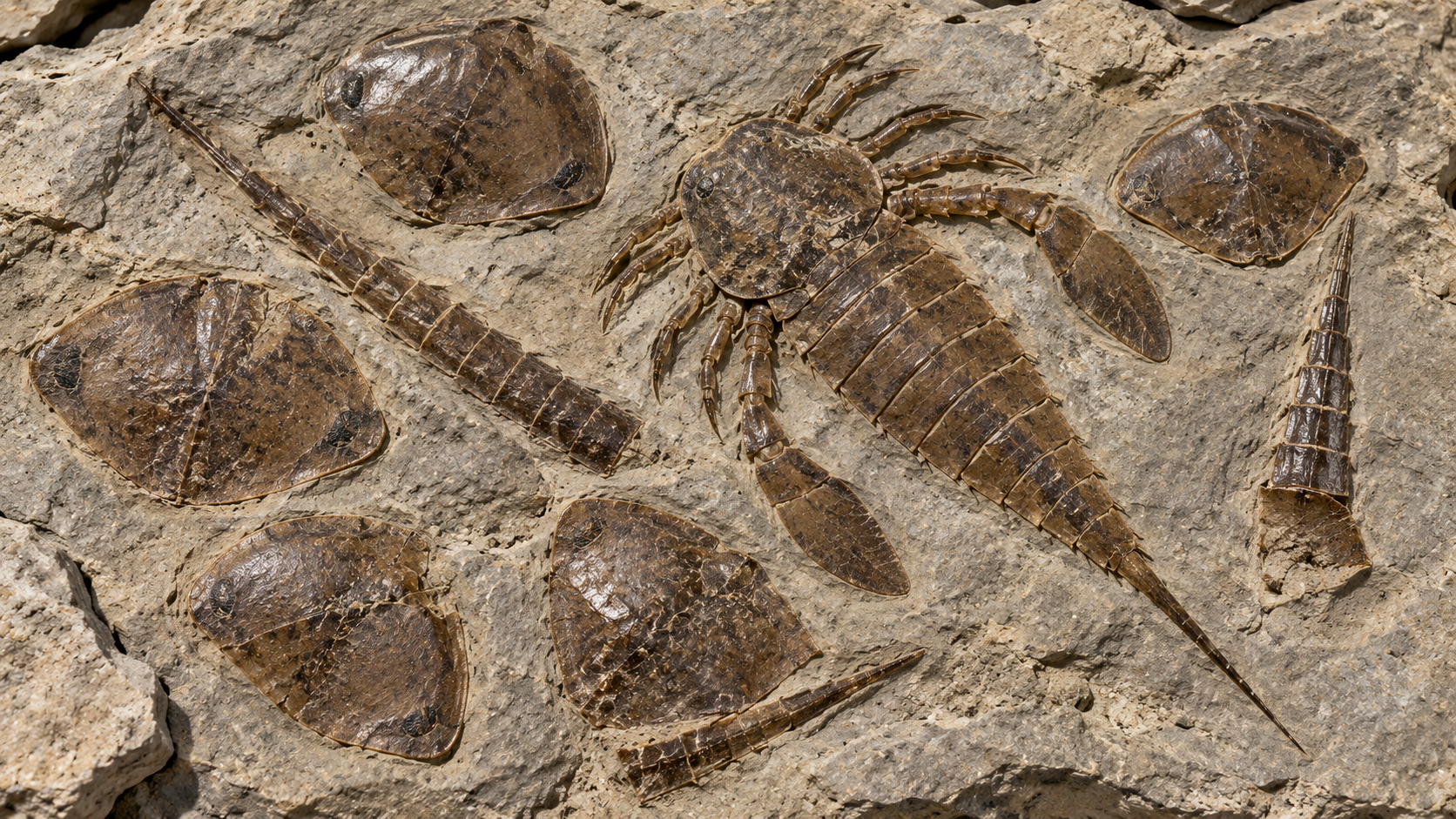
Eurypterus fossils from the Bertie Group are unusually abundant for sea scorpions, and a single rock surface may carry the remains of many individuals side by side. Whether these masses of fossils were accumulations of dead animals or shells cast off during molting has been a question since the early twentieth century.
Today there is agreement that almost all of them are molts. In 2011, Matthew Vrazo and Simon Braddy of the University of Bristol examined 632 specimens collected from three quarries in New York State and Ontario and reported that only one could be judged a carcass. Arthropods cast off their exoskeleton each time they grow. Eurypterus is thought to have molted the way horseshoe crabs do: the rim of the head shield split open and the animal crawled out forward. The shells left behind are often found with only the head shield and the first abdominal segment still joined together. This pattern of breakage shows that the shells were not broken up by tides and waves but came apart as a direct result of molting.
There is also a bias in how complete the shells are. In another study, of 1,771 body parts collected at Passage Gulf in New York State, only five percent were whole specimens. The interpretation is that separate pieces, a head shield here and a tail spine there, were swept by tidal currents into shallow hollows, where they piled up and became fossils.
This raises a question. If molted shells are everywhere, why are there almost no individuals that died during or just after molting? For an arthropod, molting is one of the most dangerous moments in life, and in living horseshoe crabs and scorpions, death during the molt is not rare. The idea put forward to explain this imbalance is that Eurypterus moved into the shallows in groups in order to molt and breed.
Moving into the Shallows in Groups
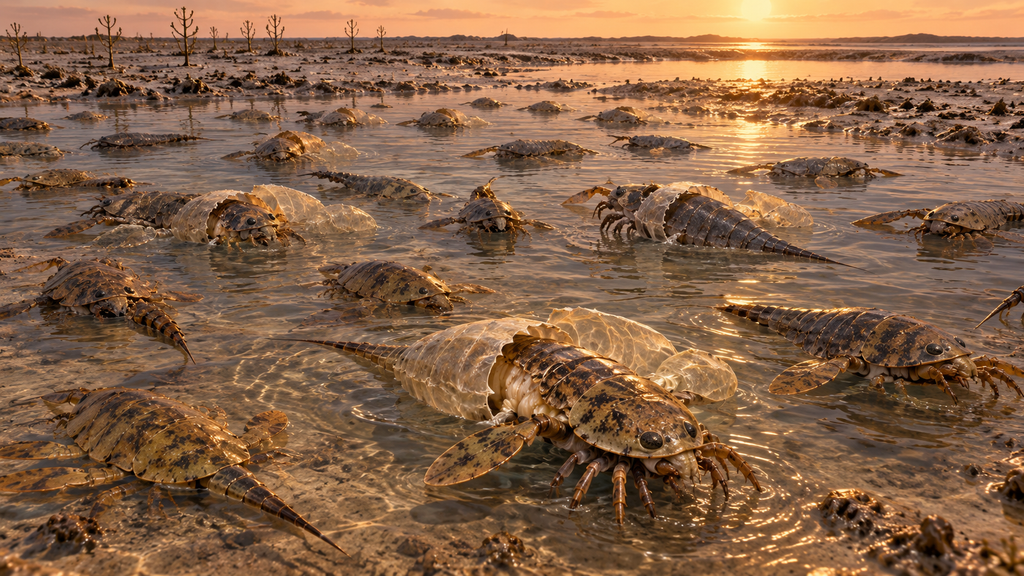
Braddy proposed this idea in 2001 as the “mass-moult-mate hypothesis.” Living horseshoe crabs come ashore once a year, in huge numbers and at a set time, to spawn on the beach. The suggestion is that sea scorpions did much the same: they left the deeper offshore water where they normally lived, moved in groups into shallow lagoons where predators were few, mated and molted there, and then returned.
There are several lines of evidence. The first is the mass accumulation of molted shells itself. In Early Devonian rocks of northern India, large numbers of sea scorpion trackways all heading in the same direction were made within a short span of time, and these are regarded as evidence of movement in groups. The organs that allowed brief breathing in air mean the animals could cross stretches of water left shallow by the falling tide and enter the lagoons. And the structure of their reproductive organs is close to that of scorpions, which is consistent with gathering at particular places to mate.
Vrazo and Braddy’s 2011 study was an attempt to test this hypothesis with numbers. At horseshoe crab breeding grounds, many males crowd around each female, so males make up a high proportion of the animals present. If sea scorpions behaved the same way, their molted shells should also be mostly male. Instead, among the 74 specimens whose sex could be determined, the type of reproductive organ assigned to females was significantly more common at every locality. Perhaps, after gathering, the males returned to deeper water first, while the females stayed in the shallows until they had laid their eggs and then molted. In light of this result, the study revised the hypothesis to a sequence of mating, spawning and then molting, all in groups.
This conclusion comes with a caveat. The assignment itself, which of the two types of reproductive organ belongs to males and which to females, has been challenged by other researchers who suggest it may be the other way around. If the assignment is reversed, males become the majority, just as in living horseshoe crabs, and the story changes again. The difficulty of reconstructing the breeding behavior of an extinct animal from fossils is laid bare at this one point.
Either way, most of the Eurypterus specimens lined up in museum cases are not the remains of dead animals but the shells that living individuals left behind as they grew a size larger. New York’s State Fossil is also a record of molting seasons repeated, year after year, in shallow lagoons 420 million years ago.
Related products
You can find books and products related to this article on Amazon.
If you buy through the links above, this blog may earn a commission.
Sources
Vrazo, M. B. & Braddy, S. J. (2011). Testing the ‘mass-moult-mate’ hypothesis of eurypterid palaeoecology. Palaeogeography, Palaeoclimatology, Palaeoecology, 311, 63–73.
https://doi.org/10.1016/j.palaeo.2011.07.031
Braddy, S. J. (2001). Eurypterid palaeoecology: palaeobiological, ichnological and comparative evidence for a ‘mass-moult-mate’ hypothesis. Palaeogeography, Palaeoclimatology, Palaeoecology, 172, 115–132.
https://doi.org/10.1016/S0031-0182(01)00274-7
Tetlie, O. E., Tollerton, V. P. & Ciurca, S. J. (2007). Eurypterus remipes and E. lacustris (Chelicerata: Eurypterida) from the Silurian of North America. Bulletin of the Peabody Museum of Natural History, 48, 139–152.
https://doi.org/10.3374/0079-032X(2007)48[139:ERAELC]2.0.CO;2
Ruebenstahl, A., Mongiardino Koch, N., Lamsdell, J. C. & Briggs, D. E. G. (2024). Convergent evolution of giant size in eurypterids. Proceedings of the Royal Society B.
https://pmc.ncbi.nlm.nih.gov/articles/PMC11330558

コメント