| Name | Ottoia, after Otto Pass, northwest of the Burgess Shale. The species name prolifica means “prolific,” from the abundance of specimens |
| Classification | A stem group within the priapulid lineage |
| Age | Middle Cambrian (about 508 million years ago) |
| Found in | The Burgess Shale in British Columbia, Canada. Microfossil teeth come from across a wide area of the Western Canada Sedimentary Basin |
| Length | 1 to 15 cm (mostly around 8 cm) |
| Way of life | Burrowed in seafloor mud, preying on small animals and scavenging carcasses |
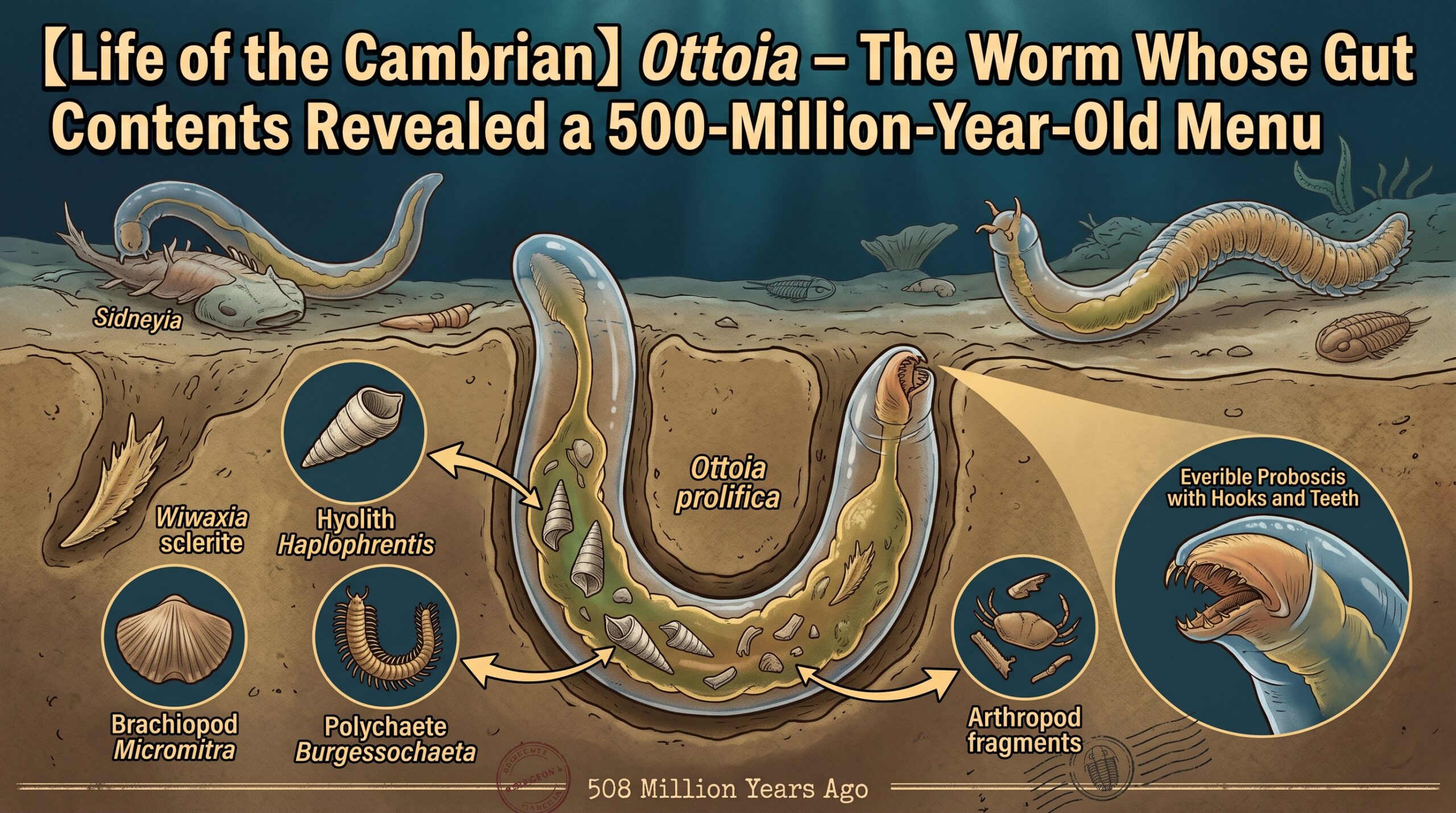
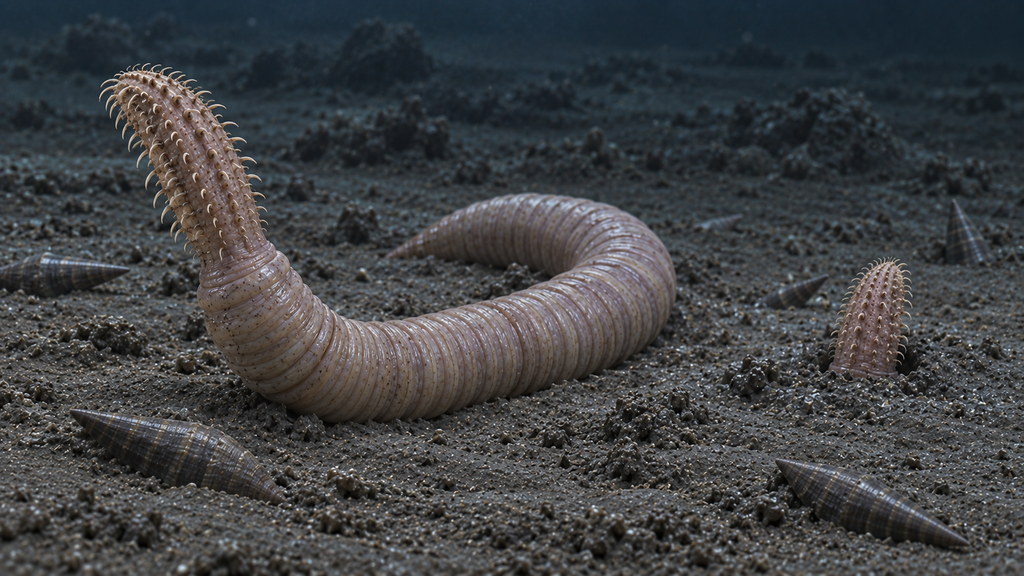
Ottoia was a priapulid worm that lived buried in the mud of the Cambrian seafloor. It is the most abundant worm found in the Burgess Shale, with specimens numbering in the thousands. Several hundred individuals preserve their gut contents intact in the fossil, making it one of the few organisms for which we can directly confirm what an animal was eating 500 million years ago.
Form and way of life
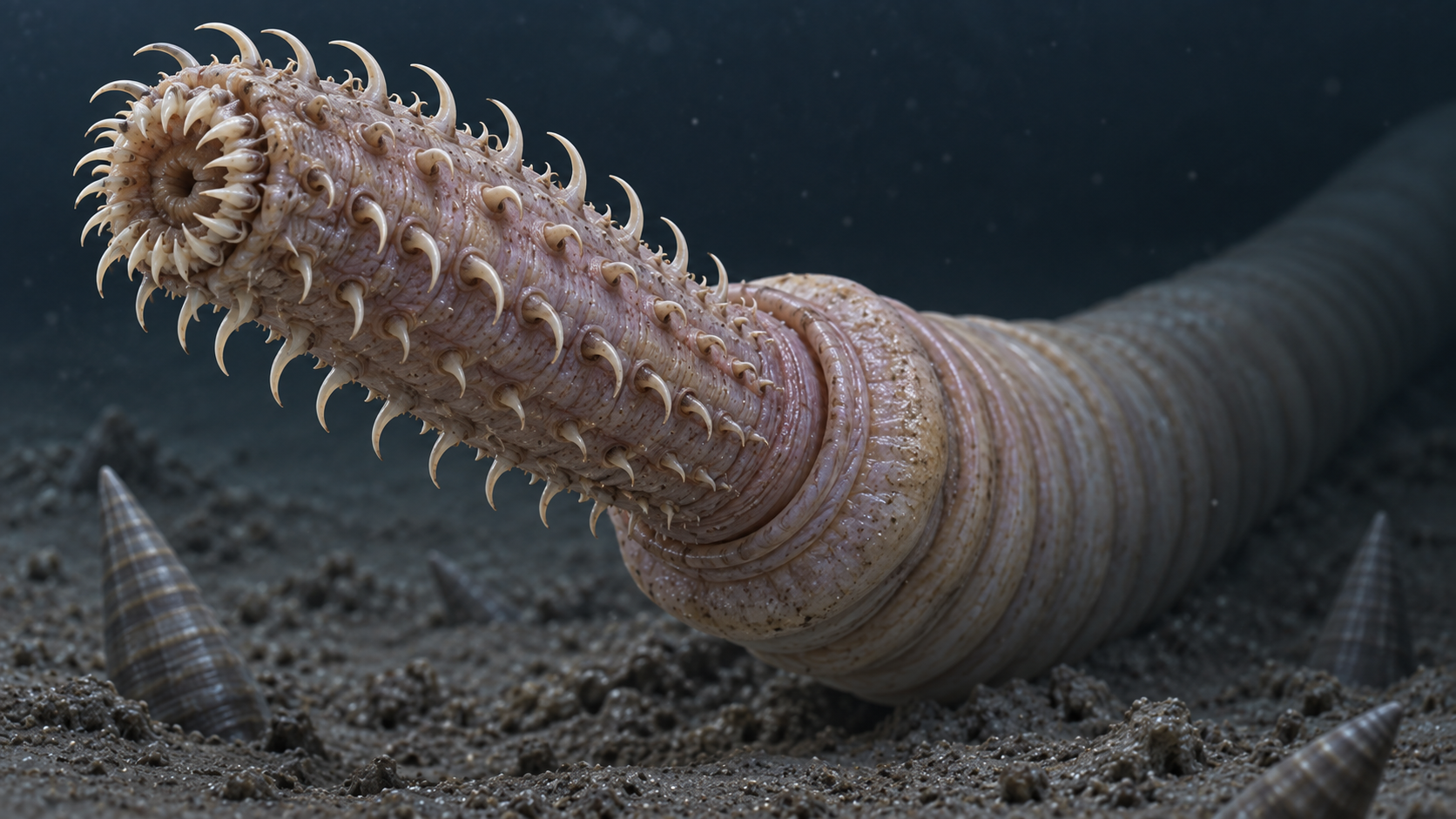
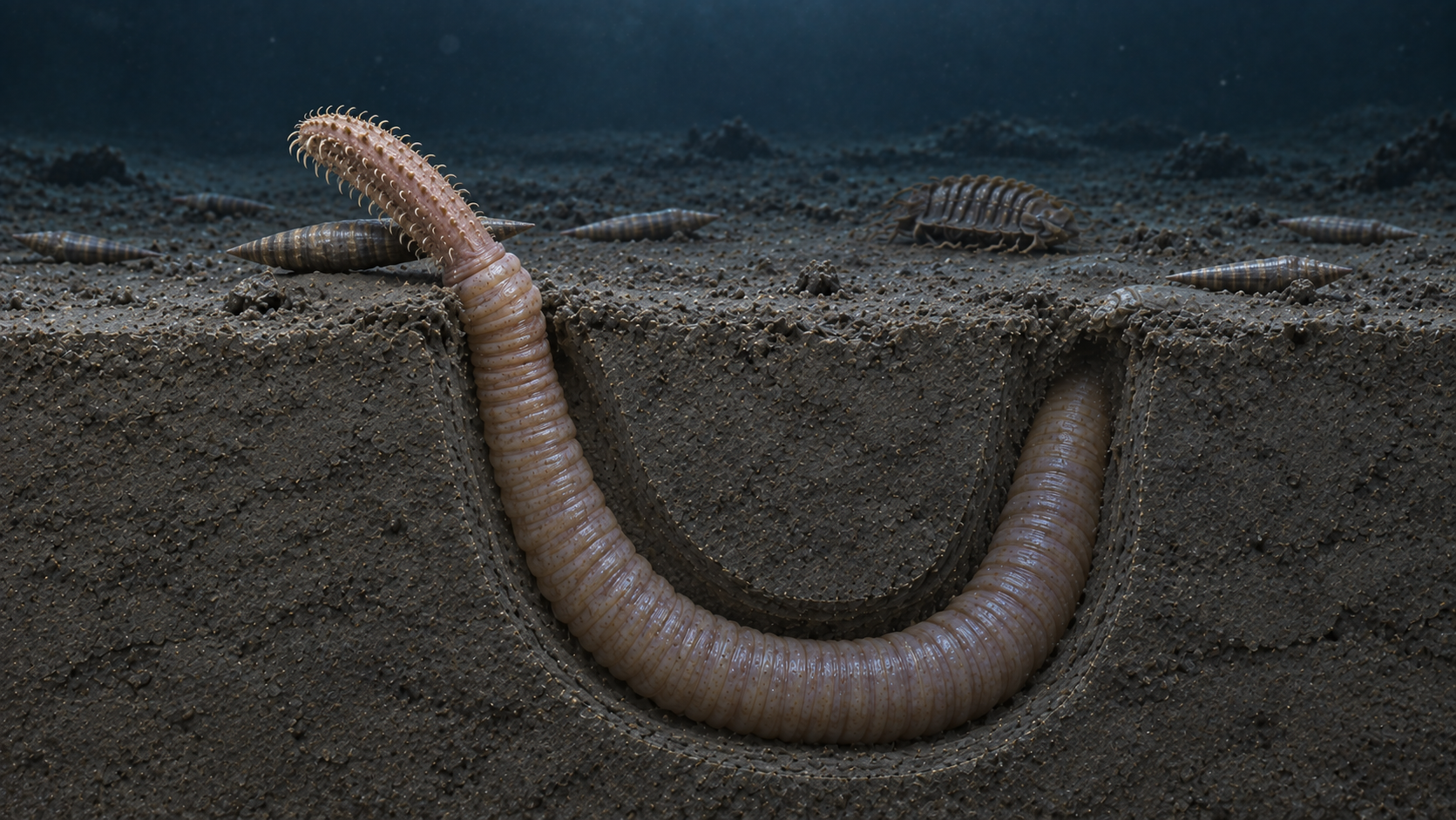
The body is a tube marked with fine ring-like wrinkles, with a proboscis bearing the mouth at the front end. The proboscis could be pulled inside the body and pushed back out, like turning a sock inside out, and its exterior carries 28 rows of densely packed hooks and spines, with further rows of teeth in the pharynx behind them. Prey, or material from the mud, was gripped with this proboscis and passed into the body. A short tail-like projection at the rear could also be retracted. Toward the back of the body, two sets of four hooks are arranged in rings; these are among the few bilaterally symmetrical features of the animal, the rest of which is built close to radial symmetry.
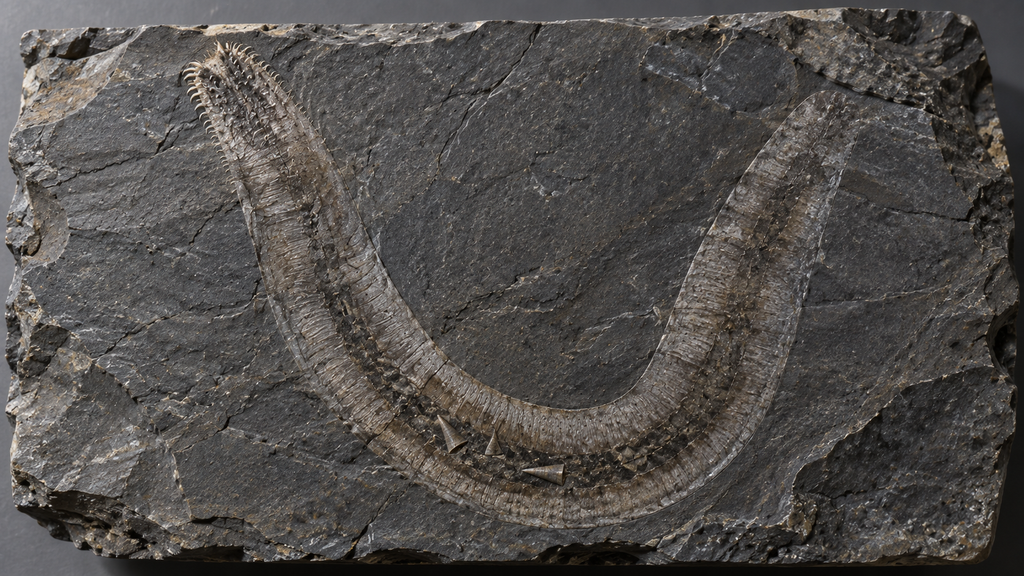
Many fossils are found bent into a U shape, with a mud-filled gut visible running down the middle of the body. The animal is thought to have occupied a U-shaped burrow, extending its proboscis to the seafloor surface as needed. The fossils also show that it moulted repeatedly as it grew, making it a member of the ecdysozoans, the same group as arthropods and nematodes. Only about twenty species of living priapulids remain, burrowing in the mud of cold seas, but the basic construction of an eversible proboscis is almost unchanged from Ottoia.
The Burgess Shale seafloor where Ottoia lived was a deep place with little light, where mud that had slumped from the edge of the continental shelf accumulated. Living on the same mud were trilobites, Anomalocaris, Wiwaxia, and the conical-shelled hyoliths. Ottoia accounts for more than 80 percent of the priapulids found at the Walcott Quarry and over 1 percent of the whole assemblage.
From earthworm relative to priapulid
Ottoia was described in 1911 by Charles Walcott, who discovered the Burgess Shale. Walcott provisionally placed the animal in the Gephyrea, a now-abandoned group lumping together assorted worms such as sipunculans and echiurans, and his paper was titled for Middle Cambrian annelids. Opinions followed placing it with the sipunculans or close to the parasitic acanthocephalans, and its classification went unresolved for a long time. No detailed re-examination of the fossils themselves was carried out until the 1970s, when Simon Conway Morris reviewed the fossil priapulids as a whole in 1977 and the priapulid relationship was secured. It is now positioned as a stem group ancestral to living priapulids.
In 2015, Martin Smith of the University of Cambridge and colleagues re-examined the proboscis hooks and pharyngeal teeth under the electron microscope and determined that specimens long assigned to the single species Ottoia prolifica included a second species with three-pronged teeth, Ottoia tricuspida. The same study also found that some of the tiny carbonaceous fossils recovered from mudstones outside the Burgess Shale are the teeth of ottoiids, showing that the group lived widely in both shallow and deep seas even though body fossils are absent.
The menu revealed by the gut contents
What distinguishes Ottoia fossils is that the gut running down the middle of the body preserves the remains of what the animal ate. In 2012, Jean Vannier of the University of Lyon in France examined the Burgess Shale specimens collectively, and while about half had empty guts, the contents of the last meal could be read from several hundred specimens.
Most common were the conical shells of the hyolith Haplophrentis. Many individuals had these shells packed into the gut whole or broken apart, and that this small shelled animal was the staple of Ottoia‘s diet had already been noted in 1977. Vannier’s survey turned up more: shells of the brachiopod Micromitra, the polychaete Burgessochaeta, the bivalved arthropod Liangshanella, fragments of the trilobite Ehmaniella and of small agnostids, and even sclerites of Wiwaxia. All are small animals that lived on or just below the surface of the seafloor mud.
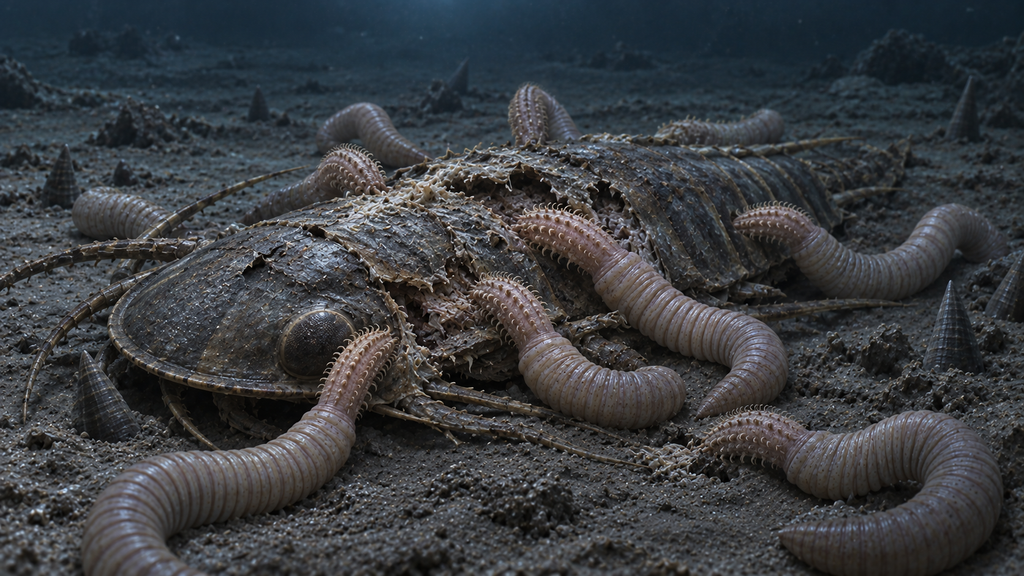
Nor did it eat only live prey. The Burgess Shale includes a single slab, reported in 2001, preserving nine Ottoia buried while clustered on the carcass of the large arthropod Sidneyia. Taking these together, Vannier concluded that Ottoia was an omnivore that did not select its prey, eating whatever came to hand, living or recently dead. Its feeding was simple as well: whatever the proboscis gripped was passed straight into the gut without being crushed, with no storage chamber, and shells were pushed through undigested.
The significance of this work goes beyond establishing the menu of one species. For the Cambrian sea, it was known that diverse animals appeared all at once, but there was almost no direct evidence of who was eating whom. The gut contents are the first substantial case in which the diet of an animal more than 500 million years old could be reconstructed at species level, drawing one rung of a food chain — from small shelled animals on the seafloor to a predator within the mud — from physical evidence rather than inference. That one of the most numerous animals on the seafloor was an unfussy generalist shows that Cambrian ecosystems already had a flexible food web of the kind found in today’s oceans.
Sources
Vannier, J. (2012). Gut Contents as Direct Indicators for Trophic Relationships in the Cambrian Marine Ecosystem. PLoS ONE 7(12): e52200. https://journals.plos.org/plosone/article?id=10.1371/journal.pone.0052200
Smith, M. R., Harvey, T. H. P. & Butterfield, N. J. (2015). The macro- and microfossil record of the Cambrian priapulid Ottoia. Palaeontology 58(4): 705-721. https://palass.org/publications/palaeontology-journal/archive/58/4/article_pp705-721
Royal Ontario Museum, The Burgess Shale: Ottoia prolifica. https://burgess-shale.rom.on.ca/fossils/ottoia-prolifica/
University of Leicester (2015). Prehistoric ‘penis worms’ shed light on ocean ecology half a billion years ago. https://le.ac.uk/news/2015/may/prehistoric-2018penis-worms2019-shed-light-on-ocean-ecology-half-a-billion-years-ago
コメント