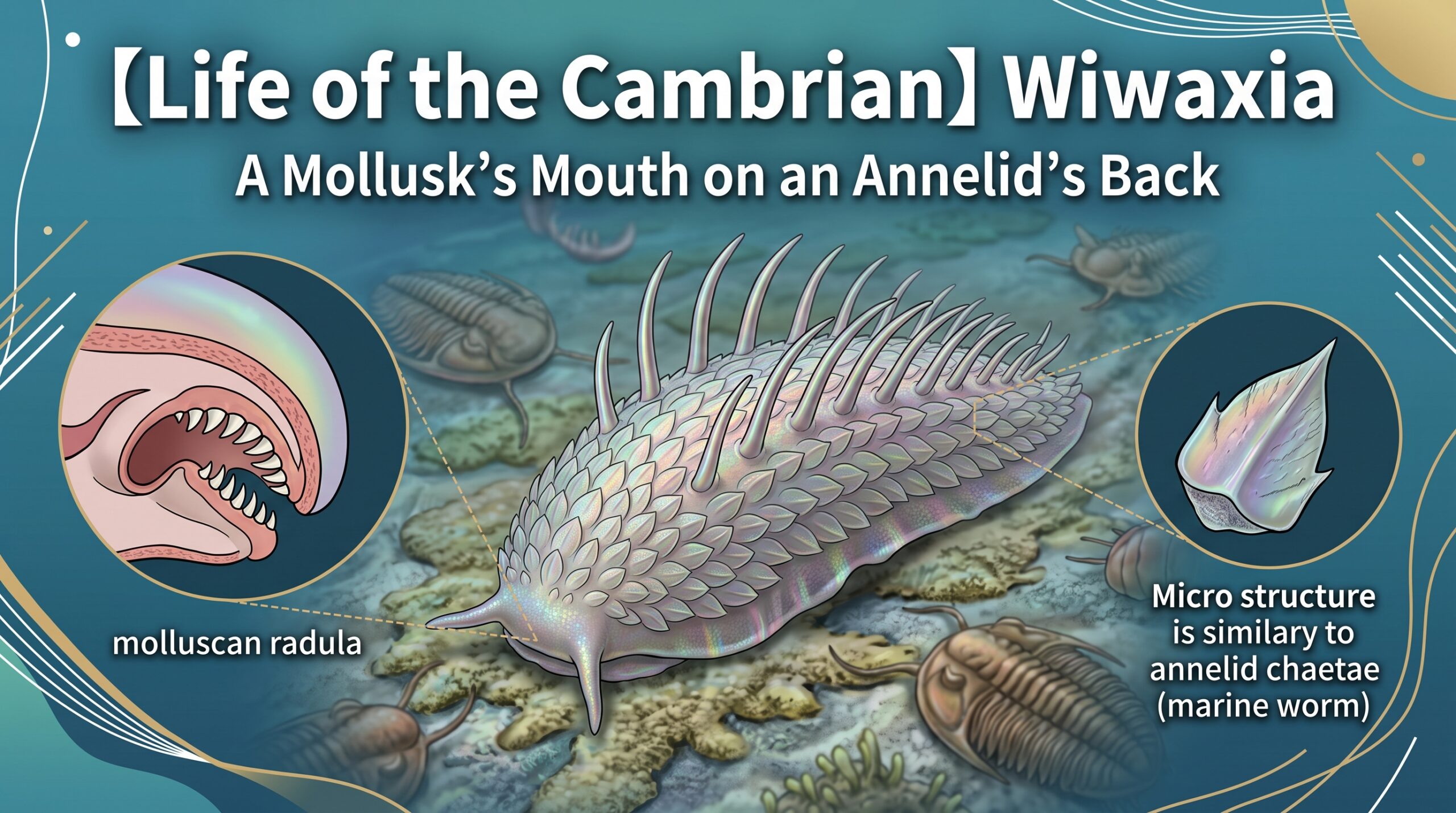
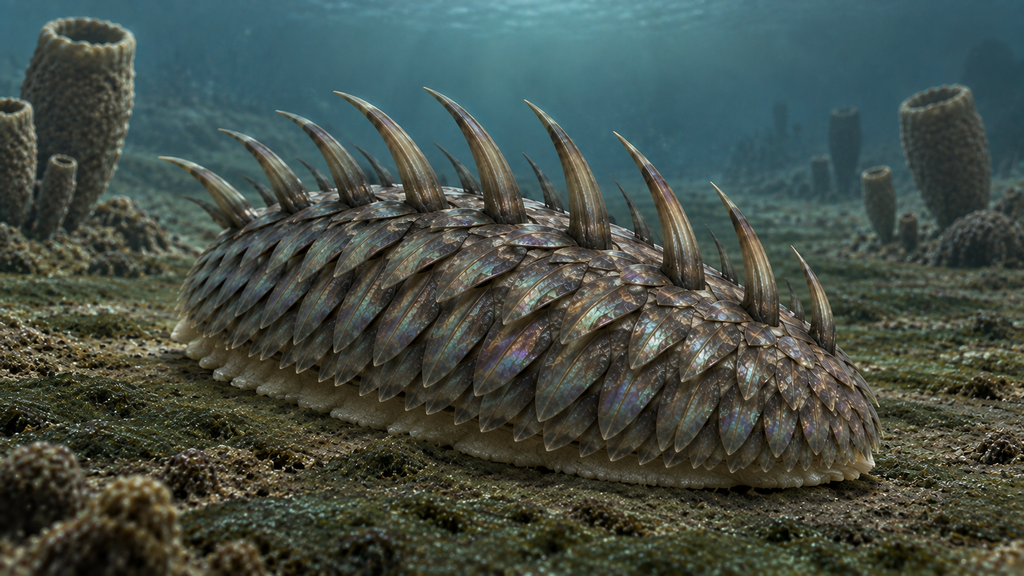
| Name | Wiwaxia. The genus name comes from Wiwaxy Peak in Yoho National Park, Canada, a name meaning “windy” in the language of the Stoney Nakoda people. The species name corrugata is Latin for “wrinkled” |
| Classification | Lophotrochozoan. The leading view places it among early mollusks, though a relationship with the annelids continues to be argued |
| Age | Middle Cambrian (about 508 million years ago) |
| Found in | The Burgess Shale in British Columbia, Canada. Close relatives are known from Yunnan and Guizhou in China, and from Siberia |
| Length | Up to about 5.5 cm. Typical individuals are around 2 to 3 cm |
| Weight | A few grams (no published estimate exists; approximated from living chitons and slugs of the same size) |
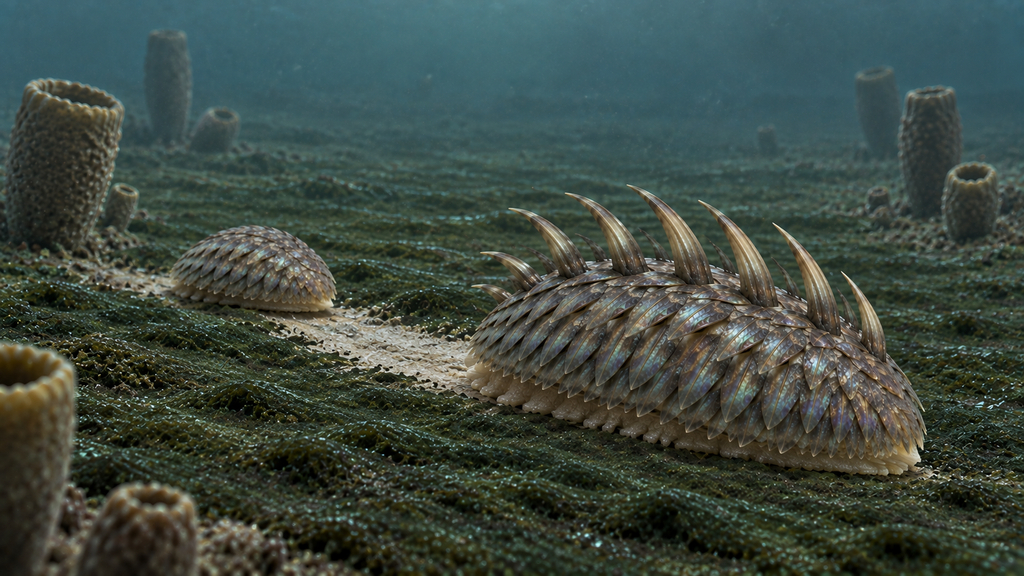
Wiwaxia was a slug-like animal covered in scales and spines that crawled across the Cambrian seafloor. Its back and flanks were covered without gaps in small leaf-shaped scales, and two rows of long spines stood along its back. Its soft underside bore a foot, and its mouth carried a feeding organ with rows of teeth. Those tooth rows resemble the radula of mollusks, while the structure of the scales resembles the chaetae of polychaetes, the marine worms. Because different parts of the body point to different phyla, what group it belongs to has been undecided for over a century.
Form and way of life
The body is oval, somewhat flattened seen from above, and unsegmented. From the back down to the flanks, roughly 50 rows of scales (hard elements called sclerites) overlap like roof tiles, and 7 to 11 pairs of long slender spines stand in two rows along the back. Both scales and spines are inserted directly into the body wall, not fused into an integrated shell. The underside is bare, and carried a foot for crawling.
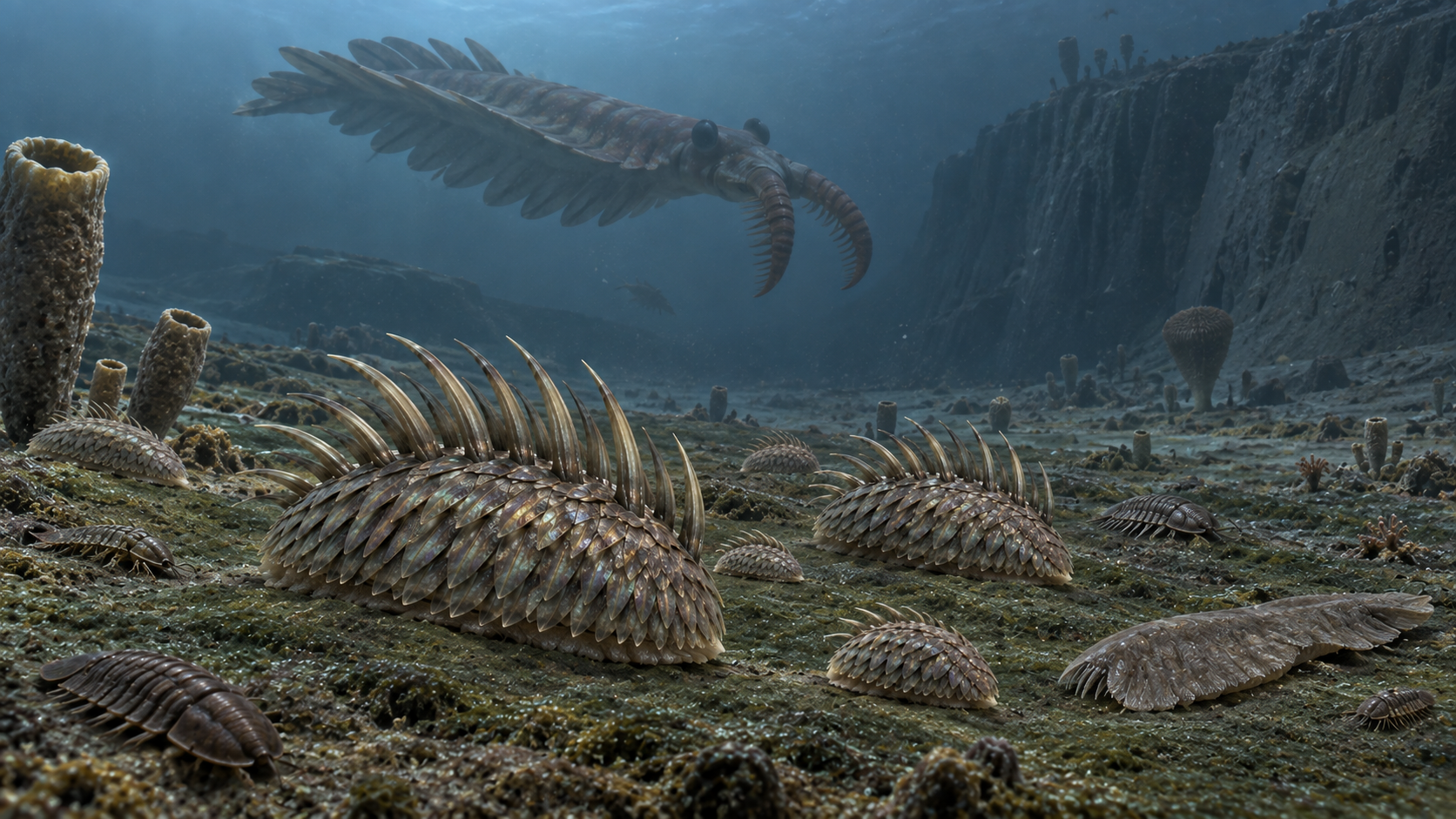
This picture is reconstructed from both whole-body fossils found in the Burgess Shale and fossils of scattered scales and spines. At the Walcott Quarry, the representative Burgess Shale locality, about 1 percent of the specimens counted are Wiwaxia, making it a common animal there.
The surface of the scales carried fine, regularly spaced ridges. The spacing of those ridges is close to the wavelength of light, so in life the animal may have shimmered iridescently as light struck it.
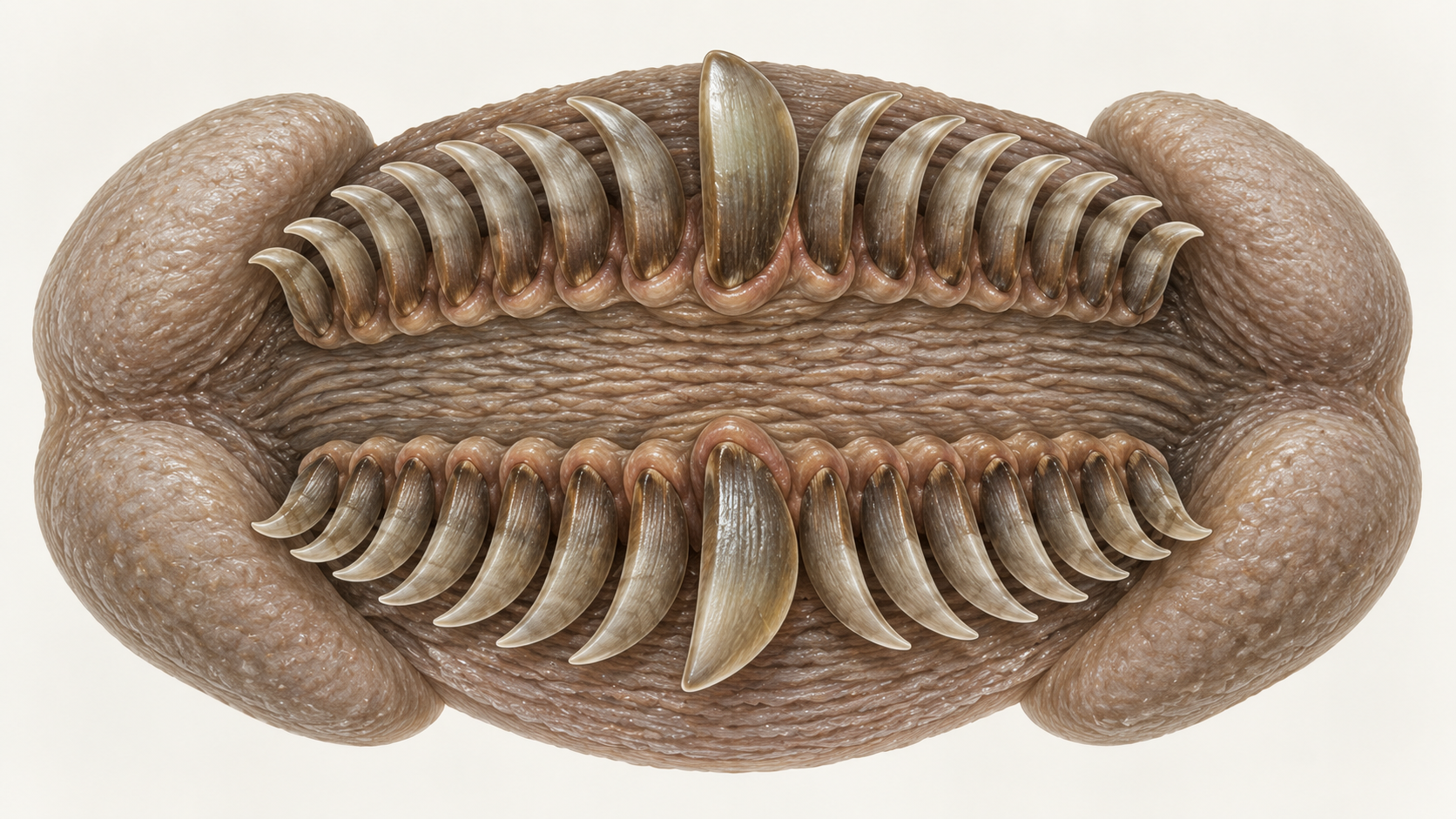
The mouth sits slightly back from the front end of the body, with two rows of teeth arranged front to back (three rows in large individuals). Each row has a single axial tooth at the center, flanked on each side by 8 to 16 teeth shaped like shoehorns. The tooth rows sat on a grooved tongue-like base, which is thought to have been used to scrape up and eat cyanobacterial mats on the seafloor. The same Burgess Shale also holds Odontogriphus, an animal with the same tooth rows, and both appear to have lived as grazers on seafloor mats.
The scales and spines appear to have served for defense, and some individuals fossilized with spines broken off. The sea of the time held predators such as trilobites and Anomalocaris, and Wiwaxia was among the hunted.
Its mode of growth is distinctive as well. The scales were not replaced all at once by moulting; they were added and exchanged one at a time, increasing gradually in step with body size. The dorsal spines only begin to grow once the body reaches around 15 mm in length, so small juveniles have no spines.
How it was discovered
Wiwaxia fossils were first described in 1899, when the Canadian paleontologist G. F. Matthew described a fossil from the trilobite beds of Mount Stephen under the name Orthotheca corrugata. Matthew took it for part of an annelid tube, but it was in fact a single spine detached from the body of a Wiwaxia. With no whole-body fossils known at the time, there was no way to tell what it was part of.
In 1911, Charles Walcott, excavating the Burgess Shale, found well-preserved specimens with the body intact, erected the genus Wiwaxia, and described the animal as a polychaete annelid. The spine specimen Matthew had first described then lay unnoticed in museum storage for decades, and was rediscovered in 1977 within the collections of the Royal Ontario Museum.
A mollusk’s mouth, an annelid’s back
Ever since Walcott, Wiwaxia was long treated as a polychaete. What shook that view substantially was the complete redescription published by Simon Conway Morris in 1985. Conway Morris pointed out that the scales of Wiwaxia differ in structure from the dorsal scales of polychaetes, and that the tooth rows in the mouth closely resemble the molluscan radula. The radula is a grater-like feeding organ possessed by most mollusks apart from bivalves. If the tooth rows of Wiwaxia are a radula, the natural place for this animal is on the mollusk side.
Nick Butterfield argued against this. In 1990, Butterfield examined the scales one by one under the microscope and showed that their microstructure is the same as that of the chaetae of Canadia, a polychaete from the same Burgess Shale. Polychaete chaetae have a characteristic construction not found in mollusks. If the scales share that construction, Butterfield argued, Wiwaxia is close to the polychaetes.
This produced the situation in which the mouth says mollusk and the scales say annelid. In 1995, Conway Morris accepted the annelid interpretation for the scales and treated Wiwaxia as an ancestor, or an “aunt,” of the polychaetes. He did not change his position on the tooth rows, however, maintaining their resemblance to the molluscan radula. In 2004, a third view was also proposed: that the animal branched off before mollusks and annelids diverged.
In 2012, Martin Smith re-examined the mouths of more than 300 Burgess Shale specimens. Describing in detail the shape of the teeth, their arrangement, how they connected, and how they increased with growth, he concluded that these features do not fit annelid jaws and are most naturally explained as a molluscan radula. With this study, the tooth rows of Wiwaxia and Odontogriphus were positioned as showing the prototype of the molluscan radula. A follow-up study in 2014 confirmed the presence of a gut and a crawling foot, strengthening the molluscan connection further.
That did not settle the matter. In 2015, whole-body specimens of juvenile Wiwaxia were reported from the Chengjiang biota in China. Examining these specimens showed that the scales were arranged as nine bands running across the body, each band paired with a projection of the body wall. This construction, with scales repeating along the front-to-back axis, does not fit early mollusks, which arrange shells or scales around the body, and is closer to the body plan of certain annelids. The discrepancy — mouth and foot molluscan, scale arrangement annelid — was not resolved by the new specimens either.
The current consensus leans toward treating Wiwaxia as an early member (stem group) of the mollusks. The Royal Ontario Museum groups it with Halkieria and Odontogriphus as the halwaxiids and treats that group as molluscan stem group. Even so, the points the scale construction shares with annelids are not denied, and the view that it preserves the condition of a time when mollusks and annelids had only just diverged remains on the table.
Wiwaxia is found outside the Burgess Shale as well. Separate species have been reported from Chengjiang, Xiaoshiba and Kaili in China, and from a new Yunnan locality described in 2024, and it is known from Siberia too. From Cambrian Stage 3 through Stage 5, it spread across the world’s oceans with essentially the same body plan.

Sources
Wiwaxia corrugata – The Burgess Shale (Royal Ontario Museum)
コメント