| Name | Opabinia regalis. The genus name comes from Opabin Pass in Canada; the species name means “royal” |
| Classification | Panarthropod, placed in the stem group ancestral to arthropods |
| Age | Middle Cambrian (about 508 million years ago) |
| Found in | The Burgess Shale, British Columbia, Canada |
| Length | 4.3 to 7 cm (body only). About 10 cm in the largest specimen including the proboscis |
| Specimens | 42 (across all collections) |
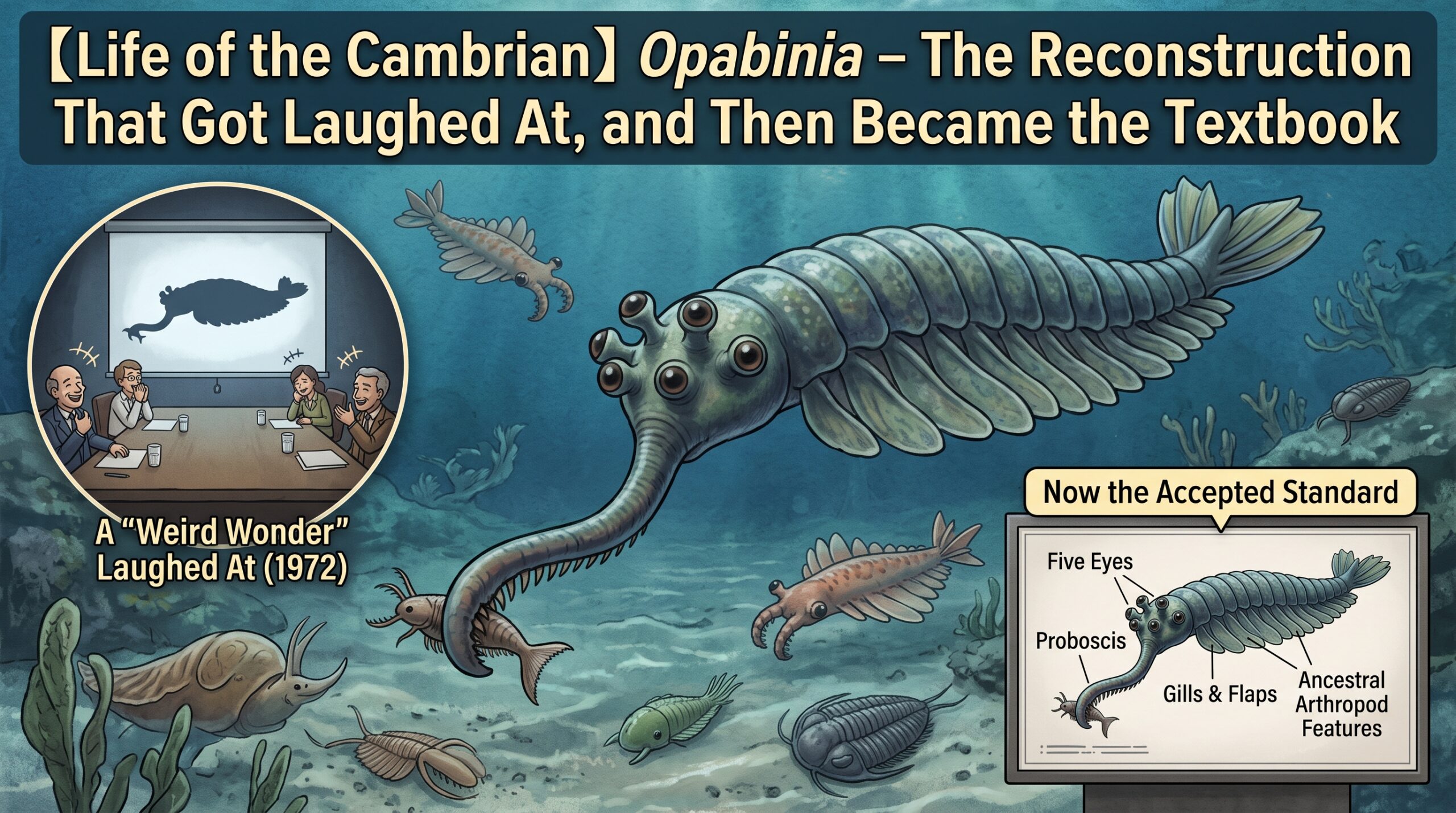
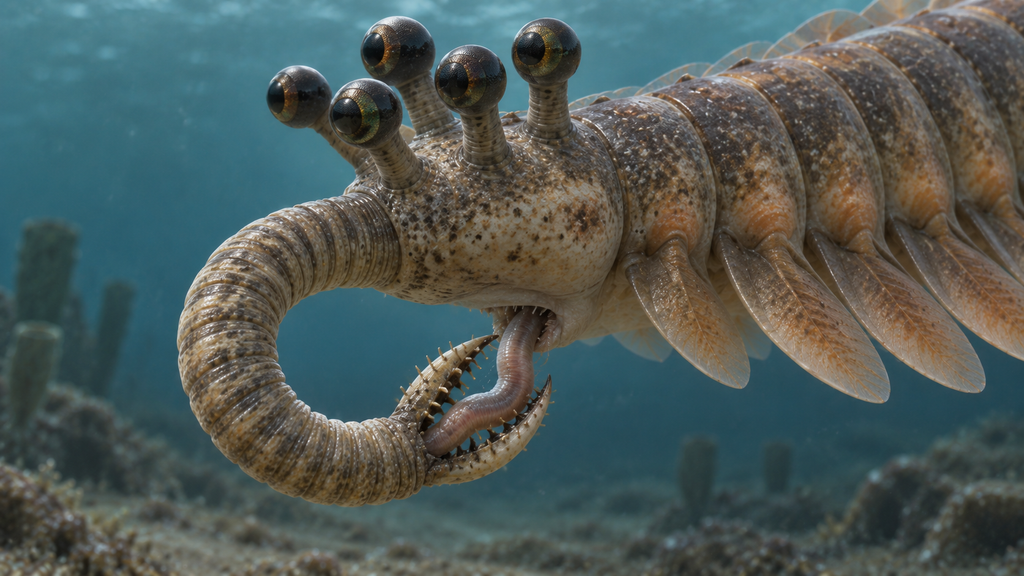
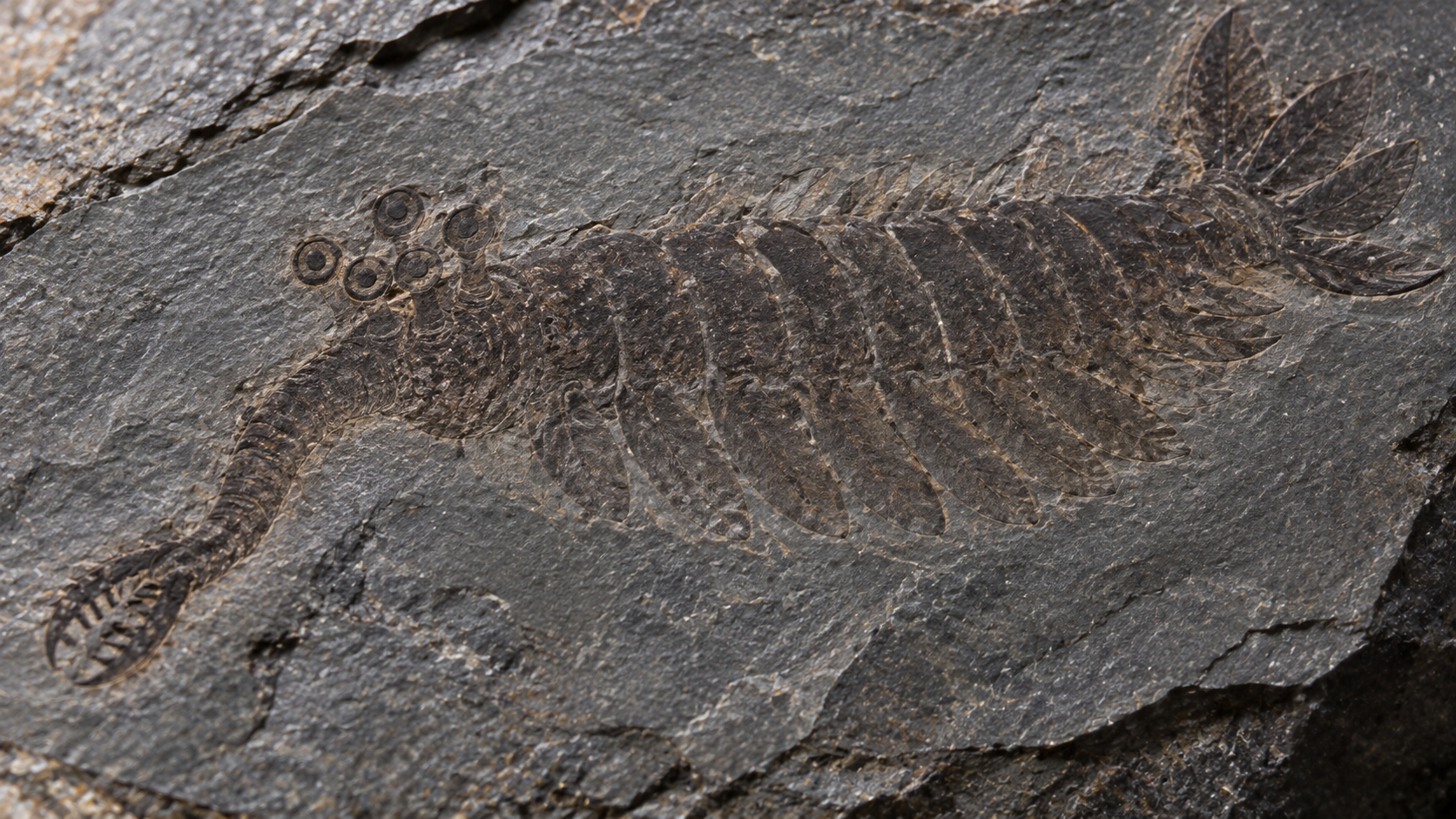
Opabinia was a small Cambrian swimmer belonging to a lineage just short of the origin of arthropods. It has five eyes on top of its head, and a long proboscis with a grasping claw at the tip extending from the front of the head. This picture comes from a redrawing of Burgess Shale fossils made in 1975, and when it was shown at a conference ahead of publication, the room broke into laughter.
Form and way of life
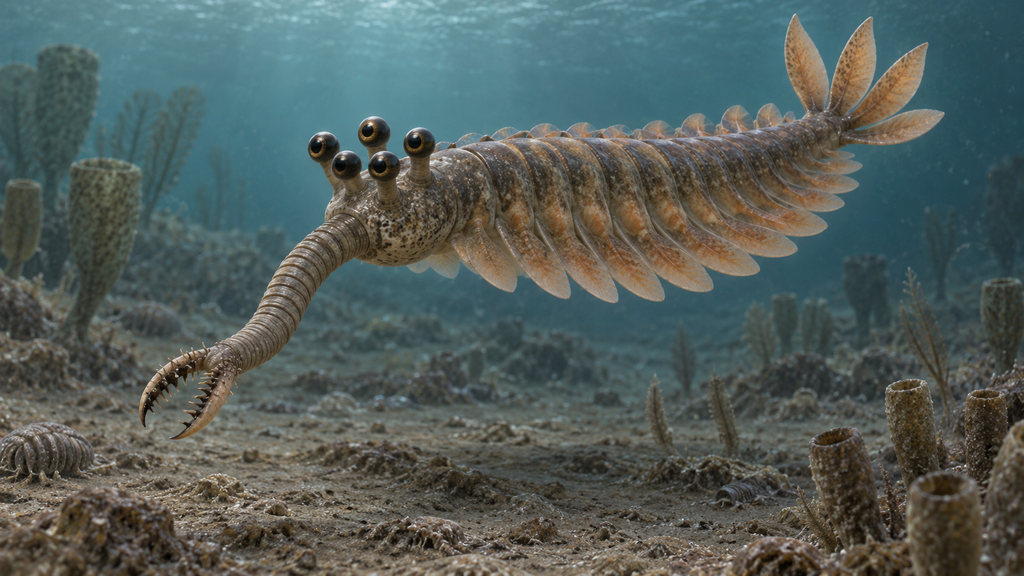
The body is elongate and divides into three parts: head, a trunk of fifteen segments, and a tail fan. Five eyes are arranged on the upper surface of the head — two pairs of large stalked eyes plus one unstalked eye at the center. Their form suggests compound eyes, but the lens structure itself is not preserved in the fossils.
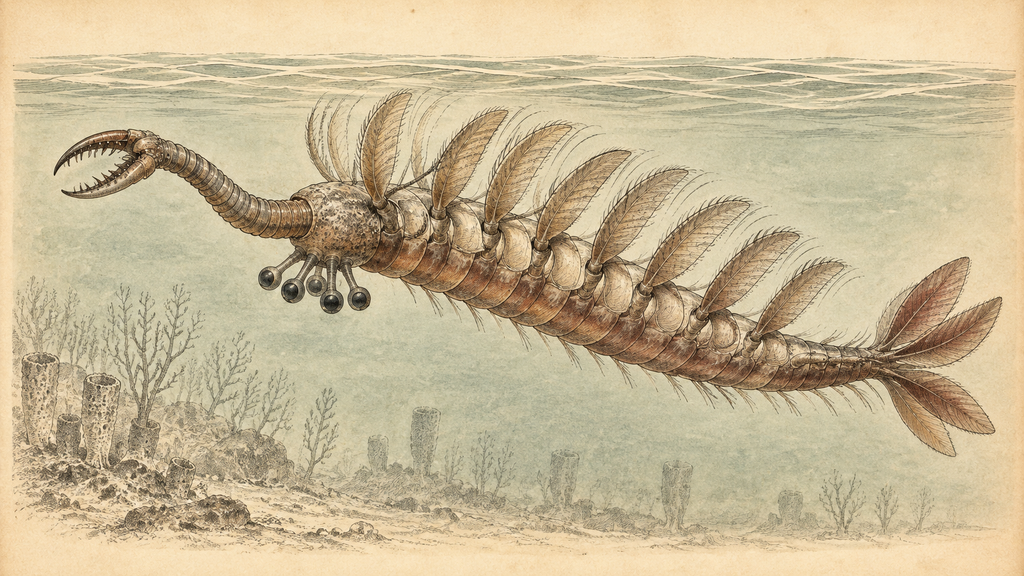
From the front of the head extends a proboscis about a quarter of the body length: a flexible tube made of many rings, with two opposing claws at the tip, each bearing five or six spines. The mouth is on the underside of the head and opens backward. Some fossils preserve the proboscis folded back beneath the body, showing that the animal could carry what it grasped at the tip to its mouth. From the spines on the claws, the large eyes, and the digestive glands arranged along both sides of the gut, it is thought to have been a predator catching small animals on the seafloor.
Each trunk segment carries a pair of broad flap-like lobes on either side, with leaf-shaped gill structures overlapping along them. As in Anomalocaris, the animal is inferred to have swum by undulating these lobes and steered with the three pairs of tail flaps. Whether there were legs on the underside of the trunk is still debated among researchers. In 1996, Graham Budd interpreted triangular structures visible in the middle of the fossils as lobopodous legs, while other researchers read them as traces of the gut or of body-fluid spaces extending into the lobes. It is unresolved.
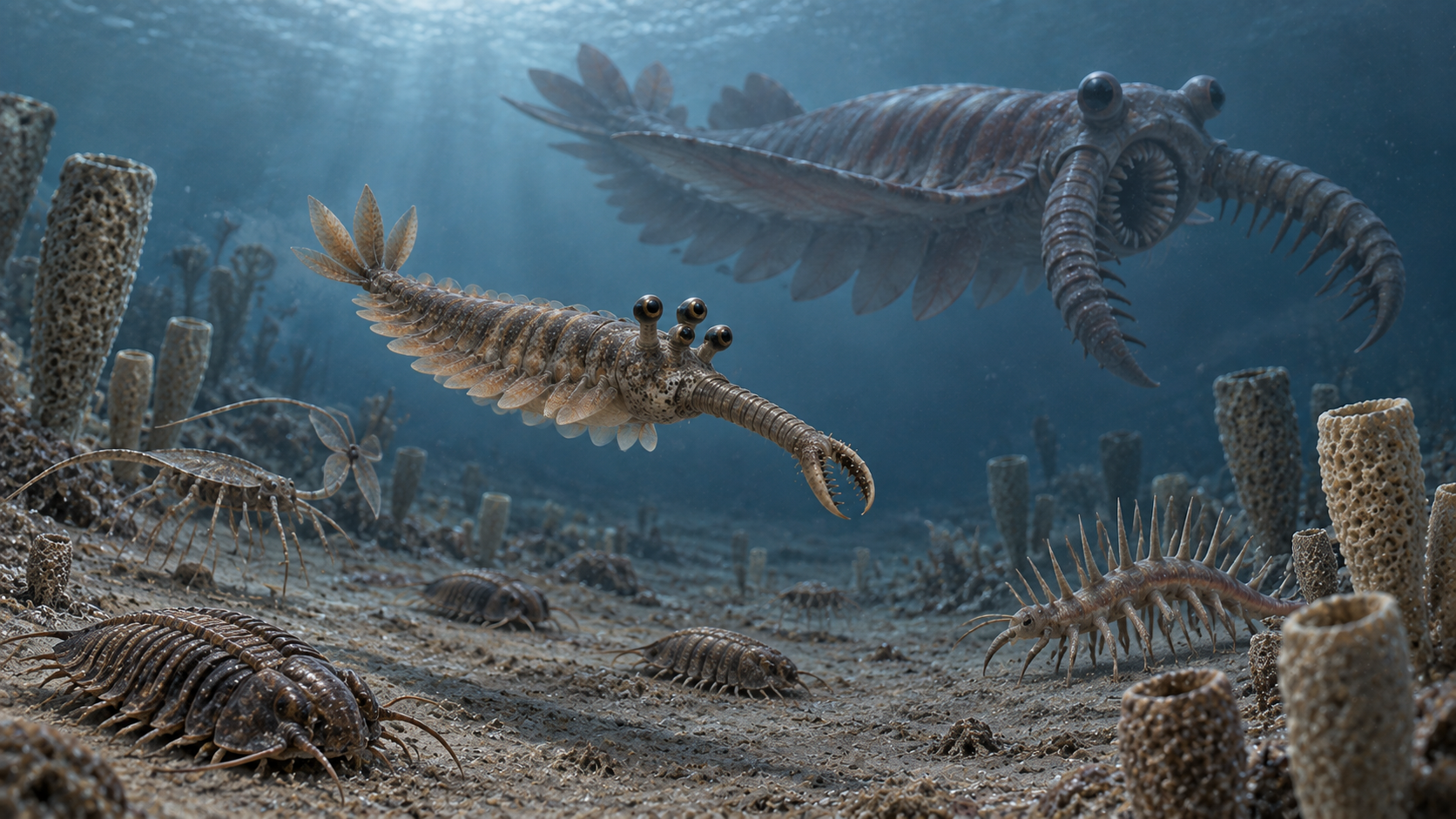
The Burgess Shale seafloor of about 508 million years ago, where Opabinia lived, held the familiar cast of Anomalocaris, Marrella, Hallucigenia and trilobites. Among them Opabinia was extremely rare: the known specimens total 42 across all collections. Its share of the Walcott Quarry assemblage does not reach 0.006 percent.
A reconstruction laughed at, and then accepted whole
Opabinia fossils were first described by Charles Walcott, who discovered the Burgess Shale. In 1912 Walcott published the animal as a crustacean close to living fairy shrimp. A reconstruction drawn in 1930 even showed it swimming on its back, as fairy shrimp do. Read the flap-like lobes as legs and the proboscis as something like an antenna, and it appeared to fit the outline of a crustacean.
What revised that view from the ground up was the work of Harry Whittington of the University of Cambridge. From the late 1960s Whittington had been re-examining Burgess Shale fossils one by one, and as part of that effort he studied ten Opabinia specimens in detail. He compared the part and counterpart (both faces of the split in the host rock), varied the angle of illumination to separate the structures that emerged, and picked away the matrix with a needle to expose buried parts. What he drew from this is the animal as we know it now: five eyes on top of the head, and a claw-tipped proboscis projecting forward. The legs that had been treated as crustacean features were not there, and the body plan fitted no animal group then known.
In 1972, Whittington presented an early version of this reconstruction at a gathering of paleontologists. The room broke into laughter. A fossil treated as a crustacean for sixty years since Walcott had turned out to be an animal nobody had seen before, with five eyes and a long claw-tipped proboscis. The scene was later recounted by Stephen Jay Gould in Wonderful Life and became widely known as the anecdote symbolizing the “weird wonders” of the Burgess Shale.
The laughter did not mean the reconstruction was wrong. Whittington’s reconstruction was published as a paper in 1975, and nearly half a century later the basic organization of the body has been carried forward essentially unchanged. Five eyes, a ringed proboscis with claws at the tip, a fifteen-segment trunk, lobes with gills, three pairs of tail flaps — that framework has only had details corrected by later research; the figure itself has never been redrawn.
What changed was the interpretation of where the animal belongs. Whittington withheld an assignment, finding it fit no existing group, but in 1986 Jan Bergström pointed out features shared with Anomalocaris, whose whole-body form had just been clarified. In 1996, Graham Budd set out a view placing Opabinia near the base of the lineage leading to living arthropods. That interpretation remains mainstream, and Opabinia is considered a lineage that branched off at an even earlier stage than the radiodonts, the group containing Anomalocaris. The opposing claws at the tip of the proboscis are interpreted as a pair of arthropod frontal appendages fused at the base. The backward-opening mouth and the divisions between trunk segments are taken as early forms of features that would later be inherited by the arthropods.
For nearly half a century after Whittington’s reconstruction, Opabinia stood alone, a genus with one species and no relatives. In 2022, a fossil from the Wheeler Formation in Utah was described as the second opabiniid after Opabinia. Named Utaurora, it came from a single specimen reported in 2008 as a species of Anomalocaris, which Stephen Pates and colleagues re-examined through phylogenetic analysis. It shares with Opabinia segment divisions running across the dorsal surface of the trunk and numerous flaps arranged on the tail. The eye and proboscis regions are poorly preserved, so whether it had five eyes has not been confirmed.
What is more, the five eyes of Opabinia are no longer unique to it. Kylinxia, described from Chengjiang in China in 2020, closely resembles Opabinia in having five eyes clustered on top of the head, while also possessing true arthropod features such as biramous legs and a head shield. And in 2022, Stanleycaris, a radiodont from the Burgess Shale, was reported to have a large median eye in addition to two pairs. The five eyes laughed at in that conference room may in fact have been a common eye arrangement in the Cambrian sea.
コメント