| Name | Trilobite. The scientific name Trilobita means “three lobes” |
| Classification | Phylum Arthropoda, class Trilobita (extinct) |
| Age | Early Cambrian (about 521 million years ago) to the end of the Permian (about 252 million years ago) |
| Found in | Worldwide. Morocco, North America, the Czech Republic and China are among the famous localities; in Japan they are found in Paleozoic strata in Iwate Prefecture and elsewhere |
| Length | 3 to 10 cm in most species. The smallest around 1 mm, the largest 72 cm (Isotelus rex) |
| Weight | A few grams in small species, likely several kilograms in the largest (approximated from living horseshoe crabs of comparable size) |
| Species | Over 20,000 described |
Trilobites were arthropods that flourished in the seas of the Paleozoic. They appear in the fossil record in the Cambrian about 521 million years ago and persisted in the ocean for nearly 270 million years, until the mass extinction at the end of the Permian removed them. More than 20,000 species have been described, making them by far the most diverse extinct animal group. Their eyes were built of calcite crystal — the oldest animal eyes known, and the only ones preserved in fossils as they were.
Form and way of life
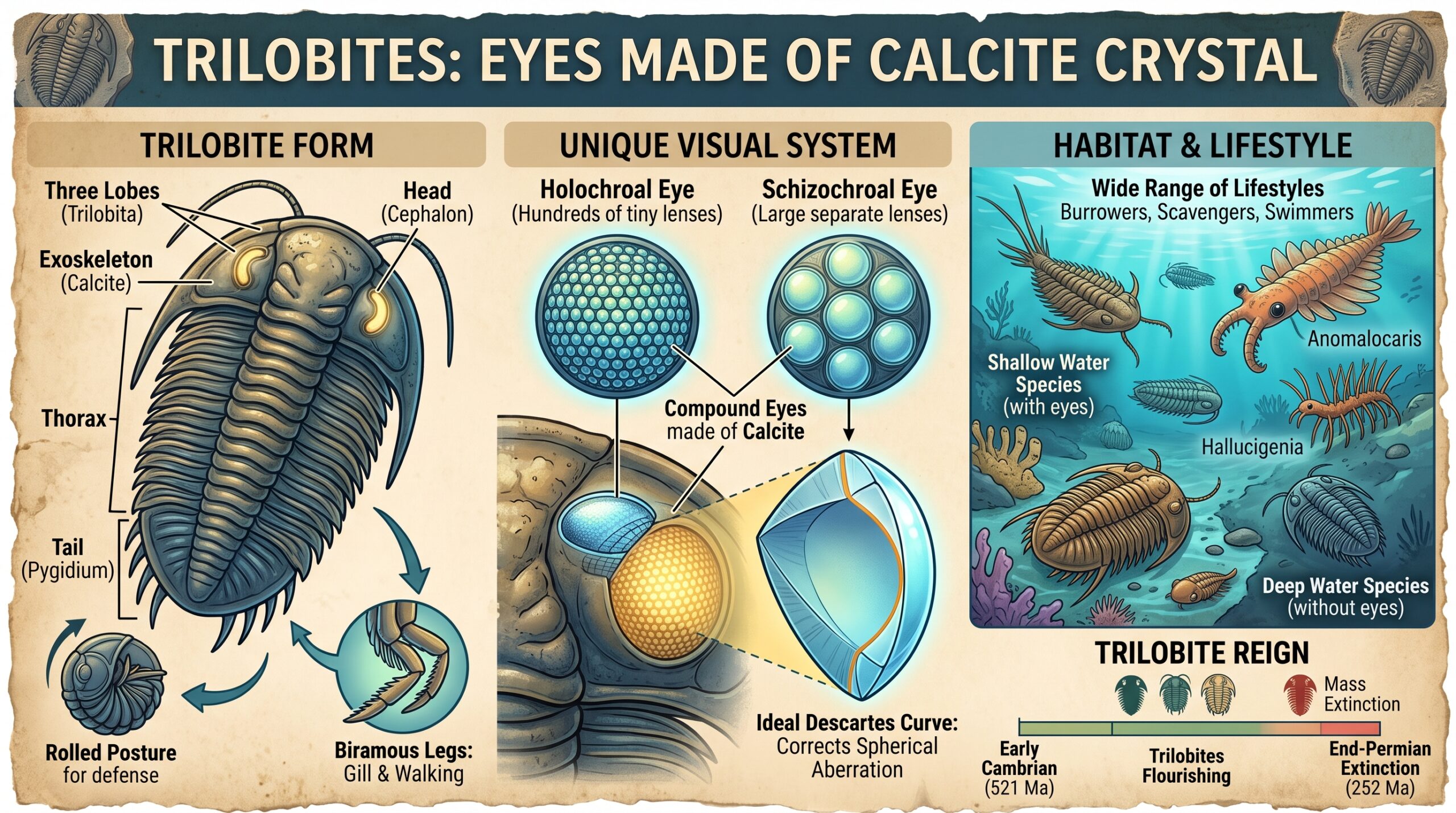
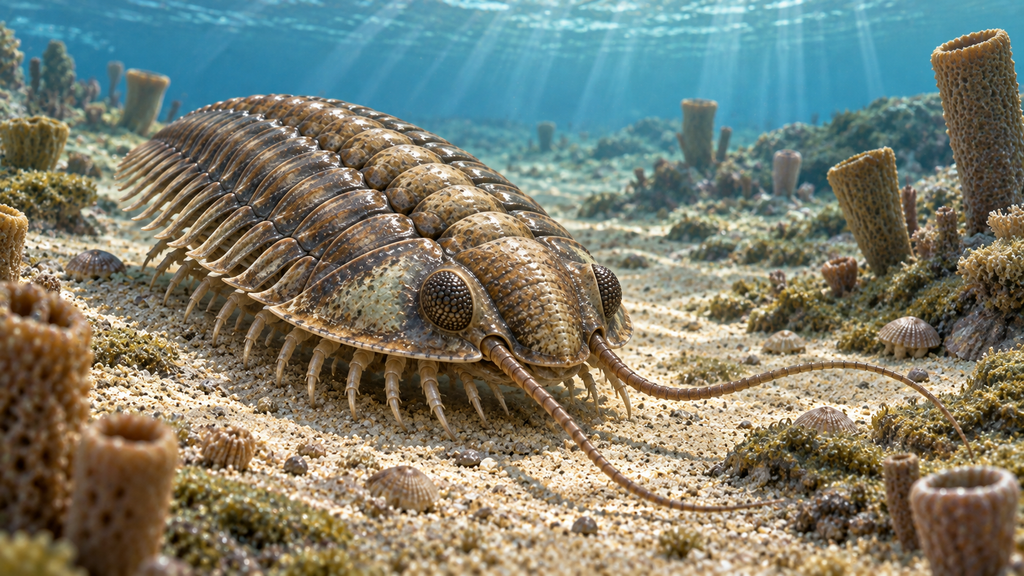
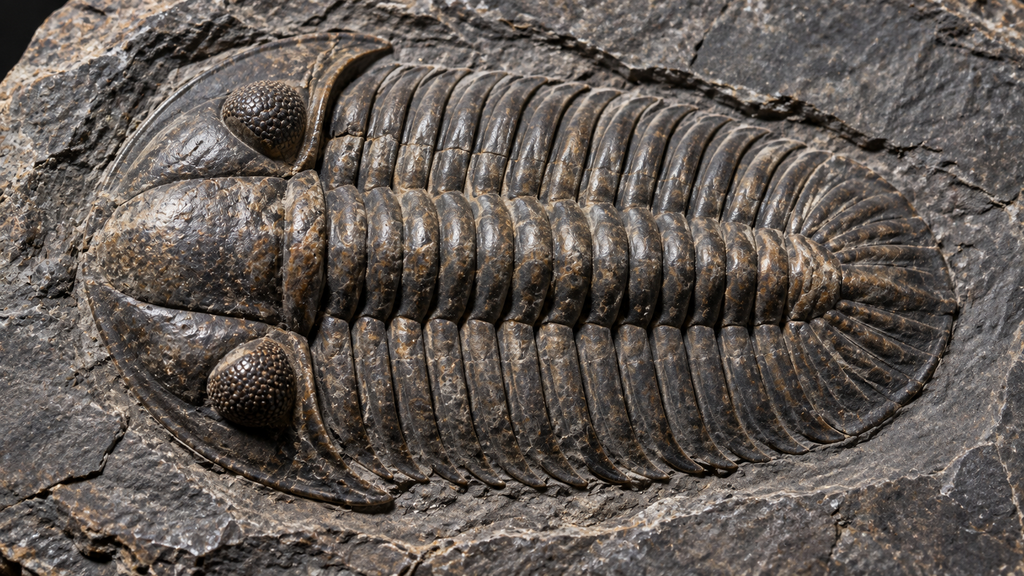
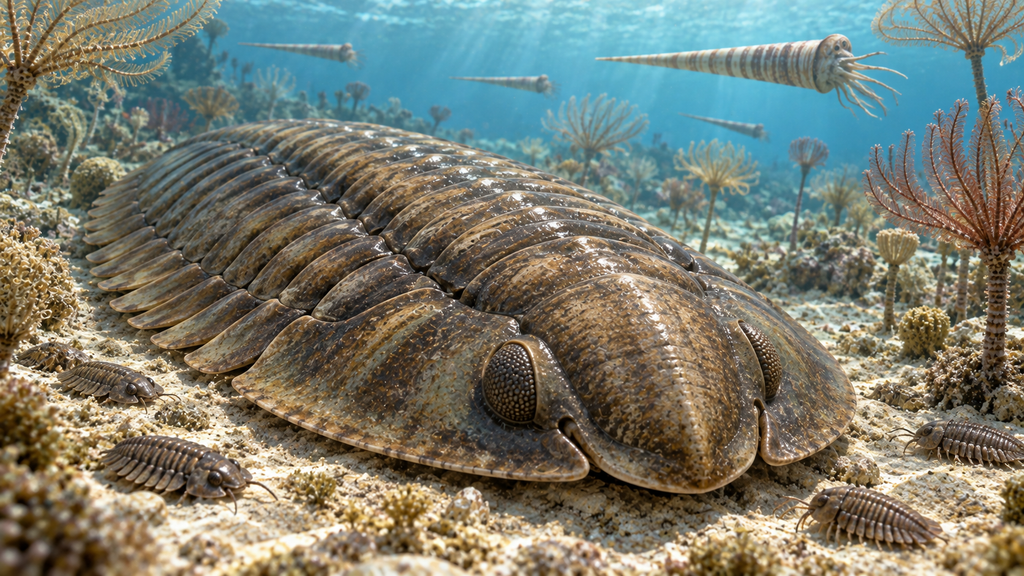
The name trilobite comes from three ridges running lengthwise down the body. An axial region runs along the center of the back, with flat regions spreading to either side, making the body look like three lobes. The body divides front to back into head, thorax and tail, with the thorax made of many linked segments. Because the joints between those segments moved, most species could roll into a ball like a pill bug when threatened. Fossils preserved in that rolled posture are not uncommon.
The exoskeleton covering the back was made of calcite, a crystal of calcium carbonate. Where the shells of other arthropods are built mainly of protein and polysaccharide, trilobite shells were made from the outset of something close to stone, which makes them extremely prone to fossilization. It is because of this shell that trilobite fossils are found in enormous numbers worldwide and became the representative index fossils for dating Paleozoic strata. Like other arthropods, trilobites grew by moulting, so many of the fossils found are not carcasses but discarded shells.
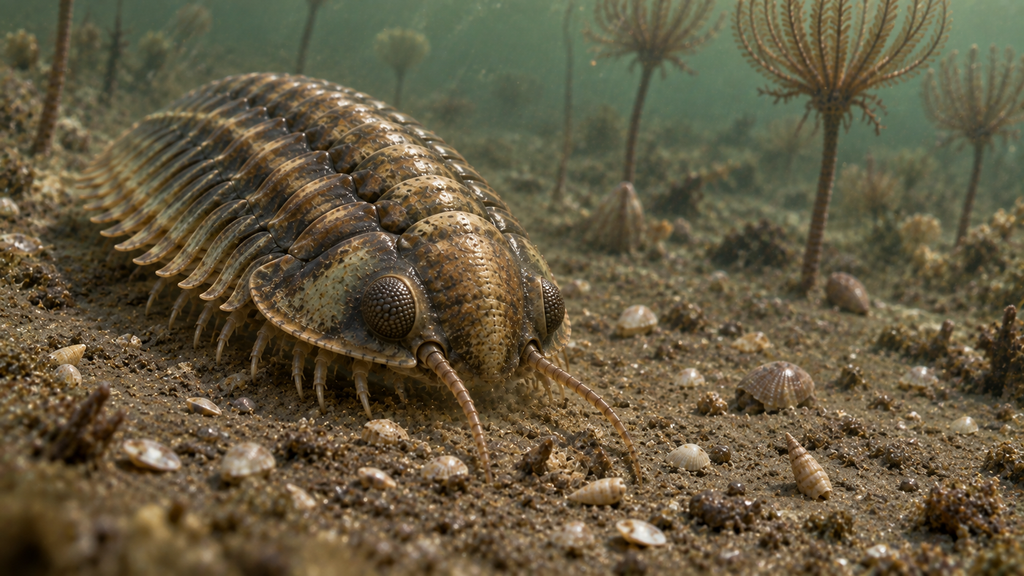
The legs and antennae beneath the shell were soft and normally do not fossilize. From the rare specimens that preserve them, it is known that the head bore a pair of long antennae and that a pair of legs ran along each body segment. The legs were biramous, with the lower branch for walking and the upper a plate-like branch that doubled as a gill. In 2024, trilobites from Cambrian strata in Morocco were reported that had been buried instantly in volcanic ash and preserved in three dimensions. X-ray examination of the interiors showed antennae, legs, setae on the legs under 0.1 mm long, the structures around the mouth and even the gut preserved undistorted. That specimen also revealed for the first time that the bases of the appendages beside the mouth curved like a spoon.
What they ate was long a matter of indirect inference, but in 2023 the gut contents of Bohemolichas, a trilobite from Ordovician strata in the Czech Republic, were examined. Imaging the interior at a synchrotron facility showed the gut packed along its full length with the shells of ostracods, hyoliths, bivalves and relatives of crinoids. It appears to have fed like a seafloor cleaner, not sorting shells but crushing what would crush and swallowing small items whole. Across the group as a whole, trilobite lifestyles ranged widely, from species that sifted seafloor mud to species that caught small animals and species that swam and lived in the water column.
In the Cambrian sea, trilobites shared the seafloor with Anomalocaris, Opabinia and Hallucigenia. Large-bodied species appeared in the Ordovician, and Isotelus rex, found in northern Manitoba, Canada, is known from a complete specimen reaching 72 cm from head to tail. At the time that location was shallow sea near the equator. In the Devonian most of the groups died out, leaving only the Proetida, and the mass extinction at the end of the Permian ended every lineage.
Eyes with lenses made of calcite crystal
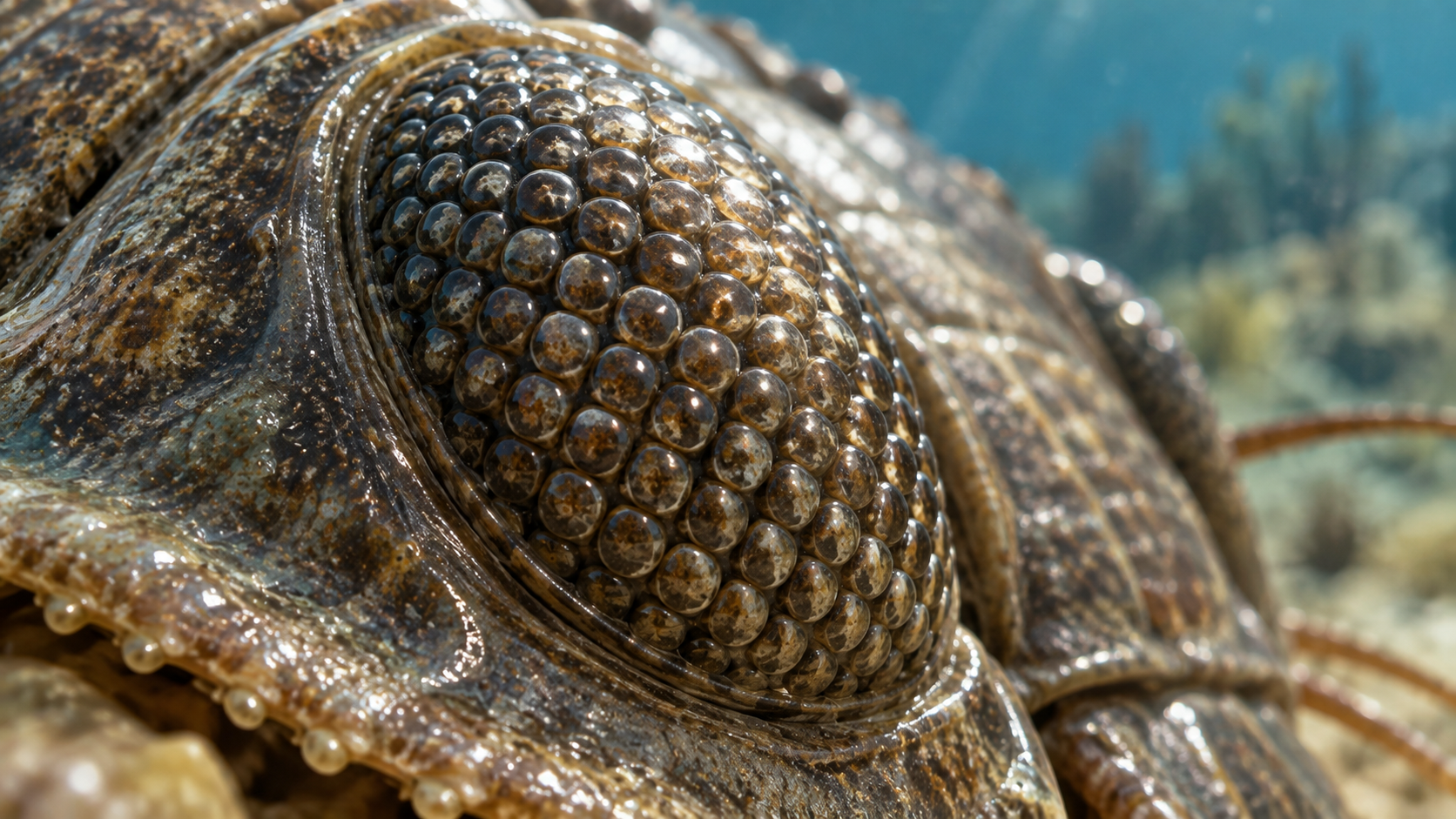
Trilobite eyes were made of the same calcite as the shell. The compound eyes on either side of the head were parts of the exoskeleton specialized into lenses, and they fossilize along with the shell. Trilobite eyes are therefore the only case of a visual organ preserved as an actual object from so early in animal history. What survives, though, is only the lens-bearing surface; the light-receiving cells beneath decayed after death, and almost nothing is known about them.
Using calcite for a lens poses one problem. Calcite is birefringent: light entering it splits in two, so used naively it produces a doubled image. In trilobite lenses, the optic axis (the c-axis) of the crystal was aligned perpendicular to the eye surface. Calcite does not produce birefringence for light travelling along that axis, so orienting the crystals this way is thought to have avoided the double image.
Trilobite eyes come in two broad types. One is the holochroal eye, in which hundreds to thousands of small lenses are packed together beneath a single corneal covering. The other is the schizochroal eye, seen in Devonian phacopids and others, in which the lenses are large and each is set separately and independently. In 1975, the British paleontologist Euan Clarkson and the University of Chicago physicist Riccardo Levi-Setti examined cross-sections of schizochroal lenses and reported in Nature that their shape matches the curve derived in the seventeenth century by Descartes and Huygens as the ideal lens free of spherical aberration. The lens consists of two layers, and the interface between the upper layer and the lower “intralensar bowl” forms the curved surface that brings light to a single point. The shape Descartes and Huygens designed on paper, trilobites had been building as part of their bodies more than 300 million years earlier.
It had long been objected that this two-layer lens interpretation is meaningless unless the refractive index differs above and below the interface. In 2007, Martin Lee of the University of Glasgow and colleagues analyzed the same Dalmanites specimens Clarkson and Levi-Setti had studied using high-resolution electron microscopy and showed that the lower layer contained more magnesium than the upper. Calcite incorporating magnesium has a lower refractive index, so the condition for light to bend at the interface was in fact met, and the two-layer lens account gained chemical support.
The fossils have given concrete answers about how trilobites used their eyes as well. In 2003, Richard Fortey and Brian Chatterton reported in Science on Erbenochile, a trilobite from Devonian strata in Morocco. Its eyes rise like towers from either side of the head, with up to eighteen lenses stacked vertically in each column, giving a view over the full horizontal circle including directly behind. At the top of each tower was an overhanging shade, a structure blocking light coming from straight above. A shade is useless without sunlight, so this trilobite was active by day. Whether trilobites were nocturnal or diurnal had lacked a decisive answer until then.
Not every trilobite had eyes, however. Among species living in deep water or within mud, several lineages are known to have reduced and lost their eyes. The elaborate calcite lens was a tool for trilobites living in shallow water where light reached.
Sources
Clarkson, E. N. K. & Levi-Setti, R. (1975) Trilobite eyes and the optics of Des Cartes and Huygens. Nature 254: 663–667. https://doi.org/10.1038/254663a0
Lee, M. R. et al. (2007) Magnesium-rich intralensar structures in schizochroal trilobite eyes. Palaeontology 50(5): 1031–1037. The Palaeontological Association
Clarkson, E., Levi-Setti, R. & Horváth, G. (2006) The eyes of trilobites: The oldest preserved visual system. Arthropod Structure & Development 35: 247–259. ScienceDirect
Fortey, R. & Chatterton, B. (2003) A Devonian trilobite with an eyeshade. Science 301: 1689. https://doi.org/10.1126/science.1088713
Kraft, P. et al. (2023) Uniquely preserved gut contents illuminate trilobite palaeophysiology. Nature 622: 545–551. https://www.nature.com/articles/s41586-023-06567-7
El Albani, A. et al. (2024) Rapid volcanic ash entombment reveals the 3D anatomy of Cambrian trilobites. Science 384: 1429–1435. https://www.science.org/doi/10.1126/science.adl4540
Rudkin, D. M. et al. (2003) The world’s biggest trilobite — Isotelus rex new species from the Upper Ordovician of northern Manitoba, Canada. Journal of Paleontology 77(1): 99–112. Cambridge University Press
American Museum of Natural History, Trilobite Website (an overview of classification, species numbers and temporal range)
コメント