This article contains affiliate links. As an Amazon Associate I earn from qualifying purchases.
| Name | Basilosaurus. From Greek words meaning “king lizard” |
| Classification | Mammalia, Cetacea, Archaeoceti, Basilosauridae |
| Age | Paleogene, late Eocene (about 38 to 34 million years ago) |
| Found in | B. cetoides: Louisiana, Alabama and elsewhere in the United States. B. isis: Wadi Al Hitan in Egypt and other sites from Morocco to Jordan |
| Length | 17–20 m for B. cetoides, 15–18 m for B. isis |
| Weight | Around 6 tonnes in a 1998 study; a 2025 study estimated 15 tonnes for an 18.35 m B. cetoides |
| Hind legs | About 35 cm long in a 16 m individual, with three toes |
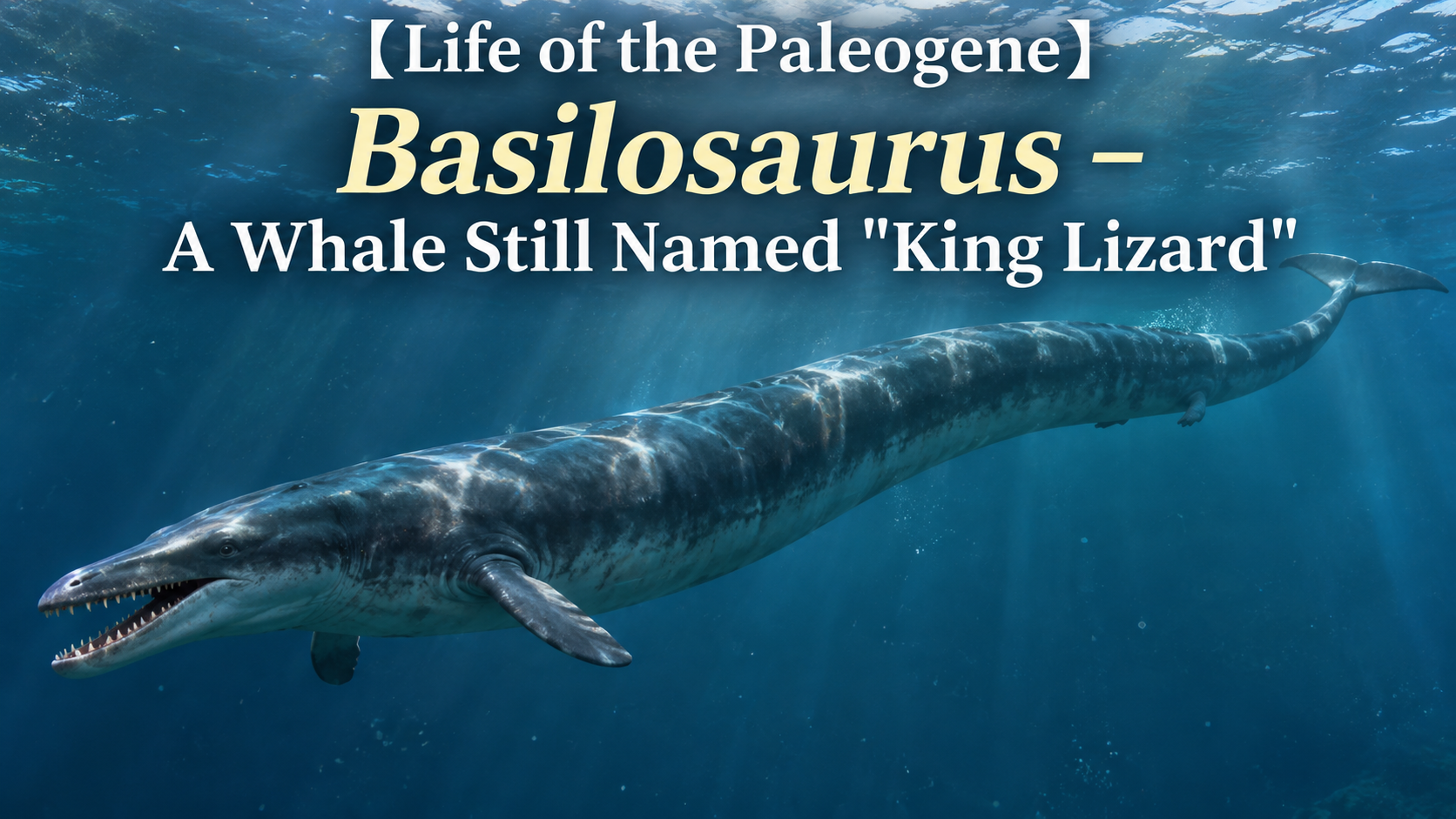
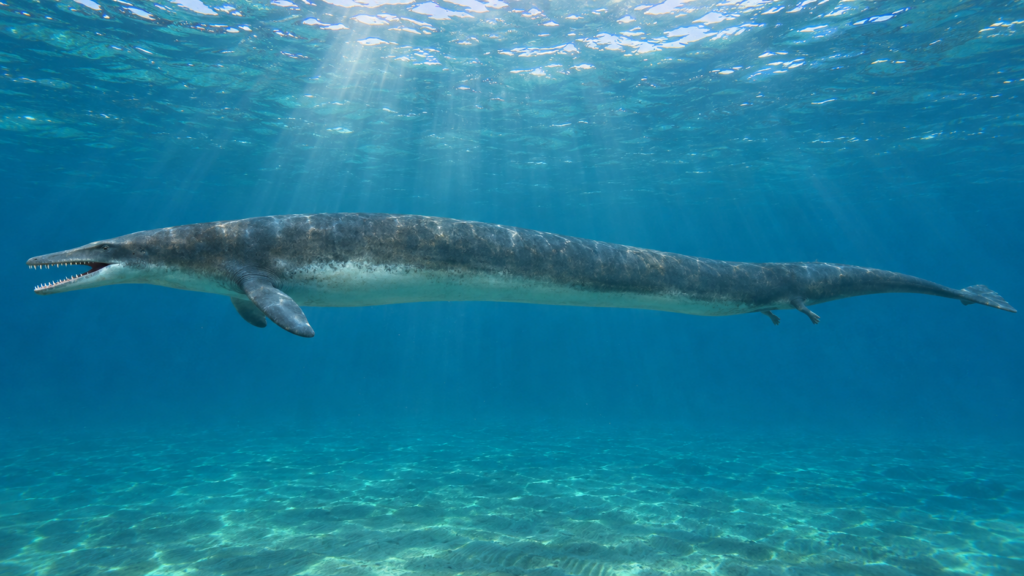
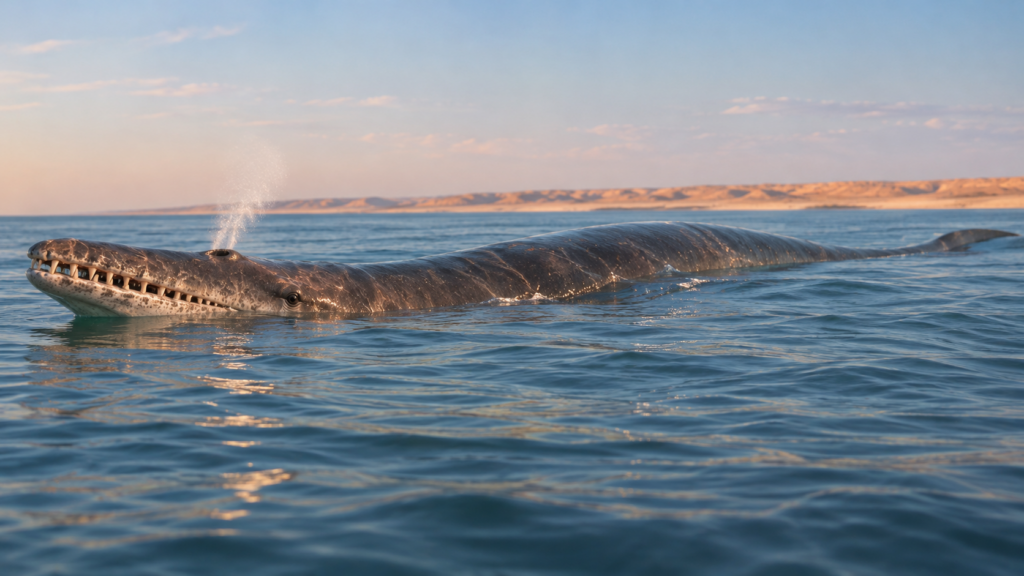
Basilosaurus was a large archaic whale of the late Eocene seas. Its long, slender body still carried a pair of tiny hind legs. Its name means “king lizard,” and that name, a relic of a mistake made at its discovery, stayed in use even after the animal turned out to be a mammal.
Body and way of life
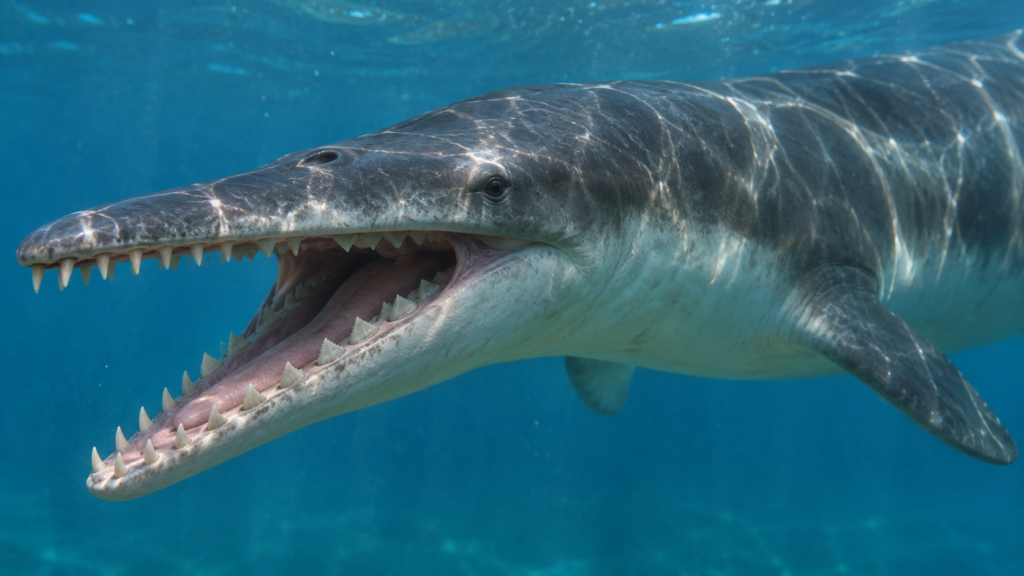
The vertebrae of the back and the base of the tail were longer than in today’s whales, which gave the whole animal a long, slender shape. At more than 15 m, it was among the largest animals of its time. The jaws held conical teeth at the front and multi-cusped teeth at the back, unlike the uniform teeth of living toothed whales.
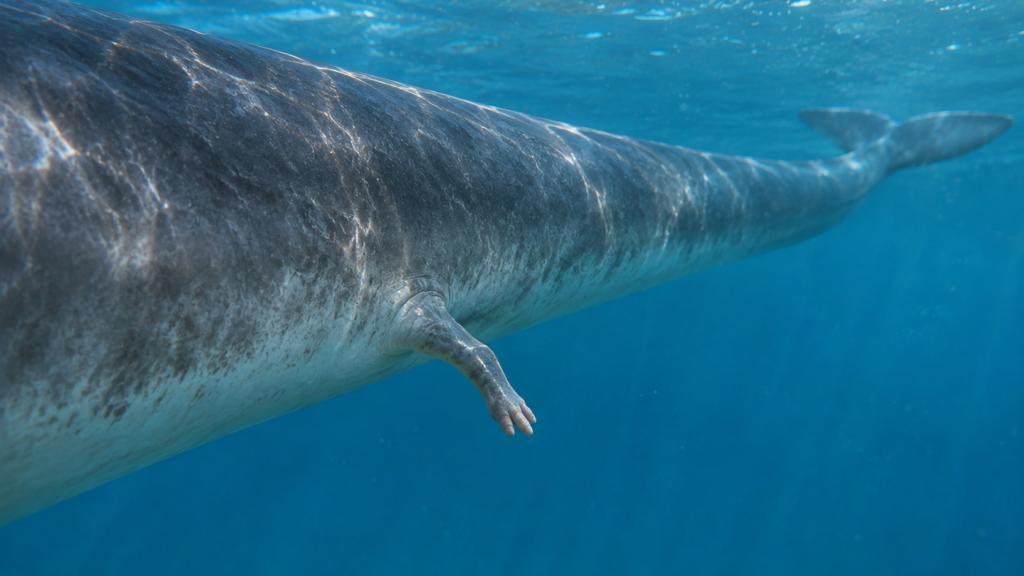
The hind legs were described in detail in 1990 from fossils found in Egypt. Philip Gingerich and colleagues reported them as the first functional pelvic limb and foot bones known in whales. In a 16 m individual, the leg was about 35 cm long, with fused ankle bones and three toes. It had no connection to the backbone, so it could not have supported the body. The authors interpreted the legs as guides during mating.
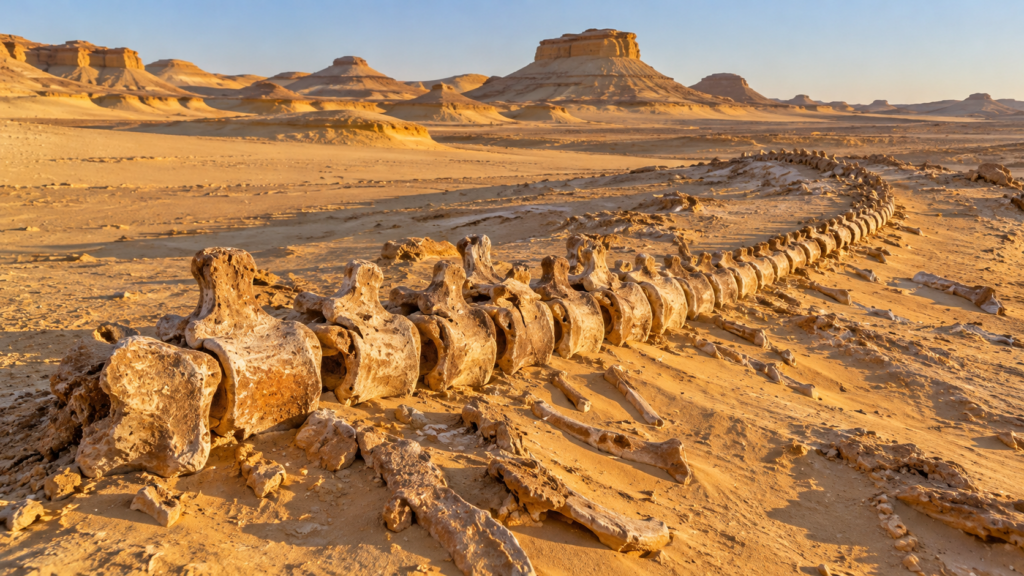
Wadi Al Hitan, “Valley of the Whales,” lies in the desert about 140 km southwest of Cairo. In the Eocene it was seabed. More than 500 archaic whale skeletons have been found there, and it is a UNESCO World Heritage Site. The most common finds are Basilosaurus isis and the 5 m whale Dorudon.
A 2019 study examined fossils from the stomach region of a B. isis skeleton. They were the bones of young Dorudon and the large fish Pycnodus, the first direct evidence of what Basilosaurus ate. Bite marks on the Dorudon skulls pointed to predation rather than scavenging. All the B. isis found at the site are adults, while Dorudon includes many juveniles. Like the orca today, Basilosaurus was an apex predator of its seas.
The whale that stayed a “king lizard”
The first fossils came into the hands of Judge Henry Bry around 1832, near the Ouachita River in Louisiana. Rain had brought down a hillside and exposed bones lying along a curved line about 120 m long. Many were used as andirons and destroyed. Bry sent a surviving vertebra and a fragment that looked like a tooth to the Philadelphia anatomist Richard Harlan.
Harlan took the tooth-like fragment for a piece of shell and focused on the enormous vertebra. Comparing it with Plesiosaurus and Mosasaurus, he concluded it came from a marine reptile, estimated the animal at no less than 24 to 30 m, and in 1834 named it Basilosaurus, “king lizard.” That same year more bones arrived from a judge in Alabama, adding jaws and teeth to the material.
In 1839 Harlan took the fossils to England and showed them to the anatomist Richard Owen. Owen sectioned the teeth and confirmed that the back teeth had two roots, a feature unknown in fishes and reptiles. It marked the animal as a mammal, and a whale at that. Owen proposed the name Zeuglodon cetoides, “yoke tooth,” and Harlan agreed. Cetoides means “whale-like.”
Zoological names, however, go by priority: the first published name wins. The rule holds even when the original author accepts the mistake and agrees to a new name. Zeuglodon stayed in use for a long time, but the valid name is Harlan’s Basilosaurus, with Owen’s cetoides surviving as the species name. Basilosaurus cetoides, read literally, is “the whale-like king lizard.”
The reptile idea also came back in another form. In 1845 Albert Koch assembled bones of this whale collected in Alabama, from several individuals, into one giant skeleton and exhibited it in New York as a sea monster called “Hydrarchos.” The anatomist Jeffries Wyman pointed out that the skull was mammalian and that the skeleton was a composite of several animals.
Today Basilosaurus cetoides is the state fossil of both Alabama and Mississippi. In both states, the official name is still “king lizard.”
Related products
You can find books and products related to this article on Amazon.
If you buy through the links above, this blog may earn a commission.
About the images
The images in this article are illustrations created with AI (ChatGPT), and you are welcome to use them. If you do, we would appreciate a link back to this article as the source.
Sources
Voss, M. et al. (2019). Stomach contents of the archaeocete Basilosaurus isis: Apex predator in oceans of the late Eocene. PLOS ONE 14(1), e0209021. https://doi.org/10.1371/journal.pone.0209021
Gingerich, P. D., Smith, B. H. & Simons, E. L. (1990). Hind limbs of Eocene Basilosaurus: Evidence of feet in whales. Science 249(4965), 154–157. https://doi.org/10.1126/science.249.4965.154
Harlan, R. (1834). Notice of fossil bones found in the Tertiary formation of the State of Louisiana. Transactions of the American Philosophical Society 4, 397–403
Owen, R. (1841). Observations on the Basilosaurus of Dr. Harlan (Zeuglodon cetoides, Owen). Transactions of the Geological Society of London 6, 69–79
Encyclopedia of Alabama, Basilosaurus cetoides https://encyclopediaofalabama.org/article/basilosaurus-cetoides/
Encyclopedia of Arkansas, Basilosaurus https://encyclopediaofarkansas.net/entries/basilosaurus-20993/
National Geographic, The Phrenology of a Monster (Koch’s Hydrarchos) https://www.nationalgeographic.com/science/article/the-phrenology-of-a-monster
UNESCO World Heritage Centre, Wadi Al-Hitan (Whale Valley) https://whc.unesco.org/en/list/1186/
Wikipedia, Basilosaurus (body size, discovery, hind legs, state fossils) https://en.wikipedia.org/wiki/Basilosaurus

コメント