| Name | Nectocaris pteryx. The genus name means “swimming shrimp,” the species name “wing” |
| Classification | The leading view (2025) places it in a lineage close to the chaetognaths, the arrow worms. Family Nectocarididae |
| Age | Cambrian (about 518 to 508 million years ago) |
| Found in | The Burgess Shale, Canada. Fossils regarded as close relatives also come from Chengjiang in China and Emu Bay in Australia |
| Length | Two size classes, about 3 cm and about 10 cm. The specimens examined in 2010 ranged from 2 to 5 cm |
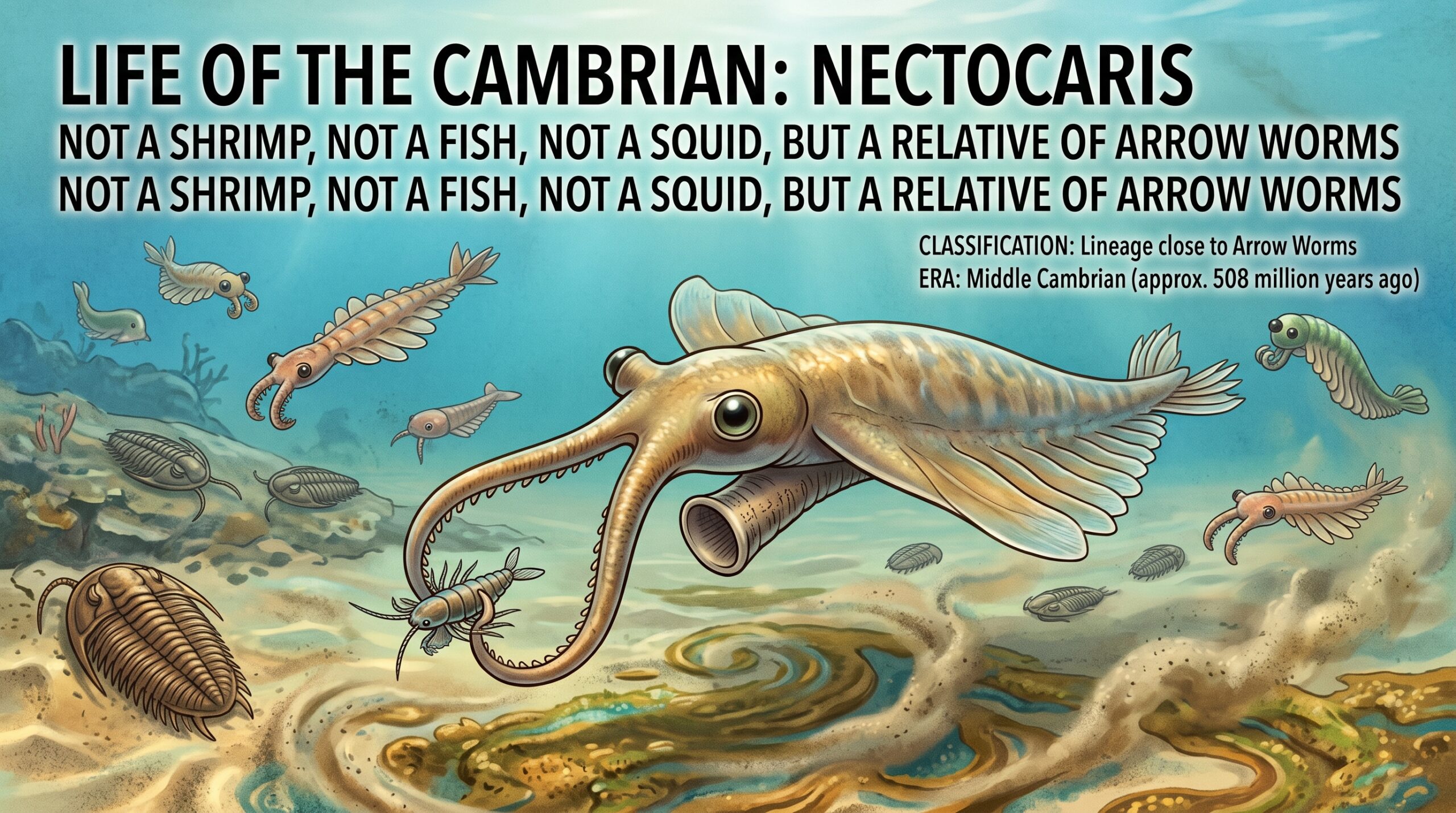
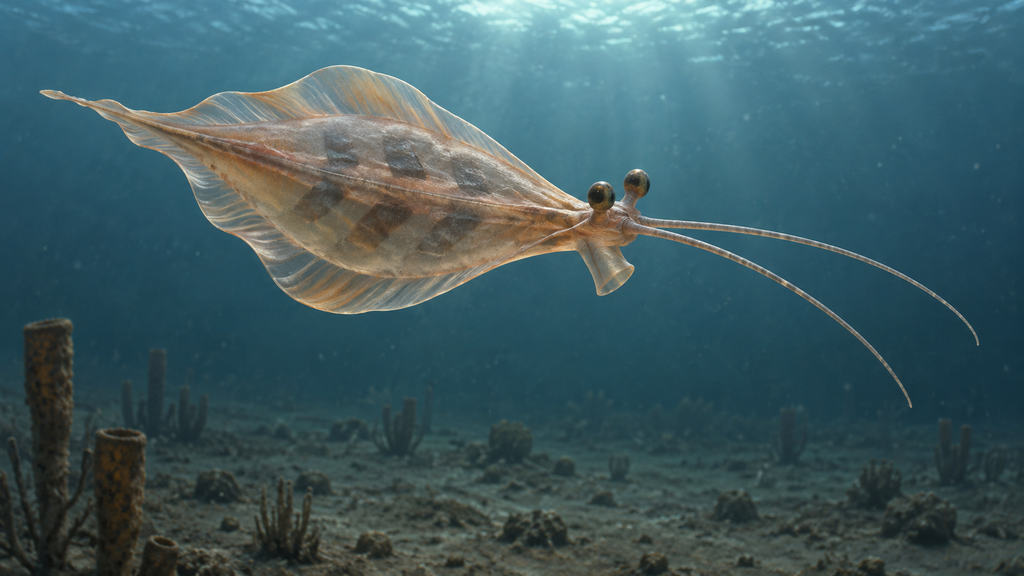
Nectocaris was a predator that swam in the Cambrian sea, with a flattened body, a pair of tentacles and stalked eyes. Fins ran along both sides of the body, and a funnel-like structure sat beneath the head. In the half century since its description in 1976, the interpretation of what it was changed three times — a shrimp-like arthropod, a chordate, the oldest squid — and a 2025 study proposed that it lies close to the ancestry of the arrow worms.
Form and way of life
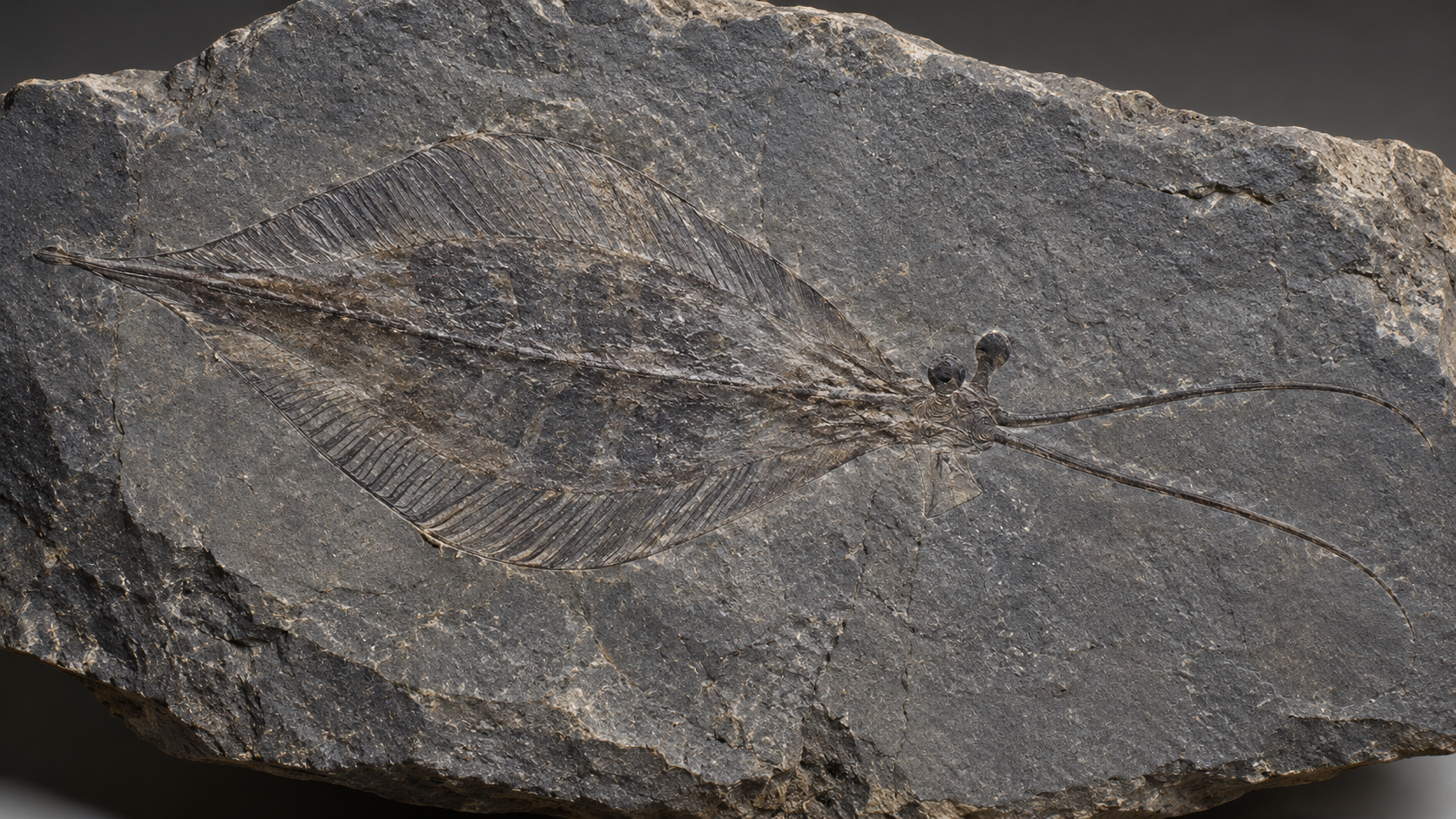
The body is dorsoventrally flattened and, seen from above, shaped like a kite with a pointed tip. The head is small, with large eyes at the ends of a pair of stalks projecting forward, and a pair of long tentacles extending from beside them. Fleshy fins run along both sides of the body like a border, and the animal swam by undulating them. Beneath the head is a tubular structure, widening toward its opening into the shape of a funnel. A gut runs down the middle of the body, with blocks of muscle arranged around it, and a pair of gills lay on the ventral side.
This anatomy came to light when about 90 specimens from the Burgess Shale in Canada were re-examined in 2010. The Burgess Shale is hardened mud about 508 million years old, in which the bodies of animals without shells or bones survive as flattened films. Nectocaris fossils preserve even the striations of the fin musculature and the outlines of the eyes.
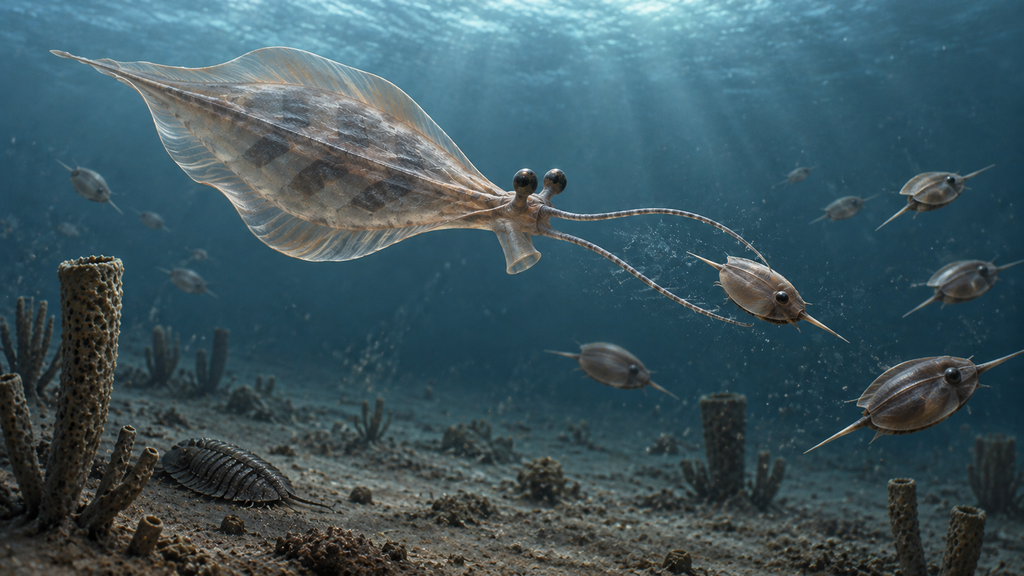
Its way of life is taken to be a predator swimming above the seafloor, or a scavenger working over carcasses. It caught prey with its tentacles and carried it to the mouth, watching its surroundings with large eyes. Estimates put the resolution of those eyes close to that of a living nautilus if they lacked lenses, and close to a living squid if they had them. Body size falls into two clearly separated classes, about 3 cm and about 10 cm, and it has been suggested this reflects a difference between the sexes.
The same strata yield the familiar Cambrian cast: trilobites, Anomalocaris, Hallucigenia and Opabinia. Petalilium from Chengjiang in China and Vetustovermis from Emu Bay in Australia closely resemble it in form and are considered either the same genus as Nectocaris or very close relatives.
Three changes of identity
A single Nectocaris fossil was collected in the 1910s by Charles Walcott, who discovered the Burgess Shale; he photographed it and it went unstudied. It was formally described in 1976, when Simon Conway Morris of the UK reported it as a new genus and species on the basis of that one specimen. The specimen was incomplete, flattened on its side, with no counterpart slab. Early study read it as having a shell-like oval structure behind the eyes, followed by a finned tail. Treated as an animal that fit no group — the front half looking like a shrimp-like arthropod, the back half like a fish-like chordate — it became one of the “weird creatures” Stephen Jay Gould introduced in Wonderful Life in 1989.
In 1981 a view emerged treating it as a primitive crustacean, and that was carried forward in much of the literature. In 1988 the Italian zoologist Alberto Simonetta, working from photographs alone, proposed a chordate affinity on the grounds that the construction of the tail resembles a lancelet. Reconstructions from this period show it with a shrimp-like shell over the head and the rear half tapering like a fish.
What overturned that view was a study published in Nature in 2010 by Martin Smith and Jean-Bernard Caron of the Royal Ontario Museum and the University of Toronto. Examining 91 new specimens the museum had accumulated over thirty years, they found that individuals flattened from above showed not a shell but a soft funnel. The oval read as a shell on the head was that funnel folded sideways. From the combination of a funnel, large stalked eyes, a pair of tentacles and fins along both sides of the body, the two concluded that Nectocaris was an early member of the cephalopods, the group leading to squid and octopus. The tentacles numbered only two, rather than the eight or ten of living forms, and the animal was interpreted as swimming by jetting water from the funnel. The claim was that the appearance of cephalopods reached back more than 30 million years earlier than had been thought, and moreover began from a shell-less ancestor.
This “oldest squid” hypothesis drew criticism immediately after publication. In 2011 came a series of objections: it has neither the radula nor the shell characteristic of cephalopods, and the funnel faces the wrong way to be used for jet propulsion. Studies examining cephalopod origins by combining the fossil record, molecular phylogeny and developmental evidence support an origin from a shelled ancestor, which does not fit a scenario placing the shell-less Nectocaris at the base. In a 2013 paper, Smith revised his position, allowing that Nectocaris may have lost a shell secondarily and that its squid-like appearance might be convergence, while maintaining the cephalopod affinity. Even so, a 2022 Bayesian phylogenetic analysis of cephalopod origins also excluded Nectocaris from the cephalopods. At that point, nothing could be said about Nectocaris with confidence beyond its being a bilaterian.
2025: toward the ancestry of arrow worms
What proved decisive were new fossils from Sirius Passet in northern Greenland. These strata, about 519 million years old, are known for preserving not only soft bodies but guts, muscle and sometimes nerves. In 2025, an international team led by Jakob Vinther of the University of Bristol examined 25 nectocaridid specimens from the site and reported them in Science Advances as Nektognathus evasmithae.
On the ventral side of these fossils, a pair of arch-shaped structures replaced by phosphate was preserved. The team interpreted these as a large ganglion on the underside of the body. Among living animals, only the chaetognaths — the arrow worms — have a large ganglion of this shape ventrally. The same structure is present in Timorebestia, a giant arrow worm ancestor previously reported from the same strata, and in Amiskwia from the Burgess Shale. Nektognathus additionally has a jaw apparatus resembling that of gnathiferans, fins along both sides of the body, an anus positioned short of the body’s end, and large antennae — all features shared with Timorebestia and Amiskwia. Phylogenetic analysis placed the nectocaridids near the base of the lineage leading to arrow worms. Support values in the analysis were not high, however, and the team presents this as a strong hypothesis rather than a settled result.
Carapaces of the contemporaneous swimming arthropod Isoxys were found in the guts of several individuals, confirming that the animal was a carnivore that swam and caught prey. Living arrow worms are transparent plankton a few centimeters long that seize small prey with head spines. Their ancestral lineage, it turns out, included predators with large eyes and tentacles that sat far higher up the food chain. A fossil named “swimming shrimp,” taken for a fish and called a squid, settled after half a century on the arrow worm side.
Sources
Vinther, J. et al. (2025). A fossilized ventral ganglion reveals a chaetognath affinity for Cambrian nectocaridids. Science Advances 11(30). https://doi.org/10.1126/sciadv.adu6990
Smith, M.R. & Caron, J.-B. (2010). Primitive soft-bodied cephalopods from the Cambrian. Nature 465, 469–472. https://doi.org/10.1038/nature09068
Smith, M.R. (2013). Nectocaridid ecology, diversity and affinity: early origin of a cephalopod-like body plan. Paleobiology 39(2), 297–321. https://doi.org/10.1666/12029
Mazurek, D. & Zatoń, M. (2011). Is Nectocaris pteryx a cephalopod? Lethaia 44(1), 2–4. https://doi.org/10.1111/j.1502-3931.2010.00253.x
Runnegar, B. (2011). Once again: is Nectocaris pteryx a stem-group cephalopod? Lethaia 44(4), 373. https://doi.org/10.1111/j.1502-3931.2011.00296.x
Kröger, B., Vinther, J. & Fuchs, D. (2011). Cephalopod origin and evolution: A congruent picture emerging from fossils, development and molecules. BioEssays 33(8), 602–613. https://doi.org/10.1002/bies.201100001
Pohle, A. et al. (2022). Early cephalopod evolution clarified through Bayesian phylogenetic inference. BMC Biology 20, 88. https://doi.org/10.1186/s12915-022-01284-5
Royal Ontario Museum (2010). ROM Burgess Shale collection solves 500 million-year-old mystery. https://www.rom.on.ca/news-releases/rom-burgess-shale-collection-solves-500-million-year-old-mystery
University of Bristol / ScienceDaily (2025). 500-million-year-old “squid” were actually ferocious worms. https://www.sciencedaily.com/releases/2025/08/250825015709.htm
コメント