| Name | Hallucigenia, from the Latin hallucinatus, “hallucination, a wandering of the mind” |
| Classification | Panarthropod, lobopodian (family Hallucigeniidae) |
| Age | Cambrian (the Burgess Shale at about 508 million years ago, including Chengjiang species at about 518 million years) |
| Found in | British Columbia, Canada (the Burgess Shale); Yunnan Province, China (Chengjiang and Guanshan) |
| Length | 1 to 5 cm (most Burgess Shale specimens under 3 cm) |
| Legs | Ten pairs (the front three pairs slender and clawless; the rear seven pairs clawed) |
| Dorsal spines | Seven pairs |
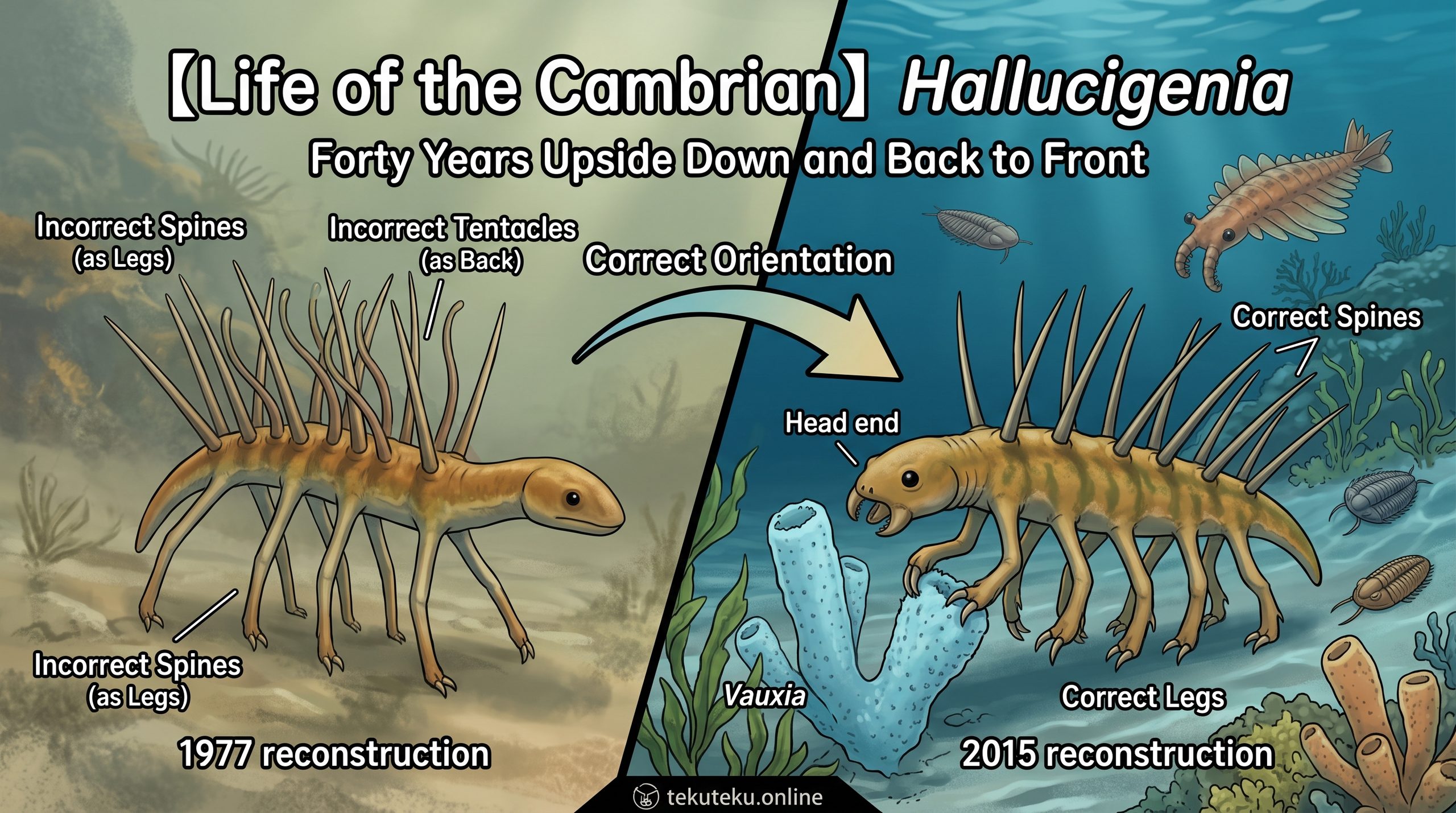
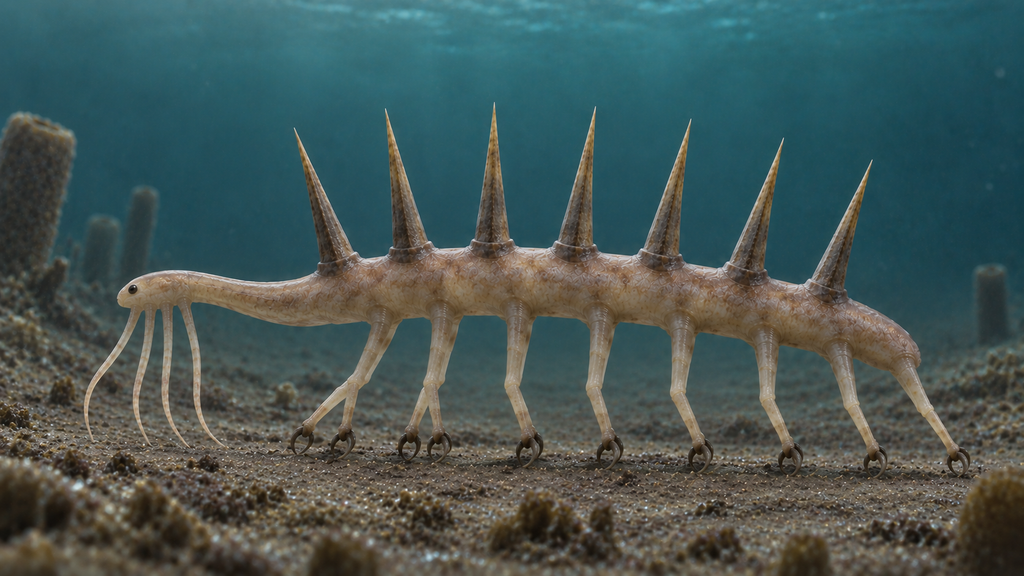
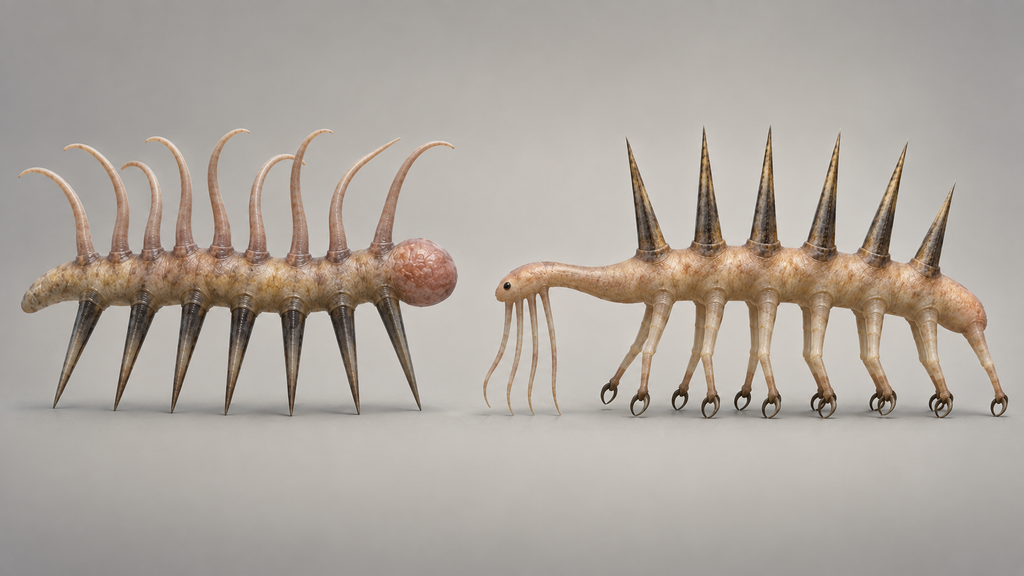
Hallucigenia was a lobopodian that lived on the Cambrian seafloor. Along the underside of its slender body ran ten pairs of clawed legs, and along the top, seven pairs of hard spines. In the reconstruction published in 1977, this animal was drawn upside down and back to front: walking on the spines, with a row of tentacles on its back, and the tail end taken for the head. Getting it the right way round took nearly forty years.
Form and way of life
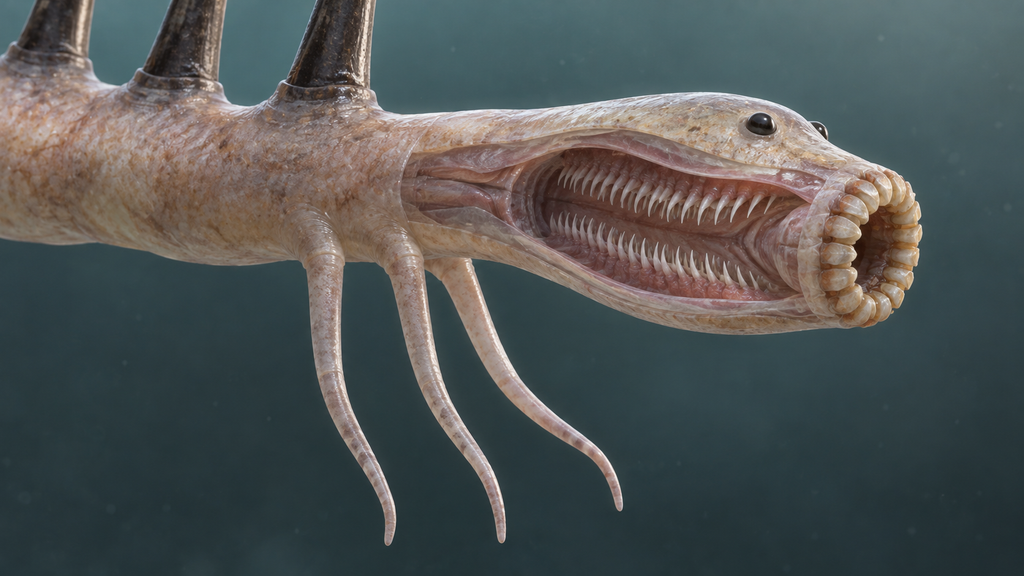
The body is a slender tube, one end of which extends into a long neck and head. The head bears a pair of simple eyes and a mouth, ringed by small plates, with the interior of the throat lined by countless fine teeth. Three pairs of slender, soft legs are arranged around the neck, followed along the trunk by seven pairs of long legs. Those seven pairs end in one or two claws, and seven pairs of spines stood on the back, corresponding in position to the legs. The spines grew as if embedded in sheaths of skin, and there is no spine above the last pair of legs.
The structure of the claws was examined in detail in a 2014 study. Each claw is not a single core but a nested structure of stacked cones — exactly the construction found in the claws and jaws of living velvet worms (onychophorans). On the basis of this shared feature, Hallucigenia came to be placed in a lineage leading to the ancestry of velvet worms. Since 2017, however, analyses have also appeared placing hallucigeniids nearer the base of the panarthropods, and its phylogenetic position is still not settled on a single answer.
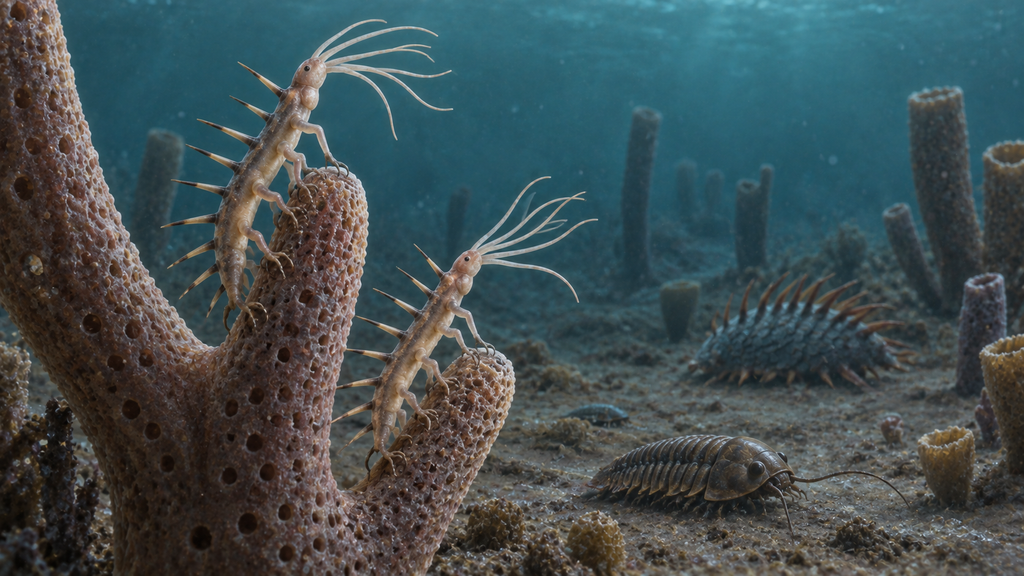
Its way of life is inferred from how the fossils occur and from the construction of the body. Burgess Shale Hallucigenia are often found together with the sponge Vauxia and fragments of other organisms, and an old interpretation has it gripping sponges with its claws, defended by its spines, and feeding on them. More recently, a view has emerged in which the three front pairs of slender legs were used for filtering: the animal gripped a sponge, held its body upright, and strained organic matter from the water. It is a rare animal in the Burgess Shale — only about 0.2 percent of the specimens counted at the Walcott Quarry, the representative locality.
The sea of the same age held Anomalocaris, Opabinia, trilobites and Wiwaxia. Among fellow lobopodians, Aysheaia comes from the same strata. Other species have been reported as well — Hallucigenia fortis from Chengjiang and Hallucigenia hongmeia from Guanshan in China — showing that this group was widely distributed in the Cambrian sea.
Born as an animal that walked on spines
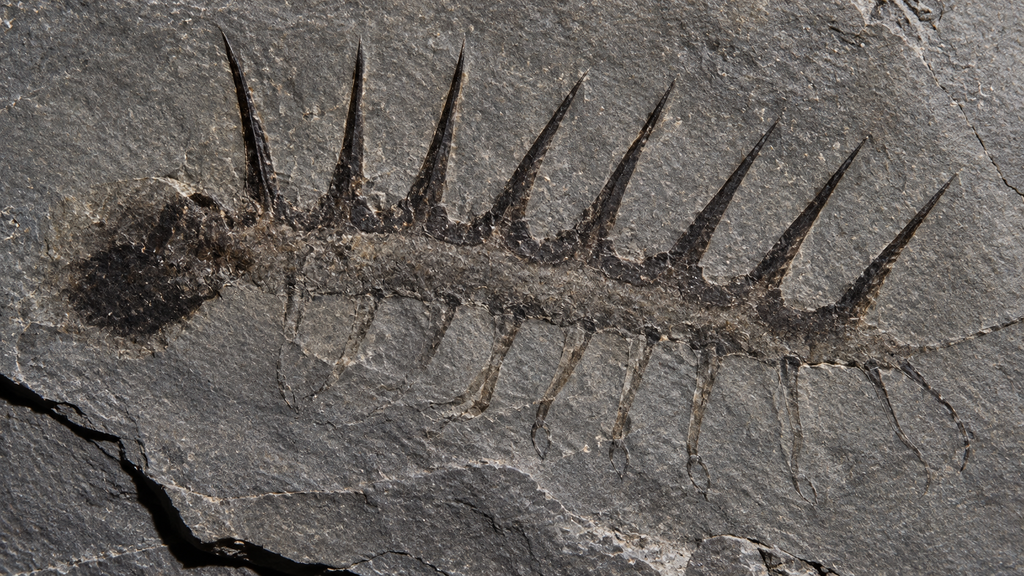
The first description came in 1911. Charles Walcott, who discovered the Burgess Shale, published the fossil as a polychaete worm species, Canadia sparsa. The fossils showed little but the spines, and no further examination was made at the time.
In 1977, Simon Conway Morris re-examined the fossil, showed that it was neither a polychaete nor a member of Canadia, and gave it the new genus name Hallucigenia. Because the seven pairs of hard spines appeared to grow downward from the body, Conway Morris interpreted them as legs. The animal stood on the seafloor on stilt-like spines, with a single row of soft tentacles along its top, taking food with their tips. A swollen mass at one end of the body was taken for the head. The genus name, meaning hallucination, comes from the strangeness of this figure.
Viewed from the fossils, the reconstruction strained. The spines are hard and do not bend, merely tapering to a point, with no structure for gripping the seafloor. The tentacles formed only one row, which is hard to account for in a bilaterally symmetrical animal. Yet there was no evidence supporting another interpretation, and this figure was used in field guides and displays for more than a decade.
A reconstruction flipped twice
The first reversal came from fossils in China. In 1991, Lars Ramsköld and Hou Xianguang described Microdictyon, a lobopodian from the Chengjiang fauna in Yunnan Province. This animal had soft legs arranged in pairs, with hard plates on its back corresponding in position to those legs. From this the two inferred that Hallucigenia was built on the same plan: the spines taken for legs were dorsal defenses, what had been taken for tentacles were the legs, and there should have been two rows of legs rather than one. The second row, they explained, was hidden within the rock, buried when the fossil was flattened.
The following year, 1992, Ramsköld examined Burgess Shale specimens directly and picked away the rock to expose the buried second row of legs. That settled the orientation top to bottom. In a paper the same year, Ramsköld proposed a second reversal as well: that the swollen mass taken for the head was not part of the body but a stain of decay fluid that had leaked out after death. If so, the head lay at the other end, the one drawn out into a long extension.
That front-to-back reversal was confirmed with evidence in 2015. Martin Smith and Jean-Bernard Caron examined 132 Burgess Shale specimens under the electron microscope and found, at the elongate end, a pair of simple eyes, a mouth ringed by plates, and a toothed throat. On the side with the swollen mass, traces were confirmed of decay fluid issuing from the anus. Only at that point was it finally settled which end of an animal described in 1911 was its head, and how many legs it had.
Only the name remains
With the reversals of the reconstruction, the taxonomic position of Hallucigenia changed as well. Under the 1977 reconstruction it was treated as an animal fitting no existing group, a representative of a body plan that appeared in the Cambrian and vanished. From 1991 it was placed as a lobopodian in the lineage leading to velvet worms, tardigrades and arthropods, and the 2014 study of the claws narrowed the relationship with velvet worms further.
Turned the right way up, Hallucigenia is a small animal geared toward defense, standing a row of spines along its back and gripping sponges with slender legs. The genus name, meaning hallucination, derives from the strangeness of that first reconstruction — a reconstruction no longer in use. The name alone remains, as a record of the years it spent upside down.
Sources
Royal Ontario Museum. The Burgess Shale: Hallucigenia sparsa.
https://burgess-shale.rom.on.ca/fossils/hallucigenia-sparsa/
Ramsköld, L. & Hou, X. (1991). New early Cambrian animal and onychophoran affinities of enigmatic metazoans. Nature, 351, 225–228.
https://doi.org/10.1038/351225a0
Ramsköld, L. (1992). Homologies in Cambrian Onychophora. Lethaia, 25, 443–460.
https://doi.org/10.1111/j.1502-3931.1992.tb01650.x
Smith, M. R. & Ortega-Hernández, J. (2014). Hallucigenia‘s onychophoran-like claws and the case for Tactopoda. Nature, 514, 363–366.
https://doi.org/10.1038/nature13576
Smith, M. R. & Caron, J.-B. (2015). Hallucigenia‘s head and the pharyngeal armature of early ecdysozoans. Nature, 523, 75–78.
https://doi.org/10.1038/nature14573
Caron, J.-B. & Aria, C. (2017). Cambrian suspension-feeding lobopodians and the early radiation of panarthropods. BMC Evolutionary Biology, 17, 29.
https://doi.org/10.1186/s12862-016-0858-y
コメント