This article contains affiliate links. As an Amazon Associate I earn from qualifying purchases.
| Name | Steller’s sea cow (Hydrodamalis gigas), named after the naturalist Georg Wilhelm Steller, who recorded it alive |
| Classification | Mammalia, Sirenia, Dugongidae |
| Age | Quaternary; extinct around 1768 |
| Found in | The Commander Islands in the Bering Sea (Bering Island and Medny Island). In the Pleistocene it ranged across the North Pacific, from Japan through the Aleutians to California |
| Length | Recorded at about 7.5 m; estimated at up to about 10 m |
| Weight | Recorded at about 4.5 to 5.9 tonnes; estimated at up to about 11 tonnes |
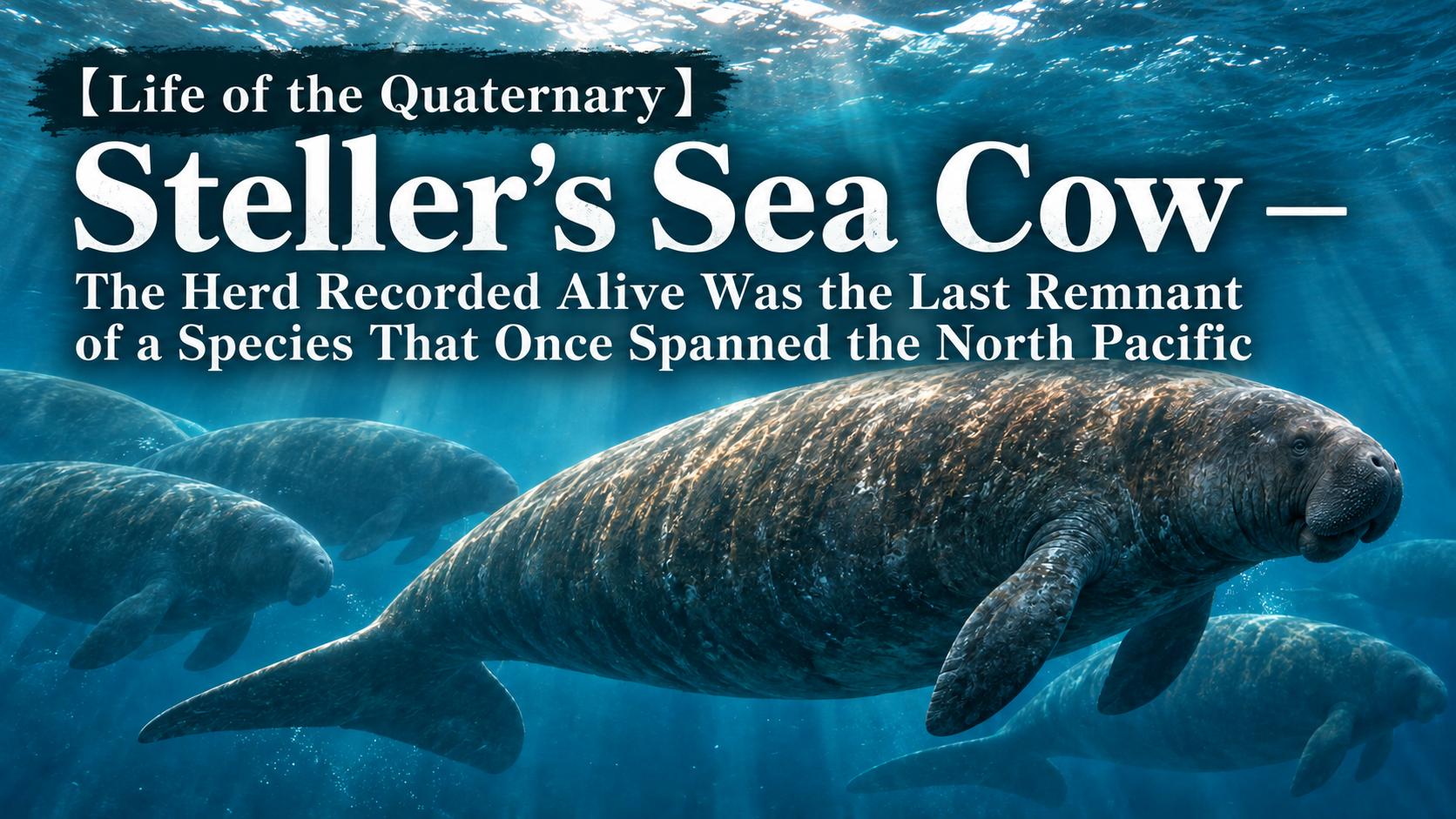
Steller’s sea cow was a giant marine mammal related to dugongs and manatees. In 1741 a shipwrecked expedition in the far North Pacific came upon herds of them grazing on seaweed along the shores of Bering Island. That was the only time a scientist observed and described the animal alive. About 27 years later, around 1768, the last one was killed and the species disappeared.
Appearance and Way of Life
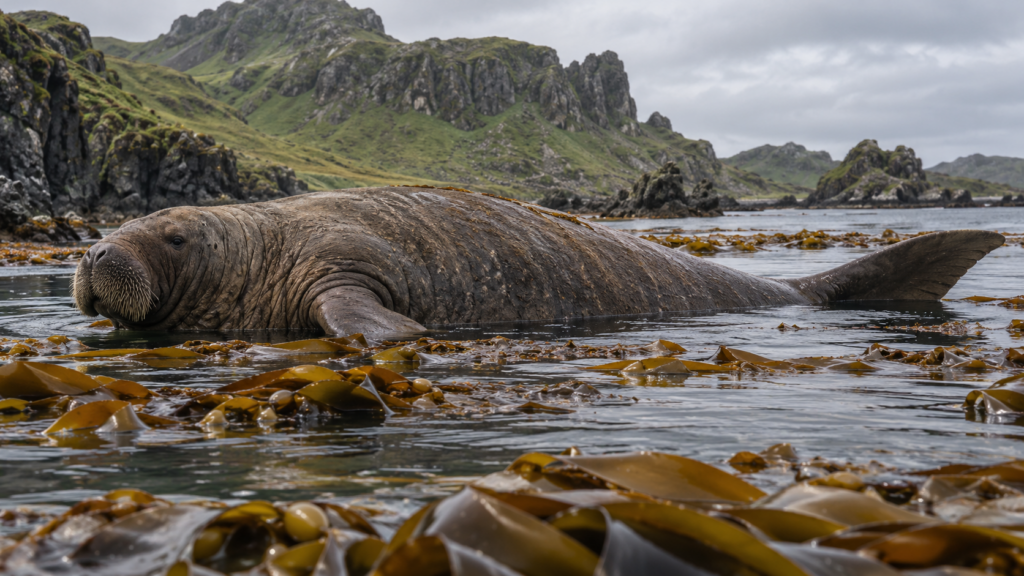
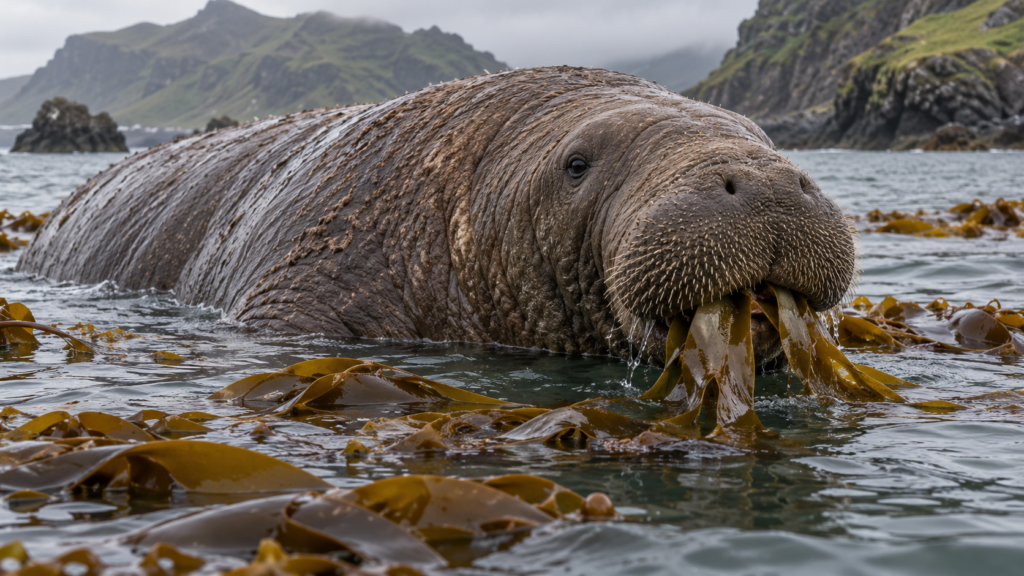
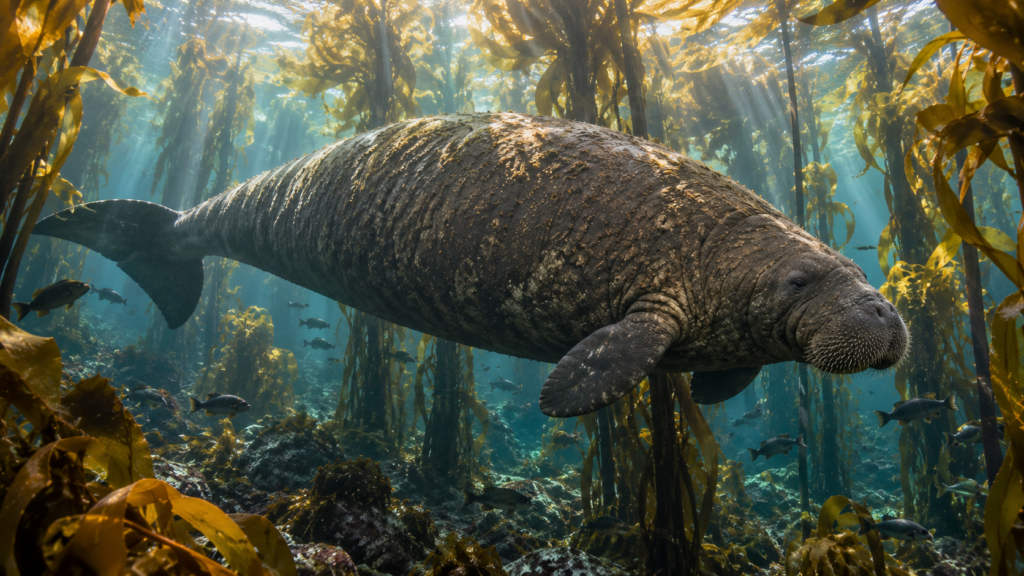
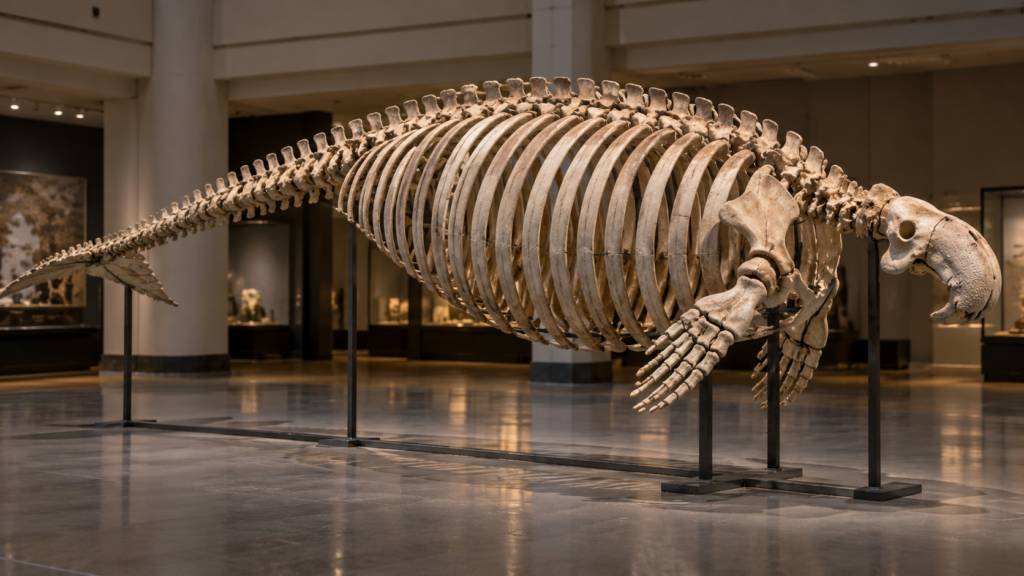
Steller’s sea cow was by far the largest member of the dugong family. Its body was a thick spindle shape, its front limbs were short flippers, it had no hind limbs, and its tail ended in a broad horizontal fluke. It had no teeth. Instead, thick horny plates on its upper and lower jaws ground up kelp and other large seaweeds.
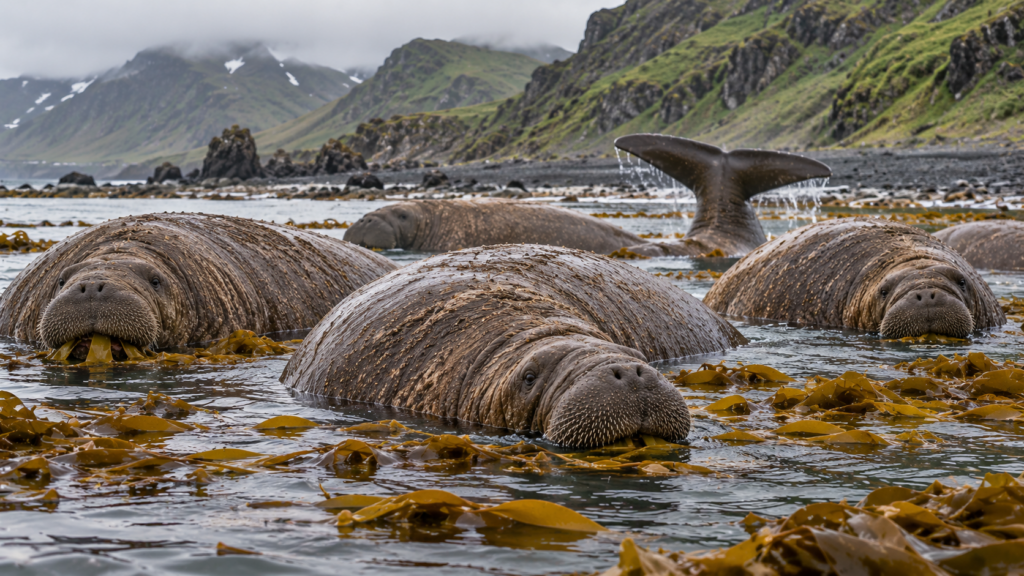
It lived in the shallow, seaweed-filled waters around sub-Arctic islands in the North Pacific. A layer of blubber about 10 cm thick lay under its skin, which made it very buoyant. It lived in groups, and Steller recorded that when a female was captured, a male followed her all the way to the shore.
The known measurements come from animals Steller measured himself: about 7.5 m long and roughly 4.5 to 5.9 tonnes. Some estimates put the largest individuals at 10 m and 11 tonnes, but a 2021 genome study concluded that the animals of the last Commander Islands population were considerably smaller than that maximum.
The species name gigas means “giant.” The German naturalist Zimmermann named it Manati gigas in 1780, and in 1794 the Swede Retzius erected the genus Hydrodamalis, based on Steller’s “sea cow.”
The Herd That Was Recorded Was the Last Remnant of a Species That Once Spanned the North Pacific
In 1741, a ship of Vitus Bering’s expedition for the Russian Empire, on its return voyage, ran aground on an uninhabited island east of the Kamchatka Peninsula, later named Bering Island. Bering died there, and the crew spent about nine months on the island, until August of the following year. During that time the ship’s surgeon and naturalist, Steller, observed the sea cows that crowded the island’s shores and measured their bodies part by part. His account was published in Latin in 1751 as De bestiis marinis (“On the Beasts of the Sea”), and it remains the only scientific description of the animal made from living specimens.
The sea otter pelts the expedition brought back caused a sensation, and fur hunters began to visit the Commander Islands. They killed the large, docile sea cows for food. The meat was said to taste like beef, and the fat was used as lamp oil. Around 1768, roughly 27 years after its discovery, the last sea cow was killed on Bering Island, and the species vanished from the record.
In 2006, Samuel Turvey of the Zoological Society of London and a colleague estimated the number of animals killed from the voyage records of the time and modeled the course of the extinction. Starting from the traditional estimate of 1,500 to 2,000 animals on the island, the model had them die out around 1756 to 1760; to last until 1768, the original population had to be about 2,900. The sustainable harvest was estimated at around 17 animals a year, but from 1743 to 1763 an average of about 123 a year were killed, roughly seven times that limit. The study concluded that human hunting alone was enough to explain the extinction.
Yet the herds of a couple of thousand animals that Steller saw were not a species native only to those small islands. Fossils and bones have been found around the North Pacific, including in Japan, the Aleutian Islands and California, showing that in the Pleistocene the species lived across a wide stretch of this ocean. A sea cow bone from St. Lawrence Island in Alaska, confirmed by DNA and dated to around 800 to 920 CE, raises the possibility that a separate population survived there until that time.
In 2021, a Russian research team sequenced the genome of Steller’s sea cow from bones found on Bering Island. Its genetic diversity was extremely low, comparable to that of the last mammoths that survived on Wrangel Island in the Arctic Ocean. The team traced the decline to a major population bottleneck about 400,000 years ago and concluded that the species had begun to fade long before humans reached the region. The herds Steller recorded were the last survivors of a species that had once spread across the North Pacific and had shrunk to the shores of a few islands.
Related products
You can find books and products related to this article on Amazon.
If you buy through the links above, this blog may earn a commission.
About the images
The images in this article are illustrations created with AI (ChatGPT), and you are welcome to use them. If you do, we would appreciate a link back to this article as the source.
Sources
Turvey, S. T. & Risley, C. L. (2006). Modelling the extinction of Steller’s sea cow. Biology Letters 2, 94–97. https://doi.org/10.1098/rsbl.2005.0415
Sharko, F. S. et al. (2021). Steller’s sea cow genome suggests this species began going extinct before the arrival of Paleolithic humans. Nature Communications 12, 2215. https://doi.org/10.1038/s41467-021-22567-5
Crerar, L. D. et al. (2014). Rewriting the history of an extinction—was a population of Steller’s sea cows (Hydrodamalis gigas) at St Lawrence Island also driven to extinction? Biology Letters 10, 20140878. https://doi.org/10.1098/rsbl.2014.0878
Natural History Museum. Steller’s sea cow: the first historical extinction of a marine mammal at human hands. https://www.nhm.ac.uk/discover/stellers-sea-cow-first-historical-extinction-of-marine-mammal-at-human-hands.html
Steller, G. W. The Beasts of the Sea (De Bestiis Marinis). Translated by Miller & Miller, edited by Royster (University of Nebraska–Lincoln, 2011). https://digitalcommons.unl.edu/zeabook/1
Sapporo City Museum Activity Center. Steller’s sea cow (in Japanese). https://www.city.sapporo.jp/museum/ouchimuseum/20221030.html

コメント