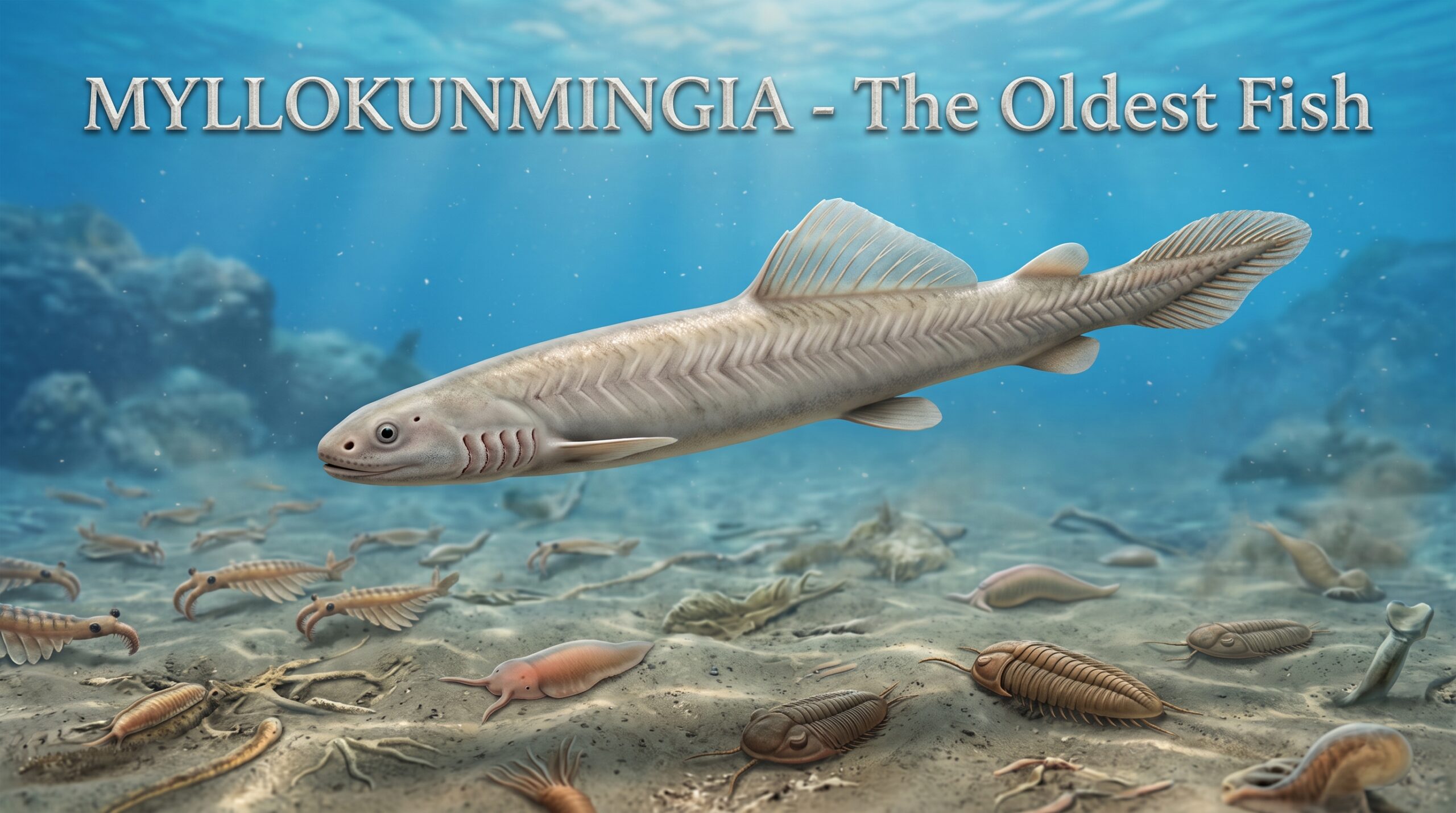
| Name | Myllokunmingia fengjiaoa, combining the Greek myllos (fish) with Kunming, the capital of Yunnan Province near the fossil locality. The species name comes from the Chinese fengjiao, “beautiful” |
| Classification | Phylum Chordata, jawless fish (family Myllokunmingiidae) |
| Age | Early Cambrian, Paleozoic (about 518 million years ago) |
| Found in | Ercaicun village, Haikou District, Kunming, Yunnan Province, China (the Chengjiang biota) |
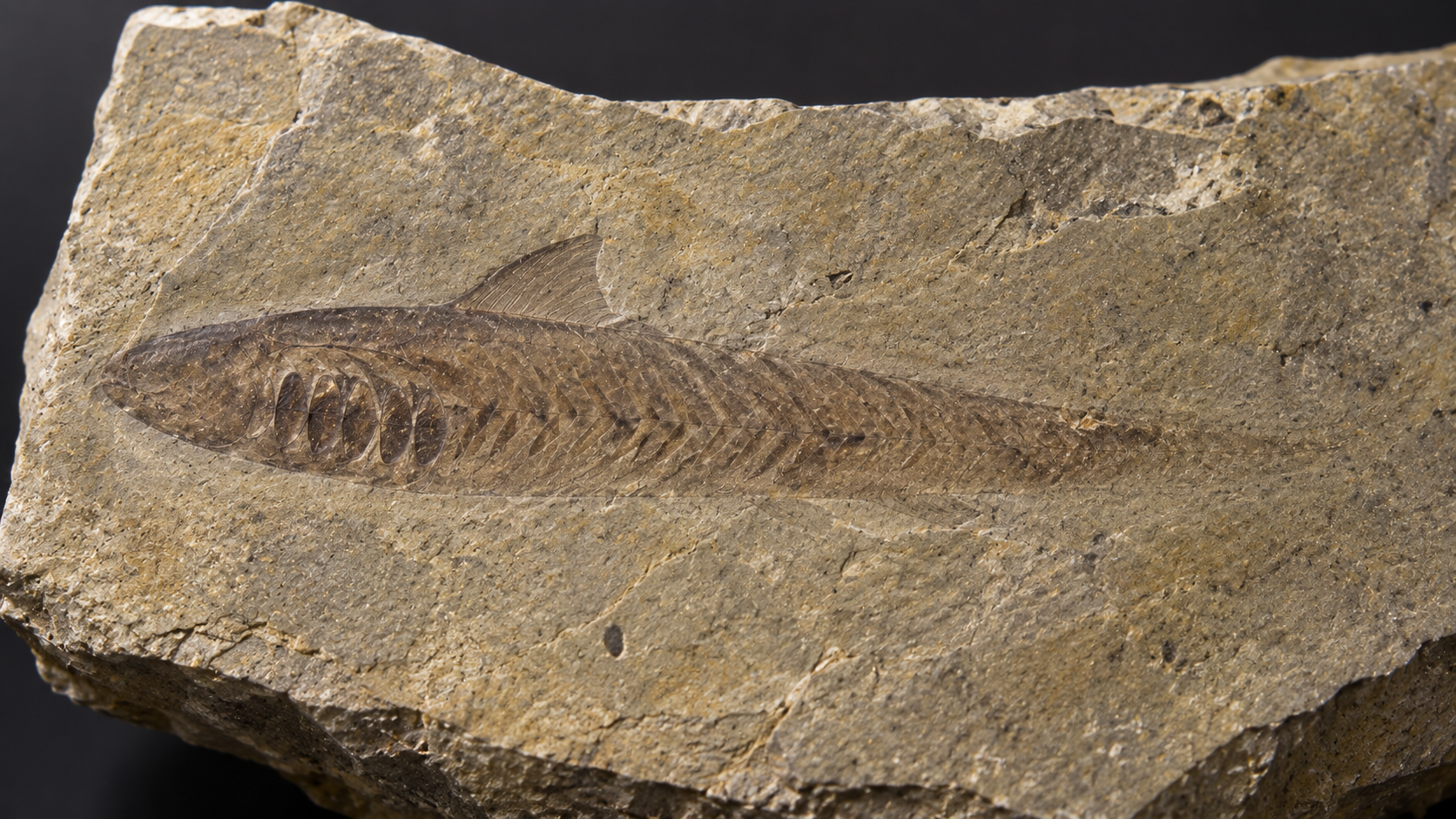
| Length | About 2.8 cm (the tip of the tail is buried in the rock, so the animal was somewhat longer) |
| Body height | About 6 mm |
| Weight | Under 1 g (approximated from small fish around 3 cm long; no published estimate exists) |
| Known specimens | One (only the holotype described in 1999) |
Myllokunmingia was a primitive jawless fish living in the Early Cambrian sea. Reported in 1999 from strata at Chengjiang in Yunnan Province, China, it is positioned, together with Haikouichthys described in the same paper, among the oldest vertebrates known from reliable fossils. It is a fixture in textbooks and field guides as the oldest fish — and only one reliable specimen, the one used in the description, has ever been found.
Form and way of life
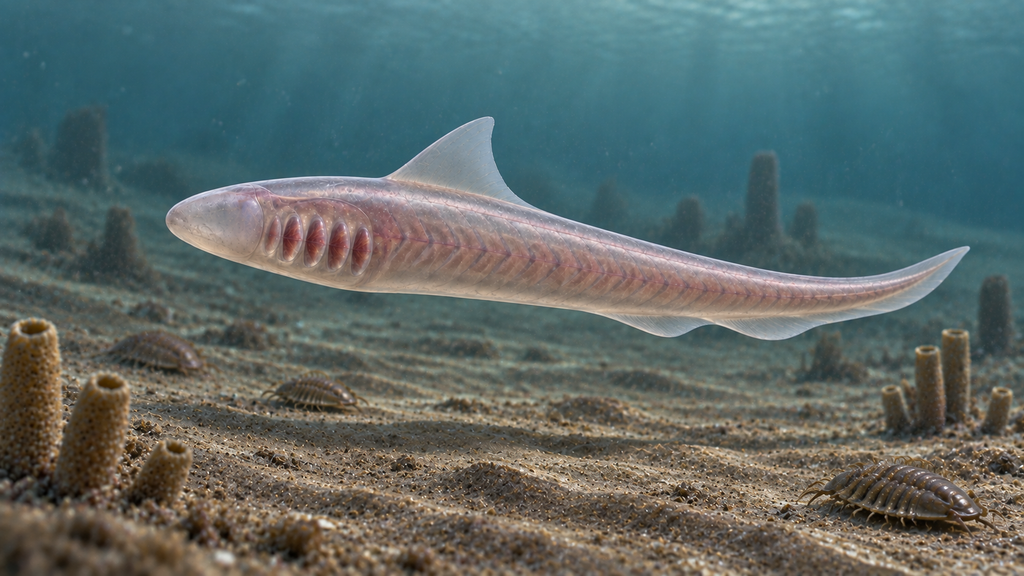
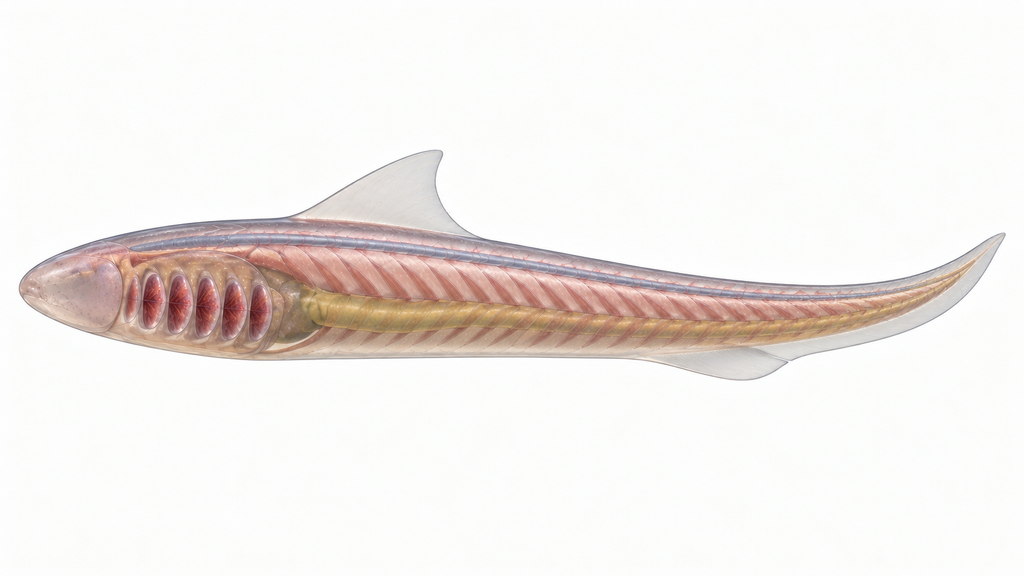
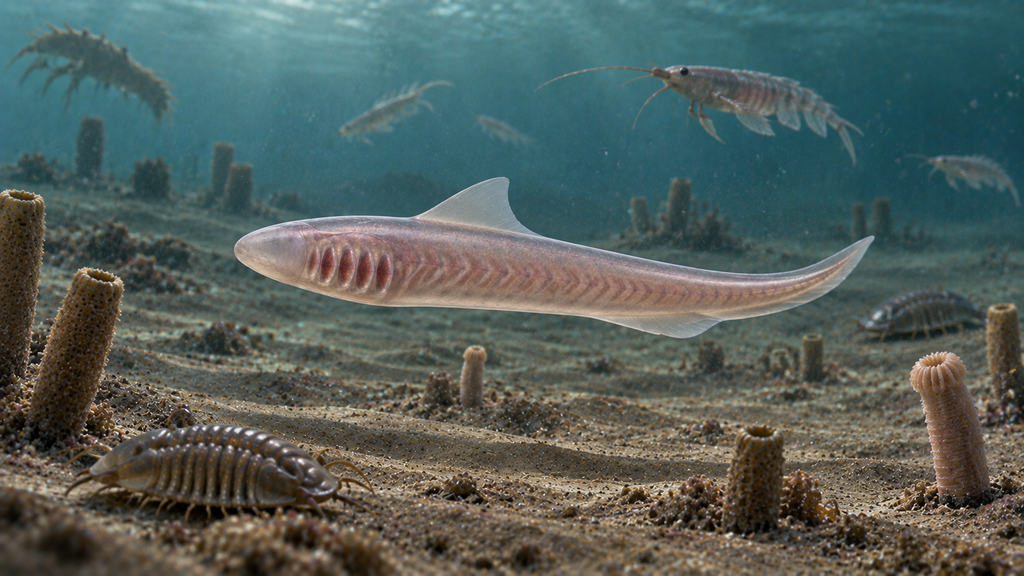
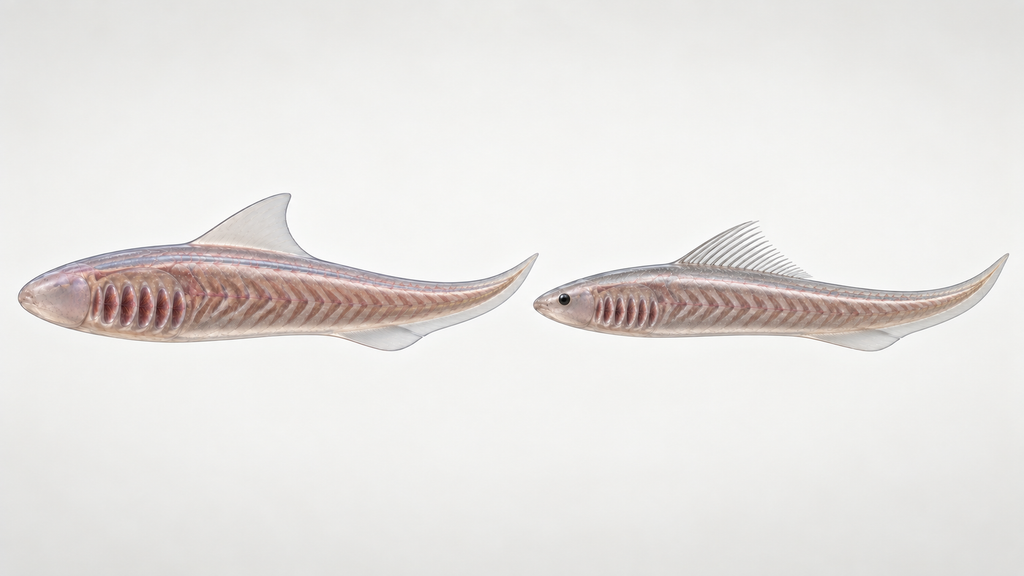
The body is a slender spindle, with a clear distinction between head and trunk. Toward the front of the back is a sail-like dorsal fin about 1.5 mm high, and along the rear of the underside runs a fin fold corresponding to a ventral fin, thought to have been paired. About 25 muscle blocks (myomeres) are arranged along the trunk, each forming a rearward-pointing double V. This is the same construction as the segmented flesh of living fish: muscle for swimming by flexing the body side to side. Five or six gill pouches are arranged in the head, each with a gill leaf known as a hemibranch. A notochord runs down the center of the body, and the gut continuing from the pharynx may have reached the rear end. There are also traces of what appears to be a pericardial cavity enclosing the heart. Where the mouth was cannot be determined from the fossil.
All of this information was read from the single fossil used in the 1999 description. That no fin rays (the fine supports within a fin) can be recognized, and that the number of gill pouches cannot be fixed, likewise follows from having one specimen with uneven preservation.
The Chengjiang sea of about 518 million years ago, where Myllokunmingia swam, was a shallow continental shelf into which fine mud flowed repeatedly. The seafloor held the trilobite Eoredlichia, priapulid worms, brachiopods and sponges, while relatives of Anomalocaris and numerous arthropods a few centimeters long swam in the water. At this point almost all marine life was still invertebrate, and Myllokunmingia and Haikouichthys were among the few that already had a vertebrate body. At just under 3 cm, with neither jaws nor paired fins, it was not a strong swimmer, and is thought to have stayed near the seafloor, straining small particles of organic matter and microbes through its gills. A pair of eyes has been confirmed in Haikouichthys from the same strata, but in the Myllokunmingia specimen the position of the eyes cannot be identified.
There is only one specimen
Myllokunmingia was described in “Lower Cambrian vertebrates from south China,” published in Nature in November 1999. The research team, led by Shu Degan of Northwest University in China, reported two fish-like animals in that paper as separate genera: Myllokunmingia, based on one specimen, and Haikouichthys, likewise based on one. The two species — same strata, same age, same size — were distinguished by the presence or absence of fin rays in the dorsal fin, the arrangement of the gills and the shape of the myomeres.
Their fates then diverged sharply. Specimens of Haikouichthys increased rapidly with further excavation, and in 2003 the details of its body — a pair of eyes, nostrils, vertebral elements — were revealed one after another on the basis of more than 500 fossils. Specimens of Myllokunmingia, meanwhile, have not increased beyond the one used in its description. Of the two species listed side by side in textbooks as the oldest fish, one has 500 specimens and the other has one.
Here a different research team raised an objection. In 2002, Hou Xianguang of Yunnan University, the discoverer of the Chengjiang biota, and colleagues examined a newly found specimen of a fish-like animal and reported that a single individual combined both the gill structure treated as diagnostic of Myllokunmingia and the features treated as diagnostic of Haikouichthys. What look like fin rays in the dorsal fin of Haikouichthys, they argued, are an appearance created by wrinkles in the rock and cannot serve as grounds for separating the genera. Hou and colleagues concluded that Myllokunmingia and Haikouichthys are the same species, the apparent differences amounting to no more than the degree to which the body broke down during fossilization.
If they are the same species, the names must be merged into one. Normally the earlier-published name survives, but because these two were described in the same paper on the same day, neither was published first. The rules of zoological nomenclature provide that in such a case the name chosen by the first researcher to treat them as identical takes precedence, and Hou and colleagues chose Myllokunmingia. Haikouichthys, with over 500 specimens, would be absorbed into the name of Myllokunmingia, which has one.
The original describers have not accepted this. Simon Conway Morris of the University of Cambridge, who joined Shu on the 1999 description, has continued to treat the two genera separately since the 2003 paper covering the 500 specimens, on the grounds of differences in gill arrangement, the presence of fin rays and the angle of the myomeres. Hou and colleagues, for their part, maintained the single-species position in their 2017 survey of the Chengjiang biota, treating Myllokunmingia, Haikouichthys and a third elongate fish-like animal from the same strata, Zhongjianichthys, as one animal preserved in different states of decay, and describing all three under the name Myllokunmingia.
Settling the dispute requires a second specimen of Myllokunmingia. There is a limit to what can be read from a single fossil, so whether its features really differ from those of Haikouichthys cannot be judged without comparing specimens preserved in the same state. Excavation at Chengjiang continues, but almost all fish-like fossils found since 1999 have been treated as Haikouichthys. Whether the name Myllokunmingia remains the name of a fish known from one specimen, or becomes the formal name of a fish known from 500, is undecided a quarter of a century after its description.
Sources
Shu, D.-G. et al. (1999). Lower Cambrian vertebrates from south China. Nature 402, 42–46. (the description of Myllokunmingia and Haikouichthys)
https://doi.org/10.1038/46965
Hou, X.-G. et al. (2002). New evidence on the anatomy and phylogeny of the earliest vertebrates. Proceedings of the Royal Society B 269, 1865–1869. (the paper treating the two genera as one species)
https://doi.org/10.1098/rspb.2002.2104
Shu, D.-G. et al. (2003). Head and backbone of the Early Cambrian vertebrate Haikouichthys. Nature 421, 526–529. (the study of over 500 Haikouichthys specimens)
https://doi.org/10.1038/nature01264
Zhang, X.-G. & Hou, X.-G. (2004). Evidence for a single median fin-fold and tail in the Lower Cambrian vertebrate, Haikouichthys ercaicunensis. Journal of Evolutionary Biology 17, 1162–1166. (noting that Myllokunmingia rests on a single specimen)
https://doi.org/10.1111/j.1420-9101.2004.00741.x
Hou, X.-G. et al. (2017). The Cambrian Fossils of Chengjiang, China: The Flowering of Early Animal Life. Wiley. (the survey merging three genera into Myllokunmingia)
https://doi.org/10.1002/9781118896372
Yang, C. et al. (2018). Geochronological constraint on the Cambrian Chengjiang biota, South China. Journal of the Geological Society 175, 659–666. (the age of the Chengjiang biota)
https://doi.org/10.1144/jgs2017-103
コメント