| Name | Triceratops (“three-horned face”) |
| Classification | Ornithischia, Ceratopsia, Ceratopsidae, Chasmosaurinae |
| Age | End of the Cretaceous (late Maastrichtian, about 68–66 million years ago) |
| Where found | Western North America (Montana, Wyoming, South Dakota, North Dakota and Colorado in the United States; Saskatchewan and Alberta in Canada) |
| Length | About 8–9 m |
| Skull length | Around 2.5 m including the frill (about 2.6 m in the largest specimens) |
| Weight | Estimated 6–9 t (some estimates put the largest individuals above 10 t) |
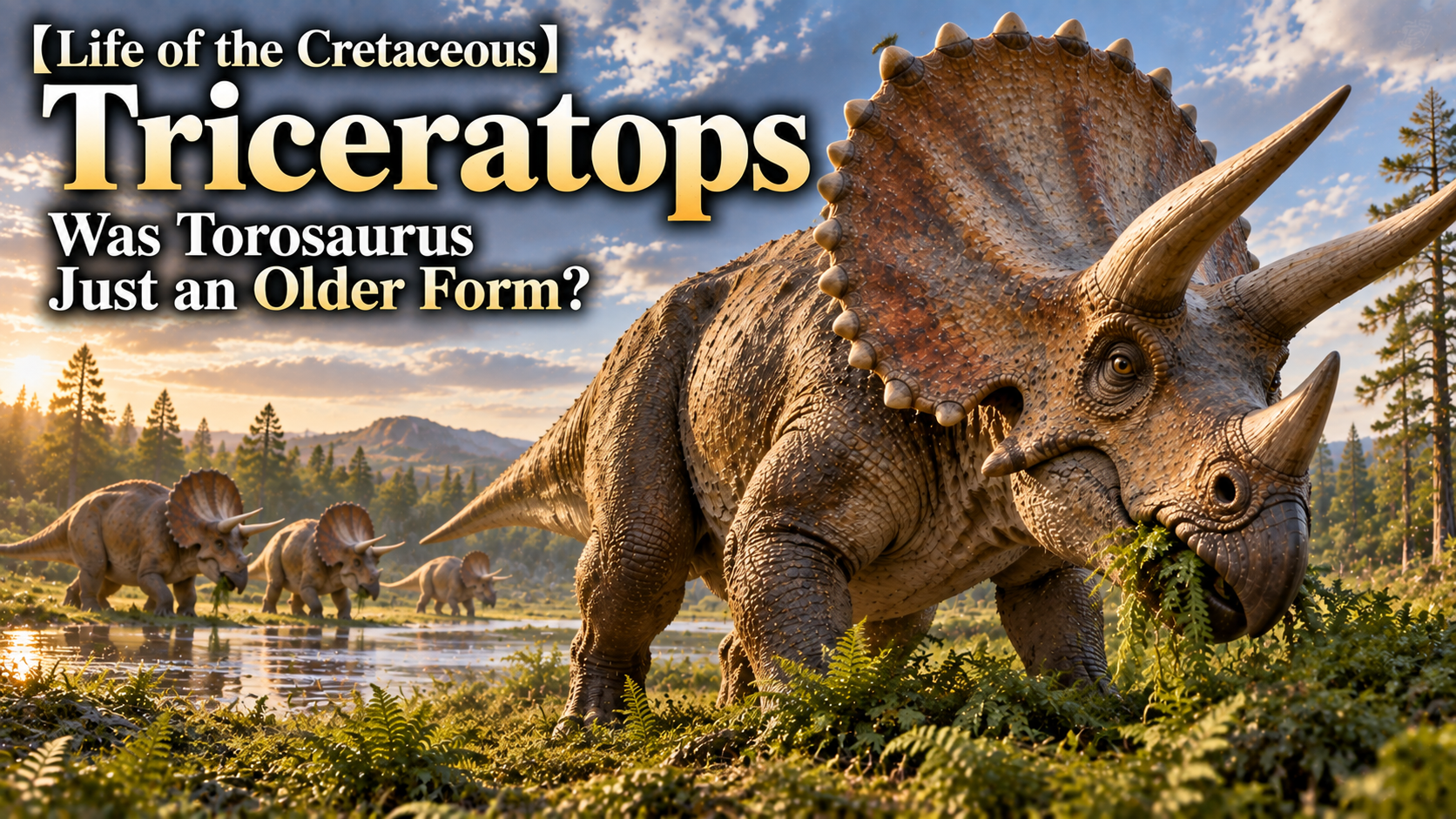
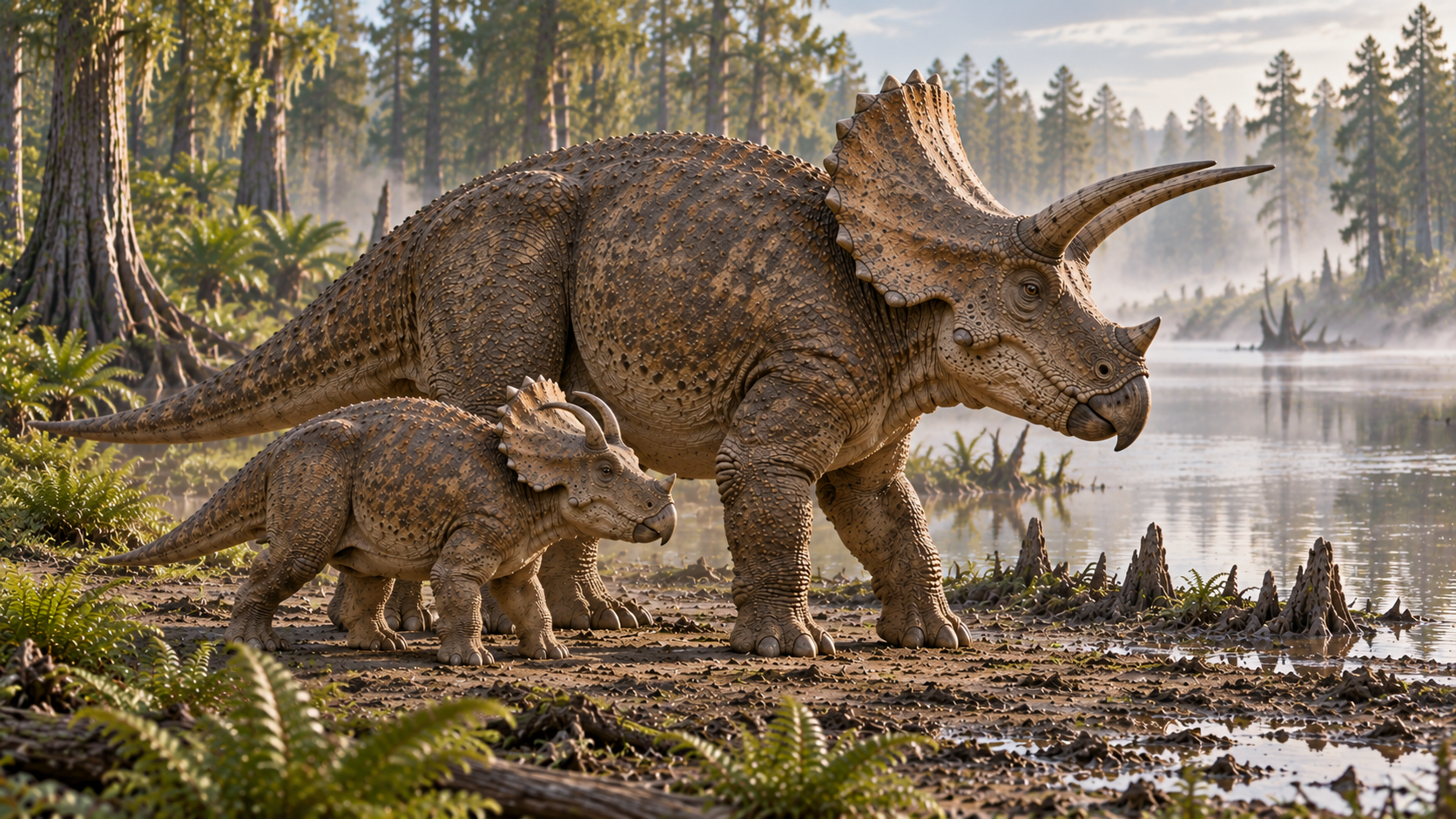
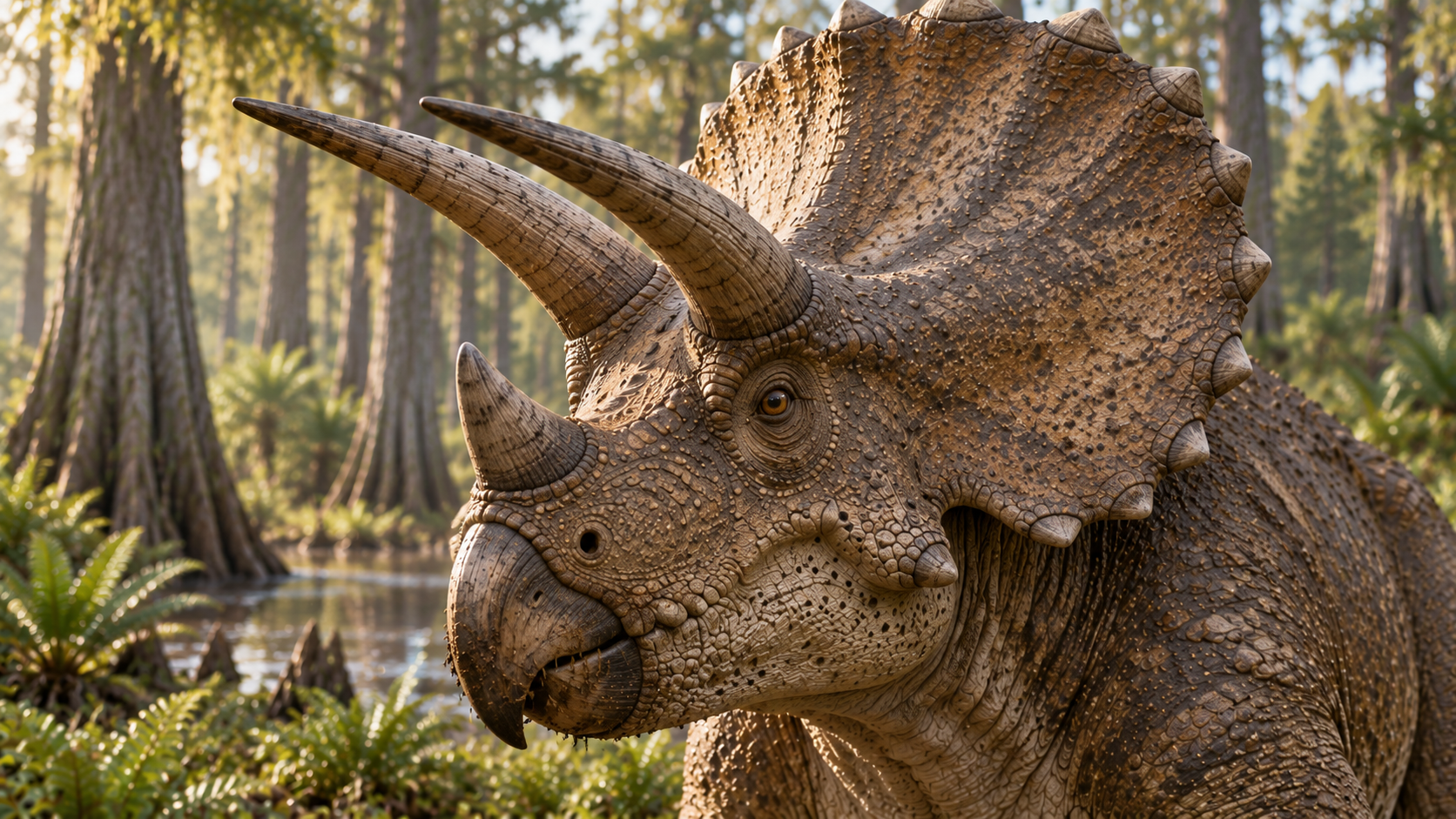
Triceratops was a large horned dinosaur (ceratopsian) that lived in North America during the very last stretch of the Cretaceous. It had two long horns above the eyes, a shorter horn on the snout, and a broad bony collar, or frill, projecting from the back of the skull; the head alone was about as long as a small car. It is the signature plant-eater of the final million-odd years of the age of dinosaurs, and one of the most commonly found dinosaurs in rocks of that age in western North America. In 2010, researchers proposed that the closely related Torosaurus was in fact an aged Triceratops, and the question remains unsettled.
Appearance and way of life
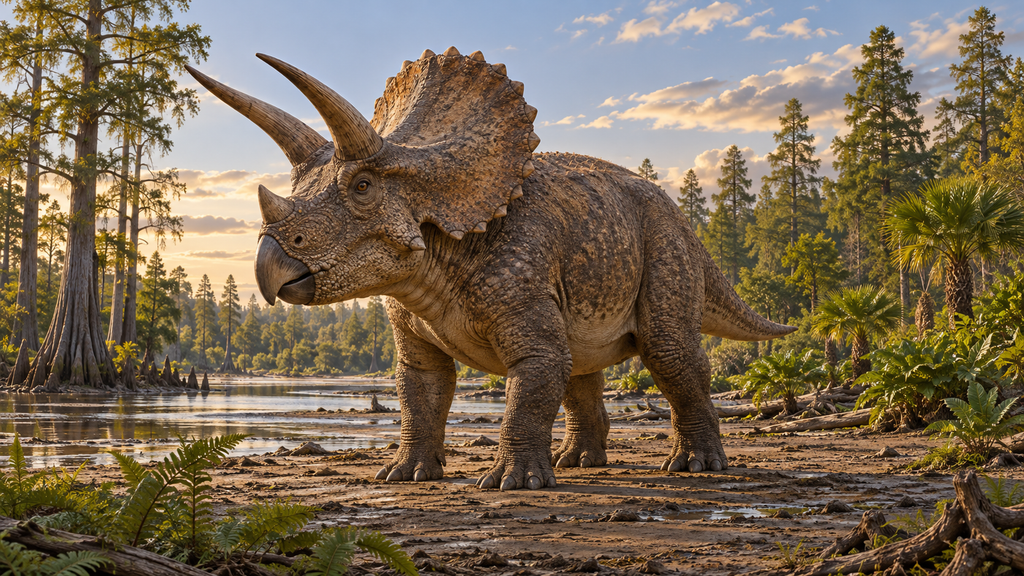
Triceratops was a heavily built animal that walked on four legs. The forelimbs were somewhat shorter than the hindlimbs, suiting a posture with the head held low. The tail was fairly short, and the body was carried on thick, elephant-like legs. The skull is among the largest of any land animal, living or extinct, and about a third of it is frill. The frill is a single plate of bone and, unlike that of most other ceratopsids, has no large openings (fenestrae). The two brow horns reached a metre in length; the nose horn was shorter and thicker. The surface of the horn cores preserves traces of blood vessels, so in life they are thought to have been covered by a keratin sheath, as in cattle, making them longer and sharper than the fossils suggest.
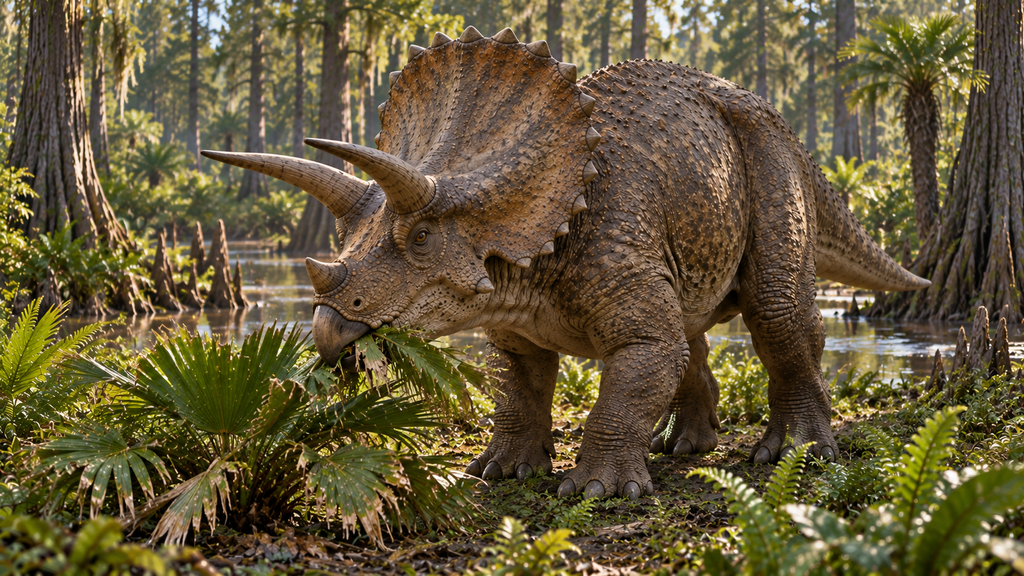
Its food was plants. The front of the mouth was a pointed bony beak, much like a parrot’s, and behind it sat dental batteries: on each side of each jaw, dozens of vertical columns of teeth, with several teeth stacked in every column. Replacement teeth waited beneath the ones in use and were pushed up in turn as those wore down, so the mouth held several hundred teeth in total. When the jaws closed, the upper and lower teeth moved past each other like crossing blades, slicing tough, fibrous plants. By this time the plains of western North America already carried broadleaf trees and palms, along with stands of ferns, cycads, bald cypress and dawn redwood. Given how low it held its head, Triceratops is thought to have fed mainly on low shrubs and ferns near the ground. There were no grasslands yet.
Its home was the lowland of rivers, forests and swamps typified by the Hell Creek Formation, which stretches from present-day Montana into the Dakotas. The same rocks have yielded Tyrannosaurus, Ankylosaurus, Pachycephalosaurus and Edmontosaurus, among others. A Triceratops hip bone bearing Tyrannosaurus tooth marks shows that it was on the receiving end of attacks. Whereas many horned dinosaurs turn up in bonebeds containing the remains of dozens of animals, Triceratops is usually found as single individuals, and some researchers take this to mean it did not form large herds. In 2009, however, three juveniles were reported buried together in Montana, raising the possibility that young animals lived in small groups.
What the horns and frill were for
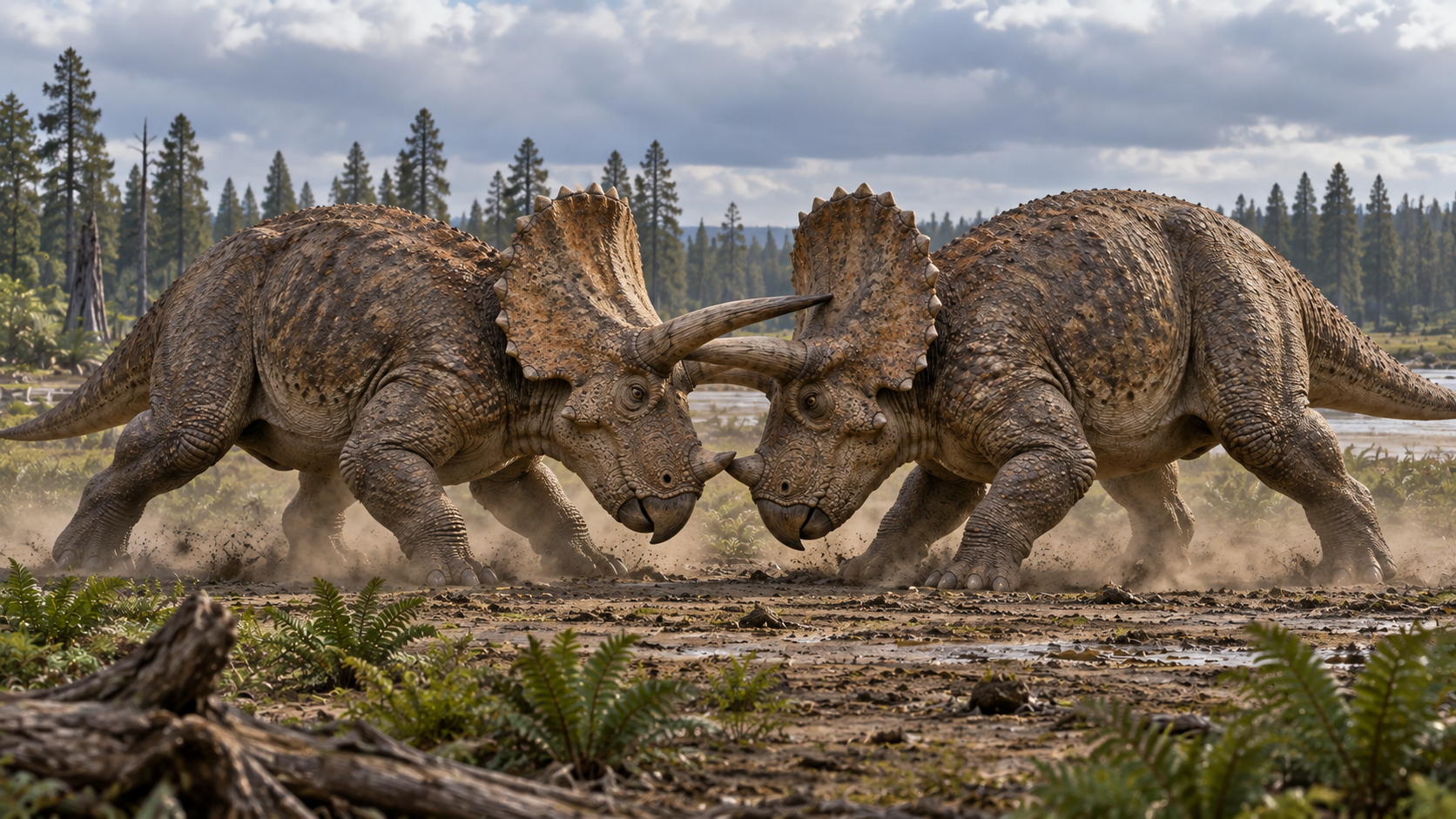
The purpose of the horns and frill has been argued over for a long time. Suggestions include defence against predators, fighting between members of the same species, display to rivals or mates, and temperature regulation. A study published in 2009 tested one of these, horn-to-horn combat within the species, by looking at where injuries occur on the skull. It compared skulls of Triceratops with those of Centrosaurus, a relative with a large nose horn and small brow horns. Among the nose, cheek and frill bones, only one, the squamosal, which runs from behind the eye to form the lower part of the frill, showed significantly more injuries in Triceratops. When two animals lower their heads and lock horns, that is exactly where an opponent’s long brow horns would land. The pattern fits the idea that Triceratops used its horns as weapons and its frill as a shield. It does not rule out display, and the current view is that the horns and frill served both purposes.
The first fossil was mistaken for a bison
The first fossil to be described consisted of two brow horn cores and part of a skull found near Denver, Colorado. In 1887 the palaeontologist Othniel Charles Marsh, famous for the Bone Wars, judged them to be the horns of a large bison from a geologically recent age and named them Bison alticornis. Nobody imagined that a dinosaur could carry horns that long. Two years later, in 1889, a skull with its horns intact reached Marsh from Wyoming. He described it as the new genus Triceratops and corrected his earlier verdict, assigning the Denver horns to the same group. The species name horridus, meaning “rough”, refers to the coarse surface of that skull. It is now known that this roughness is a feature of old individuals.
Two species of Triceratops are recognised: Triceratops horridus, from the lower part of the Hell Creek Formation, and Triceratops prorsus, from the upper part. A study published in 2014 arranged more than fifty skulls from the Hell Creek Formation in Montana by the level at which they were found, and showed a continuous shift from bottom to top: the nose horn grows longer, the brow horns shorter, and the beak taller. The likeliest reading is that horridus gradually turned into prorsus over one to two million years, a single lineage changing shape rather than splitting in two.
Was Torosaurus an old Triceratops?
In 1891, two years after naming Triceratops, Marsh described another horned dinosaur from the same Wyoming rocks. Its three horns were arranged much like those of Triceratops, but the frill was longer and flatter, with one large opening on each side. Marsh named it Torosaurus, “perforated lizard”, after these holes. Torosaurus fossils come from the same beds as Triceratops but are far rarer, and every one of them is a large skull. For more than a century the two were treated as separate genera.
That arrangement was challenged by John Scannella and Jack Horner of the Museum of the Rockies at Montana State University. In 2010 they published a paper in the Journal of Vertebrate Paleontology arguing that Torosaurus was the final growth stage of Triceratops. Their evidence came from the huge collection the university had built up over ten years of fieldwork in the Hell Creek Formation. Forty per cent of the fossils were Triceratops, covering every stage of growth from juveniles with skulls the size of an American football to adults with skulls the size of a small car. These had already shown that the head of Triceratops changed shape dramatically as it grew. In juveniles the brow horns curve backwards; they straighten as the animal grows and curve forwards in adults. The triangular ornaments along the edge of the frill start out pointed and flatten out in adulthood, merging into the frill.
Scannella and Horner argued that these changes went further still. The frills of large Triceratops have areas of thinned bone in exactly the positions of the Torosaurus openings. Under the microscope, the bone tissue of Torosaurus skulls is even more heavily remodelled than that of the largest Triceratops, pointing to older animals. The complete absence of juvenile Torosaurus is also explained if it is an old-age form rather than a separate species. Nedoceratops, a horned dinosaur described in 1905 from a single skull with small holes in its frill, was interpreted by the pair as a Triceratops caught midway, with the openings just starting to form.
When the study was reported, headlines announced that “Triceratops never existed”. The reality was the reverse. Under the rules of zoological nomenclature the older name takes priority, so if the two are one genus, the name to disappear is not Triceratops of 1889 but Torosaurus of 1891. The misunderstanding spread widely, and researchers spent a long time correcting it.
Specialists were divided. In 2012 Nicholas Longrich and Daniel Field of Yale University assessed the maturity of 35 skulls from both genera using, among other things, the degree of fusion between skull bones. They found individuals assigned to Torosaurus that were still growing, individuals assigned to Triceratops whose bones had fully fused and which were therefore complete adults, and no intermediate specimens combining features of the two, and concluded that the genera are distinct. In 2013 another team, using geometric morphometrics, a method that compares skull shapes mathematically as sets of coordinates, reported that Torosaurus falls clearly apart from Triceratops in shape whether or not the frill is included, and that the two change shape differently as they grow. Scannella and Horner, for their part, published a rebuttal in 2011 maintaining that Nedoceratops is a transitional form.
Where things stand
Into the 2020s the question remains open. Most researchers still treat Torosaurus as a valid genus, and the name survives in books and museum labels. Yet the single-genus hypothesis has not been fully refuted either. Because Torosaurus in the Hell Creek Formation is concentrated in the lower levels, those of Triceratops horridus, a compromise has been proposed: only the aged individuals of early Triceratops took on the Torosaurus form, while the later prorsus grew up keeping its short frill. What would settle the matter is an unambiguous specimen whose frill is caught in the act of opening.
The debate left more behind than the fate of Torosaurus. It made widely shared the idea that dinosaurs can change the shape of their heads so much during growth that they are mistaken for other genera, and that before a fossil is described as a new species, one has to check whether it might be the young or the elderly of a species already known. The juvenile Pachycephalosaurus that had been described as a separate genus, and the “Nanotyrannus” dispute over juvenile Tyrannosaurus, are being re-examined from the same angle. Triceratops, with its vastly larger number of specimens, is one of the few dinosaurs for which the question can be argued head-on.
Sources
Scannella, J. B. & Horner, J. R. (2010). Torosaurus Marsh, 1891, is Triceratops Marsh, 1889 (Ceratopsidae: Chasmosaurinae): synonymy through ontogeny. Journal of Vertebrate Paleontology, 30(4), 1157–1168. https://www.tandfonline.com/doi/abs/10.1080/02724634.2010.483632
Longrich, N. R. & Field, D. J. (2012). Torosaurus Is Not Triceratops: Ontogeny in Chasmosaurine Ceratopsids as a Case Study in Dinosaur Taxonomy. PLOS ONE, 7(2), e32623. https://journals.plos.org/plosone/article?id=10.1371/journal.pone.0032623
Maiorino, L., Farke, A. A., Kotsakis, T. & Piras, P. (2013). Is Torosaurus Triceratops? Geometric Morphometric Evidence of Late Maastrichtian Ceratopsid Dinosaurs. PLOS ONE, 8(11), e81608. https://journals.plos.org/plosone/article?id=10.1371/journal.pone.0081608
Scannella, J. B., Fowler, D. W., Goodwin, M. B. & Horner, J. R. (2014). Evolutionary trends in Triceratops from the Hell Creek Formation, Montana. PNAS, 111(28), 10245–10250. https://doi.org/10.1073/pnas.1313334111
Horner, J. R. & Goodwin, M. B. (2006). Major cranial changes during Triceratops ontogeny. Proceedings of the Royal Society B, 273, 2757–2761. https://doi.org/10.1098/rspb.2006.3643
Farke, A. A., Wolff, E. D. S. & Tanke, D. H. (2009). Evidence of Combat in Triceratops. PLOS ONE, 4(1), e4252. https://journals.plos.org/plosone/article?id=10.1371/journal.pone.0004252
Montana State University / ScienceDaily (2010). Triceratops and Torosaurus were same dinosaur at different stages. https://www.sciencedaily.com/releases/2010/07/100714131244.htm
Melbourne Museum. All about Horridus (the mounted skeleton of Triceratops horridus). https://museumsvictoria.com.au/melbournemuseum/whats-on/triceratops-fate-of-the-dinosaurs/all-about-horridus/
コメント