This article contains affiliate links. As an Amazon Associate I earn from qualifying purchases.
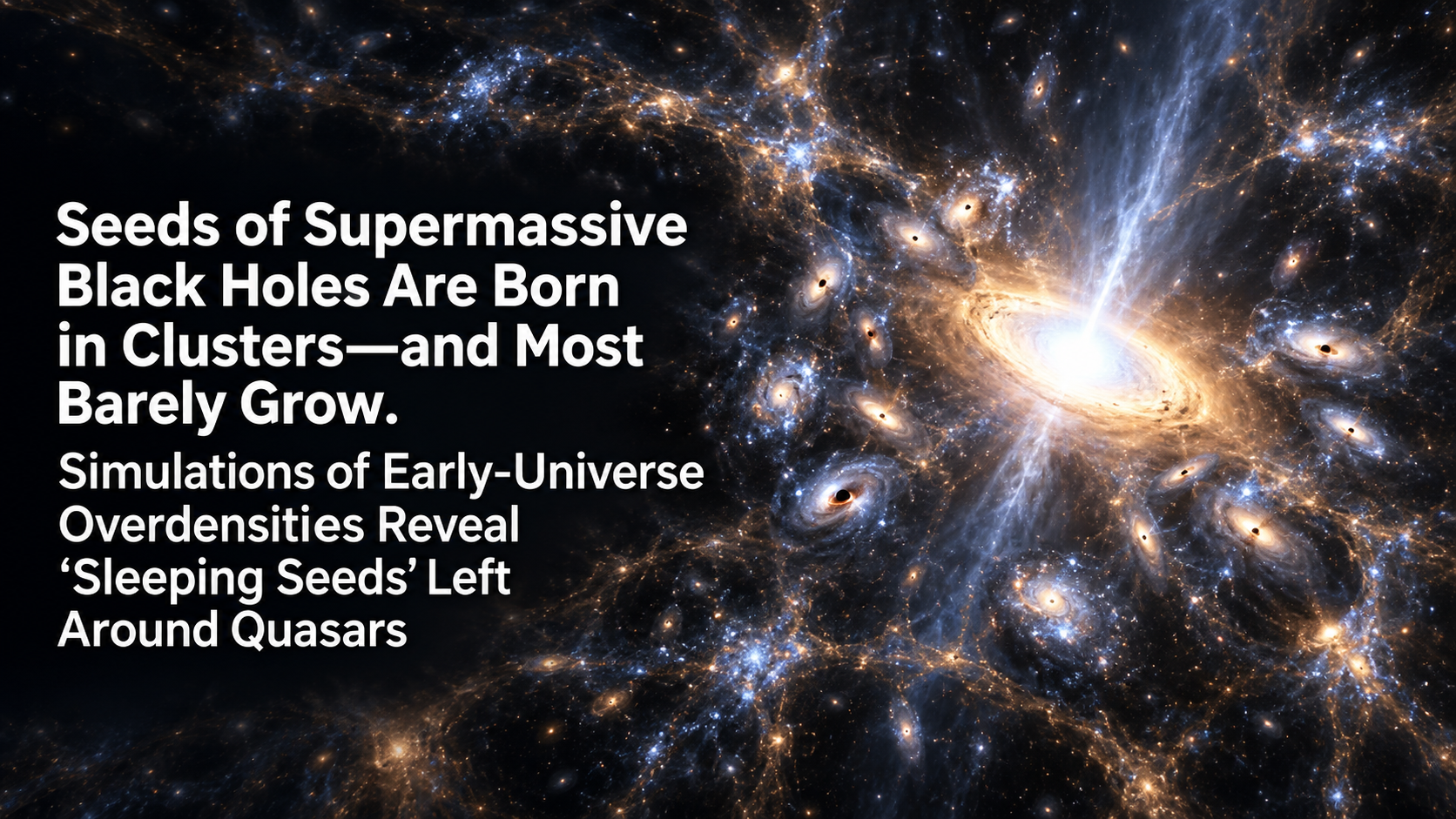
Less than a billion years after the Big Bang, black holes a billion times the mass of the Sun were already in place. The farther the James Webb Space Telescope (JWST) looks, the more of these “too early” giants it finds. If they started out as the remnants of dead stars, a few tens of solar masses each, then even feeding at the usual limit for hundreds of millions of years would struggle to reach that mass in time. That is why many astronomers favour a different route: a cloud of gas that never breaks into stars and instead collapses straight into a black hole of around 100,000 solar masses in one go. This is the “direct collapse” scenario.
Direct collapse comes with conditions, though. The gas must still be free of heavy elements. The cloud must be large and massive enough. And there must be a young galaxy close by, bathing the cloud in strong ultraviolet light that stops the gas from cooling. Gas that cools fragments into ordinary stars, so keeping it hot is the whole point. Places where all of this lines up are rare, and the leading candidates have long been the densest regions of the early universe: the spots where the huge dark matter haloes that later host bright quasars are being assembled.
A team from Italy, the United Kingdom, Austria, France and the United States has now followed one such dense region from start to finish in a computer model, counting how many direct-collapse black holes form there and what becomes of them. The paper appears in Monthly Notices of the Royal Astronomical Society, with Alessandro Trinca of the Institute for Astronomy at the University of Edinburgh as first author. The answer: the seeds are born by the dozen, only a handful ever grow, and the rest are left behind, ungrown, scattered around the quasar.
The family tree of a three-trillion-solar-mass halo
The team started from a high-resolution zoom-in simulation of a region that grows into a dark matter halo of three trillion solar masses about 900 million years after the Big Bang (redshift 6). That is the kind of halo that hosts the bright quasars seen at that epoch. The simulation resolves particles of roughly 90,000 solar masses, fine enough to pick out the million-solar-mass “minihaloes” in which the very first stars form.
Dark matter haloes grow by repeatedly merging with smaller ones. Along every branch of that merger history, the team used its own semi-analytic model, the Cosmic Archaeology Tool (CAT), to work out how much gas flows in, how many stars form, how much heavy-element pollution the supernovae spread, and how the black holes grow. Rather than pushing individual gas particles around as a hydrodynamic simulation does, CAT tracks the contents of each halo with physical recipes. That makes it cheap enough to follow the whole tree in detail, right back to the minihalo era.
The new ingredient is ultraviolet light from the neighbours, computed place by place. The radiation that triggers direct collapse comes from nearby galaxies. Earlier calculations spread the total light from the region out as a uniform background. Here, the team used the positions supplied by the N-body simulation to estimate, for each halo, how strongly it was lit by the galaxies around it. At about 270 million years after the Big Bang (redshift 15), the region contains 30,649 progenitor haloes, and each one was treated individually.
Fifty-four seeds, starting 160 million years after the Big Bang
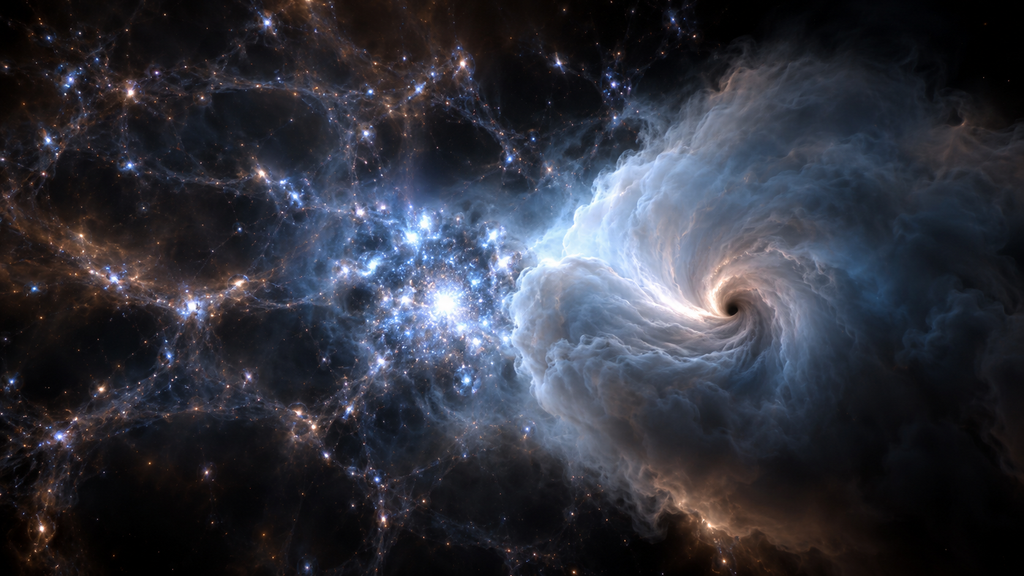
With the local ultraviolet field followed in this way, 54 haloes in the region meet the conditions for direct collapse. The first forms at redshift 22, roughly 160 million years after the Big Bang. About 10 of the 54 are in place before redshift 17, less than 220 million years in.
The old approach, with a uniform background, gives a similar total of 47 seeds. The difference is timing. The average background does not reach the trigger level until much later, so the uniform-background run produces no early seeds at all. In reality, a single neighbour that has just begun forming stars is enough to light up the halo next door. The idea of a “synchronised pair,” where one galaxy forms stars first and the other stays starless while it grows into a direct-collapse site, had been proposed before. In this calculation, though, the combined light of several more distant galaxies also mattered, not just close pairs. At the moment of collapse, many of the seed haloes were receiving ultraviolet fluxes several to several hundred times the model’s trigger value.
Seed formation stops around redshift 14 to 15, roughly 300 million years after the Big Bang. By then the supernovae of the first stars have spread heavy elements across the whole region, and the gas in any newly formed halo is already “polluted.” Enriched gas cools efficiently and forms ordinary stars, so the conditions for direct collapse no longer hold.
The team also tried stricter assumptions. Raising the ultraviolet trigger from the reference value of 300 to 1,000 (both in the standard units astronomers use for this radiation), which recent work suggests is more realistic, cuts the count from 54 to 24. Assuming on top of that the surroundings of every star-forming galaxy are polluted, so that no seed can form near one, brings it down to 13. Stacking both strict assumptions leaves 4. It never reaches zero. Whatever the assumptions, the team concludes, dense regions of the early universe produce multiple direct-collapse seeds.
Five grew up, 22 were left behind
This is where the study gets interesting. The team followed the seeds forward to the era when quasars are actually observed.
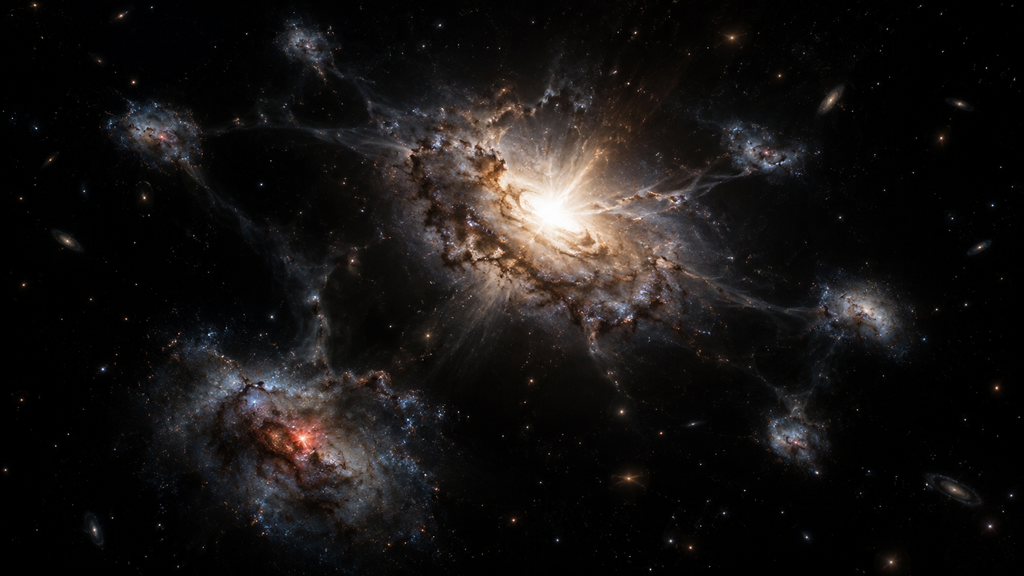
Some seeds are swallowed as the central galaxy grows through merger after merger. A swallowed seed either sinks to the centre and joins the main black hole, helping it grow, or ends up wandering the galaxy’s outskirts where it is effectively invisible. But at about 700 million years after the Big Bang (redshift 7.5), 22 of the 54 seeds had not joined the central galaxy at all. They were still sitting in small satellite galaxies around it. And only 5 of those 22 had grown past three million solar masses. The rest had barely moved from their birth mass of 100,000 solar masses, with more than half still at around 300,000 solar masses or less.
So a well-placed overdensity really does mass-produce heavy black hole seeds, dozens at a time. But the one at the centre gets to hog the gas that feeds growth. The others are stranded in small, gas-poor satellites, sleeping at close to their birth weight for hundreds of millions of years. By this reckoning, a quasar is surrounded by its siblings that never grew up.
They do not sleep all the time, however. The team’s representative example, a satellite galaxy labelled ID48871, sits about 5 kiloparsecs (16,000 light-years) from the quasar, with roughly 14 million solar masses of stars and a 200,000-solar-mass black hole. At redshift 7.26, that black hole is feeding at close to its maximum rate (an Eddington ratio of 0.86), and its light outshines the stars of its galaxy. Yet only 8 million years earlier, at redshift 7.32, it was feeding at one percent of the limit (an Eddington ratio of 0.01), and the galaxy was nothing but a faint smudge of starlight. In a small galaxy with little gas to eat, black hole activity comes in short bursts that switch on and off. That is a large part of why these objects are so hard to find.
One hour of JWST time on a single quasar
Can these ungrown siblings be seen? The team synthesised the spectra of the satellite galaxies and estimated their brightness in the F444W filter of JWST’s near-infrared camera NIRCam, at a wavelength of about 4.4 micrometres. While ID48871 is actively feeding, it comes out at magnitude 29 to 31 (AB), depending on how much the gas around the black hole dims it. That is right at, or just below, the detection limit of JWST’s deep wide-field surveys. While dormant, it is fainter than magnitude 31 and out of reach without an extremely long exposure or help from gravitational lensing.
So the team counted how many active seeds would show up, on average, in an image of the surroundings of one quasar at redshift 7 to 8. Judging by the black hole’s own light alone, an image reaching magnitude 29 would catch 3 on average, and one reaching magnitude 31 would catch 5. The chance of catching at least one is 95 percent and 99 percent respectively. Restricting the count to objects whose light can be clearly attributed to a black hole lowers the numbers: fewer than 1 on average down to magnitude 29 (about a 60 percent chance of at least one), and 1.8 on average down to magnitude 31 (about 83 percent). Most seeds are buried in the starlight of their host galaxies, and a photograph alone cannot tell you a black hole is there.
The observing cost is surprisingly modest. According to JWST’s exposure time calculator, detecting a magnitude-29 source in F444W at a signal-to-noise ratio above 3 takes about an hour. The satellites carrying seeds are spread out to about 70 kiloparsecs (230,000 light-years) from the quasar, but all of them fit inside a single NIRCam module, which covers 2 arcminutes on a side. The field of view of integral-field spectroscopy (IFU) pointed at the quasar, by contrast, is only 3 arcseconds across and would take in about 3 of the 22 on average. The team’s proposed recipe is to image wide first, pick out candidates, then point the IFU at the promising satellites and spend 1 to 2 hours confirming the broad hydrogen emission line that gas near a black hole produces.
Why dense regions alone are not enough
The team is clear about the limits of the result. It follows the family tree of a single quasar, and the number and size of satellites would differ in another region. The seed mass is fixed at 100,000 solar masses, whereas real seeds surely vary. And the ultraviolet trigger level is still debated among researchers.
There is also a matter of numbers. Scaling the seed count from this one overdensity up to the whole universe gives a density of about 3 to 40 seeds per hundred million cubic megaparsecs (a megaparsec being about 3.3 million light-years). The density of black holes above a million solar masses that JWST is finding beyond redshift 5 is roughly a thousand times higher. If direct collapse is the main source of the early universe’s black holes, it cannot be happening only in the rare, extreme overdensities that become quasar hosts. It would have to happen in far more ordinary, smaller settings as well. The team links this to a recent proposal by other researchers that seeds form next to small, vigorously star-forming galaxies.
Even so, quasar surroundings remain the easiest place to look. A dormant seed brightens only during a burst of activity. One hour on one quasar, repeated across several quasars, would eventually catch one in the act. That, the team suggests, is a practical way to test whether direct collapse ever really happened.
Related products
You can find books and products related to this article on Amazon.
If you buy through the links above, this blog may earn a commission.
Sources
- Trinca, A., Lupi, A., Haiman, Z., Volonteri, M., Valiante, R., Schneider, R. & Decarli, R. (2026) Hunting the first cosmic giants: formation and detectability of direct collapse black holes around high-redshift quasars. Monthly Notices of the Royal Astronomical Society, 551(1), stag1230. https://doi.org/10.1093/mnras/stag1230
- Preprint of the same paper (free full text): arXiv:2601.14370
- Universe Today, “Researchers Measure the Environment Where the First Supermassive Black Holes Formed” (19 September 2026): article page


コメント