
| Name | Tribrachidium (“three little arms”) |
| Classification | Affinity unknown (placed in the extinct group Trilobozoa) |
| Age | Ediacaran, at the end of the Proterozoic in the Precambrian (about 555 to 550 million years ago) |
| Found in | The Flinders Ranges of South Australia; the White Sea coast of Russia; Ukraine |
| Size | A hemispherical body 3 mm to about 5 cm across (mostly 2 to 4 cm) |
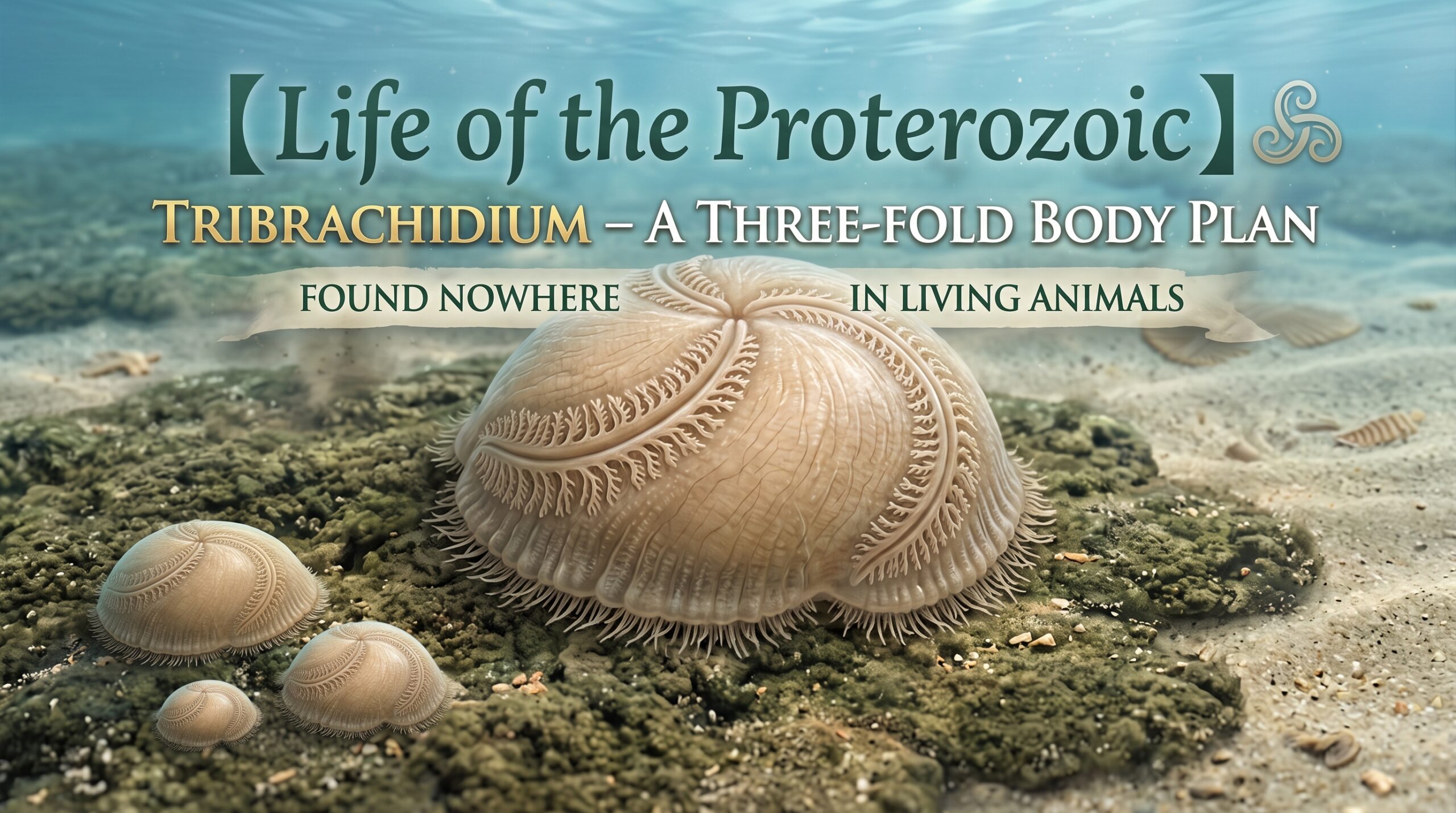
Tribrachidium was a hemispherical organism living on the Ediacaran seafloor about 550 million years ago. Three arm-like ridges extend from the center of the dome’s surface, curling outward counterclockwise. This construction, in which the body has three-fold rotational symmetry, is called triradial symmetry, and it exists in no phylum of animals alive today. Neither bilateral, nor radial in the manner of jellyfish or starfish, this body has meant that more than half a century after its discovery, what group it belongs to remains undecided.
Form and way of life
The fossils are found as circular impressions on the underside of sandstone beds. In life it is reconstructed as a low dome about 2 to 4 cm across, like a small bowl turned upside down on the seafloor. The three arms converge near the apex and taper as they curve toward the margin. Some specimens show small swellings called bullae near the bends of the arms, and fine frill-like ornament from the arm tips to the rim. No traces of movement have been found, and it is thought to have settled on the seafloor and stayed put.
What a motionless organism ate, and how, went without clues for a long time. In 2015, a team from the UK, the United States and Canada placed a 3D model of Tribrachidium in a virtual current and computed the flow around the body. The three arms turned out to intercept the current and guide it toward the apex, with the flow slowing above three depressions near the top. Where flow slows, particles of organic matter drifting in the water settle and accumulate. This body, in other words, worked as a device for gathering food carried by the current with its three arms, without moving itself. As an organism performing this suspension feeding at large body size, it counts among the oldest known examples. In 2024, recalculation with a more precise model supported the same result.
The shallow seafloor where Tribrachidium lived was covered by mat-like films woven by microbes. The same strata yield soft-bodied organisms emblematic of the Ediacaran, such as Dickinsonia and Spriggina. With many of its contemporaries thought to have absorbed nutrition directly from the seafloor film, the feeding style of Tribrachidium, straining food from the water, is evidence that the ecosystem of this age was not a single monotone.
Three arms that refuse classification
Animal bodies today divide almost entirely into two kinds by symmetry. Bilateral symmetry, as in humans, fish and insects, where the right and left halves mirror each other. And radial symmetry, as in jellyfish, sea anemones and starfish, where the same construction repeats around a central axis. But even among radially symmetrical animals, the number of repetitions is 4, 5, 6 or 8, and no phylum is based on 3. The triradial symmetry of Tribrachidium is a body plan found nowhere on Earth today.
Martin Glaessner, who described the fossil in 1959, treated the organism from the outset as a problematic fossil that could not be placed in any animal group. Because the surface spirals resemble the arms of edrioasteroids (an extinct echinoderm group), a relationship with echinoderms was discussed, but echinoderms are fundamentally five-rayed and the numbers do not match. The Russian researcher Mikhail Fedonkin grouped it with the equally triradial Albumares and Anfesta and proposed an independent extinct group, the Trilobozoa. That framework is still in use, but where the Trilobozoa attach to the animal family tree is unknown. An interpretation of the Y-shaped groove at the center as a mouth was proposed, but a study examining several hundred specimens did not confirm it, and the view of the arm swellings as reproductive organs remains speculation without evidence.
The fossils themselves are not rare, however. Besides Australia, they are found on the White Sea coast of Russia and in Ukraine, showing that the animal was established over a wide area of Ediacaran shallow seas. The genus name means “three little arms,” and the species name heraldicum means “heraldic,” after the close resemblance to the arms of the Isle of Man, with its three legs arranged in a spiral. Long treated as a genus with a single species, it gained its first congener in 2024, sixty-five years after being named, when a second species, Tribrachidium gehlingi, was described from Nilpena Ediacara National Park in South Australia. The puzzle of the body plan remains, and this three-armed family keeps quietly adding members.


Sources
Rahman, I. A. et al. (2015) Suspension feeding in the enigmatic Ediacaran organism Tribrachidium demonstrates complexity of Neoproterozoic ecosystems (Science Advances)
Olaru, A. et al. (2024) Functional morphology of the Ediacaran organism Tribrachidium heraldicum (Paleobiology)
Hall, C. M. S. et al. (2015) Paleoecology of the enigmatic Tribrachidium: New data from the Ediacaran of South Australia (Precambrian Research)
Botha, T. L. & García-Bellido, D. C. (2024) A new species of the iconic triradial Ediacaran genus Tribrachidium from Nilpena Ediacara National Park (Journal of Paleontology)
コメント