This article contains affiliate links. As an Amazon Associate I earn from qualifying purchases.
| Name | Ichthyosaurus, Greek for “fish lizard” |
| Classification | Reptilia, Ichthyosauria, Ichthyosauridae |
| Age | Early Jurassic (about 200 to 190 million years ago) |
| Found in | Southwest England (Lyme Regis in Dorset, and Somerset), Germany, Belgium, Portugal and Spain |
| Length | About 1.5 to 3.5 m depending on species; the largest known specimen is about 3 to 3.5 m |
| Species | Six (I. communis and others) |
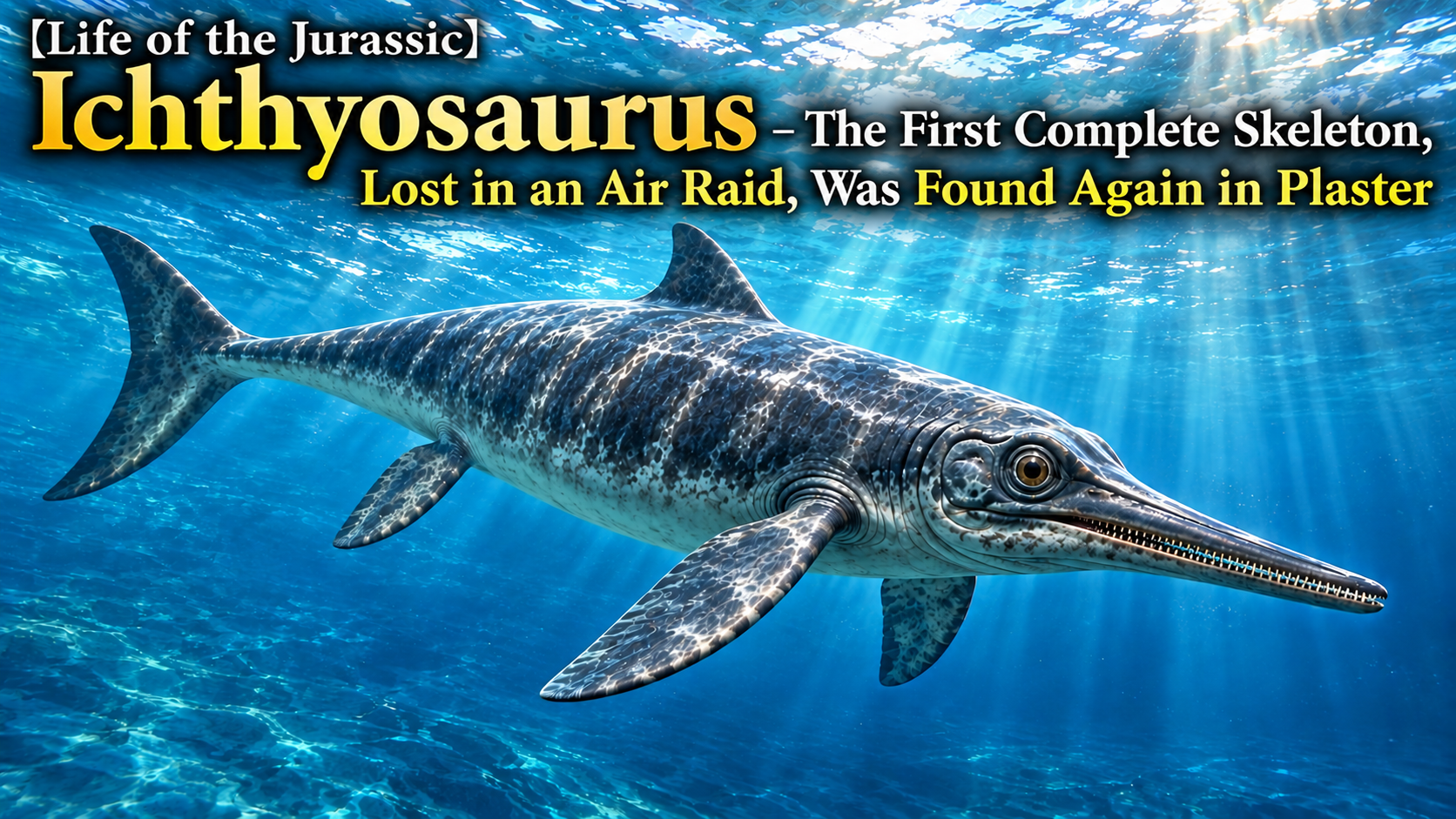
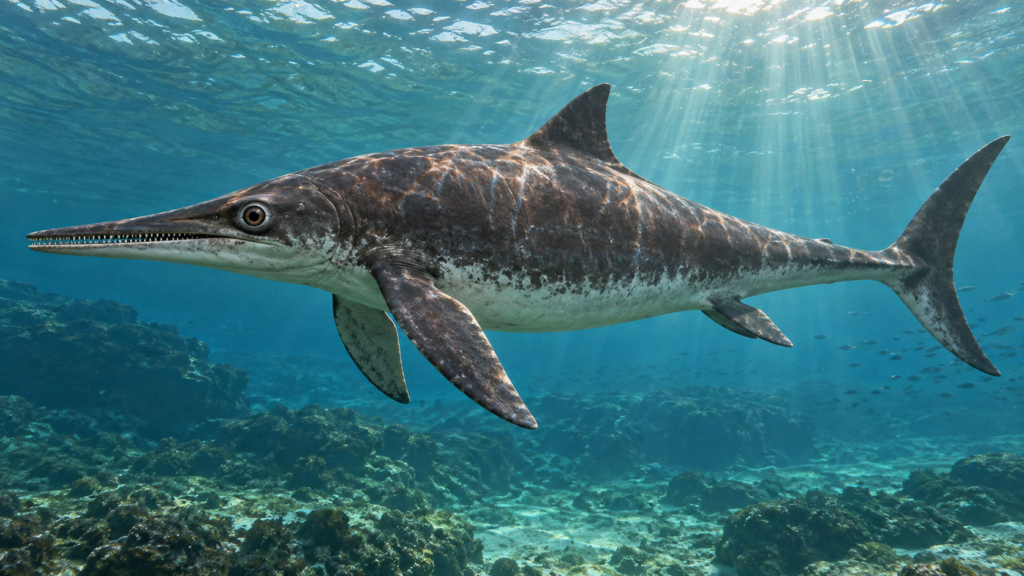
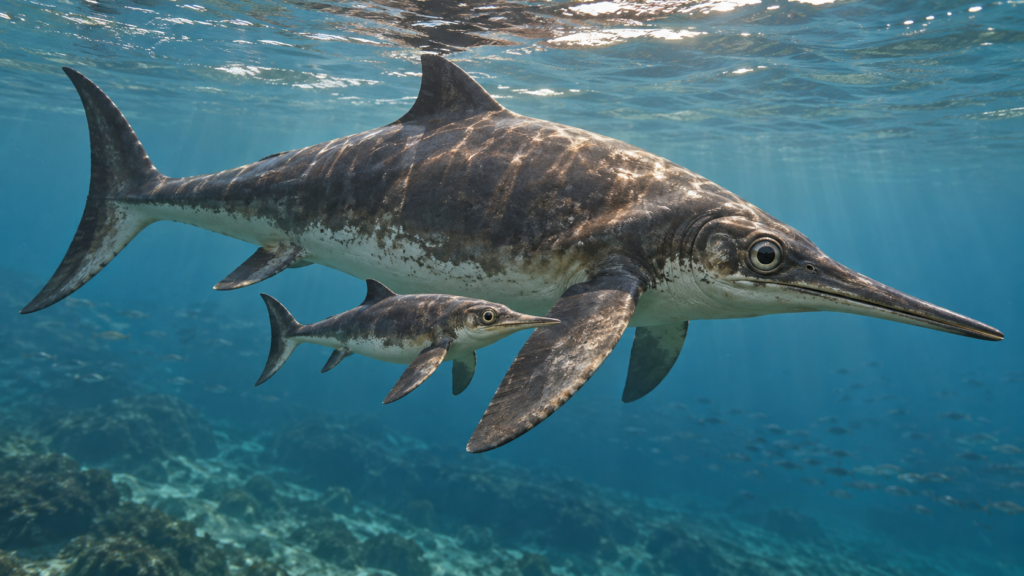
Ichthyosaurus was an ichthyosaur, one of the marine reptiles that lived in the seas of the dinosaur age. Its body was streamlined like a dolphin’s, its limbs were flippers, and its tail ended in a crescent-shaped fin. Many fossils come from the sea cliffs of England, and it was fossils from this region that first introduced ichthyosaurs to science. The first complete ichthyosaur skeleton ever reported was given a name that fell out of use and was forgotten, and the skeleton itself was destroyed in a Second World War air raid; in 2022, two plaster casts of it came to light.
Appearance and Way of Life
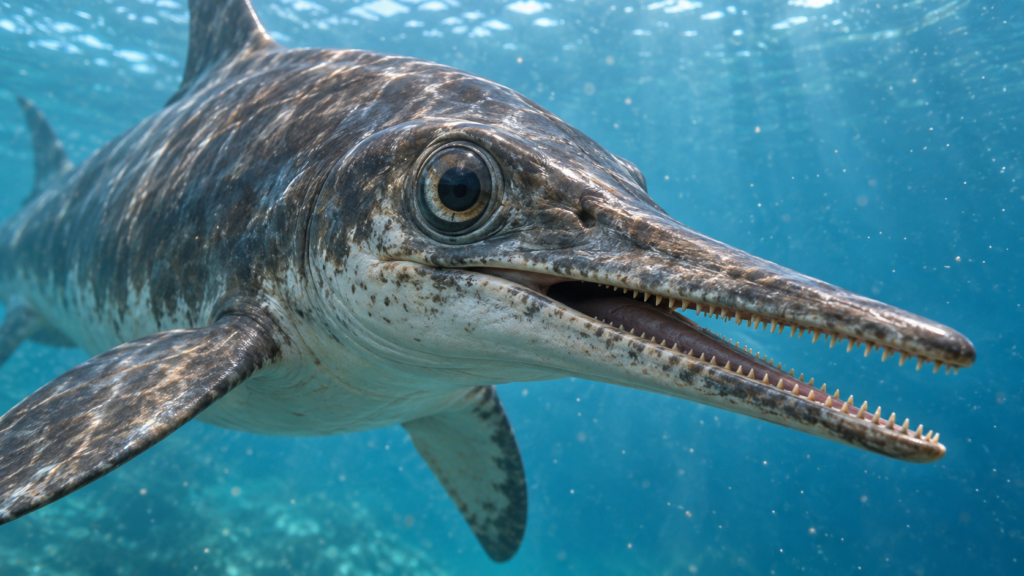
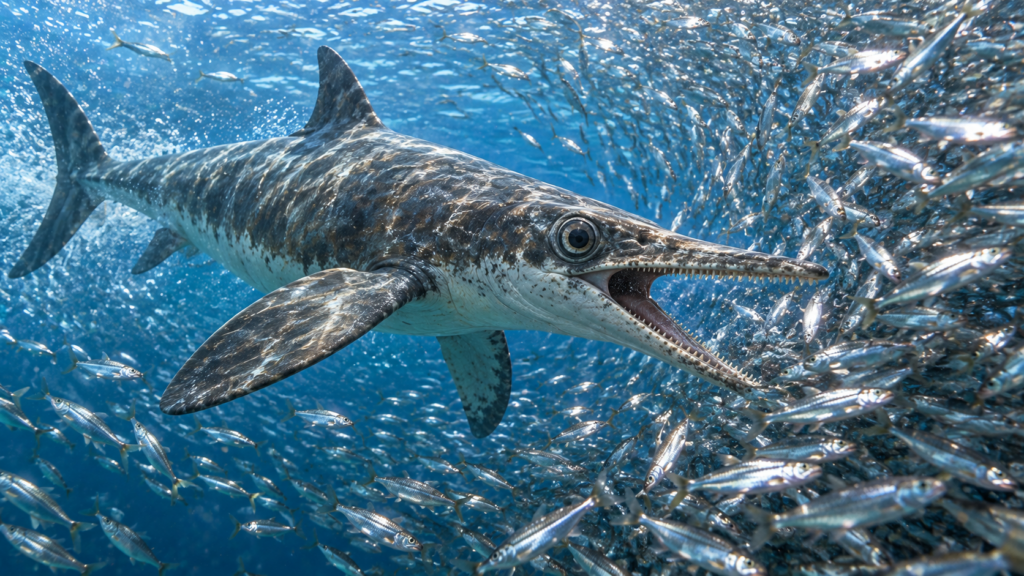
Among ichthyosaurs, Ichthyosaurus was small to medium-sized, and most species were around 2 m long. The long, narrow snout was lined with small conical teeth, and its large eyes suggest that it hunted by sight. Fossils with preserved stomach contents contain cephalopods, relatives of squid, and fish, and it is thought to have been a fast pursuit predator. It swam like a tuna, keeping the rear half of its body fairly stiff and sweeping the tail fin from side to side.
Ichthyosaurs did not lay eggs but gave birth at sea. Three Ichthyosaurus fossils are known with the bones of an unborn young inside the body. One from Somerset, reported in 2017, is the largest Ichthyosaurus known, a female about 3 to 3.5 m long carrying an embryo that preserves part of its backbone and a flipper. The specimen had been on display in a museum, and re-examination showed that its tail came from a different, smaller individual, added to make the skeleton look complete.
Most fossils come from the Blue Lias of Lyme Regis and Somerset in southwest England, alternating layers of gray limestone and mudstone. The area was then a shallow, warm sea shared with ammonites, belemnites, the plesiosaur Plesiosaurus and the large ichthyosaur Temnodontosaurus. One of the six species, I. anningae, was named in 2015 after Mary Anning, who dug fossils on this coast.
The Lost First Skeleton, Found Again in Plaster
Ichthyosaur fossils reached science through the finds of the Anning family, who dug and sold fossils at Lyme Regis. In 1811 Mary’s brother Joseph found a skull more than a metre long, and in 1812 Mary, then about 13, dug out the backbone and ribs of the same animal. In 1814 the surgeon Everard Home reported it to the Royal Society as an animal “more nearly allied to fishes” than to other groups. That first fossil, however, was later identified as the large ichthyosaur Temnodontosaurus, not Ichthyosaurus.
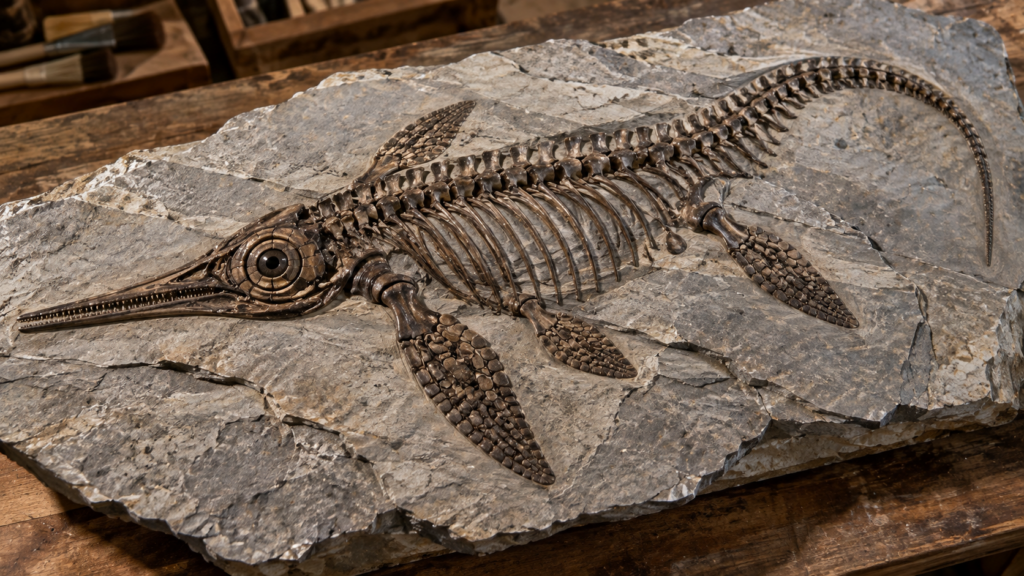
In 1818 the collector Colonel Thomas Birch acquired a small ichthyosaur skeleton less than a metre long, probably collected by Mary Anning. Nearly complete from head to tail, it was the most complete ichthyosaur skeleton known at the time. Home illustrated it in a paper in 1819 and named it “Proteo-saurus”, because he thought its vertebrae resembled those of Proteus, a salamander; he saw the animal as a link between reptiles and amphibians.
A year earlier, in 1818, Charles König of the British Museum had already used the name Ichthyosaurus for the same kind of animal. It came without a formal description, but in 1821 Henry De la Beche and William Conybeare adopted it, and later researchers followed them. No one but Home ever used Proteosaurus, and the name was forgotten.
Home’s skeleton entered the museum of the Royal College of Surgeons in London in 1820 and was kept there for more than 120 years, until it was destroyed in an air raid in May 1941. Only the illustrations in Home’s paper remained, and there was no longer any way to check which kind of ichthyosaur it had been.
In 2016 the British palaeontologist Dean Lomax found a plaster cast of the skeleton in the collections of Yale University’s Peabody Museum in the United States. In 2019 a second cast turned up at the Museum für Naturkunde in Berlin, Germany. There is no record of any casts ever being made, and who made them, and when, is unknown. In 2022 Lomax and the American palaeontologist Judy Massare studied the two casts and concluded from the shape of the upper arm bone, the number of digits in the front flipper and a forked digit in the hind flipper that the skeleton belonged to the genus Ichthyosaurus. The casts do not show enough detail of the skull to identify the species. Measured on the casts, the skeleton was about 90 cm long. The skeleton behind the forgotten name Proteosaurus turned out to be an example of the name that replaced it, Ichthyosaurus.
Related products
You can find books and products related to this article on Amazon.
If you buy through the links above, this blog may earn a commission.
About the images
The images in this article are illustrations created with AI (ChatGPT), and you are welcome to use them. If you do, we would appreciate a link back to this article as the source.
Sources
Lomax, D. R. & Massare, J. A. (2022). Rediscovery of two casts of the historically important ‘Proteo-saurus’, the first complete ichthyosaur skeleton. Royal Society Open Science 9, 220966. https://doi.org/10.1098/rsos.220966
Lomax, D. R. & Sachs, S. (2017). On the largest Ichthyosaurus: A new specimen of Ichthyosaurus somersetensis containing an embryo. Acta Palaeontologica Polonica 62. https://doi.org/10.4202/app.00376.2017
Lomax, D. R. & Massare, J. A. (2017). Two new species of Ichthyosaurus from the lowermost Jurassic (Hettangian) of Somerset, England. Papers in Palaeontology 3, 1–20. https://doi.org/10.1002/spp2.1065
Home, E. (1814). Some account of the fossil remains of an animal more nearly allied to fishes than any of the other classes of animals. Philosophical Transactions of the Royal Society of London 104, 571–577. https://doi.org/10.1098/rstl.1814.0029
Natural History Museum. Mary Anning: the unsung hero of fossil discovery. https://www.nhm.ac.uk/discover/mary-anning-unsung-hero.html
The Geological Society. Temnodontosaurus platyodon, found 1811-1812. https://www.geolsoc.org.uk/the-library/online-exhibitions/mary-anning-and-the-geological-society/first-discoveries/temmodontosaurus/


コメント