This article contains affiliate links. As an Amazon Associate I earn from qualifying purchases.
| Name | Megalosaurus, Greek for “great lizard” |
| Classification | Saurischia, Theropoda, Megalosauridae |
| Age | Middle Jurassic (Bathonian, about 166 million years ago) |
| Found in | Oxfordshire, England (Stonesfield and elsewhere, Taynton Limestone Formation) |
| Length | Estimated at about 6 to 8 m |
| Weight | Estimated at about 0.7 to 1 tonne |
Megalosaurus was a two-legged meat-eating dinosaur from Middle Jurassic England. It was named in 1824, making it the first dinosaur genus to receive a valid scientific name. Almost 150 years earlier, in 1677, a thigh bone thought to come from this dinosaur was illustrated in a book, the first known published picture of a dinosaur bone. The scholar who drew it concluded that it came from a giant.
Appearance and Way of Life
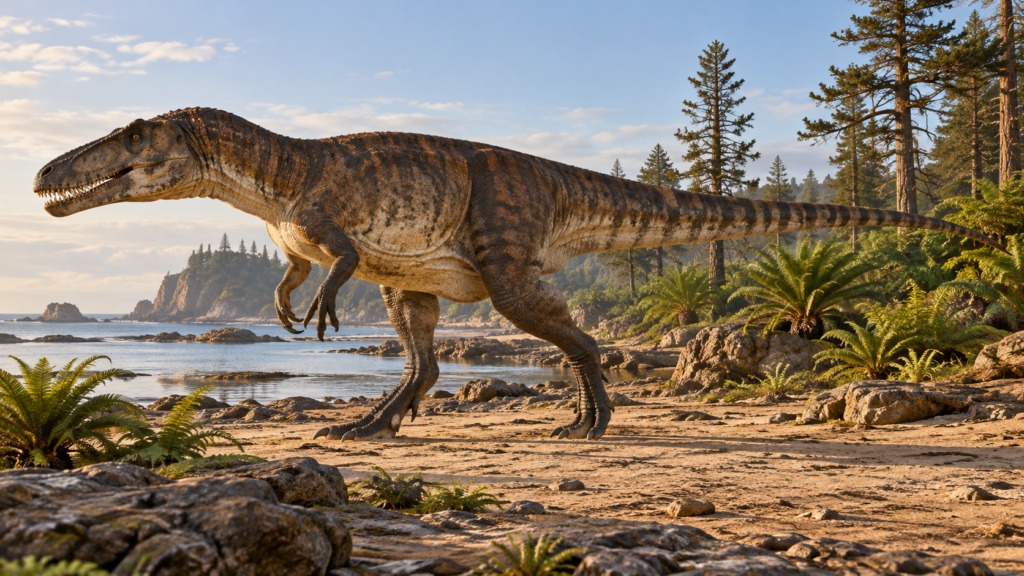
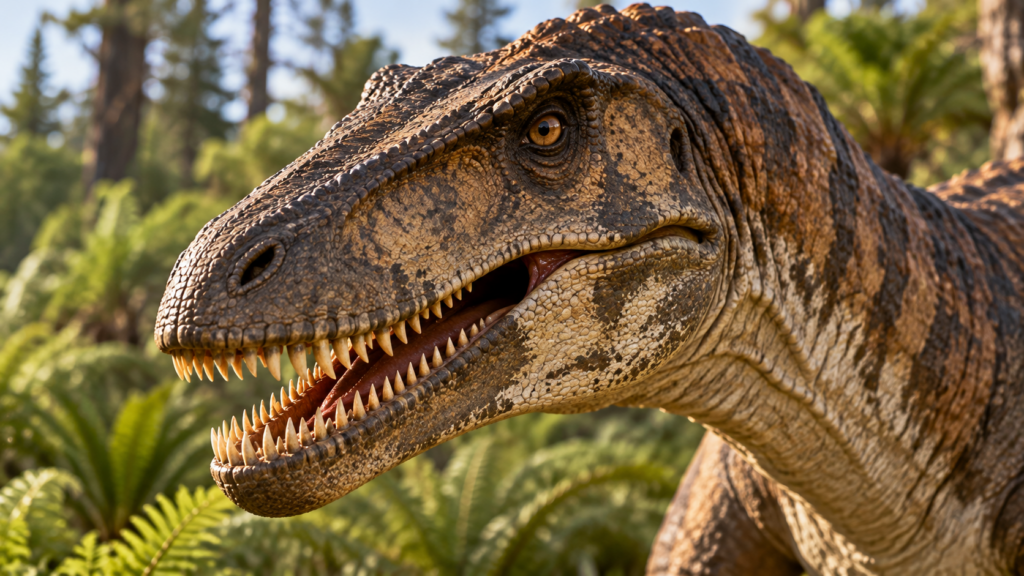
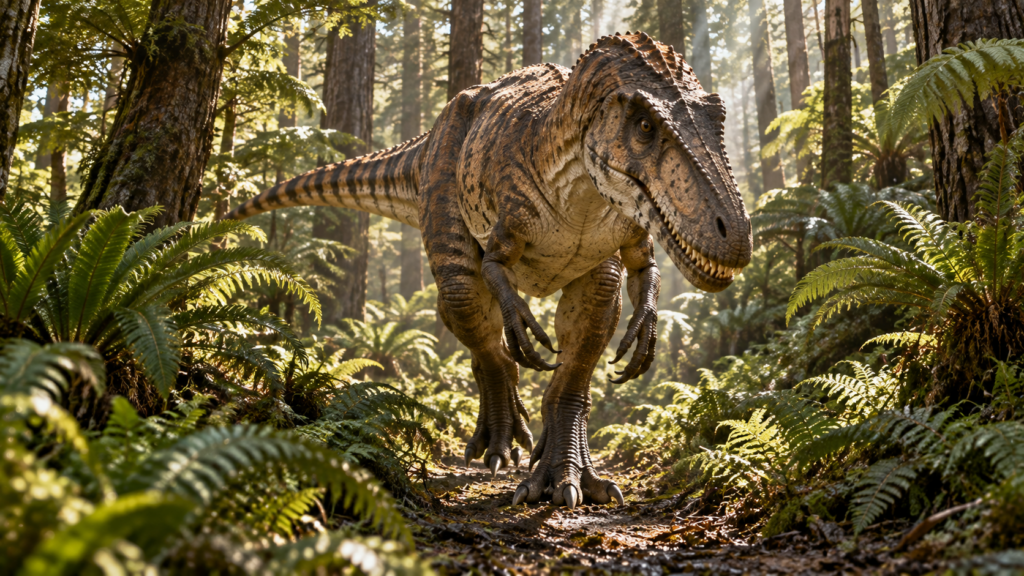
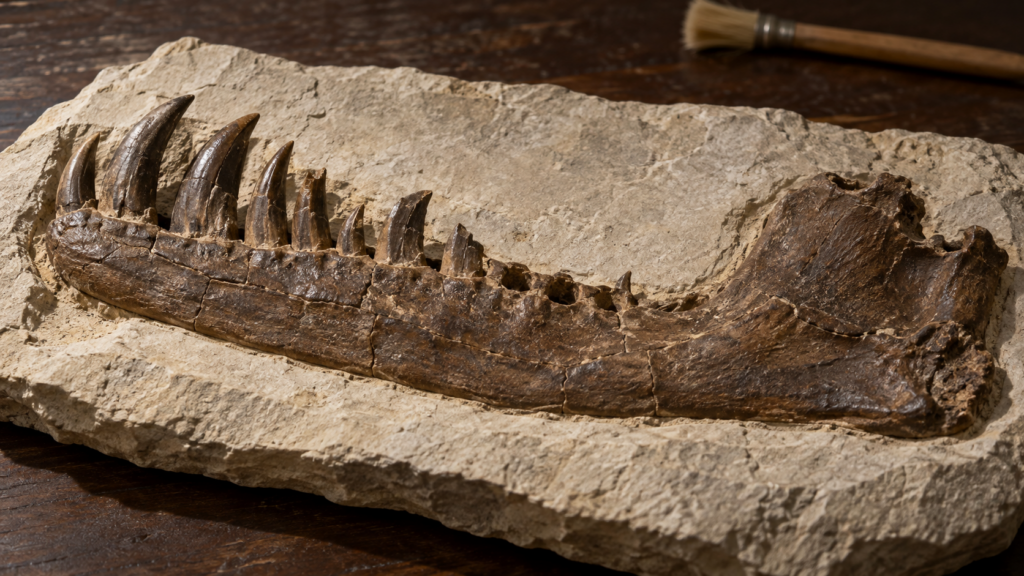
Megalosaurus was a theropod that stood on thick hind legs, with short arms and a long tail. Its jaws held curved, blade-like teeth with finely serrated edges. No complete skeleton has been found; it is known from partial fossils of the jaws, backbone, hips and legs. The type specimen (lectotype) is a right lower jaw bone at the Oxford University Museum of Natural History.
Estimates of its size have shrunk over time. The first report in 1824 described a giant lizard about 12 m long; Richard Owen reduced this to about 9 m in 1842, and today a length of around 6 m is favored. Roger Benson, who redescribed the skeleton in 2010, estimated a body mass of about 943 kg from the thigh bone and regarded it as one of the larger theropods of the Middle Jurassic.
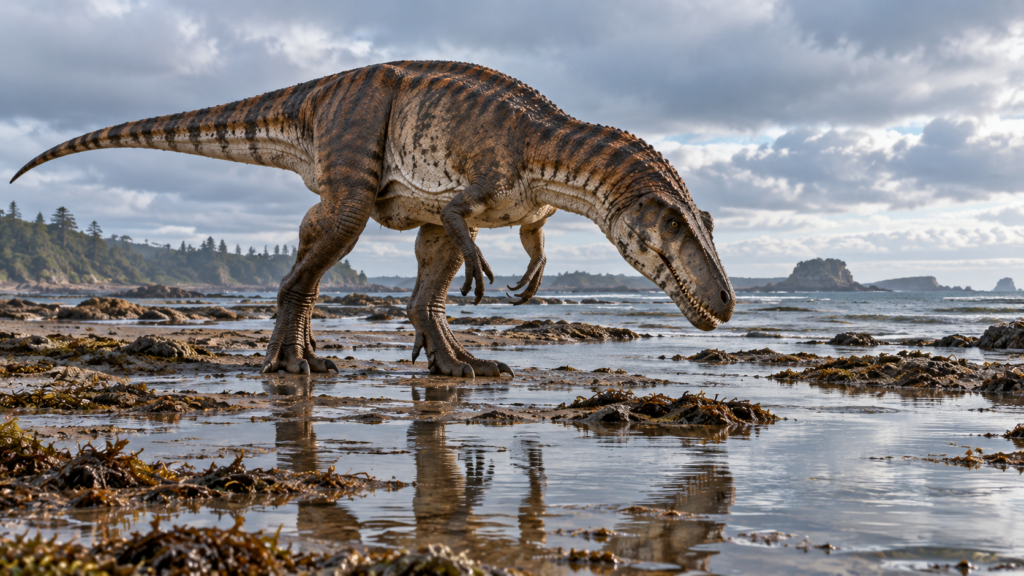
Southern England at the time was a land of shallow seas and islands, and the limestone that yields its fossils also contains crocodile relatives, pterosaurs and the jaws of tiny mammals. Megalosaurus is thought to have been the largest predator in its region, hunting sauropods and stegosaurs.
In the 19th century, the bones of large meat-eating dinosaurs found in Britain, France and elsewhere were described one after another under the name Megalosaurus, and at one point the genus held dozens of species. Later research moved most of them to other genera or treated them as doubtful, and today only one species, M. bucklandii, is accepted as Megalosaurus.
The First Dinosaur Bone Ever Illustrated Was Taken for a Giant’s Thigh
In 1677, Robert Plot, professor of chemistry at Oxford and later the first keeper of the Ashmolean Museum, published The Natural History of Oxford-shire. In it he described and illustrated a large bone from a quarry in the parish of Cornwell in the county. Plot correctly identified it as the lower end of a thigh bone.
Plot first suggested that it came from a war elephant brought to Britain by the Romans. When he compared it with elephant bones, however, the shapes did not match, and he dropped the idea. In the end Plot concluded that it was a human bone, and that there must once have been very large people, like the giants described in the Bible.
In 1763, when the physician and writer Richard Brookes redrew Plot’s illustration in a natural history book, he captioned it “Scrotum humanum” (human scrotum), because the two swellings at the end of the bone looked that way. His text describes it as a human thigh bone, so why he chose this caption is unknown.
The caption has the same form as a Linnaean scientific name, with a genus and species. In 1970 the palaeontologist Beverly Halstead argued that it was the first scientific name ever given to a dinosaur and, under the rules, might take priority over Megalosaurus. Under the International Code of Zoological Nomenclature, however, a name that has not been treated as valid since 1899 is a “forgotten name” and does not replace a name in long use. Scrotum humanum falls into this category and is not recognized as a scientific name.
Plot’s bone itself was later lost. Only the illustration survives, so it cannot be confirmed whether the bone really belonged to Megalosaurus. Based on the shape and size shown in the drawing and its origin in the Middle Jurassic rocks of Oxfordshire, it is widely regarded as the thigh bone of Megalosaurus or a closely related large theropod. In 2020, a bone in the collections of the Oxford University Museum of Natural History was proposed as Plot’s lost bone, but when it was examined it weighed only about half of the weight Plot had recorded, showing that it was a different bone.
The scientific name came about 150 years after Plot’s illustration. William Buckland, a geologist at Oxford, studied jaws, vertebrae and leg bones collected from the quarries at Stonesfield and reported them to the Geological Society of London on 20 February 1824. He named the animal Megalosaurus, meaning “great lizard.” In 1827 Gideon Mantell added the species name, completing the binomial Megalosaurus bucklandii. In 1842 Owen proposed the group “Dinosauria” on the basis of three genera, Megalosaurus, Iguanodon and Hylaeosaurus. The story that began with a bone taken for a giant’s thigh leads all the way to the birth of the word “dinosaur” (for Iguanodon, named in the same era, see 【Life of the Cretaceous】Iguanodon – The Nose Horn Was a Thumb: An Early Dinosaur That Kept Being Redrawn).
Related products
You can find books and products related to this article on Amazon.
If you buy through the links above, this blog may earn a commission.
About the images
The images in this article are illustrations created with AI (ChatGPT), and you are welcome to use them. If you do, we would appreciate a link back to this article as the source.
Sources
Buckland, W. (1824). Notice on the Megalosaurus or great Fossil Lizard of Stonesfield. Transactions of the Geological Society of London s2-1, 390–396. https://doi.org/10.1144/transgslb.1.2.390
Benson, R. B. J. (2010). A description of Megalosaurus bucklandii (Dinosauria: Theropoda) from the Bathonian of the UK and the relationships of Middle Jurassic theropods. Zoological Journal of the Linnean Society 158, 882–935. https://doi.org/10.1111/j.1096-3642.2009.00569.x
Natural History Museum. Megalosaurus (Dino Directory). https://www.nhm.ac.uk/discover/dino-directory/megalosaurus.html
Naish, D. (2022). Robert Plot’s Lost Dinosaur Bone. Tetrapod Zoology. https://tetzoo.com/blog/2022/12/12/robert-plots-lost-dinosaur-bone
Biodiversity Heritage Library (2015). The First Described and Validly Named Dinosaur: Megalosaurus. https://blog.biodiversitylibrary.org/2015/10/the-first-described-and-validly-named.html
コメント