This article contains affiliate links. As an Amazon Associate I earn from qualifying purchases.
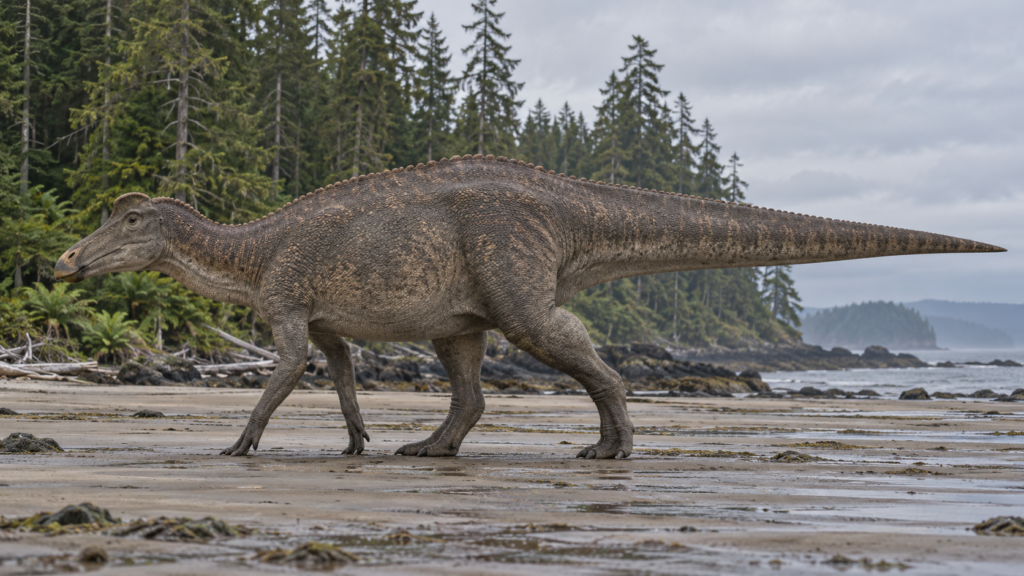
| Name | Kamuysaurus japonicus. From the Ainu word kamuy, “deity,” and sauros, “reptile”; the name means “Japanese dragon deity.” Known in Japan as the Mukawa dinosaur |
| Classification | Dinosauria, Ornithischia, Hadrosauridae, Hadrosaurinae, Edmontosaurini |
| Age | Late Cretaceous, early Maastrichtian (about 72 million years ago) |
| Found in | Hobetsu, Mukawa Town, Hokkaido, Japan, in marine rocks of the Hakobuchi Formation |
| Length | About 8 m |
| Weight | Estimated at about 4 tonnes as a biped, or about 5.3 tonnes as a quadruped |
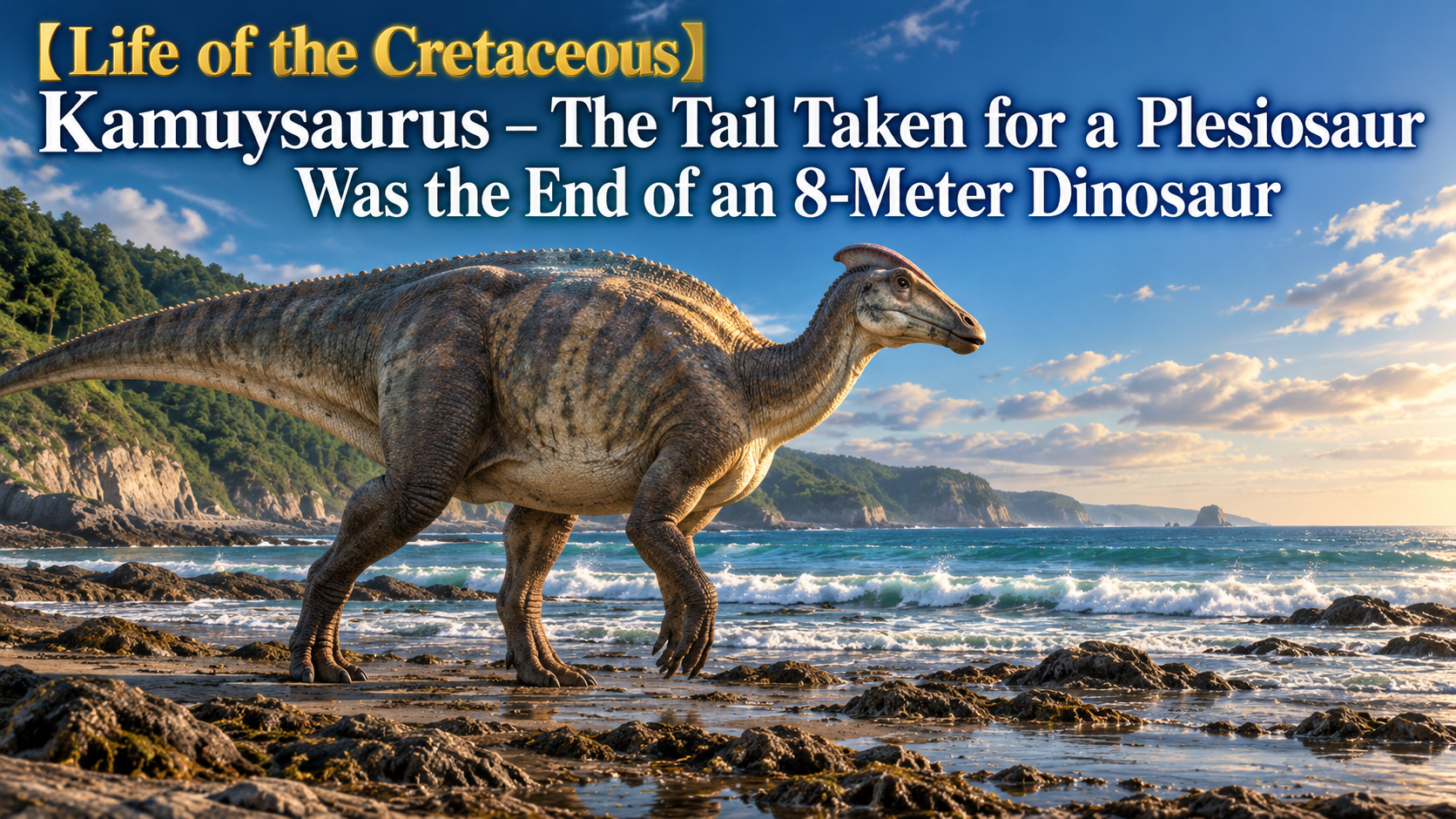
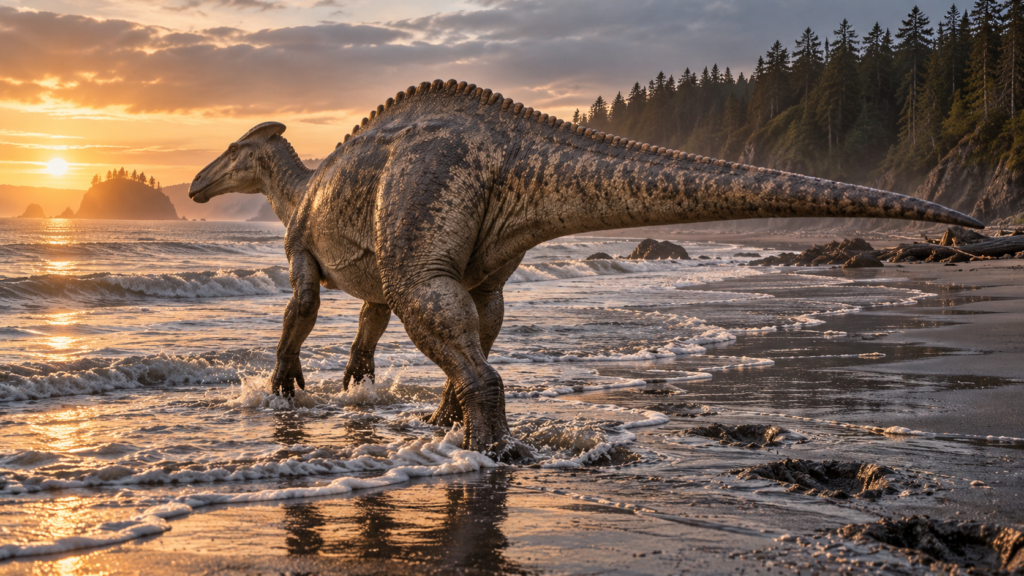
Kamuysaurus was a plant-eating hadrosaurid dinosaur that lived in Late Cretaceous Hokkaido. At about 8 m long, it is the largest complete dinosaur skeleton found in Japan. The skeleton came from marine rocks rather than land deposits, and the first piece to turn up, a section of tail, was taken for a marine reptile for about eight years.
Appearance and Way of Life
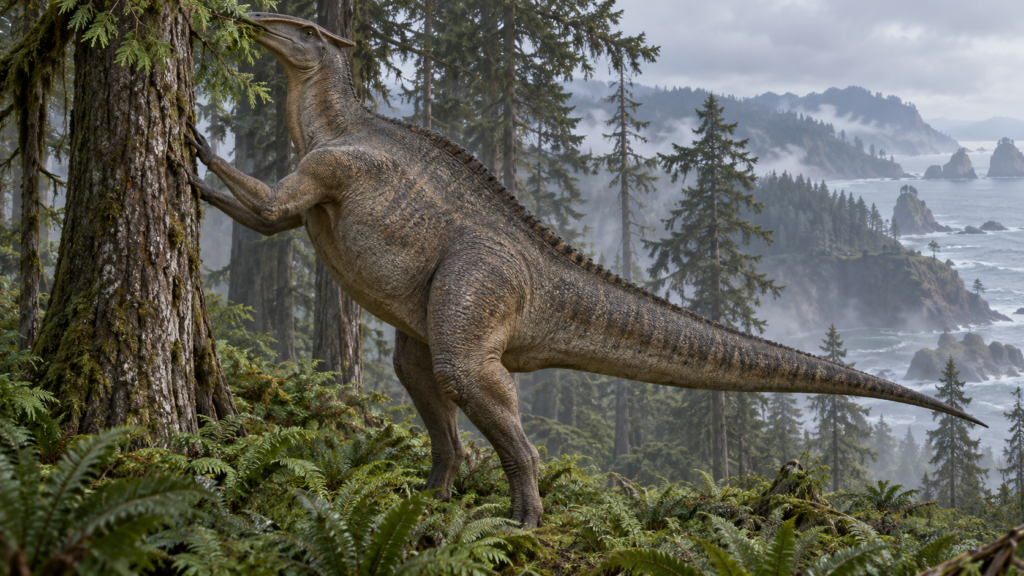
Hadrosaurids are the dinosaurs with flat beaks and many stacked rows of teeth. They flourished in the Late Cretaceous, and their fossils are common in North America and Asia. Kamuysaurus belongs to the Edmontosaurini within this family, and phylogenetic analysis places it close to Kerberosaurus from Russia and Laiyangosaurus from China.
The skeleton, specimen HMG-1219, is kept at the Hobetsu Museum in Mukawa. Nearly the whole animal is present apart from the tip of the skull and the hip vertebrae. According to Hokkaido University and its partners, about 60 percent of the body’s bones were identified, or more than 80 percent by volume. Among the features that set it apart from other dinosaurs are the spines on its back vertebrae, which lean strongly forward, and the slender bones of its forelimbs.
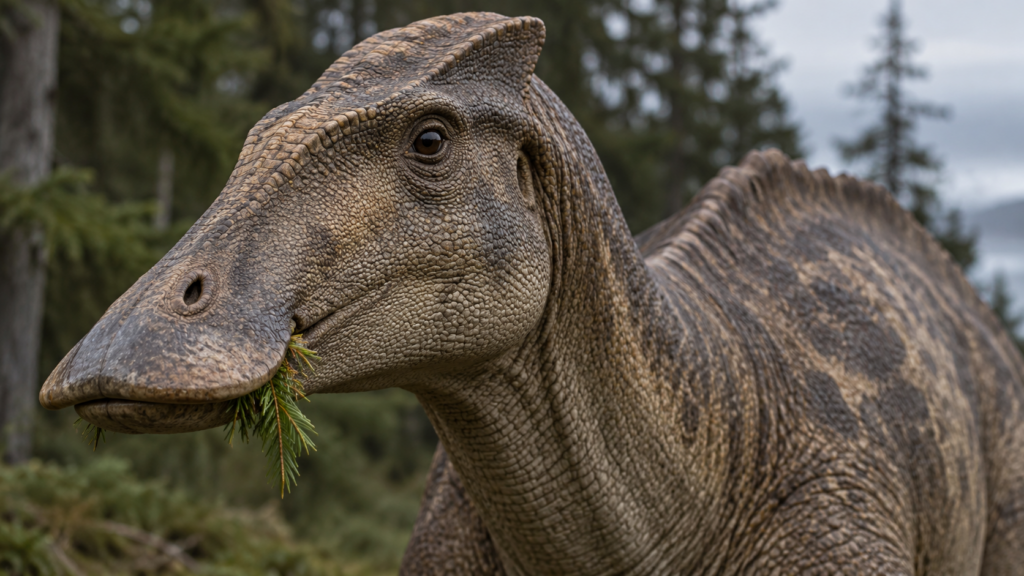
A bone on top of the skull, the frontal, has a long surface where it met the nasal bone. This shape suggests the animal may have had a small, thin crest, though no crest itself was preserved. The life reconstruction in the original paper shows one individual with a crest and one without.
A cross section of the shin bone shows at least nine lines marking pauses in growth. This individual was an adult of nine years or older and probably died after the age of twelve, by which time its growth curve had nearly levelled off.
The Hakobuchi Formation was laid down on the seafloor well offshore, in water estimated at about 80 to 200 m deep. The same rocks have yielded ammonites, mosasaurs, and sea turtles. Complete hadrosaurid skeletons from marine rocks are rare worldwide, since these were land animals. The life reconstruction in the paper shows a carcass floating at sea. Some of the bones carry damage from organisms that eroded them before burial. The analysis also suggests that environments near the coast may have been home to early hadrosaurids.
A Tail Taken for a Marine Reptile
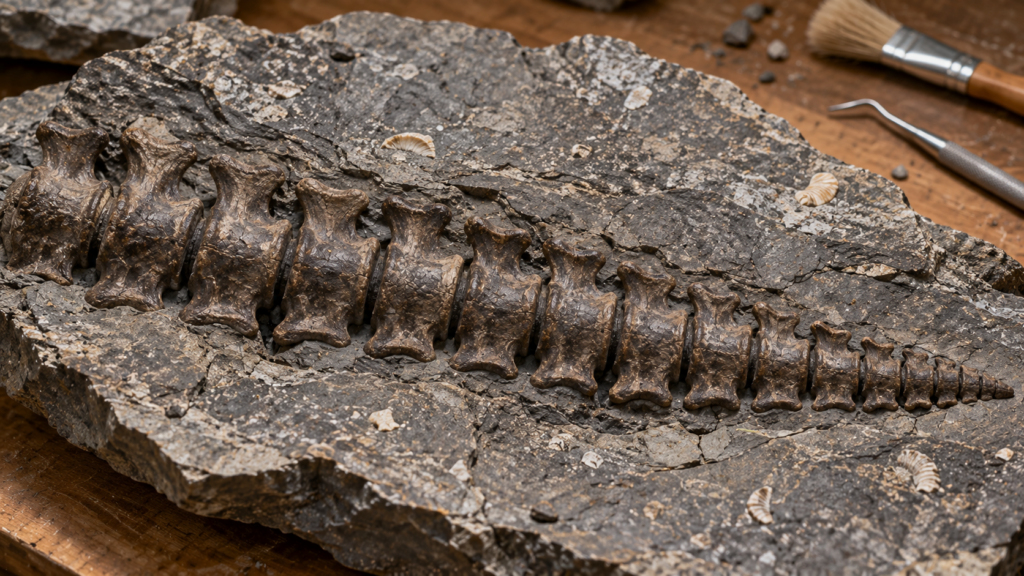
The first fossil was found on April 9, 2003. Yoshiyuki Horita, a Hobetsu resident who was looking for ammonites, came across a row of vertebrae inside a rock nodule and donated it to what was then the Hobetsu Town Museum. There were at least 13 vertebrae, from the middle to the rear of the tail.
The marine rocks of Hobetsu are known for plesiosaur and mosasaur fossils. The museum took the tail to be a plesiosaur, and work on it was put off. Preparation to free the bones from the rock began only in November 2010.
In August 2011, Tamaki Sato of Tokyo Gakugei University, a plesiosaur researcher, pointed out that the fossil might be a dinosaur. The next month, Yoshitsugu Kobayashi of the Hokkaido University Museum identified it as one, and the two institutions began working together. The vertebrae had six-sided cross sections and flat joint surfaces, both hadrosaurid features.
That same year, a survey of the cliff where the fossil had been found turned up a single vertebra from farther up the body, still buried in the rock. The rest of the skeleton might continue into the cliff, so the Hobetsu Museum and Hokkaido University began excavating in 2013. That dig confirmed at least about 30 percent of the skeleton, and the 2014 dig found part of an upper jaw, showing that the head was there too. The bones lay partly articulated in an area of 4 m by 7 m.
The excavated material filled 31 plaster jackets and nearly 500 blocks of rock. In April 2017 the find was announced as a complete skeleton, and in September 2019 it was described in Scientific Reports as a new genus and species, Kamuysaurus japonicus. Counting as a complete skeleton any specimen with more than half of its bones, it is Japan’s first from the Late Cretaceous, its first from a plant-eating dinosaur, and its first from marine rocks.
Related products
You can find books and products related to this article on Amazon.
If you buy through the links above, this blog may earn a commission.
About the images
The images in this article are illustrations created with AI (ChatGPT), and you are welcome to use them. If you do, we would appreciate a link back to this article as the source.
Sources
Kobayashi, Y. et al. (2019). A new hadrosaurine (Dinosauria: Hadrosauridae) from the marine deposits of the Late Cretaceous Hakobuchi Formation, Yezo Group, Japan. Scientific Reports 9, 12389. https://doi.org/10.1038/s41598-019-48607-1
Hokkaido University and Hobetsu Museum (2013), press release on the dinosaur fossil from Hobetsu (in Japanese). https://www.hokudai.ac.jp/news/130717_pr_museum.pdf
Hokkaido University and Hobetsu Museum (2017), press release on Japan’s largest dinosaur skeleton (in Japanese). https://www.hokudai.ac.jp/news/170428_pr.pdf
Hokkaido University and others (2019), press release on the naming of Kamuysaurus japonicus (in Japanese). https://www.hokudai.ac.jp/news/190906_pr.pdf
Bungeishunju, on the discovery of the tail and its identification as a plesiosaur (in Japanese). https://bunshun.jp/bungeishunju/articles/h1384

コメント