This article contains affiliate links. As an Amazon Associate I earn from qualifying purchases.
| Name | Futabasaurus suzukii, known in Japan as Futaba-suzuki-ryu. Named after the rock unit it came from, the Futaba Group, and its discoverer, Tadashi Suzuki |
| Classification | Reptile; Plesiosauria; Elasmosauridae (not a dinosaur) |
| Age | Late Cretaceous (early Santonian, about 85 million years ago) |
| Where found | Ōhisa, Iwaki City, Fukushima Prefecture, Japan. A cliff along the Ōhisa River exposing the Irimazawa Member of the Tamayama Formation, Futaba Group |
| Length | Estimated at 6.4–9.2 m (2006 description). Most of the neck and the tail are missing, so the figure is based on the proportions of related species |
| Bones found | About 70% of one individual: the front of the skull and the lower jaw, the backbone from the base of the neck to the hips, ribs, shoulder and hip bones, and all four flippers |
| Specimen | National Museum of Nature and Science, Tokyo. Skeletal reconstructions are on display at the Iwaki City Coal and Fossil Museum and elsewhere |
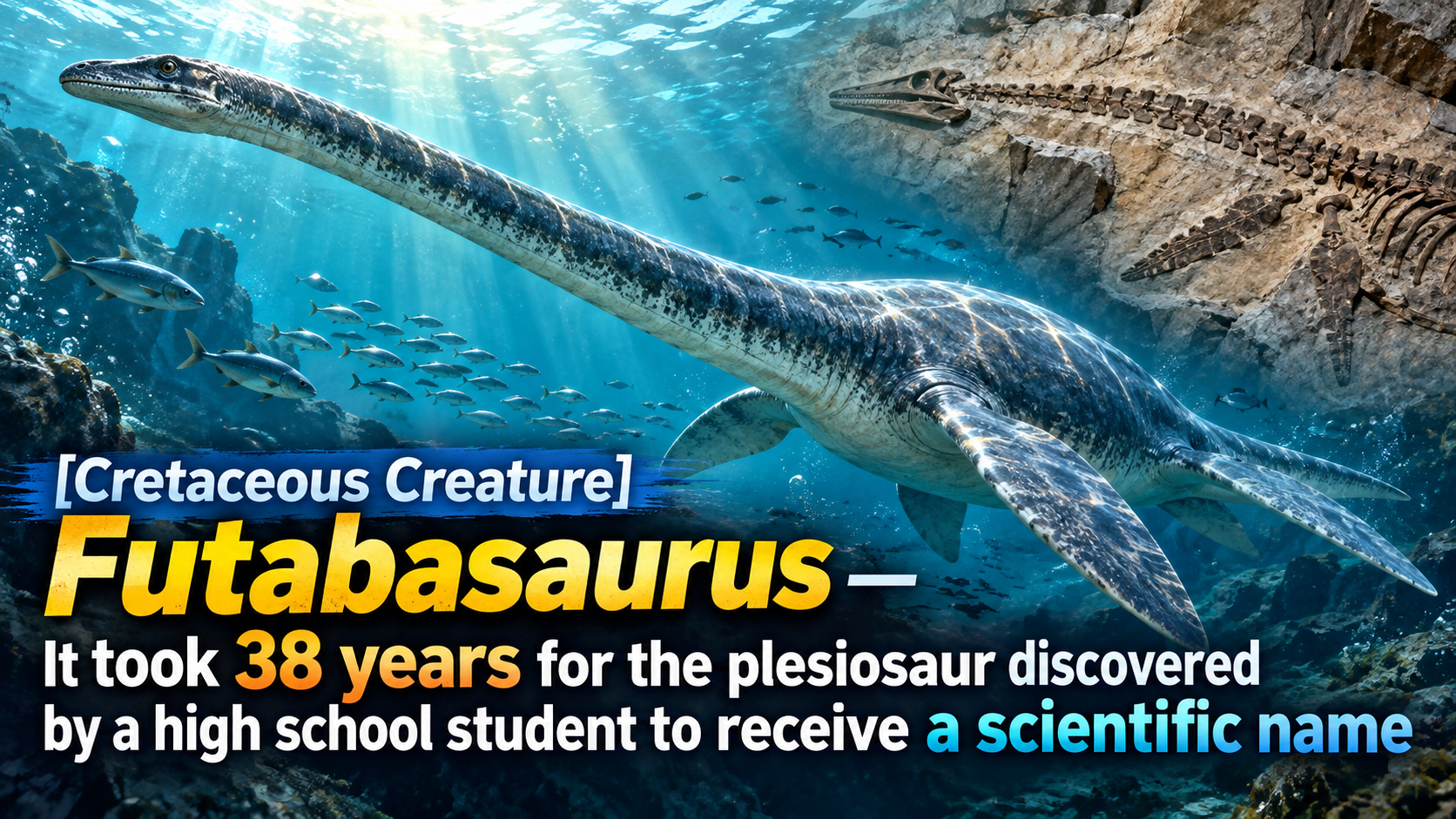
Futabasaurus was a plesiosaur that lived in the seas of the Late Cretaceous. In 1968, Tadashi Suzuki, then a second-year high school student, found its fossil in Iwaki, Fukushima Prefecture. The first report in 1970 called it a plesiosaur distinct from all known species, yet it received its formal scientific name only in 2006, 38 years after its discovery.
Appearance and Life
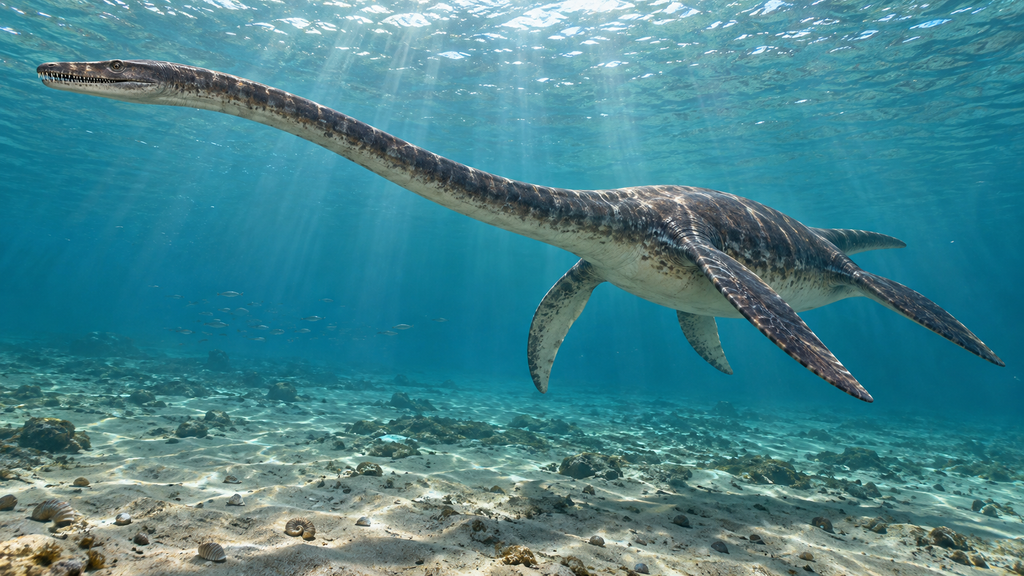
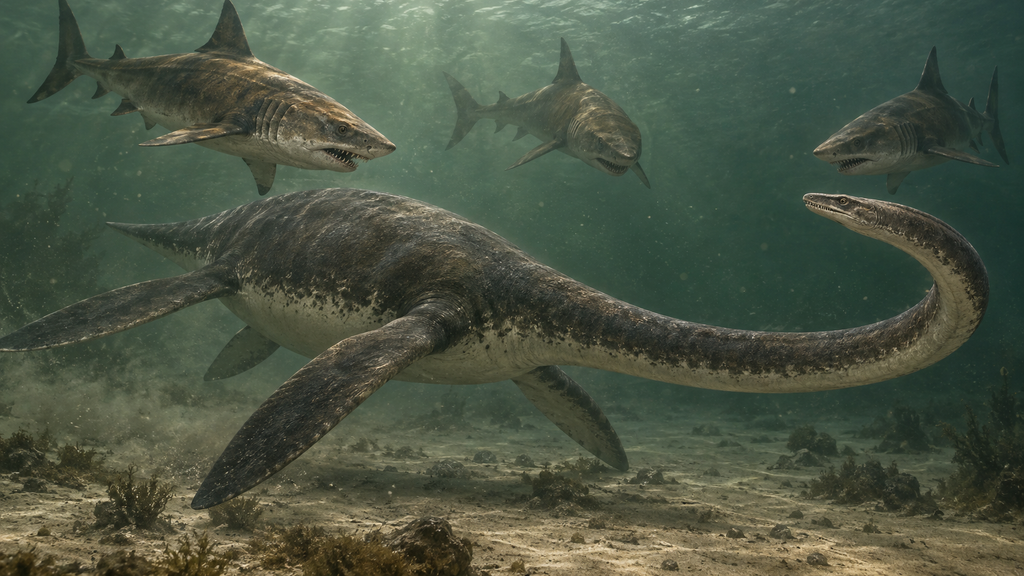
Futabasaurus belongs to the Elasmosauridae, the plesiosaur family with the longest necks. It had a small head, a long neck, a broad, flattened body, four oar-like flippers and a short tail, and is thought to have swum by moving its flippers in a flying stroke. This individual, however, preserves only the base of the neck where it joins the body. The long neck of the skeletal reconstruction is filled in from the number and length of neck bones in other members of the family.
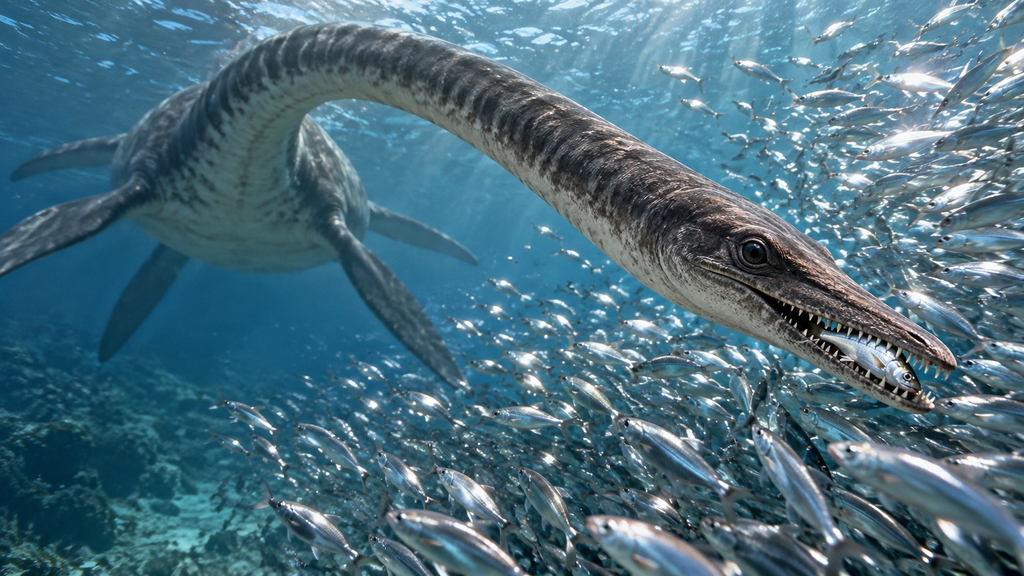
Its mouth was lined with long, slender, pointed teeth; the largest is 7 cm long including the root. According to the 1970 report, the lower teeth are larger than the upper ones, and most of the teeth were found loose, separated from the skull.
The 2006 description lists four features that set it apart from other elasmosaurids: a wide gap between the eye socket and the nostril, a backward extension of the interclavicle (the bone joining the left and right clavicles), a relatively long upper arm bone (humerus) in the front flipper, and a prominent muscle scar on the thigh bone.
Futabasaurus appears to have lived in a shallow sea. The same rocks have yielded trigoniid clams (Apiotrigonia), what appear to be bittersweet clams (Glycymeris), and amber washed in from the land.
More than ten teeth of a shark (Odontaspis) were collected around the skeleton. They were concentrated beneath the backbone, on the side that had been the animal’s back in life. The pelvis and left hind flipper lay belly-side up, while the skull and right hind flipper lay the normal way up. From this arrangement, the 1970 report inferred that the carcass was turned over by waves or currents as it decayed. The 2006 description reports signs that the animal was attacked by sharks or scavenged by them after death.
Thirty-Eight Years to a Name
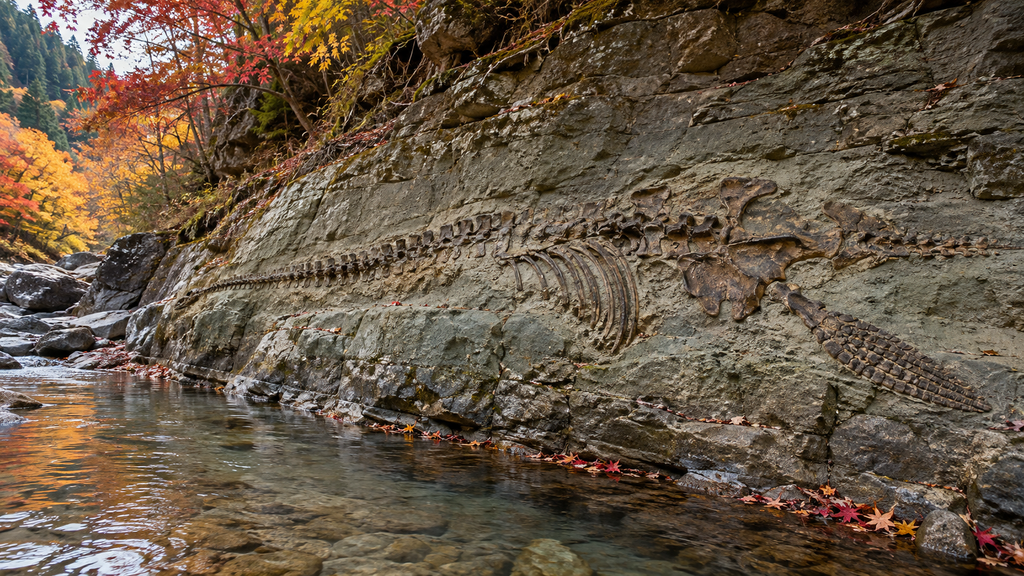
In 1926, fragments of bone attributed to a plesiosaur and an ichthyosaur were reported from the Futaba Group. Those specimens burned in the air raids on Tokyo, and no further reptile fossils were reported from these rocks. Suzuki, who had been collecting fossils on his own, read a 1967 paper on the Futaba Group by Ikuwo Obata of the National Science Museum and contacted him. In the autumn of 1968, Suzuki found more vertebrae in a cliff along the Ōhisa River.
Yoshikazu Hasegawa of the same museum joined them, and over more than ten field sessions the three dug into the cliff and cut out the skeleton of a single animal together with the rock around it. The bones were softer and more fragile than the rock and, at a glance, could be mistaken for bits of plant. Most of the neck and the tail had already been eroded away by the river.
In March 1970, the three published the first report in the Journal of the Geological Society of Japan. It noted that the skull and hips resembled those of the North American elasmosaurids Alzadasaurus and Hydrotherosaurus, and concluded that it was “a plesiosaur of a different kind from those known species.” Even so, the authors did not name it. Comparison with known species from abroad required the chest skeleton and the front flippers, and because these had not been found, they wrote, there were difficulties in fixing its taxonomic position. The report added that if the chest and front flippers were still in the rock, the most promising place was to the northeast of the backbone.
The specimen went into the collection of the National Science Museum, and the nickname “Futaba-suzuki-ryu” spread on its own. In the 1980 animated film Doraemon: Nobita’s Dinosaur, the plesiosaur Piisuke, which the boy Nobita raises from an egg, is a Futabasaurus. It was the most complete Cretaceous plesiosaur skeleton from Japan, but elasmosaurids around the Pacific had few specimens identifiable to species that could serve as a basis for comparison, and comparative specimens and literature were scarce in Japan.
The specimen was finally described by Tamaki Sato, who studied in graduate school in the United States and earned her PhD in Canada for research on plesiosaurs. In May 2006, Sato, Hasegawa and Makoto Manabe of the National Museum of Nature and Science named it as a new genus and species, Futabasaurus suzukii, in the British journal Palaeontology. The specimen used for the description includes the shoulder skeleton and all four flippers. Of the four features listed as distinguishing it from other species, two come from the chest and front flipper: the extension of the interclavicle and the length of the humerus. These are the parts the 1970 report said were needed before a name could be given.
The description calls Futabasaurus the first, and the oldest, elasmosaurid from the northern Pacific that can be identified to species. 2006 was also the year a remake of Nobita’s Dinosaur was released in Japanese cinemas.
Related products
You can find books and products related to this article on Amazon.
If you buy through the links above, this blog may earn a commission.
Sources
Sato, T., Hasegawa, Y. & Manabe, M. (2006). A new elasmosaurid plesiosaur from the Upper Cretaceous of Fukushima, Japan. Palaeontology 49(3), 467–484. https://doi.org/10.1111/j.1475-4983.2006.00554.x
Obata, I., Hasegawa, Y. & Suzuki, T. (1970). Discovery of elasmosaur from the Upper Cretaceous Futaba Group. Journal of the Geological Society of Japan 76(3), 161–164 (in Japanese). https://doi.org/10.5575/geosoc.76.161
Iwaki Digital Museum. Futabasaurus suzukii (in Japanese). https://iwaki-museum.com/3d/5/
Iwaki City Coal and Fossil Museum. Futabasaurus suzukii (in Japanese). https://www.sekitankasekikan.or.jp/%E6%9C%AA%E5%88%86%E9%A1%9E/3829.html
academist Journal. The story behind the research on Futabasaurus, a plesiosaur found in Japan (in Japanese). https://academist-cf.com/journal/?p=3434
コメント