This article contains affiliate links. As an Amazon Associate I earn from qualifying purchases.
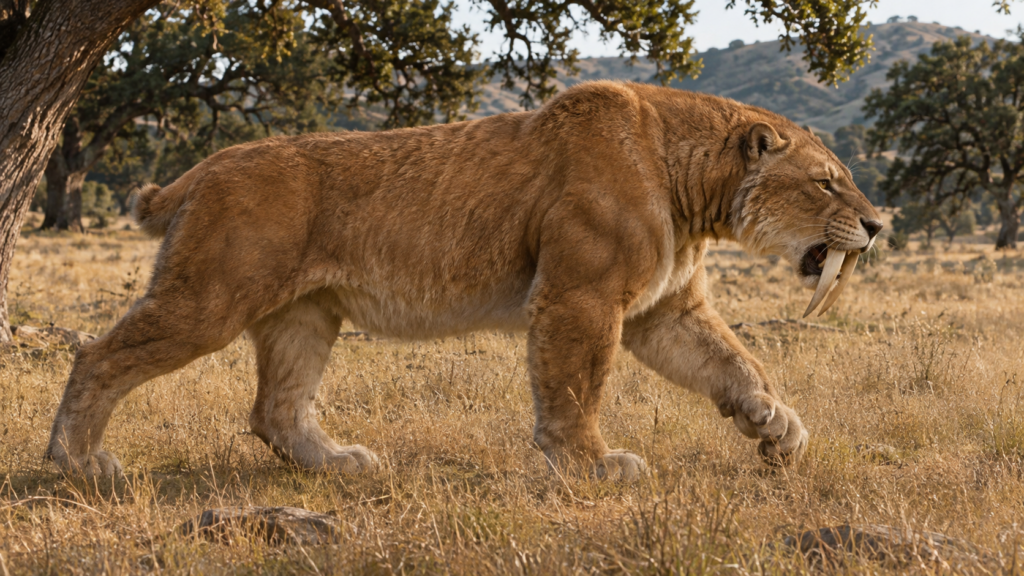
| Name | Smilodon. From Greek words meaning “scalpel” or “two-edged knife” and “tooth.” Popularly called the saber-toothed tiger |
| Classification | Mammalia, Carnivora, Felidae, Machairodontinae (saber-toothed cats) |
| Age | Quaternary, Pleistocene (about 2.5 million to about 10,000 years ago) |
| Found in | North and South America, including the caves of Lagoa Santa in Brazil and La Brea in Los Angeles |
| Length | About 1.75 m in body length and about 1 m at the shoulder in the best-known species, S. fatalis |
| Weight | 55–100 kg for the small S. gracilis, 160–280 kg for S. fatalis, and 220–360 kg for the largest species, S. populator, with some individuals estimated above 400 kg |
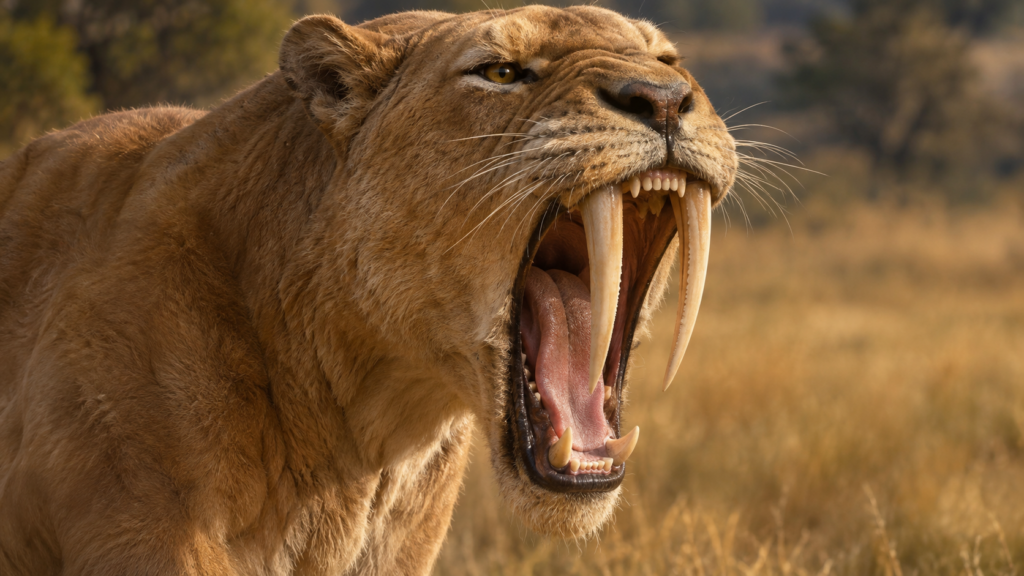
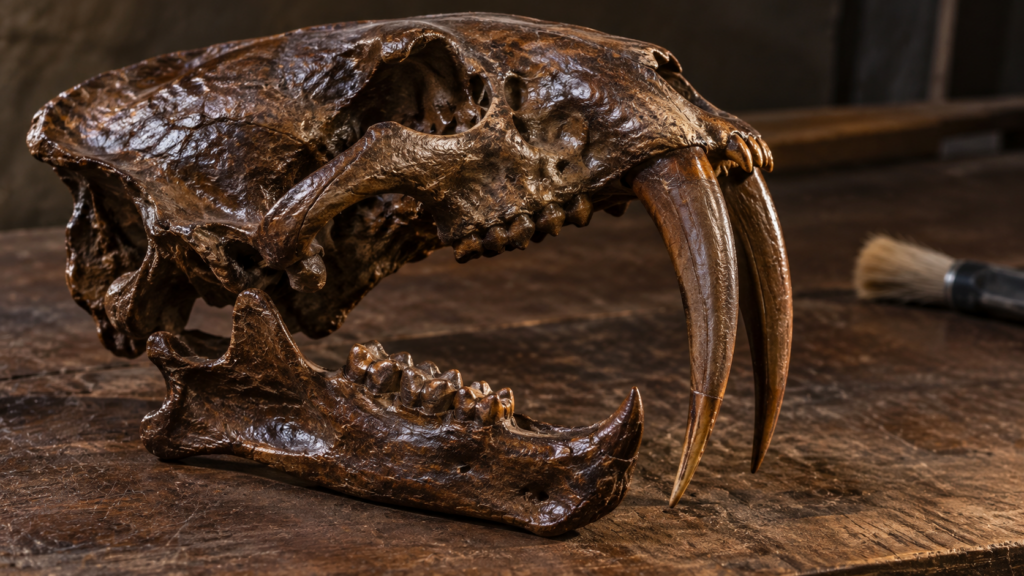
| Sabers | Upper canines, about 28 cm long in S. populator |
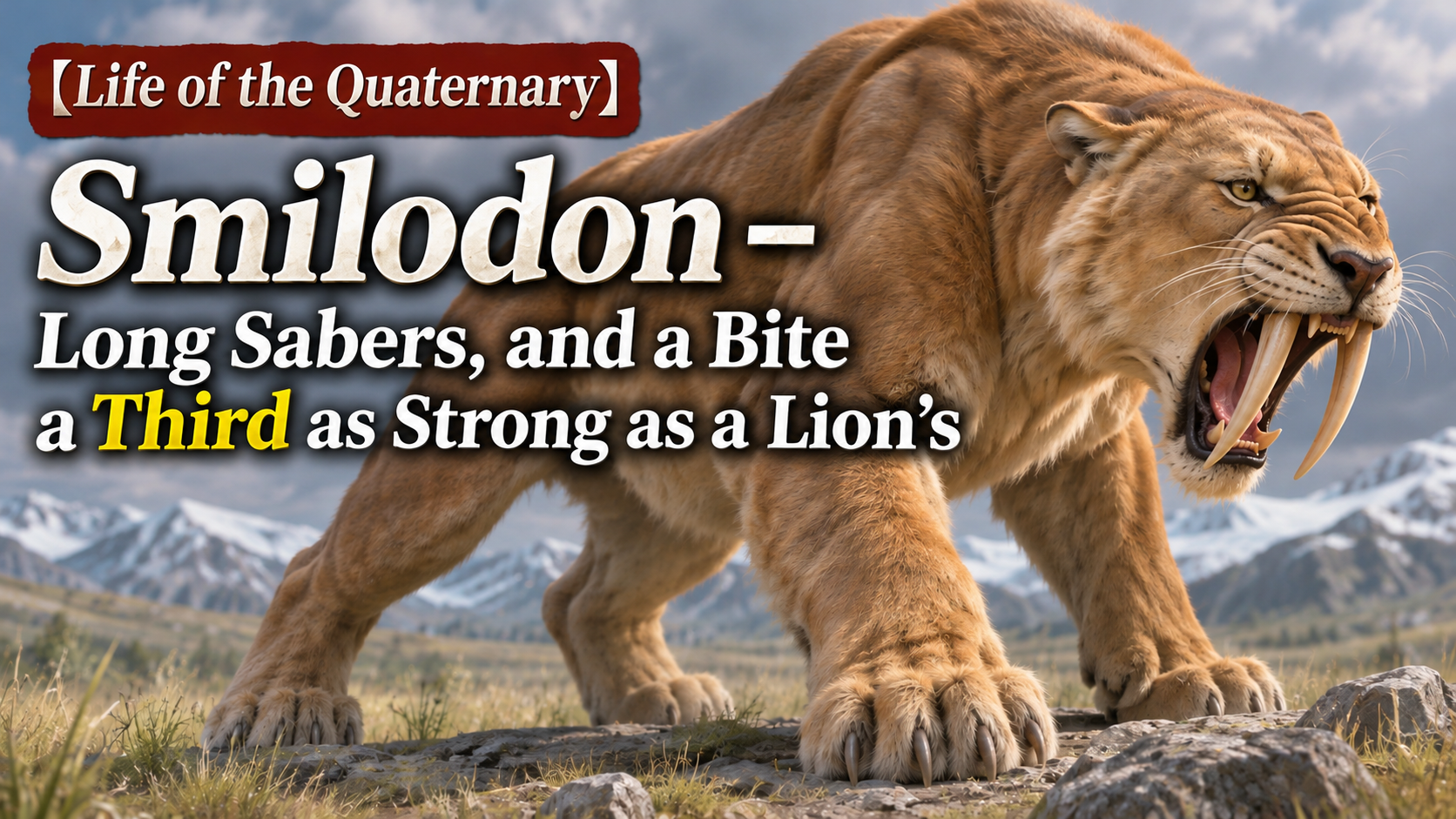
Smilodon was a large cat that lived in North and South America during the Pleistocene. It is known for its long upper canines and is often called the saber-toothed tiger, but it belonged to a different lineage from tigers. For all its heavy build and long sabers, the bite force from its jaw muscles was only about a third that of a lion of the same size.
Appearance and Life
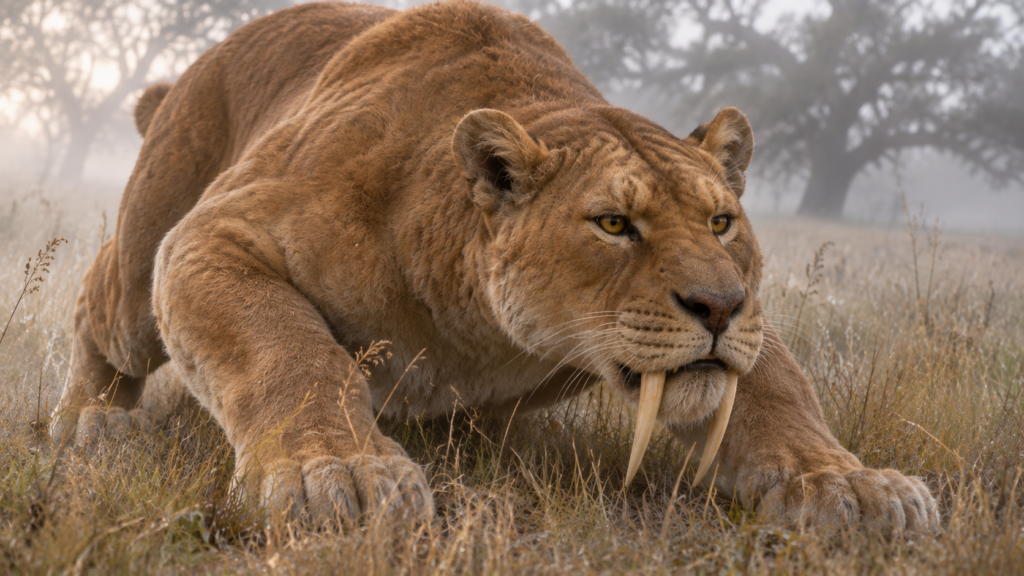
Smilodon was built more robustly than any living cat, with especially thick forelimbs and a short tail. Its upper canines were long and slender, with fine serrations along the front and back edges.
Three species are recognized. The oldest, S. gracilis, appeared in North America about 2.5 million years ago and was about the size of a jaguar. S. fatalis spread mainly across North America and is estimated at 160–280 kg, close to the largest tigers. The South American S. populator was larger still, heavier than any living cat.
The Danish naturalist Peter Wilhelm Lund named the animal. He collected fossils in the caves around Lagoa Santa, Brazil, in the 1830s and named Smilodon populator in 1842.
At La Brea, in present-day Los Angeles, animals became stuck in natural asphalt seeps, and the predators drawn to them were trapped as well. More than 2,000 Smilodon individuals have been recovered there. That abundance helped make it California’s state fossil in 1974.
Predators far outnumber herbivores in the La Brea record. A 2009 study compared this record with African surveys in which recordings of distressed prey were played to attract carnivores. At La Brea, dire wolves made up 51 percent of the record and Smilodon 33 percent. The pattern resembled the surveys, where social lions and hyenas dominated, and the authors concluded that Smilodon was social. That remains an inference from the fossil record, not a settled fact.
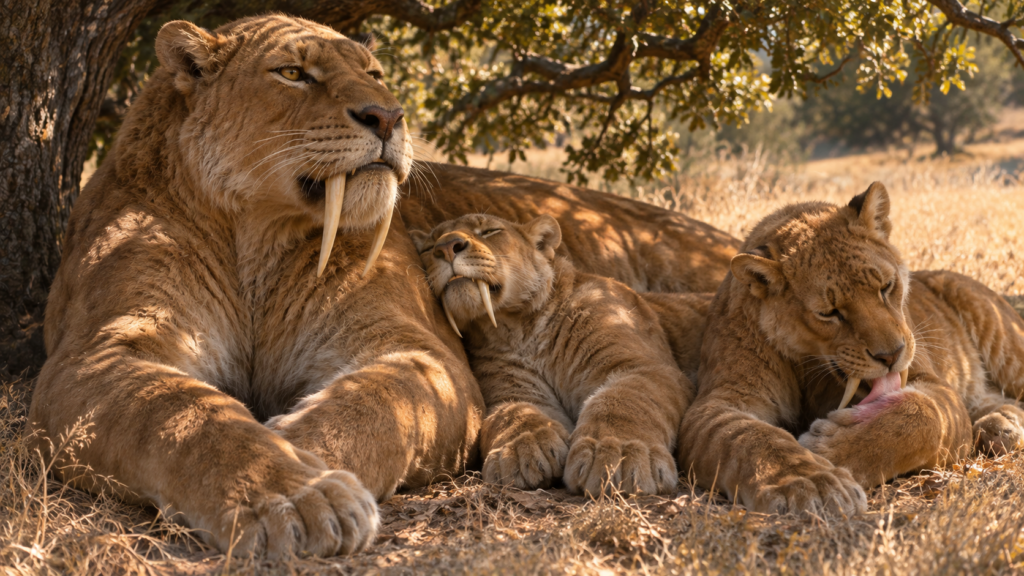
Other fossils point to family ties. Coastal deposits in Ecuador yielded two subadults and one adult that apparently died together. The two young cats share a rare dental trait and are interpreted as siblings. They were at least two years old and still with an adult that was probably their mother, which suggests prolonged parental care.
The Machairodontinae, the group that includes Smilodon, split from the ancestors of living cats about 20 million years ago. Ancient DNA work published in 2005 also placed Smilodon on a separate lineage from living cats. At La Brea, seven species of large extinct animals, Smilodon among them, had disappeared by about 12,900 years ago.
Long Sabers, Weak Jaws
For more than 150 years, researchers debated how Smilodon used its sabers: whether they helped bring down large prey, whether the cat ripped open the abdomen, and whether its bite was strong or weak compared with living big cats.
In 2007, Colin McHenry and colleagues built one of the most detailed 3D computer models of a vertebrate skull yet made, using a skull of S. fatalis, and ran it through finite element analysis, a method borrowed from engineering. The comparison was a modern lion. The bite force generated by the jaw muscles alone was about one-third that of a lion of comparable size. The skull was also poorly suited to resisting the forces from struggling prey.
The same skull handled loads well when biting restrained prey with added force from the neck muscles. The team concluded that Smilodon brought large prey to the ground and held it there before delivering a killing bite, driven largely by powerful neck muscles. Because large prey is easier to restrain with its head secured, the bite was most likely aimed at the neck.
The forelimbs did the holding. A 2010 study compared the humerus of Smilodon with 28 living cat species and the extinct American lion. Its outer bone layer was thicker than in any living cat or the much larger American lion. Slender canines were vulnerable to fracture if prey struggled during a bite, and the strong forelimbs are interpreted as a way to pin the prey and protect the teeth.
The 2007 authors suggested that the stronger jaw muscles of lions may be needed for long, suffocating bites. The relatively weak jaws of Smilodon may reflect an ability to kill large prey more quickly.
Related products
You can find books and products related to this article on Amazon.
If you buy through the links above, this blog may earn a commission.
About the images
The images in this article are illustrations created with AI (ChatGPT), and you are welcome to use them. If you do, we would appreciate a link back to this article as the source.
Sources
McHenry, C. R. et al. (2007). Supermodeled sabercat, predatory behavior in Smilodon fatalis revealed by high-resolution 3D computer simulation. PNAS 104(41), 16010–16015. https://doi.org/10.1073/pnas.0706086104
Meachen-Samuels, J. A. & Van Valkenburgh, B. (2010). Radiographs reveal exceptional forelimb strength in the sabertooth cat, Smilodon fatalis. PLOS ONE 5(7), e11412. https://doi.org/10.1371/journal.pone.0011412
Christiansen, P. & Harris, J. M. (2005). Body size of Smilodon (Mammalia: Felidae). Journal of Morphology. https://doi.org/10.1002/jmor.10384
Carbone, C. et al. (2009). Parallels between playbacks and Pleistocene tar seeps suggest sociality in an extinct sabretooth cat, Smilodon. Biology Letters 5(1), 81–85. https://doi.org/10.1098/rsbl.2008.0526
Reynolds, A. R., Seymour, K. L. & Evans, D. C. (2021). Smilodon fatalis siblings reveal life history in a saber-toothed cat. iScience. https://doi.org/10.1016/j.isci.2020.101916
Barnett, R. et al. (2005). Evolution of the extinct Sabretooths and the American cheetah-like cat. Current Biology. https://doi.org/10.1016/j.cub.2005.07.052
O’Keefe, F. R. et al. (2023). Pre–Younger Dryas megafaunal extirpation at Rancho La Brea linked to fire-driven state shift. Science. https://doi.org/10.1126/science.abo3594
La Brea Tar Pits, Here, Kitty, Kitty (number of individuals and the state fossil) https://tarpits.org/stories/here-kitty-kitty
UNSW Sydney (2007), Scientists say sabretooth bit like a pussycat https://www.unsw.edu.au/newsroom/news/2007/10/scientists-say-sabretooth-bit-like-a-pussycat
Wikipedia, Smilodon (age of the genus, body length and height, naming history) https://en.wikipedia.org/wiki/Smilodon
Turner, A. & Antón, M. (1997). The Big Cats and Their Fossil Relatives. Columbia University Press (saber length)

コメント