This article contains affiliate links. As an Amazon Associate I earn from qualifying purchases.
| Name | Glossopteris, from the Greek for “tongue” and “fern” |
| Classification | Seed plant, order Glossopteridales. Not a fern but a seed-bearing plant whose relationship to other seed plants is unclear |
| Age | Permian (about 299 to 252 million years ago) |
| Found in | India, South America, Africa, Madagascar, Australia and Antarctica, all middle- and high-latitude parts of Gondwana at the time |
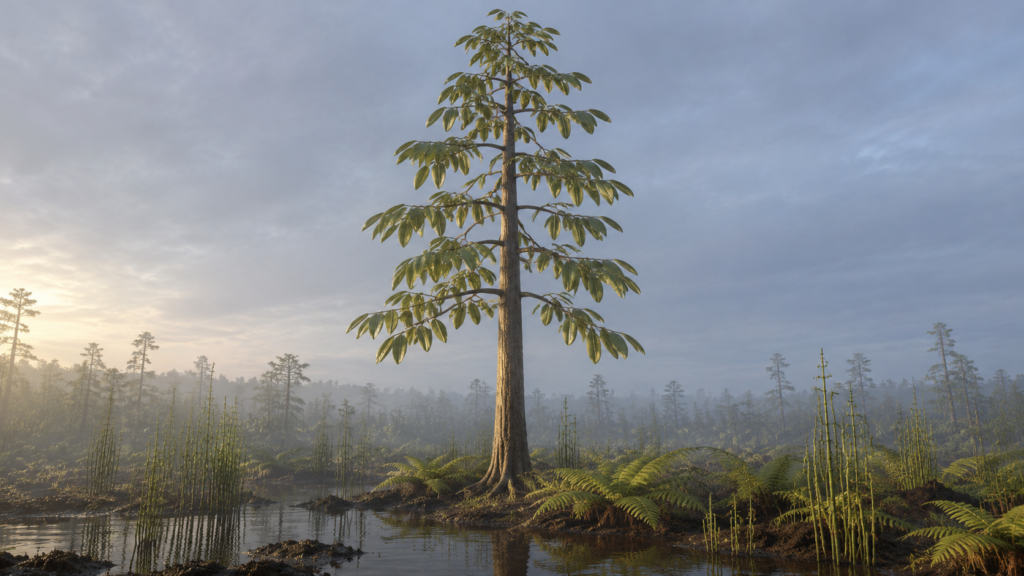
| Height | The largest are thought to have reached about 30 m |
| Trunk diameter | Up to 80 cm |
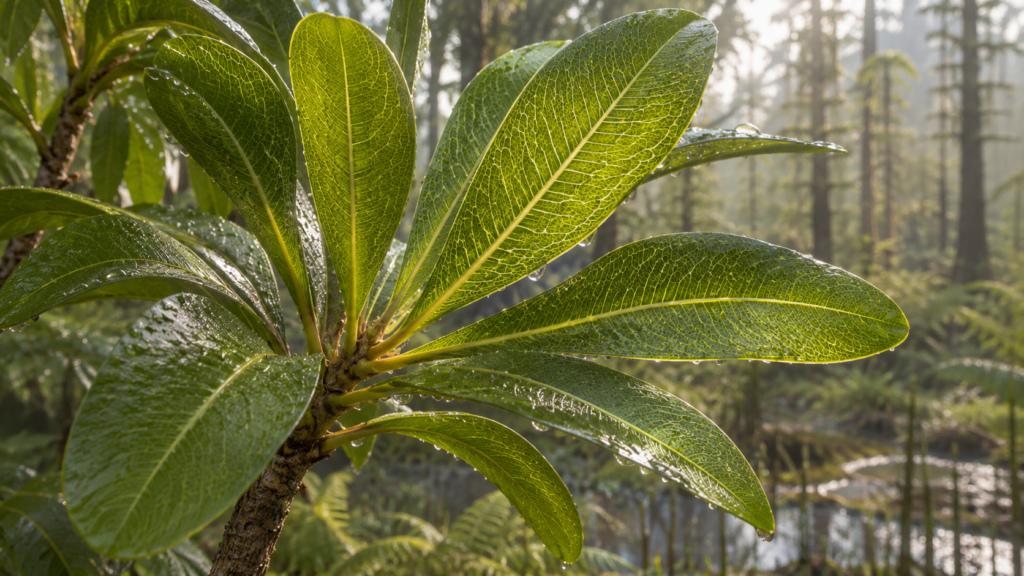
| Leaf length | About 2 cm to over 30 cm |
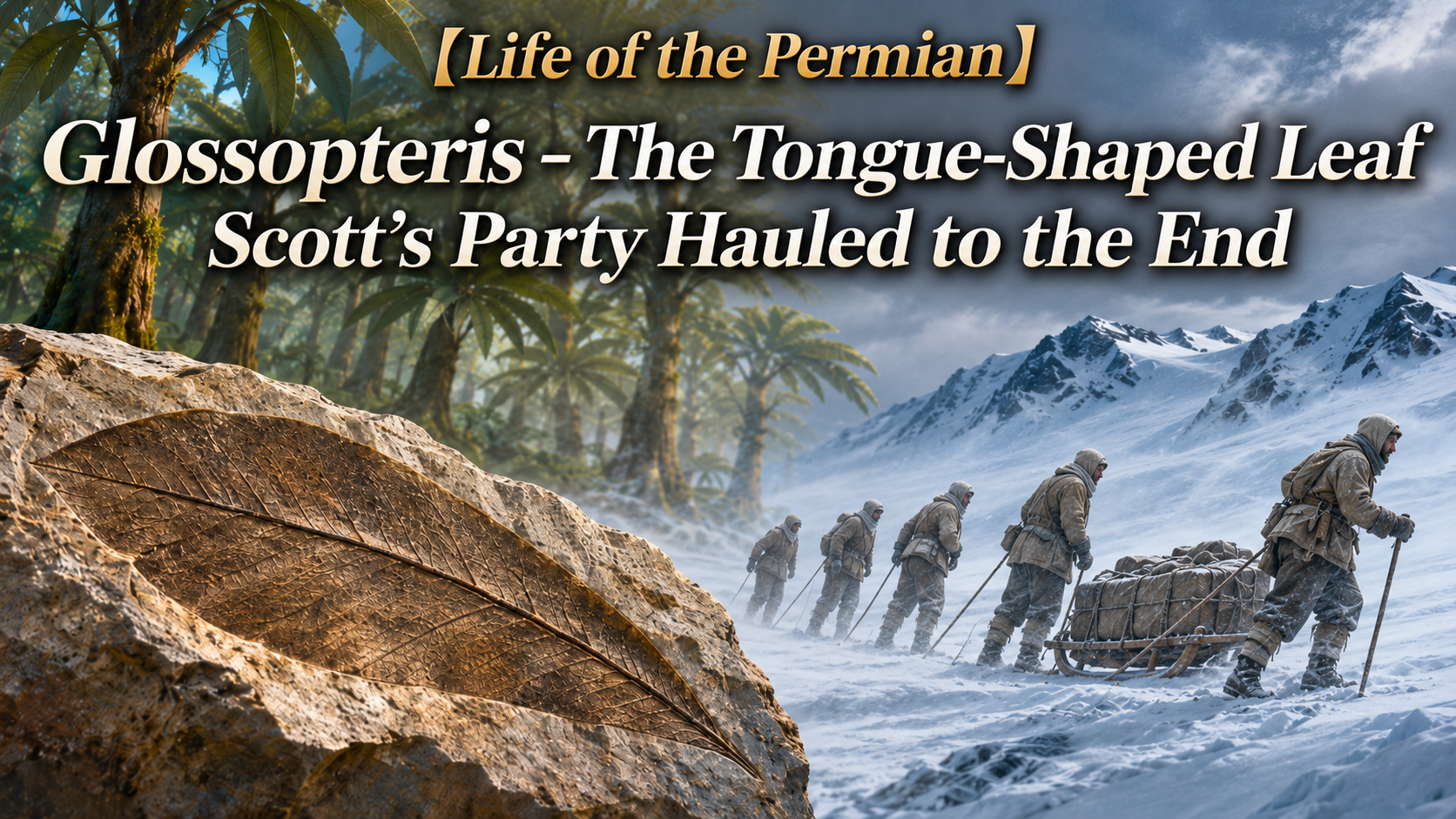
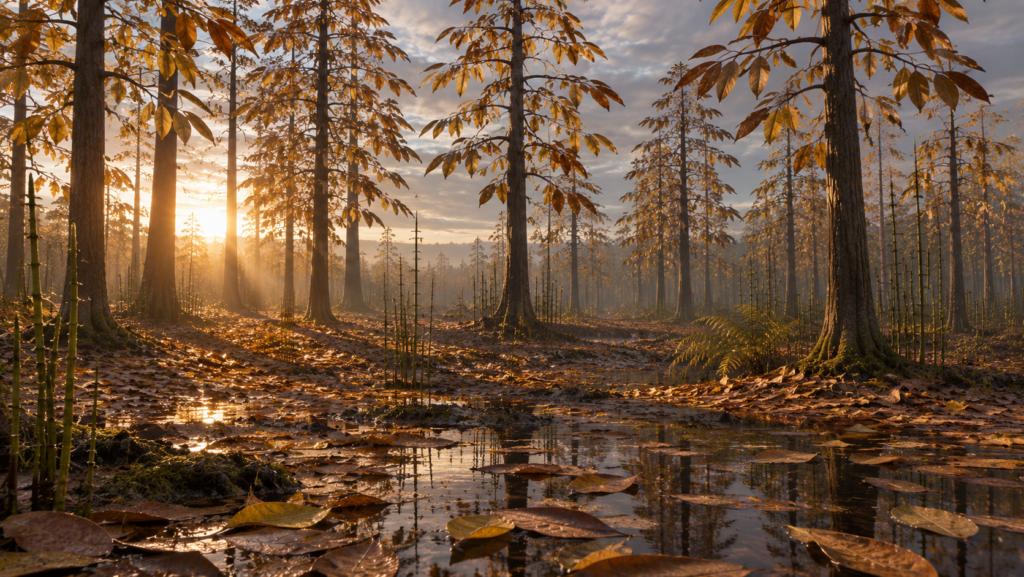
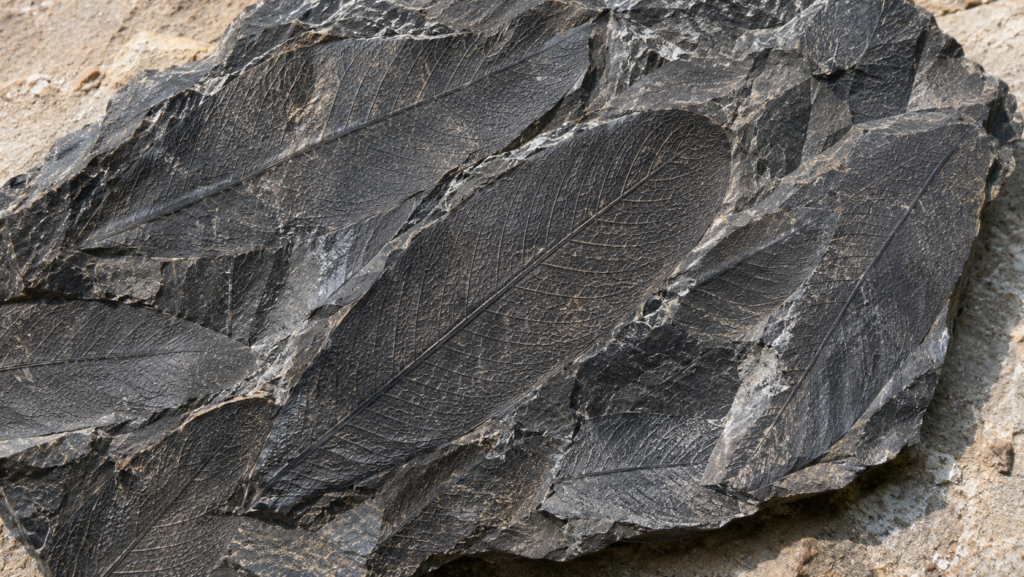
Glossopteris was a tree that formed forests across the Southern Hemisphere in the Permian. It is known for its tongue-shaped fossil leaves, and the fact that the same leaves turn up from India to Antarctica became one piece of evidence that the southern continents were once joined. The first specimens to establish it firmly in Antarctica were carried by Scott’s polar party, which perished on the way back from the South Pole in 1912.
Appearance and Life
Trunks reached 80 cm across, with wood resembling that of the araucarian conifers inside. The roots had a distinctive segmented form, known as fossils under the name Vertebraria. The leaves had net-like veins and grew either widely spaced on long stems or crowded in a spiral on short shoots. Seeds sat on one side of branching structures partly joined to the leaves, and pollen organs hung in clusters at the tips of slender filaments.
When it was found in the 1820s it was taken for a fern, and the word “fern” is still in its name, given by the French botanist Adolphe Brongniart. It in fact reproduced by seed, but how its leaves relate to its seed-bearing organs is still debated, and its place among the seed plants remains unsettled. More than 70 species have been described from India alone.
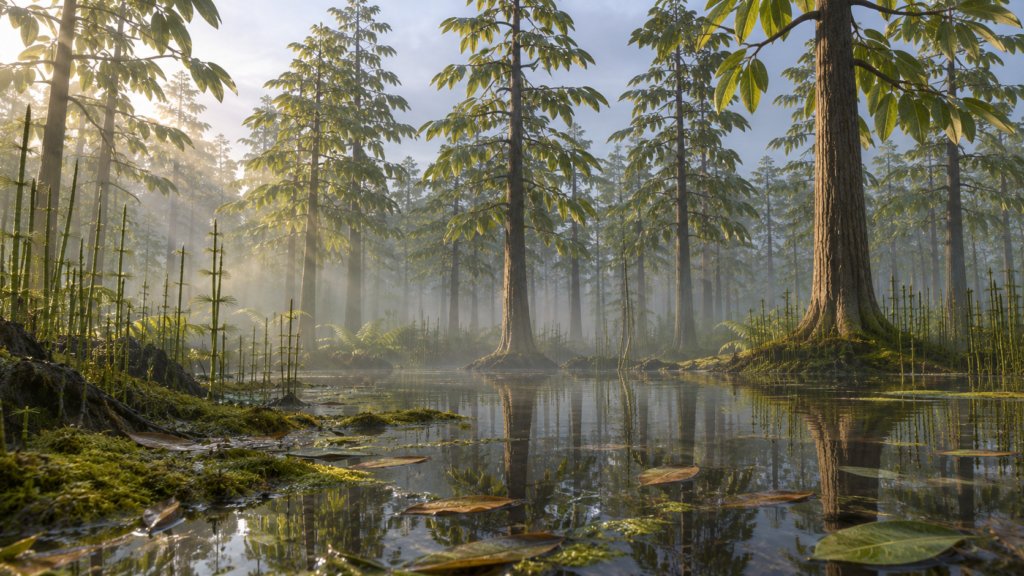
It grew on very wet ground, in forests somewhat like modern bald cypress swamps. The plant matter piled up as peat and became a major source of the great Permian coal deposits of the southern continents. Growth rings in Antarctic wood show that the trees stopped growing before winter, a shutdown that could take as little as a month. Dense mats of fossil leaves have long suggested that it dropped its leaves in autumn, though one isotopic study found that the Antarctic forests were a mix of evergreen and deciduous trees.
Its wide distribution drew attention in the 19th century. In an 1885 book the Austrian geologist Eduard Suess argued that the southern continents had once been one, and named that land Gondwanaland after the district in India rich in Glossopteris fossils. Glossopteris disappeared from nearly everywhere at the end of the Permian. In Australia’s Sydney Basin the forests collapsed before about 252.3 million years ago.
The Fossils Carried to the End
The presence of the Glossopteris flora in Antarctica was established by specimens collected by Robert Scott’s polar party. Hartley Ferrar had found traces of plants on the expedition of 1901–1904, but they were too fragmentary to identify. Shackleton’s party had also found coal at Mount Buckley on the Beardmore Glacier.
Scott and his four companions reached the South Pole in January 1912, learned that Amundsen’s Norwegian party had beaten them there, and turned for home. On February 8, after leaving the depot at the top of the glacier and a morning of hard wind, they steered for the moraine under Mount Buckley. Once out of the wind, Scott decided to spend the rest of the day on geology.
According to his journal, they found themselves under cliffs of Beacon sandstone with true coal seams in them. Edward Wilson picked out plant impressions, the last of them a piece of coal with leaves traced in layers, along with impressions of thick stems. Collecting on the moraine continued the next day.
At Wilson’s request, the party kept the specimens. As food and fuel ran short, and as Edgar Evans fell in February and Lawrence Oates in March, the rocks stayed on the sledge. Scott’s last journal entry is dated March 29.
On November 12, 1912, a search party found the tent. On the sledge were the geological specimens that Scott, Wilson and Henry Bowers had hauled that far. The search party’s record gives their weight as 35 pounds (about 16 kg); the expedition member Apsley Cherry-Garrard’s book says 30 pounds.
Albert Seward of Cambridge University studied the specimens and described them in 1914, confirming for the first time that the Glossopteris flora had grown in Antarctic rocks. They were evidence that this ice-covered continent near the pole had once held forests thick enough to make coal. Even so, Alfred Wegener’s writings on continental drift reportedly make no mention of the Antarctic specimens.
Related products
You can find books and products related to this article on Amazon.
If you buy through the links above, this blog may earn a commission.
About the images
The images in this article are illustrations created with AI (ChatGPT), and you are welcome to use them. If you do, we would appreciate a link back to this article as the source.
Sources
Scott, R. F. (1913). Scott’s Last Expedition, Vol. I (journal entry for February 8, 1912) https://www.gutenberg.org/cache/epub/11579/pg11579.html
Cherry-Garrard, A. (1922). The Worst Journey in the World https://www.gutenberg.org/ebooks/14363
Edwards, W. N. (1928). The occurrence of Glossopteris in the Beacon Sandstone of Ferrar Glacier, South Victoria Land. Geological Magazine 65(7), 323–327. https://doi.org/10.1017/s0016756800107848
Gulbranson, E. L. et al. (2014). Leaf habit of Late Permian Glossopteris trees from high-palaeolatitude forests. Journal of the Geological Society 171, 493–507. https://doi.org/10.1144/jgs2013-127
IFLScience, What Links Scott’s Expedition To The Antarctic, A Bag Of Rocks, And The Theory Of Plate Tectonics? https://www.iflscience.com/what-links-scotts-expedition-to-the-antarctic-a-bag-of-rocks-and-the-theory-of-plate-tectonics-84150
Wikipedia, Glossopteris (classification, size, leaves and seed organs, habitat, distribution) https://en.wikipedia.org/wiki/Glossopteris

コメント