This article contains affiliate links. As an Amazon Associate I earn from qualifying purchases.
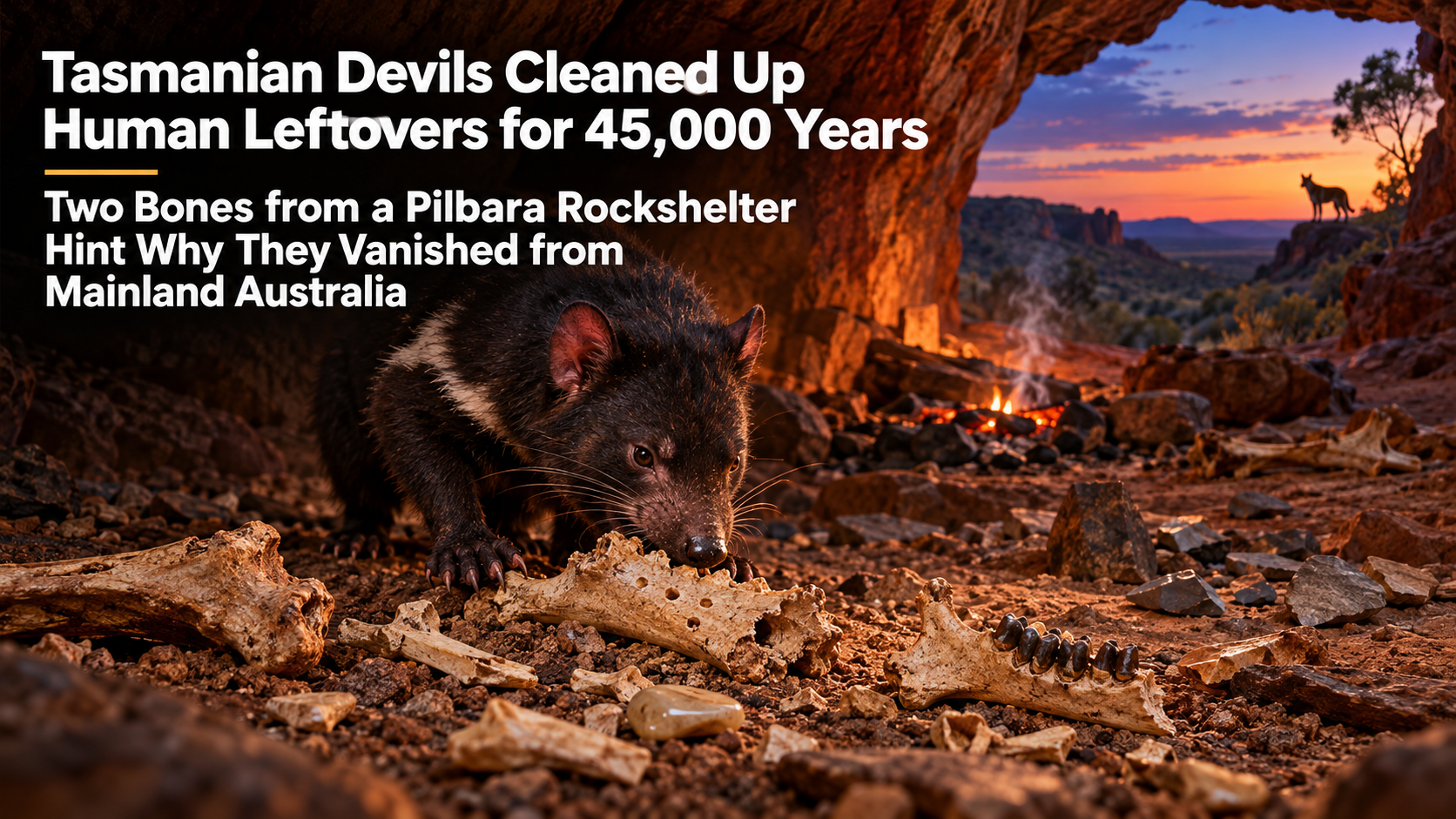
Tasmanian devils survive in the wild today only on the island of Tasmania. Despite the name, they once lived across most of mainland Australia, and they vanished from the mainland only about 3,200 years ago. One region, though, had never produced a single record from that mainland past: the Pilbara, the dry iron-ore country of northern Western Australia. Palaeontologist Timothy J. Churchill of the University of New South Wales and his colleagues re-examined bones excavated from a rockshelter in Juukan Gorge in the Pilbara and, in a paper published in Archaeology in Oceania on 10 September 2026, reported the first devil remains from the region. Only two pieces of devil came out of the shelter. Read together with the more than 8,000 other bones found around them, however, those two pieces reveal a relationship between devils and people that lasted some 45,000 years.
A Rockshelter Blown Up in 2020
Juukan Gorge lies on the Country of the Puutu Kunti Kurrama and Pinikura peoples. Its rockshelters made headlines around the world in May 2020, when the mining company Rio Tinto blasted them to expand an iron-ore mine. Excavations carried out before the blast had already shown that people used the shelter from at least 47,000 years ago, and had produced stone tools, hearths, shell beads, bone tools, a belt plaited from human hair, and large quantities of animal bone, including kangaroo and monitor lizard. The new study went looking for devils among the material recovered in those excavations. The digs were overseen by the Puutu Kunti Kurrama and Pinikura Aboriginal Corporation, and Gavin Ashburton of that corporation is a co-author of the paper.
A Piece of Jaw and a Broken Tooth
Two specimens can be called devil itself. One is a fragment of the right lower jaw with the first and second molars still in place. It came from Holocene sediments, the layers laid down from about 11,600 years ago to the present, and the surrounding deposit dates to roughly 6,900 to 7,300 years ago. The other is part of a lower premolar, found in layers older than the Last Glacial Maximum, in sediment dated to about 42,500 to 47,100 years ago. Neither shows cut marks or signs of burning, so there is no evidence that people ate devils here. The team thinks the animals wandered into the shelter while foraging, and some died there.
A devil is about the size of a small dog, but it is the largest living carnivorous marsupial, with powerful jaws and a habit of eating its food bones and all. That is why the real story lies not in those two specimens but in the feeding traces left on the bones around them.
Bite Marks on 8,000 Bones
Of the more than 8,000 catalogued animal bones, over 1,000 carry chewing or gnawing marks. Most were made by rodents, but some match quolls, devils and possibly monitor lizards. The team measured 55 bones with clear marks in detail and found that on at least ten of them, the size of the pits pressed into the bone by teeth is closest to that of devil teeth.
The second clue is bone that passed through a stomach. There are 263 fragments whose surfaces have been dissolved and rounded by digestive juices, and many of them are too large to have been swallowed by the Pilbara’s smaller carnivores, the quolls and the mouse-sized mulgaras. The authors write that they are best explained by digestion in a large, bone-eating marsupial carnivore, in other words a devil.
These traces turn up through almost the entire history of the shelter: in layers from about 47,000 to 26,000 years ago, in layers after the Last Glacial Maximum (roughly 29,000 to 19,000 years ago), and in the Holocene layers.

The Local Cleanup Crew
What matters is whose bones were being chewed. The animals that people butchered and ate in the shelter, and whose remains they left behind, were medium-sized and large species, kangaroos above all. The devil bite marks and digestion traces are concentrated on exactly those leftovers. The team’s reading is that from the time people first settled in this shelter, devils were living partly on the scraps that human camps produced. Churchill calls them the local cleanup crew, and suggests that having an animal nearby that disposed of rotting meat, bones included, would have been an advantage for people too, not least by reducing disease.
The Pilbara is dry country today, and during the Last Glacial Maximum it became drier still. Finding devil traces in the layers around that period shows that the animals got through those harsh times alongside people. Churchill says the discovery shows just how adaptable Tasmanian devils were.

What Dingoes Took Was Not the Prey but the Seat Beside People
From here on, the paper is proposing a hypothesis. Devils and thylacines disappeared from mainland Australia about 3,200 years ago. Shortly before that, at least 3,500 years ago, dingoes arrived on the mainland. Because of that overlap, the idea that dingoes pushed devils out has been around for a long time. But the usual version of the story was competition for carrion in the wild, or dingoes killing devils outright.
What this study adds is the possibility that the contest took place at human camps. Dingoes live and move with people, and they are likely to have taken over the role of eating the leftovers of human camps that devils had held. Losing a food source they had relied on for more than 40,000 years, the authors argue, may have helped drive devils to extinction on the mainland. Churchill notes that dingoes have long been blamed for competing with devils over carrion, while competition for access to people and their food scraps has been largely overlooked.
What One Rockshelter Can and Cannot Tell Us
This study presents the record of a single rockshelter, and it does not prove that dingoes were the cause. Other explanations for the mainland extinction, including human hunting and climate change, remain on the table, and the paper does not dismiss them. Whether devil traces turn up at other Pilbara sites will decide how strong the case becomes.
There is also the fact that this record only narrowly survived. The shelter the material came from was blasted in 2020, and the study exists only because bones had been removed in the earlier excavations. The authors describe a site where human and animal histories overlap for this long as irreplaceable, and call in the paper for places like it to be protected.
Tasmanian devils are now declining because of a contagious facial cancer. In 2020, as a trial reintroduction to the mainland, 26 devils were released in a national park in New South Wales. What devils back on the mainland after roughly 3,000 years will eat is an open question, and a 45,000-year record of their relationship with people is a useful thing to have when thinking about it. The paper is open access and free to read.
Related products
You can find books and products related to this article on Amazon.
If you buy through the links above, this blog may earn a commission.
Sources
- Churchill, T. J., Slack, M., Matheson, E., Neill, L., Saktura, W. M. & Ashburton, G. (2026) “First Record of Tasmanian Devils in the Pilbara: Late Quaternary Subfossils From Juukan Gorge, Puutu Kunti Kurrama Country, and Insights Into Human—Faunal Relationships and Extinction.” Archaeology in Oceania. https://doi.org/10.1002/arco.70031
- UNSW media release “Tasmanian devils lived alongside humans in the Pilbara for 45,000 years, and dingoes may have broken the bond” (via Medianet, 11 September 2026) https://newshub.medianet.com.au/2026/09/tasmanian-devils-lived-alongside-humans-in-the-pilbara-for-45000-years-and-dingoes-may-have-broken-the-bond/170934/
- Archaeology News “Tasmanian devils lived in Australia for 45,000 years” (14 September 2026) https://archaeologymag.com/2026/09/tasmanian-devils-lived-in-australia-for-45000-years/
- Smithsonian Magazine “Tasmanian Devils Lived Alongside Humans in Northwestern Australia as Far Back as 45,000 Years Ago, Researchers Find” (16 September 2026) https://www.smithsonianmag.com/smart-news/tasmanian-devils-lived-alongside-humans-in-northwestern-australia-as-far-back-as-45000-years-ago-researchers-find-180989503/


コメント