This article contains affiliate links. As an Amazon Associate I earn from qualifying purchases.
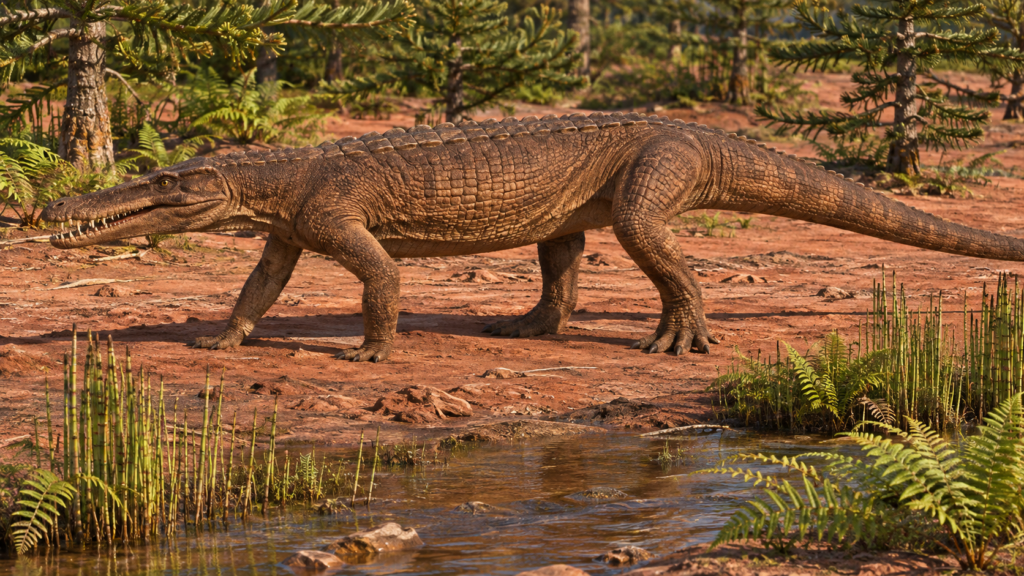
| Name | Chirotherium (“hand beast”). A name given to fossil footprints (an ichnogenus); the best-known species is Chirotherium barthii |
| Classification | Trace fossil (footprints). The trackmakers are thought to be archosaurs on the crocodile line (pseudosuchians) |
| Age | Triassic (C. barthii tracks date from the end of the Early Triassic to the start of the Middle Triassic) |
| Where found | Hildburghausen, Thuringia, Germany (1833). Also found in Cheshire, England, in Spain and elsewhere |
| Track size | Hind-foot prints about 19–22 cm long (C. barthii) |
| Trackmaker size | Ticinosuchus from Switzerland, whose feet closely match the tracks, was about 2.5–3 m long |
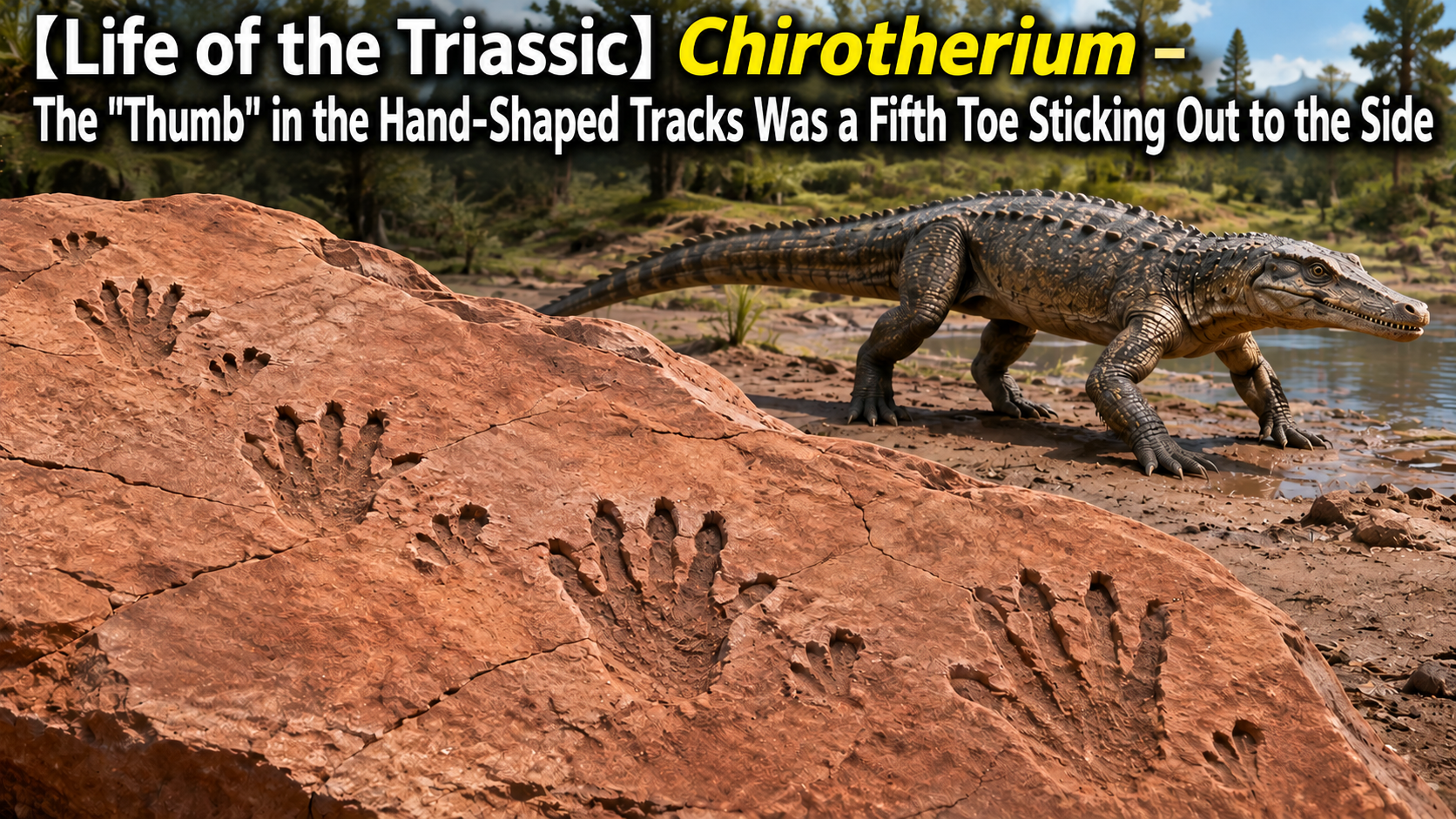
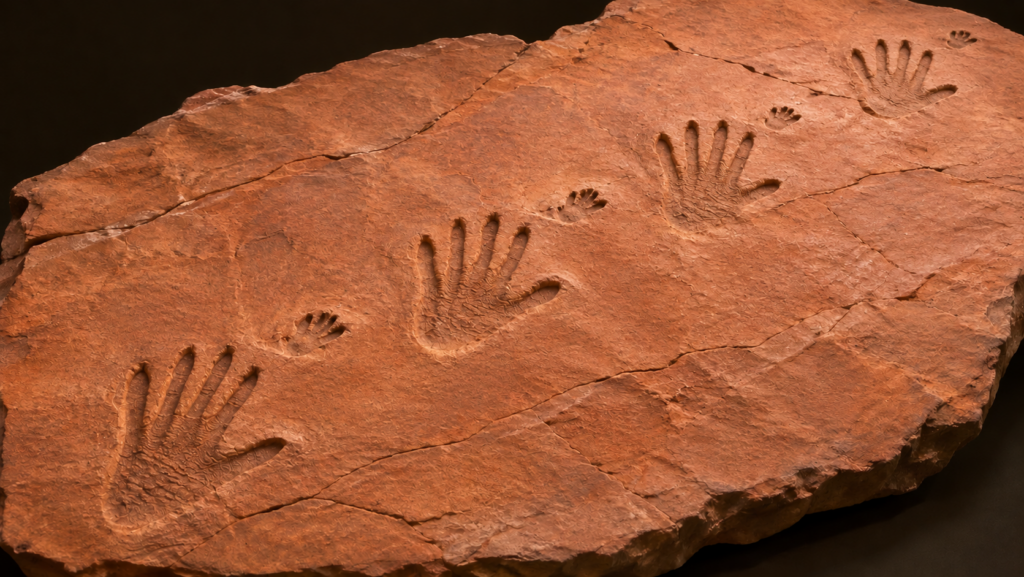
Chirotherium is the name given to fossil footprints found in Triassic rocks. Because the hind-foot prints look like a human hand with the thumb sticking out, they were named the “hand beast.” The first tracks were found in 1833, but what the animal that made them looked like remained unknown for about the next 90 years.
The Tracks
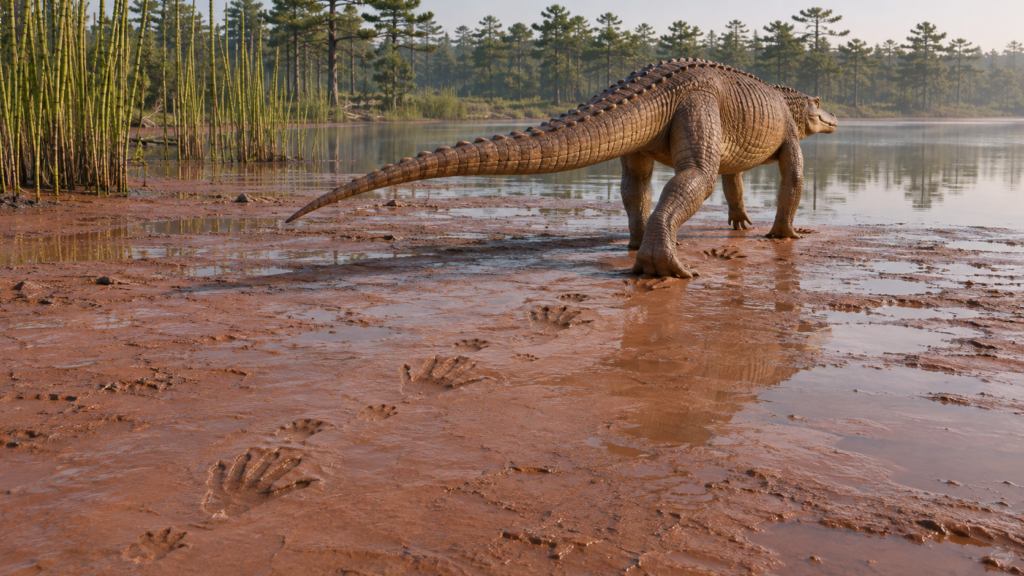
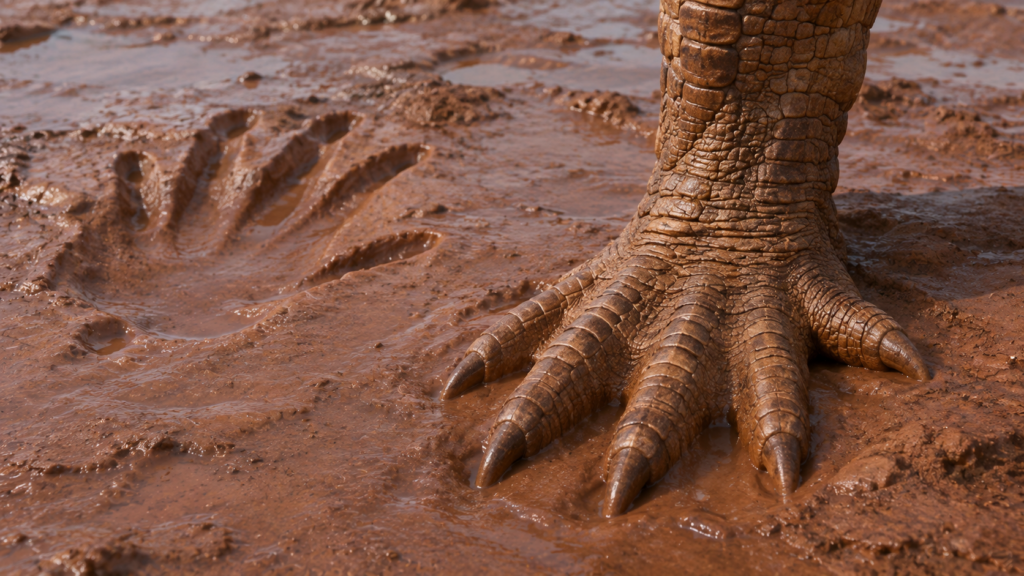
Chirotherium tracks run in pairs of front and hind prints. The hind print is large: of its five toe marks, four point forward and one sticks far out to the side. The front print is much smaller and sits just in front of the hind print. In C. barthii, the best-known species, the hind prints are about 19–22 cm long. Smaller tracks (8–14 cm) are known from Spain and elsewhere, and one study suggests the difference in size reflects young and adult animals rather than different species.
The tracks are common in rocks from the end of the Early Triassic to the start of the Middle Triassic. In Germany they come from reddish sandstone layers known as the Buntsandstein (“colored sandstone”). Tracks of the same shape have been reported from across Europe, including England, Spain and Scotland.
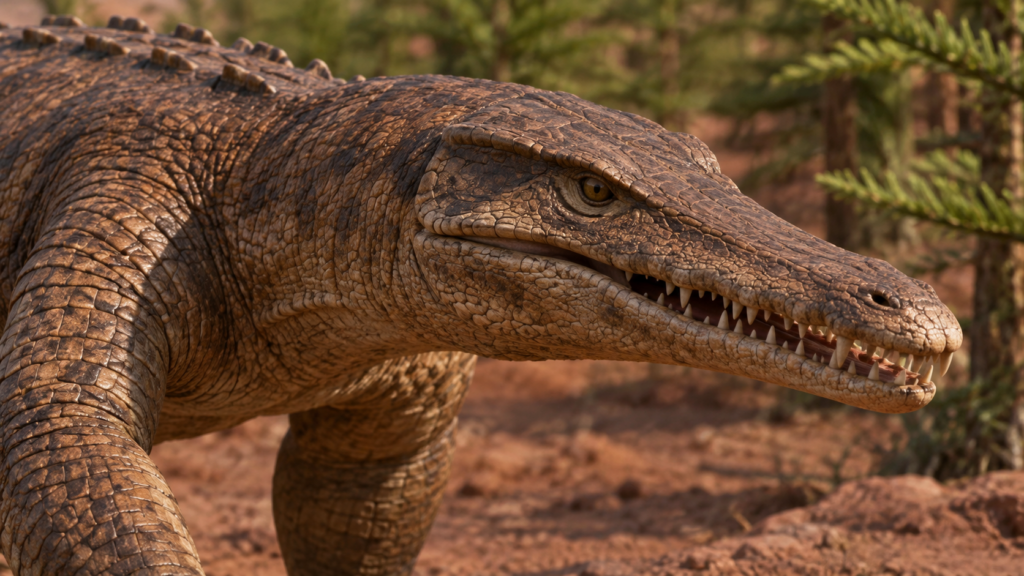
The trackmakers are thought to have been archosaurs on the line leading to crocodiles: reptiles several meters long with strong hind legs and shorter front legs, walking with their legs held under the body. The tracks are not tied to a single species; several related animals with similar feet probably made them.
What the “Thumb” Really Was
The first tracks were spotted in 1833 by Friedrich Sickler, a school headmaster in Hildburghausen, on sandstone slabs he was using to build a garden house. Sickler paid quarry workers to collect more and published the find in 1834. In 1835 the German naturalist Johann Jakob Kaup named the tracks Chirotherium. Kaup compared a print to “a large man’s hand in a thick fur glove.” He put “beast” in the name because he thought a mammal had made the tracks, and added that if the maker turned out to be an amphibian, the name should be “Chirosaurus.”
Many ideas about the trackmaker followed. The German naturalist Alexander von Humboldt saw the sideways toe as a thumb that could grasp branches and suggested a marsupial. Kaup, too, imagined a giant marsupial with thumbs on its front and hind feet. Others proposed a large ape, a toad or a bear.
In the 1840s the British anatomist Richard Owen named bones of a large amphibian found in England Labyrinthodon and suggested it had made the Chirotherium tracks. With the sculptor Benjamin Waterhouse Hawkins, Owen turned Labyrinthodon into a life-size model that looked like a giant toad; the model still stands in a park at Sydenham in south London. The geologist Charles Lyell reasoned that if this Labyrinthodon had made the tracks, then with its “thumbs” on the outside it must have walked with its feet crossed. An 1855 sketch by Lyell shows a toad-like creature walking with crossed legs.
The answer came from the tracks themselves. In 1925 the paleontologist Wolfgang Soergel re-examined the Chirotherium tracks held in museums across Germany. He showed that the sideways “thumb” was not a thumb at all but the outer, fifth toe of a five-toed hind foot, the equivalent of a little toe. From the way the tracks were laid out, he reconstructed an animal with strong hind legs and short front legs that walked with its legs held under its body, and placed it close to early archosaurs.
Body fossils caught up with this reconstruction later. In 1942 the paleontologist Friedrich von Huene described Prestosuchus, a large archosaur from Triassic rocks in Brazil, and noticed that its foot resembled Soergel’s reconstruction. In 1965 Bernard Krebs described Ticinosuchus from Monte San Giorgio in Ticino, southern Switzerland. Its feet matched the tracks almost perfectly, its body fit Soergel’s reconstruction, and the rocks were the same age. More than 130 years had passed since the first tracks were found.
In 2004 Hildburghausen dedicated a monument to the long search for the trackmaker. It pairs a wall reproducing the track surface that was first described with a bronze statue of a crocodile-like reptile. The original slabs bearing the tracks are now spread among about 30 collections across Europe.
Related products
You can find books and products related to this article on Amazon.
If you buy through the links above, this blog may earn a commission.
About the images
The images in this article are illustrations created with AI (ChatGPT), and you are welcome to use them. If you do, we would appreciate a link back to this article as the source.
Sources
Sues, H.-D. (2019). The Long, Strange Tale of the Hand Beast Footprints. Smithsonian Magazine https://www.smithsonianmag.com/smithsonian-institution/long-strange-tale-hand-beast-footprints-180973096/
National Geographic, Conjuring Chirotherium https://www.nationalgeographic.com/science/article/conjuring-chirotherium
Scientific American, Alexander von Humboldt and the Hand Beast https://www.scientificamerican.com/blog/history-of-geology/alexander-von-humboldt-and-the-hand-beast/
Díaz-Martínez, I. et al. (2015). A reappraisal of the Middle Triassic chirotheriid Chirotherium ibericus Navás, 1906 (Iberian Range NE Spain), with comments on the Triassic tetrapod track biochronology of the Iberian Peninsula. PeerJ 3, e1044. https://doi.org/10.7717/peerj.1044
Klein, H. & Lucas, S. G. (2010). Tetrapod footprints – their use in biostratigraphy and biochronology of the Triassic. Geological Society, London, Special Publications 334, 419–446. https://doi.org/10.1144/SP334.14
Lautenschlager, S. & Desojo, J. B. (2011). Reassessment of the Middle Triassic rauisuchian archosaurs Ticinosuchus ferox and Stagonosuchus nyassicus. Paläontologische Zeitschrift 85, 357–381. https://doi.org/10.1007/s12542-011-0105-1
Tresise, G. (2003). Chirotherium and the Quarry Men: The 1838 Discoveries at Storeton Quarry, Cheshire, U.K. Ichnos 10, 77–90. https://doi.org/10.1080/10420940390257897
Museo dei fossili del Monte San Giorgio (length of Ticinosuchus) https://www.museums.ch/fr/visite-au-musee/musees/musees/museo-dei-fossili-del-monte-san-giorgio-2155.html
Wikimedia Commons, Chirotherium.jpg (the Hildburghausen monument) https://commons.wikimedia.org/wiki/File:Chirotherium.jpg

コメント