This article contains affiliate links. As an Amazon Associate I earn from qualifying purchases.
| Name | Lepidodendron, the “scale tree,” named for the scale-like pattern covering its trunk |
| Classification | Plant (lycopsid, the clubmoss group). Its closest living relatives are the quillworts (Isoetes) |
| Age | Carboniferous. In East Asia it survived into the Permian |
| Where found | Coalfields in Europe, North America and elsewhere. In Japan, fossils of it and close relatives come from the Kitakami Mountains and Shikoku |
| Height | Over 30 m. The longest known trunk is about 35 m |
| Trunk width | Over 1 m across at the base (up to about 2 m in related trees) |
| Leaf length | Narrow leaves about 10–50 cm long |
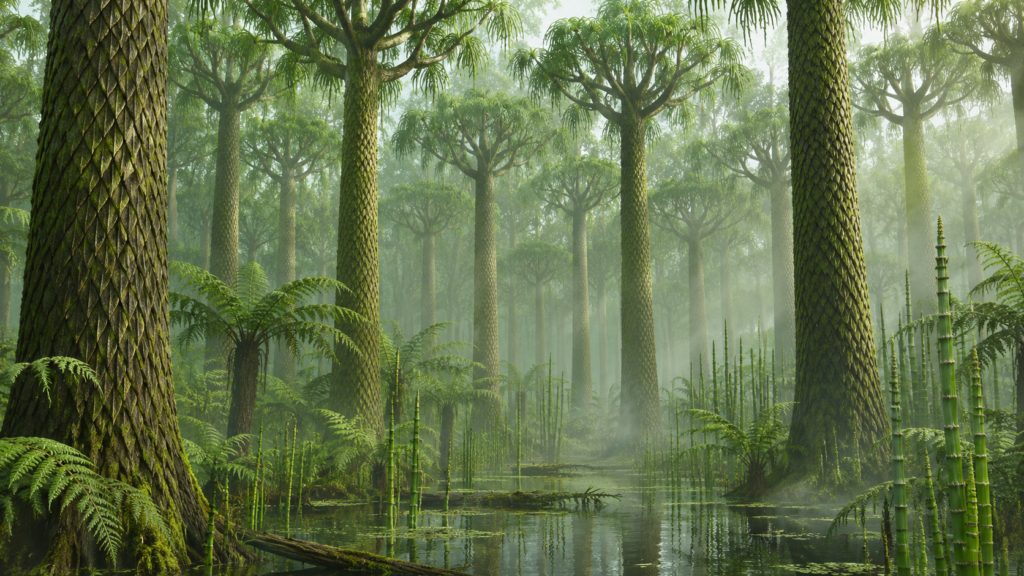
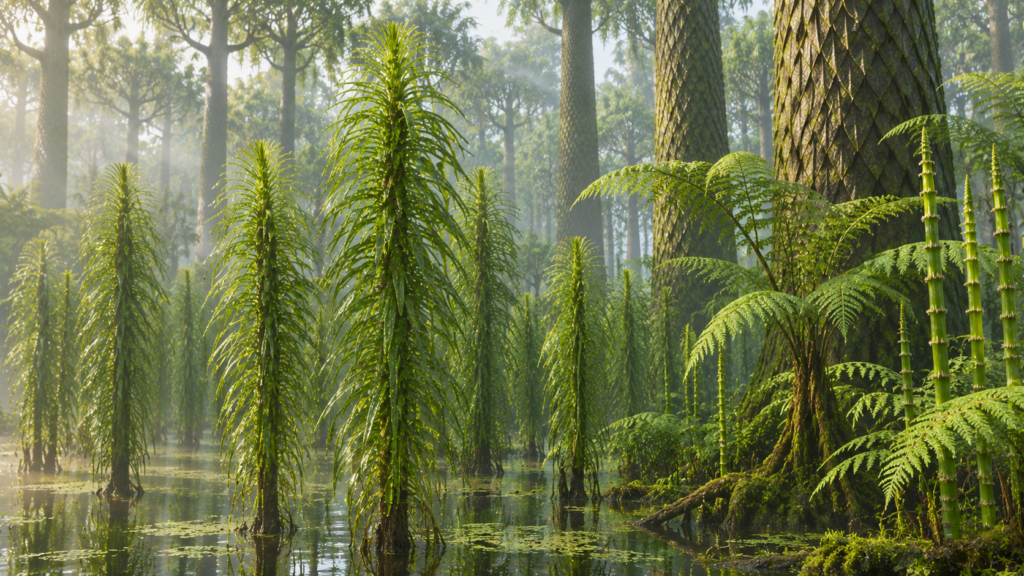
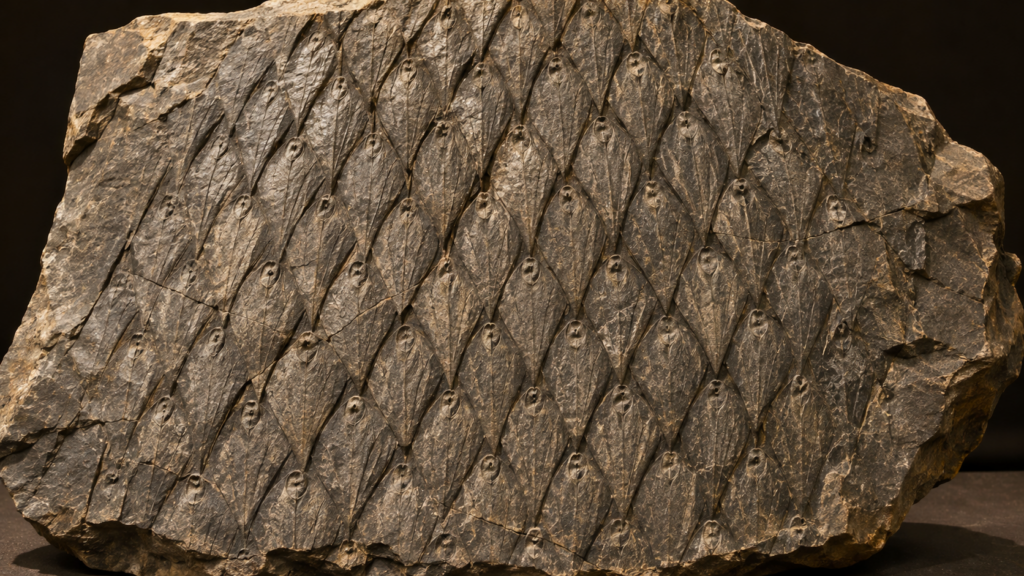
Lepidodendron was a tree that formed forests in the swamps of the Carboniferous period. Its trunk is covered in a tight pattern of diamond shapes, like scales. Today’s clubmosses and quillworts are no bigger than small herbs, but this group grew into trees more than 30 m tall. They were the main plants behind the coal of that age, and coal is packed with the bark of these trees.
Appearance and way of life
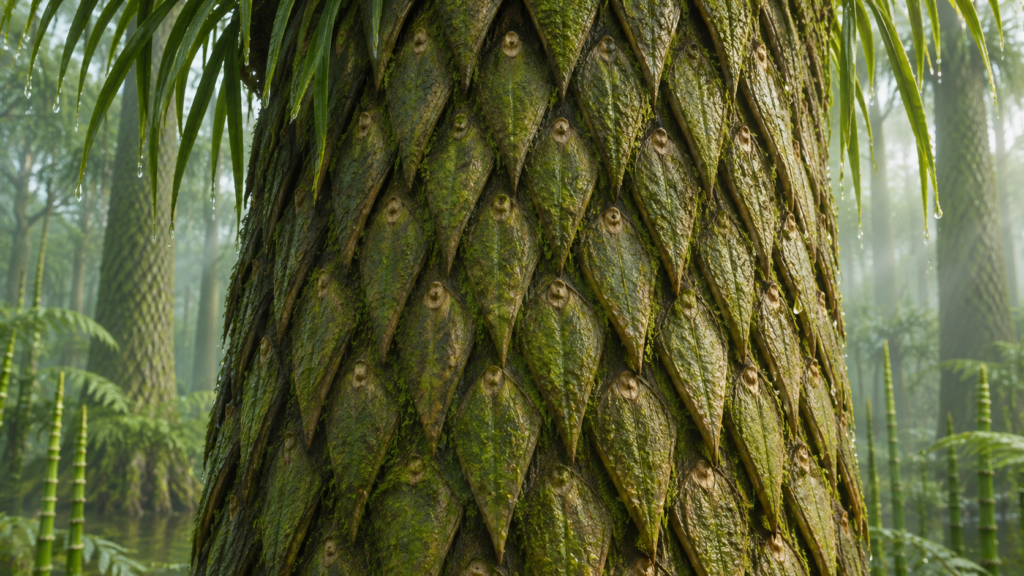
The scale-like pattern on the trunk is not a pattern in the bark itself. Each diamond is a leaf cushion, the swollen base where a leaf was attached, which stayed on the trunk after the leaf fell. In Lepidodendron the leaf cushions are diamonds taller than they are wide, each still bearing the scar where its leaf grew. The leaves were long and narrow, and young trees were thickly covered with long, grass-like leaves.
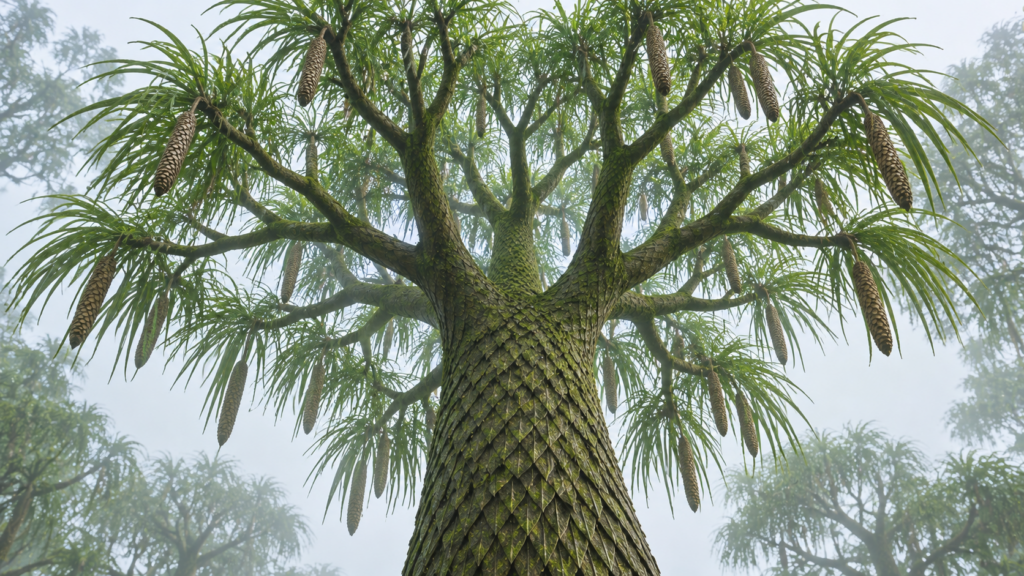
Trees in this group are thought to have grown to a set plan. A young tree rose as a single unbranched stem, growing taller and thicker. Once it reached full size, its top forked again and again into a crown, and cones holding spores formed at the branch tips. After producing cones, the tree is thought to have died.
The roots, leaves and cones of these trees are usually found separately. As a result, each part was given its own name. The underground part that did the job of roots is called Stigmaria, the leaves Lepidophylloides, and the cones names such as Lepidostrobus; only later was it shown that they belonged to the same plants. Fossils of Stigmaria are common in the clay layers just beneath coal seams.
In Glasgow, Scotland, a forest of these trees survives where it stood. In 1887, workers cutting a path through an old quarry in Victoria Park uncovered tree stumps. The paleobotanist Robert Kidston identified the trunks as a species of Lepidodendron and the roots as Stigmaria. Eleven stumps with their roots stand where they grew in ground about 325 million years old, and since 1889 they have been protected inside a building. (Because their identity as Lepidodendron is not certain, they are now often described more loosely as scale trees.)
In the Carboniferous swamps of North America and Europe, these scale trees dominated the forests for about 9 million years. Later in the Carboniferous, however, a major extinction struck the swamp trees of North America, wiping out most of the scale trees, and tree ferns took their place.
Bark in the coal, bark on the living tree
Much of the coal of the Carboniferous consists mainly of the bark (periderm) of these scale trees. At the same time, their trunks contained only a little true wood. From this it was long thought that their trunks were mostly thick bark, and that the bark held these tall trees up.
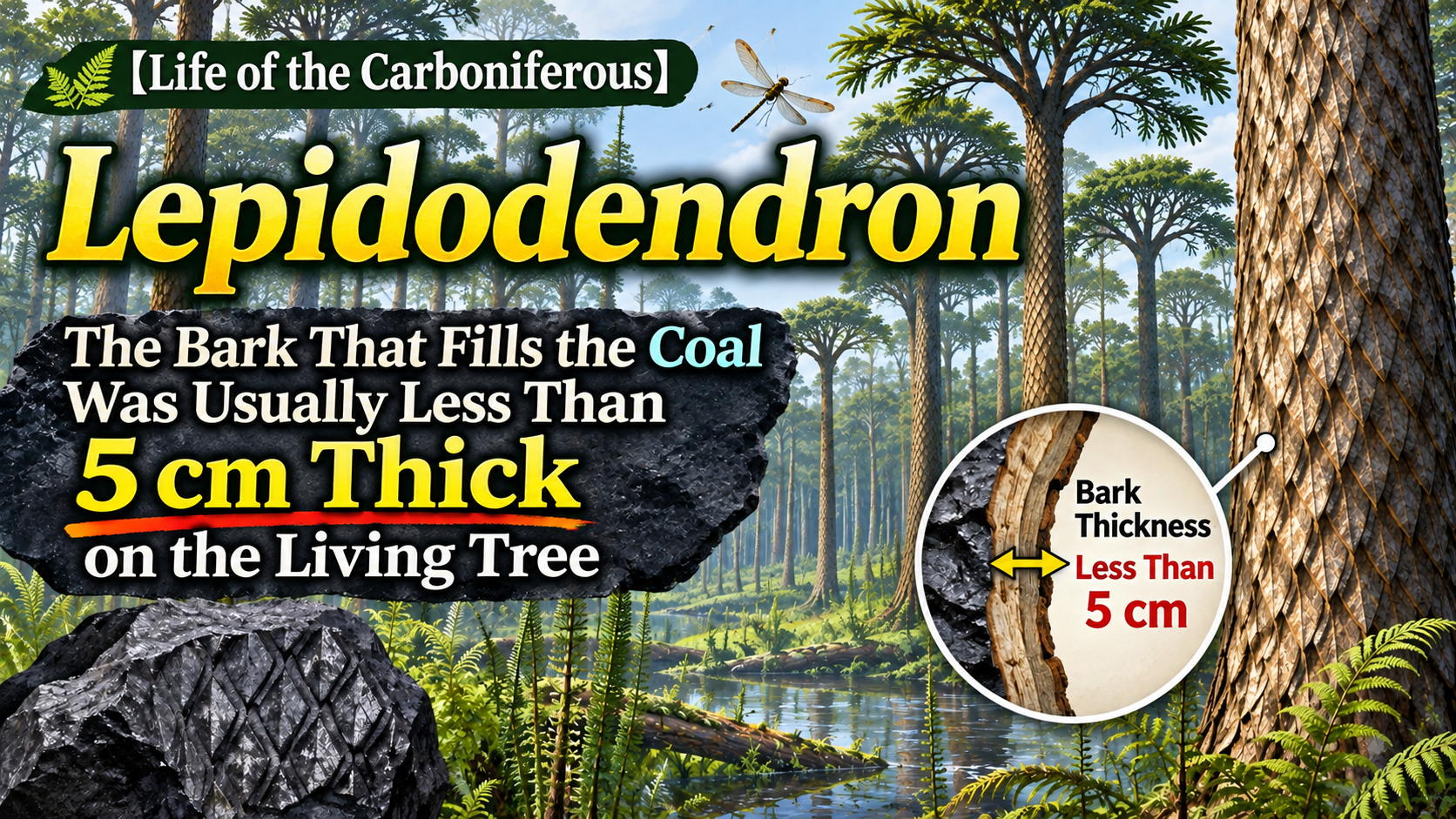
In 2020, Michael D’Antonio and Kevin Boyce of Stanford University measured the thickness of the bark in fossil trunks of these trees. Even in trunks more than 1 m across, the bark was usually less than 5 cm thick, and never more than 15 cm. Their conclusion was that coal is rich in bark not because the living trees had a lot of it, but because bark resisted decay, so its share grew on the way to becoming coal.
The trees that made the coal did not have trunks as thickly barked as the coal itself suggested. What remains in coal is a record of the parts of the tree that did not rot.
Related products
You can find books and products related to this article on Amazon.
If you buy through the links above, this blog may earn a commission.
About the images
The images in this article are illustrations created with AI (ChatGPT), and you are welcome to use them. If you do, we would appreciate a link back to this article as the source.
Sources
D’Antonio, M. P. & Boyce, C. K. (2020). Arborescent lycopsid periderm production was limited. New Phytologist 228(2), 741–751. https://doi.org/10.1111/nph.16727
Nelsen, M. P. et al. (2016). Delayed fungal evolution did not cause the Paleozoic peak in coal production. PNAS 113, 2442–2447. https://doi.org/10.1073/pnas.1517943113
Thomas, B. A. (2021). Why Lycospora dominated many Pennsylvanian spore assemblages. Fossil Imprint 77(1), 11–16. https://doi.org/10.37520/fi.2021.002
Thomas, B. A. & Watson, J. (1976). A rediscovered 114-foot Lepidodendron from Bolton, Lancashire. Geological Journal 11(1), 15–20. https://doi.org/10.1002/gj.3350110102
DiMichele, W. A., Elrick, S. D. & Bateman, R. M. (2013). Growth habit of the late Paleozoic rhizomorphic tree-lycopsid family Diaphorodendraceae. American Journal of Botany 100(8), 1604–1625. https://doi.org/10.3732/ajb.1200623
UCMP Berkeley, Lycophyta: Fossil Record (leaf cushions and organ genera) https://ucmp.berkeley.edu/IB181/VPL/Lyco/Lyco3.html
National Research Council (1995). Effects of Past Global Change on Life (Carboniferous swamp vegetation and extinction) https://www.nationalacademies.org/read/4762/chapter/88
Fossil Grove Glasgow, History https://fossilgroveglasgow.org/history
Scottish Geology Trust, Fossil Grove, Glasgow https://scottishgeologytrust.org/geology/51-best-places/fossil-grove-glasgow/
Kotobank, “Rinboku (scale tree)” (Japanese encyclopedia entries) https://kotobank.jp/word/%E9%B1%97%E6%9C%A8-150504


コメント