This article contains affiliate links. As an Amazon Associate I earn from qualifying purchases.
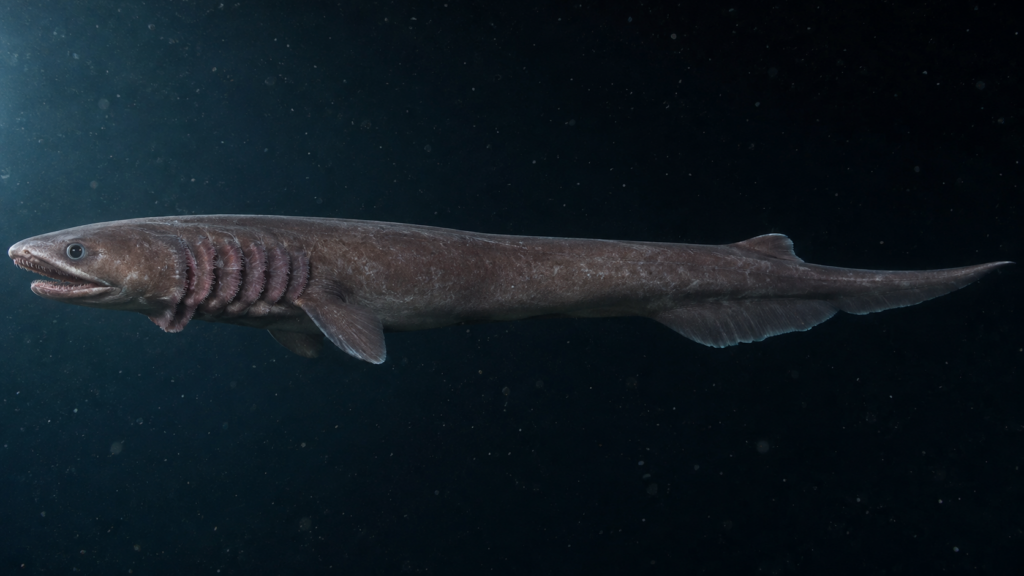
| Name | Frilled shark (Chlamydoselachus anguineus). The genus name joins the Greek words for “cloak” and “shark”, after the gills that wrap the throat like a frill. The species name is Latin for “snake-like”. Described in 1884 |
| Classification | Chondrichthyes, Elasmobranchii, Hexanchiformes, Chlamydoselachidae |
| Age | The oldest fossils of the genus are teeth from Late Cretaceous (Santonian–Campanian) rocks in Antarctica. Living today |
| Range | Scattered patchily through the world’s oceans. In Japan, the deep waters of Suruga Bay, Sagami Bay and elsewhere |
| Depth | Usually 120–1,280 m |
| Length | Up to about 2 m; mature at about 1.45 m |
| Size at birth | About 55 cm long and 380 g |
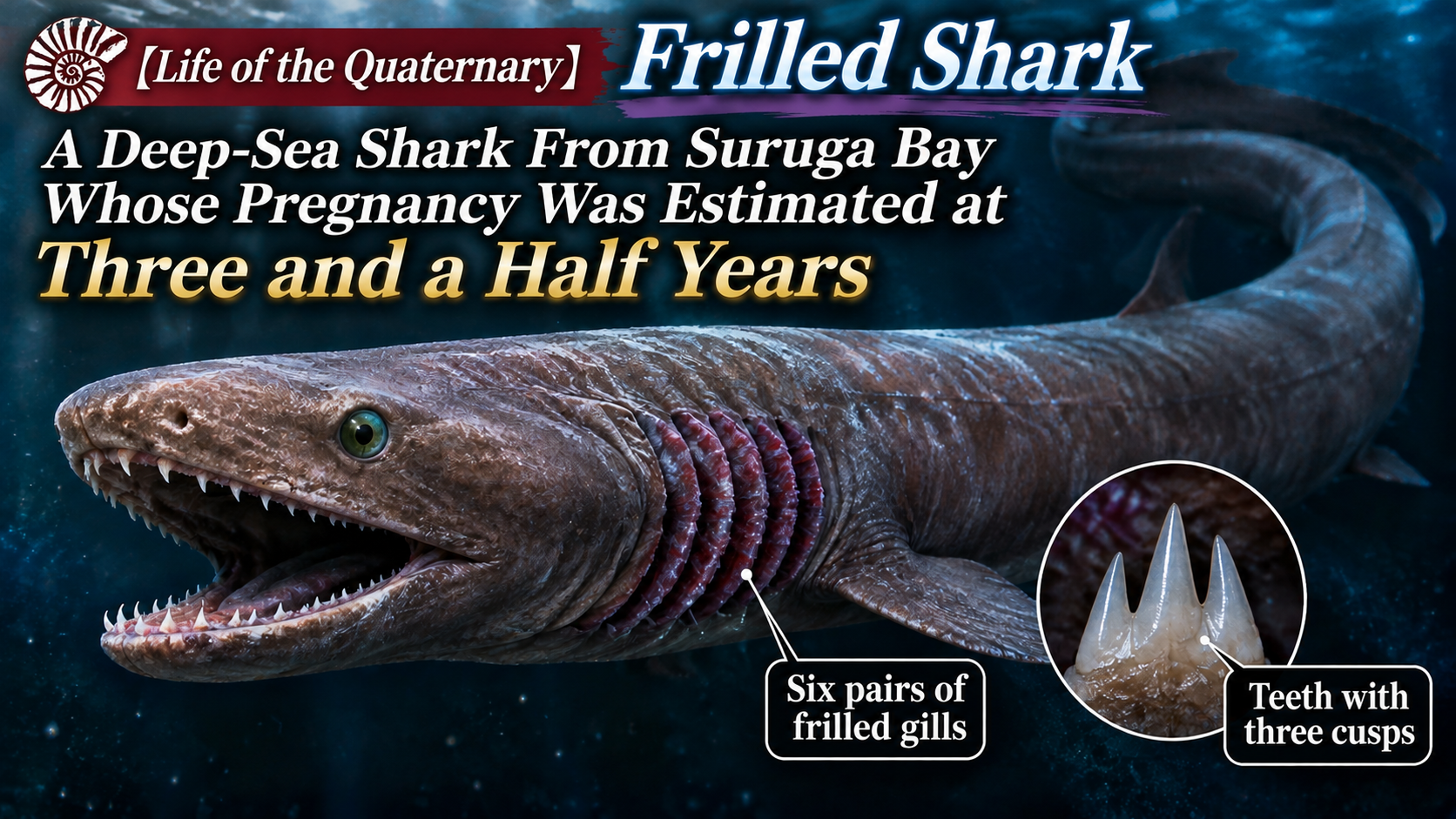
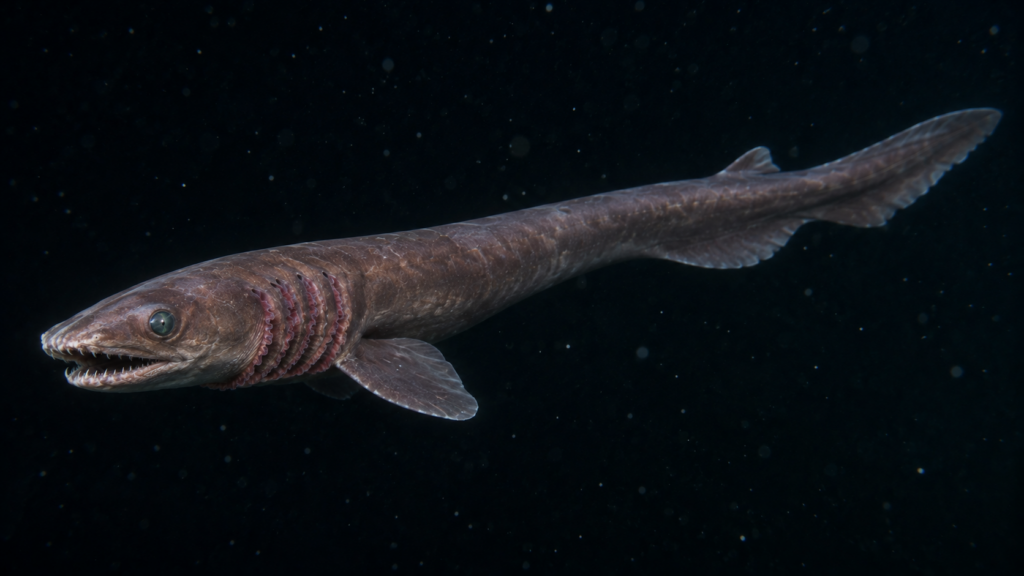
The frilled shark is a deep-sea shark. It has a long, eel-like body and six pairs of gills with frilled edges. In Japan it is sometimes caught in fishing nets in places such as Suruga Bay, and it has long been called a “living fossil”. A study of specimens collected in Suruga Bay estimated that its pregnancy lasts at least three and a half years.
Appearance and Way of Life
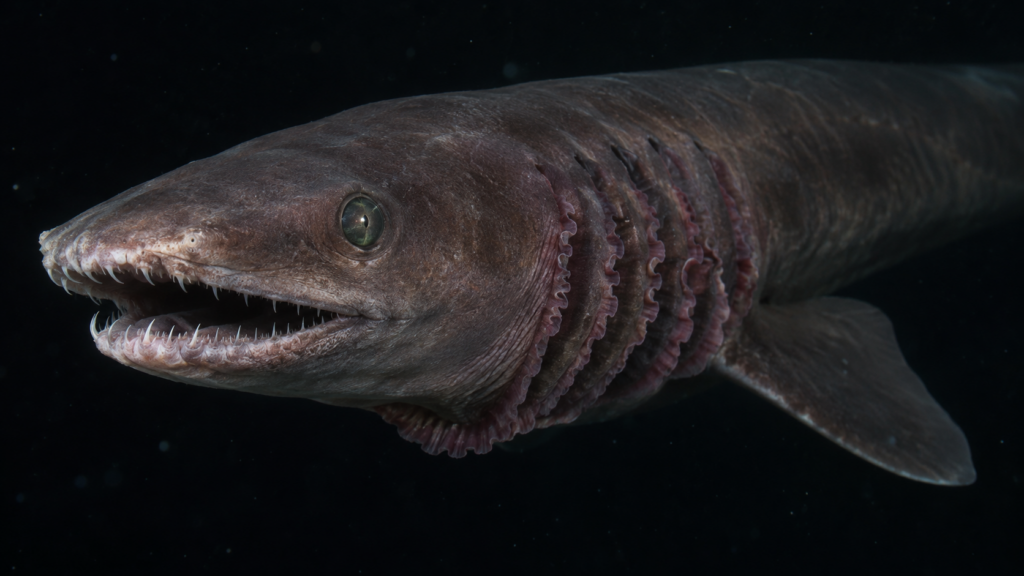
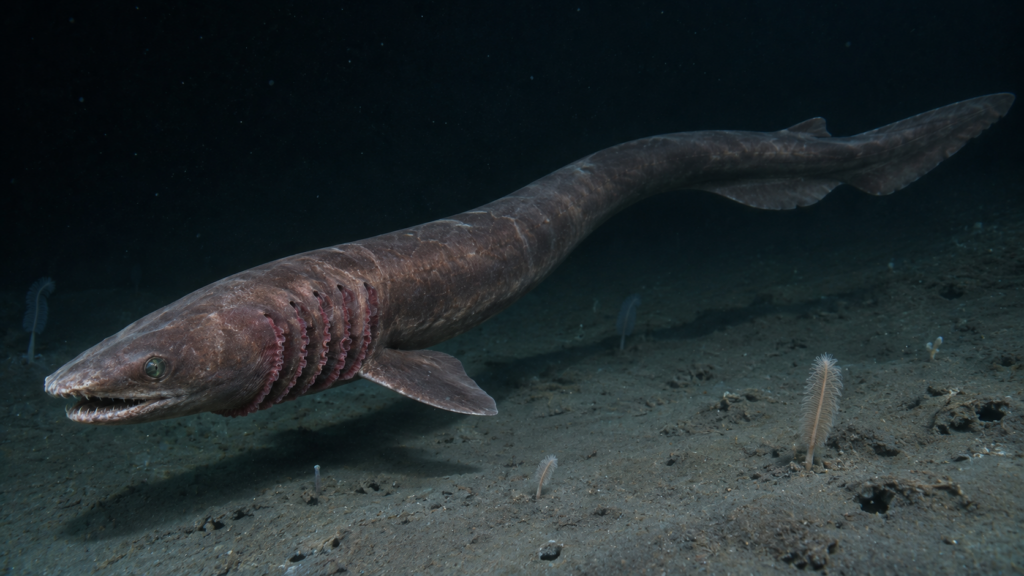
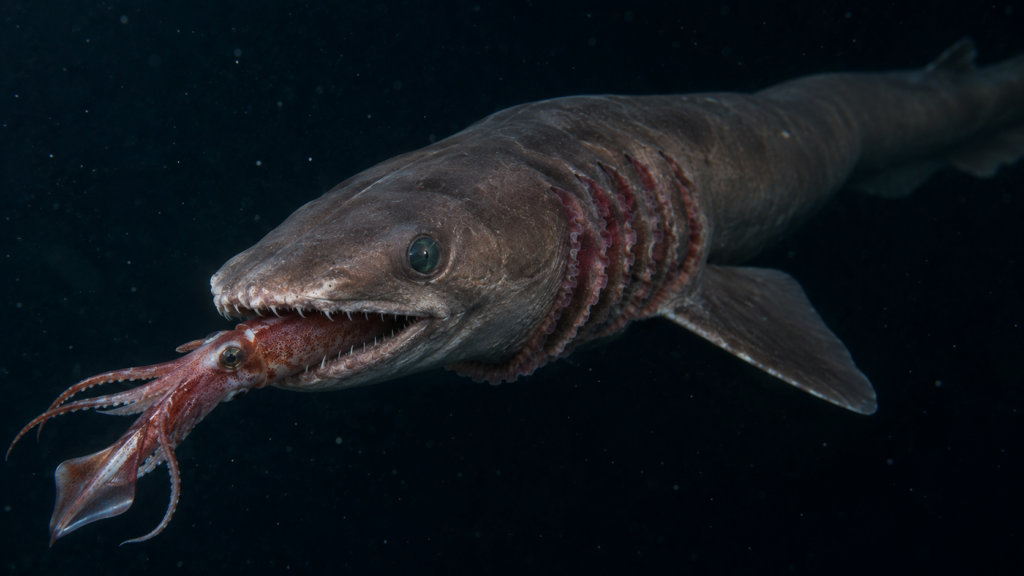
The frilled shark has a long body and a flattened head, and its mouth opens at the very tip of the head rather than beneath the snout. Both jaws carry slender teeth, each split into three points. It has six pairs of gill slits, one more than most sharks, and their edges ripple like frills. The first pair of gill slits joins beneath the throat. There is only one dorsal fin, set far back above the pelvic fins, and the anal fin below it is larger.
In Suruga Bay, frilled sharks are caught along with other fish in nets used for sakura shrimp and in gillnets set on the seafloor. A study of 139 stomachs collected in Suruga Bay from 1984 to 1988 found that 73.4% were empty. Of the stomachs that held food, 60.5% contained squid and 10.5% contained fish; the squid were identified from the shape of their beaks. The frilled shark is thought to feed mainly on squid.
Live frilled sharks are almost never seen. In January 2007, a fisherman spotted one swimming near a port in Numazu, Shizuoka Prefecture. Staff from Awashima Marine Park caught it and filmed it swimming in a seawater pool. It was a female about 1.6 m long, and it died a few hours after it was caught.
Fossil teeth of the genus have been found in Late Cretaceous rocks on James Ross Island in Antarctica, and were described as a new species, “the oldest described frilled shark”, in 1990. A 2013 study of whole mitochondrial genomes estimated that the frilled shark lineage split from the other Hexanchiformes about 82 million years ago, which it found broadly consistent with the fossil record. The same study treats the structure of the frilled shark’s jaw joints not as a primitive feature but as one that arose later in this lineage.
A Three-and-a-Half-Year Pregnancy
The frilled shark does not lay eggs. The young hatch from eggs inside the mother’s body and grow there before they are born. A study published in 1990 by a Japanese research team looked at this in detail. The team collected 264 frilled sharks caught in fishing nets in Suruga Bay and examined the eggs and embryos inside the females.
The researchers kept embryos, still inside their egg capsules, in artificial conditions for up to 134 days and measured how fast they grew. The embryos lengthened by 10–17 mm a month. Frilled sharks are about 55 cm long at birth. From the time it would take to reach that length at this rate, the team estimated that pregnancy lasts at least three and a half years. Litters ranged from 2 to 10 young, with an average of 6.
This estimate is often cited as the longest pregnancy of any vertebrate. However, no one has directly observed how embryos develop inside a mother living in the deep sea, and the fish database FishBase gives the pregnancy as probably one to two years. The length of the frilled shark’s pregnancy has not yet been confirmed.
Related products
You can find books and products related to this article on Amazon.
If you buy through the links above, this blog may earn a commission.
About the images
The images in this article are illustrations created with AI (ChatGPT), and you are welcome to use them. If you do, we would appreciate a link back to this article as the source.
Sources
Tanaka, S. et al. (1990). The reproductive biology of the frilled shark, Chlamydoselachus anguineus, from Suruga Bay, Japan. Japanese Journal of Ichthyology 37(3), 273–291. https://www.jstage.jst.go.jp/article/jji1950/37/3/37_3_273/_article/-char/en
Kubota, T., Shiobara, Y. & Kubodera, T. (1991). Food habits of the frilled shark Chlamydoselachus anguineus collected from Suruga Bay, central Japan. Nippon Suisan Gakkaishi 57(1), 15–20. https://doi.org/10.2331/suisan.57.15
Tanaka, K. et al. (2013). Evolutionary relations of Hexanchiformes deep-sea sharks elucidated by whole mitochondrial genome sequences. BioMed Research International 2013, 147064. https://doi.org/10.1155/2013/147064
Richter, M. & Ward, D. J. (1990). Fish remains from the Santa Marta Formation (Late Cretaceous) of James Ross Island, Antarctica. Antarctic Science 2(1), 67–76. https://doi.org/10.1017/S0954102090000074
FishBase, Chlamydoselachus anguineus https://www.fishbase.se/summary/Chlamydoselachus-anguineus.html
NBC News / Reuters (2007). Japan marine park captures rare shark on film https://www.nbcnews.com/id/wbna16785254


コメント