This article contains affiliate links. As an Amazon Associate I earn from qualifying purchases.
| Name | Arthropleura. The genus name combines the Greek words for “joint” and “side” |
| Classification | Arthropod, myriapod. Considered an early member of the millipede lineage |
| Age | Early Carboniferous to early Permian (about 346 to 290 million years ago) |
| Found in | Germany, Britain, France and elsewhere |
| Length | About 2.6 m in large individuals |
| Weight | Up to about 50 kg in large individuals (Natural History Museum, London) |
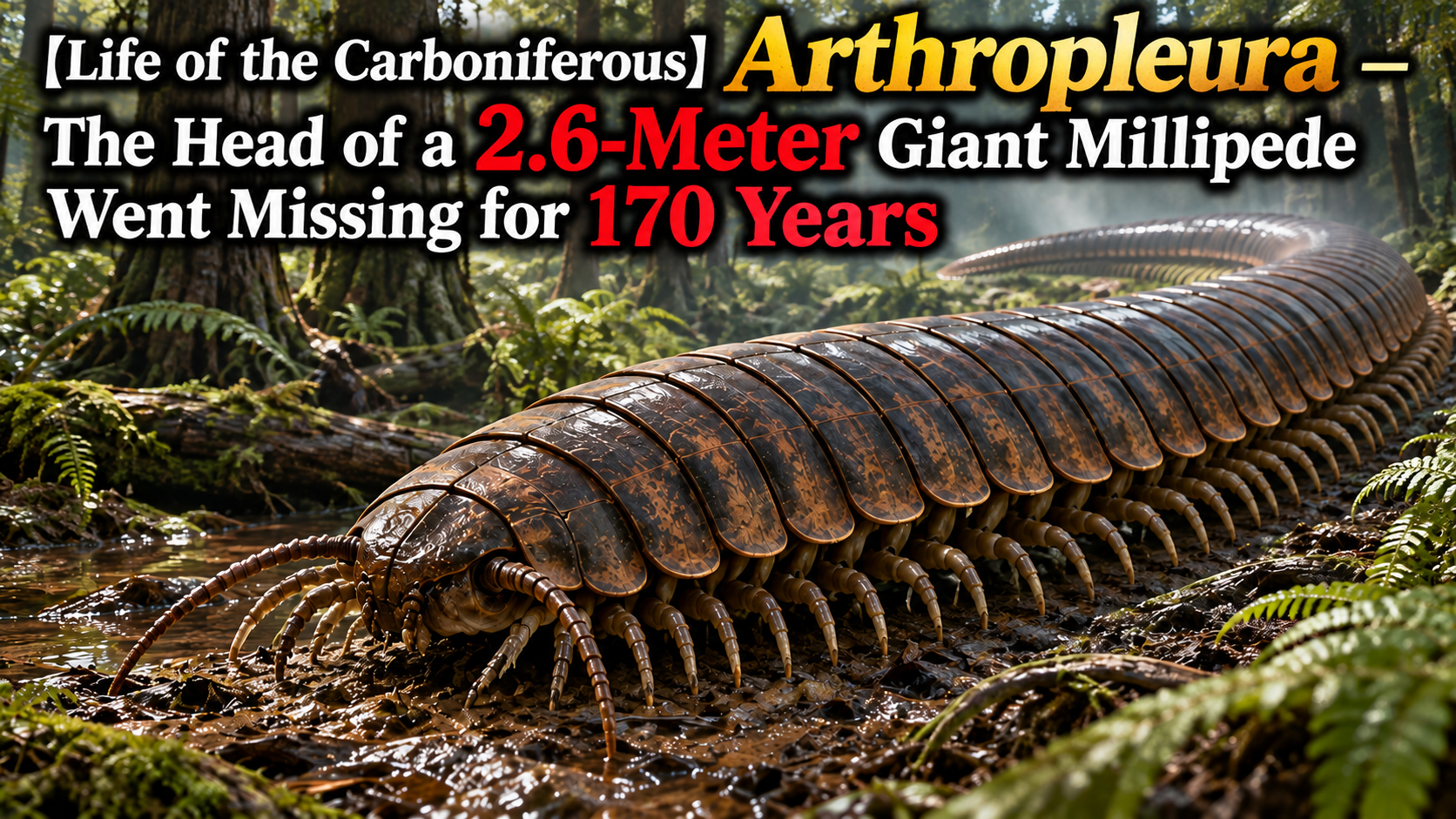
Arthropleura was a giant myriapod that walked the forest floors of the Carboniferous. Large individuals reached about 2.6 m in length, making it the largest invertebrate known to have lived on land. Its long, flat body and many legs had been known since it was first described from body fossils in 1854, but the shape of its head remained unknown for a very long time.
Appearance and Way of Life
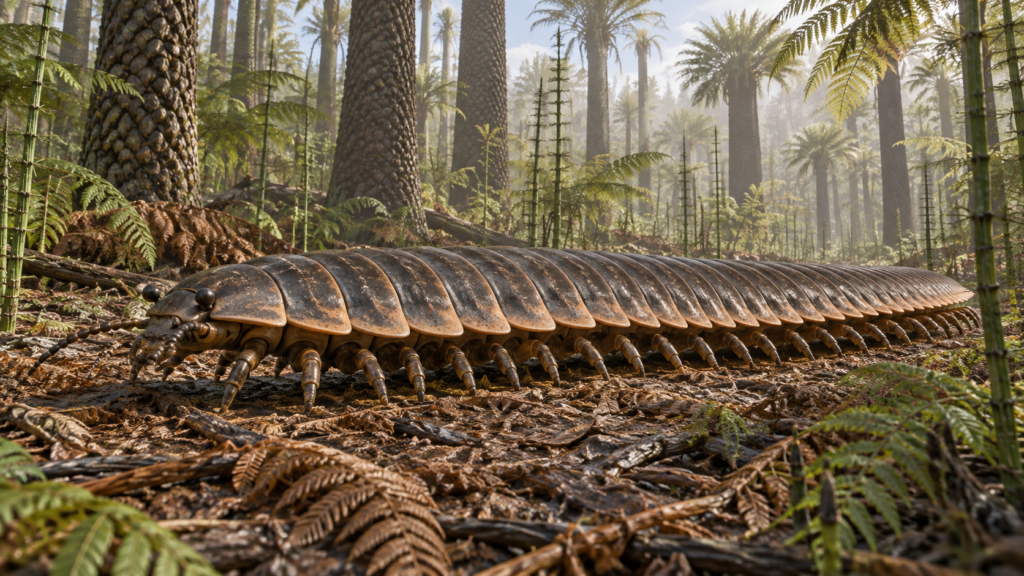
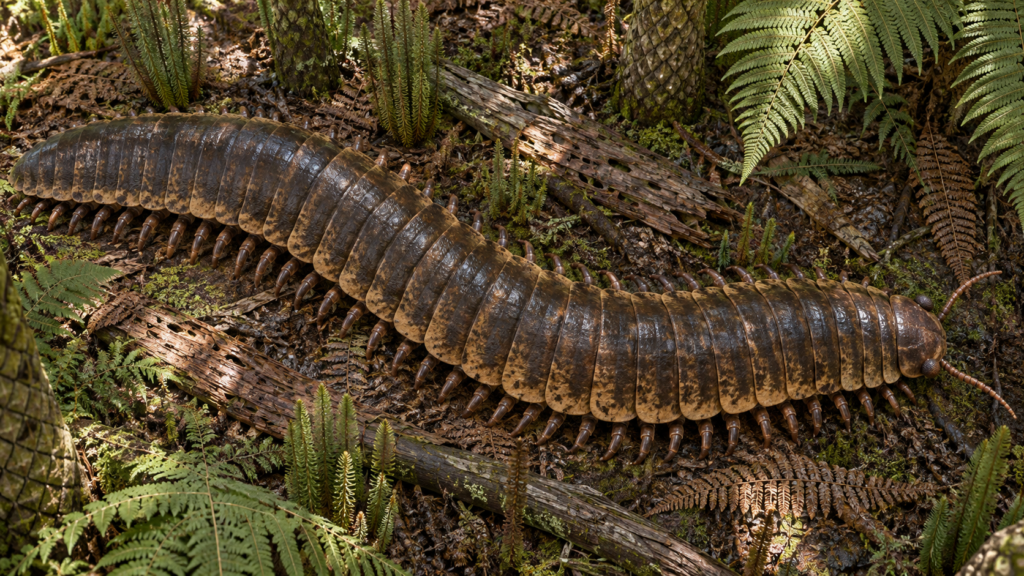
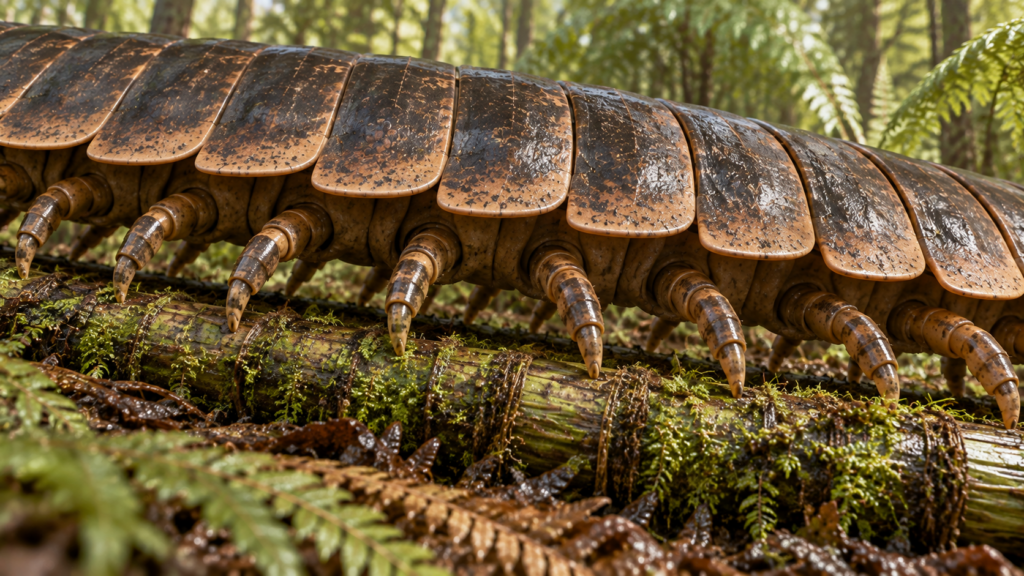
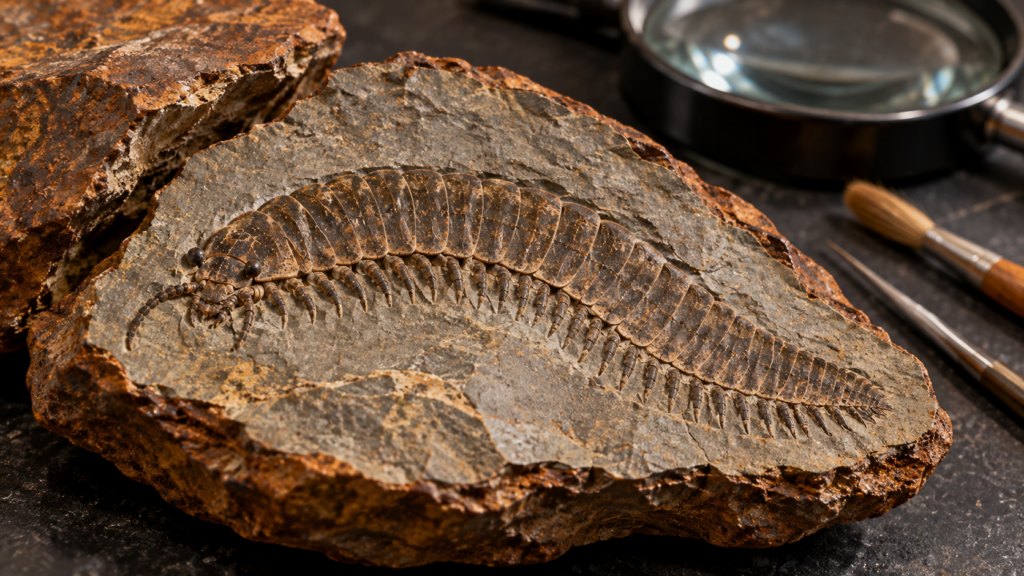
The body of Arthropleura was a long chain of flat segments, each covered above by broad plates, with two pairs of legs beneath every segment. Two pairs of legs per segment is the same arrangement seen in living millipedes. Most of its body fossils are scattered segments and legs, and finds of whole, articulated animals are rare.
It lived from the early Carboniferous to the early Permian, a span of about 56 million years. The land at the time was covered with giant scale trees, horsetails, tree ferns and the gymnosperms known as cordaites. Arthropleura was long thought of as an animal of the swamp forests that became coal, but the rocks holding a fossil found in Britain show that it also lived in open woodland near the coast. No venom fangs or legs built for seizing prey have been found, so it is thought to have eaten leaf litter and dead plant matter, like living millipedes.
The largest known specimen turned up by chance. In 2018, a block of sandstone fell from a cliff at Howick Bay in Northumberland, northeast England, and broke open to reveal part of an Arthropleura body about 326 million years old. The preserved section alone was about 75 cm long, and Neil Davies of the University of Cambridge and his colleagues estimated from it a total length of about 2.6 m and a weight of up to about 50 kg. In their paper, Davies and colleagues called Arthropleura the largest land invertebrate known. Its size is sometimes explained by the oxygen-rich air of the time, but the oxygen level when this specimen lived was only slightly higher than today, and the team noted that oxygen alone cannot explain it.
The Head of a 2.6-Meter Giant Millipede Went Missing for 170 Years
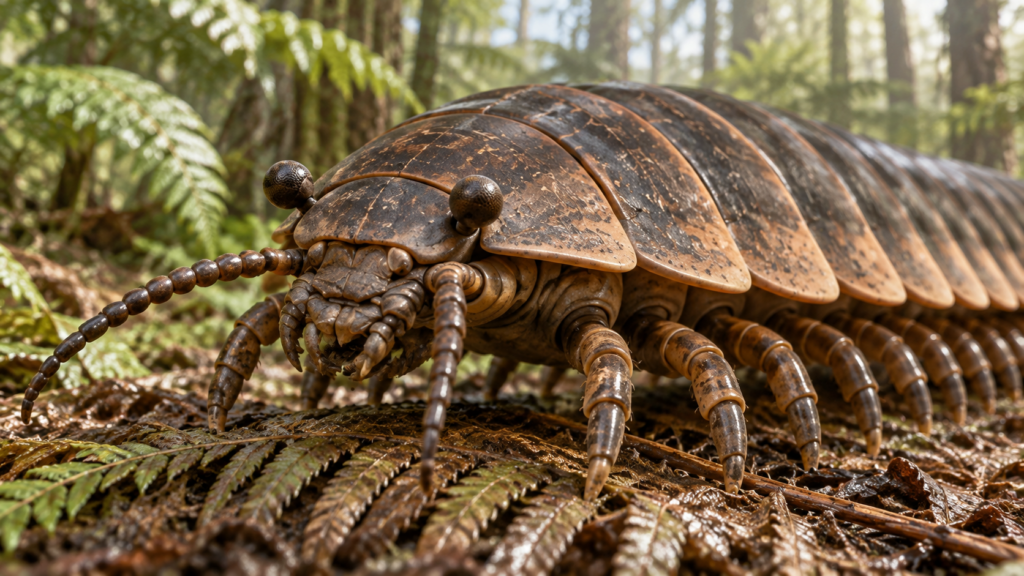
For as long as Arthropleura had been known, no fossil with a complete head had been found. Earlier reconstructions drew the head by inference from related myriapods and damaged fossils. As a result, it remained unclear whether Arthropleura was closer to millipedes, closer to centipedes, or a separate, wholly extinct group.
The answer came not from an adult but from juveniles. The coal mines of Montceau-les-Mines in central France have yielded animals about 300 million years old preserved inside siderite (ironstone) nodules, and many of these are held at the Natural History Museum of Autun. Mickaël Lhéritier of the University of Lyon and his colleagues imaged two juvenile fossils from this collection, 25 mm and 40 mm long, with micro-CT and synchrotron scanning, without breaking the nodules. One of them preserved a complete head, with antennae, eyes, mandibles and the appendages around the mouth.
The results, published in 2024, showed a head that combined features of millipedes and centipedes. The mandibles enclosed within the head, followed by two pairs of appendages, resemble centipedes, while the body, with two pairs of legs on each segment, matches millipedes. The eyes were club-shaped and projected from the head, a form not seen in any living millipede or centipede. Combining genetic data from hundreds of genes of living myriapods with anatomical features, the team showed that millipedes and centipedes are each other’s closest relatives, and that Arthropleura was an early member of the millipede lineage. The mouthparts, with no venom fangs, fit the view that it fed on leaf litter.
Some 170 years after it was named from body fossils in 1854, the head of a myriapod that grew to 2.6 m long was revealed by fossils of juveniles only a few centimeters long.
Related products
You can find books and products related to this article on Amazon.
If you buy through the links above, this blog may earn a commission.
About the images
The images in this article are illustrations created with AI (ChatGPT), and you are welcome to use them. If you do, we would appreciate a link back to this article as the source.
Sources
Lhéritier, M., Edgecombe, G. D., Garwood, R. J., Buisson, A., Gerbe, A., Mongiardino Koch, N., Vannier, J., Escarguel, G., Adrien, J., Fernandez, V., Bergeret-Medina, A. & Perrier, V. (2024). Head anatomy and phylogenomics show the Carboniferous giant Arthropleura belonged to a millipede-centipede group. Science Advances 10(41), eadp6362. https://doi.org/10.1126/sciadv.adp6362
Davies, N. S., Garwood, R. J., McMahon, W. J., Schneider, J. W. & Shillito, A. P. (2021). The largest arthropod in Earth history: insights from newly discovered Arthropleura remains (Serpukhovian Stainmore Formation, Northumberland, England). Journal of the Geological Society 179, jgs2021-115. https://doi.org/10.1144/jgs2021-115
Natural History Museum (2024). Largest ever millipede’s head revealed by 300-million-year-old fossils. https://www.nhm.ac.uk/discover/news/2024/october/largest-ever-millipede-head-revealed.html
Natural History Museum (2021). The world’s largest arthropod was a car-sized millipede. https://www.nhm.ac.uk/discover/news/2021/december/worlds-largest-terrestrial-arthropod-was-car-sized-millipede.html

コメント