This article contains affiliate links. As an Amazon Associate I earn from qualifying purchases.
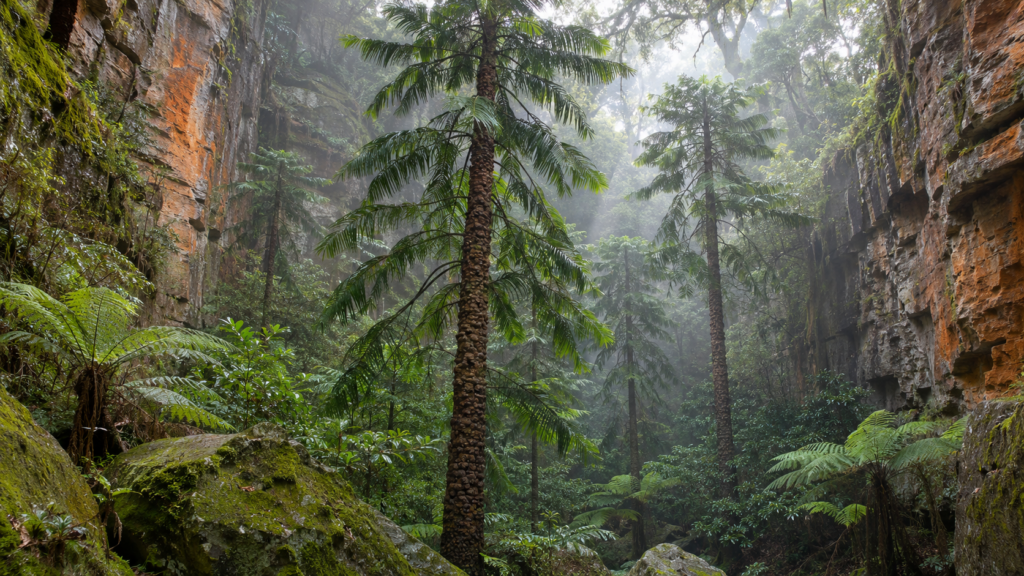
| Name | Wollemi pine (Wollemia nobilis; the genus is named after Wollemi National Park, where it grows, and the species after its discoverer, David Noble) |
| Classification | Gymnosperms, conifers, Araucariaceae |
| Period | Living. Fossil pollen of the same type ranges from the Late Cretaceous (about 90 million years ago) to about 2 million years ago |
| Native range | A gorge in Wollemi National Park, New South Wales, Australia (the exact location is not public) |
| Height | Up to about 40 m (the tallest wild tree is 43 m) |
| Trunk diameter | Up to about 1.2 m |
| Wild population | 46 adult trees and 43 juveniles (2021) |
The Wollemi pine is a conifer of the family Araucariaceae that grows wild only in a gorge in eastern Australia. It was found in 1994 and described as a new genus and species in 1995. Its pollen cannot be told apart from fossil pollen found in rocks from about 90 million to about 2 million years old.
Appearance and Life
The Wollemi pine is an evergreen tree that grows to about 40 m. Despite its name it is not a true pine; it belongs to the Araucariaceae rather than the pine family. Its closest living relatives are the kauri trees of the genus Agathis, followed by Araucaria. The genus Wollemia contains only this one species.
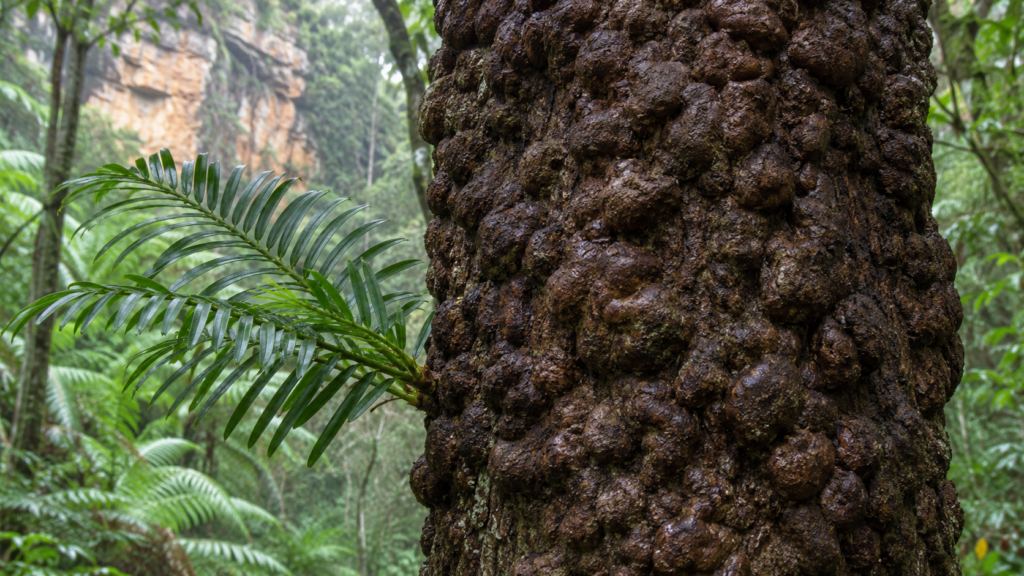
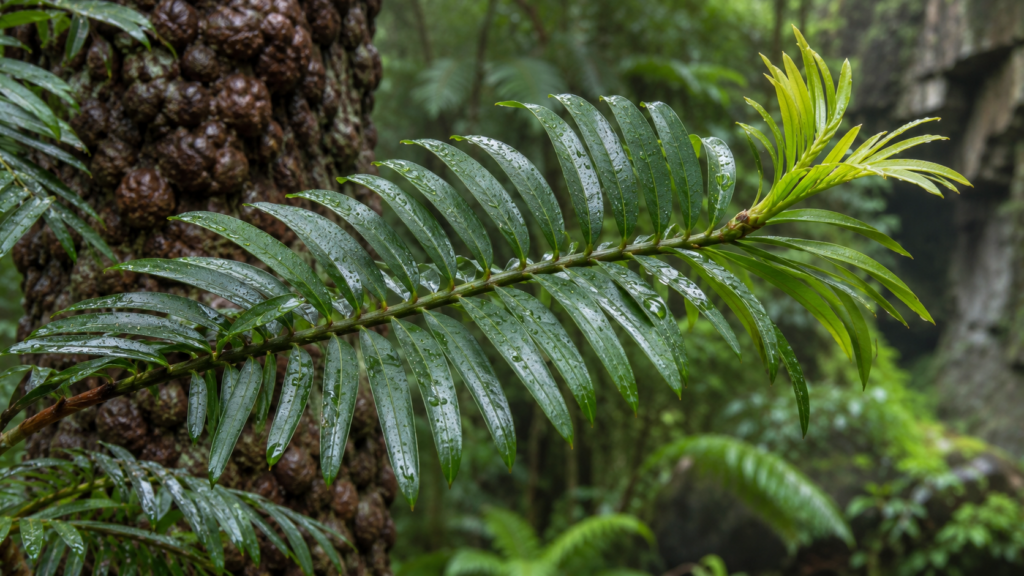
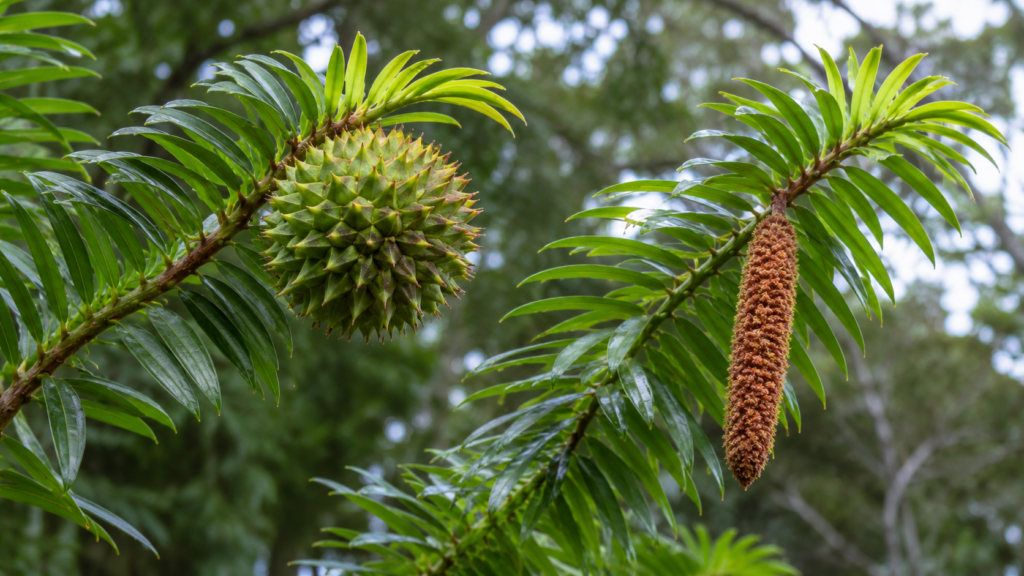
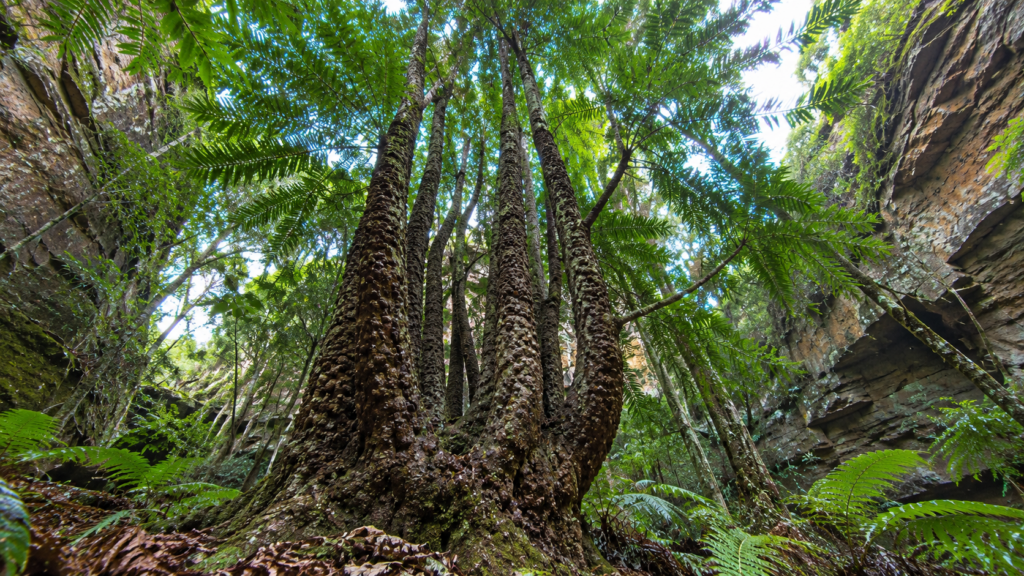
The trunk of a mature tree is densely covered in soft, knobbly nodules. No other member of the Araucariaceae has bark like this. The leaves take three forms. Upright shoots carry narrow triangular leaves 3–10 mm long, young side branches carry leaves 2–8 cm long in two rows, and the side branches of mature trees carry leaves 1–4 cm long in four rows. Young leaves are deep green above and whitish below.
Male and female cones grow on the same tree. Both form at the tips of branches. The female cones reach about 12.5 cm long and 10 cm across and are usually borne higher on the tree than the male cones. The seeds are winged.
The Wollemi pine keeps sending up new trunks from its base. According to the New South Wales National Parks and Wildlife Service, a single tree can produce up to 40 trunks, and one trunk may live for up to about 450 years. The rootstock may be far older than that.
Wild Wollemi pines grow in just four stands within a single catchment. Their range covers less than 4 square kilometers. A survey in May 2021 counted 46 adult trees and 43 juveniles. In its 2024 assessment the International Union for Conservation of Nature (IUCN) lists the species as Critically Endangered, the highest category of extinction risk.
There is almost no genetic variation either. In 2003, Rod Peakall and colleagues examined more than 800 genetic markers in the wild trees and found not a single difference between one tree and another. The team called it the most extreme case known in plants.
The location of the site has been withheld ever since the original description. Entering it without permission is prohibited. In 2005 the root-rot pathogen Phytophthora cinnamomi was detected in the largest stand. It is thought to have been carried in by unauthorized visitors.
During the bushfires of 2019–2020, fire approached the gorge. The state’s National Parks and Wildlife Service and its partners installed an irrigation system in the largest stand, used large aircraft to lay fire retardant around the catchment, and winched firefighters down from helicopters to put out flames. Most of the adult trees survived with their upper canopies intact, but up to 95 percent of the juveniles under 2 m tall are thought to have been lost. In January 2021 the site was declared the state’s first Asset of Intergenerational Significance.
Cultivation began early. The first Wollemi pine raised by human hands was planted in the Royal Botanic Garden Sydney in 1998. The first saplings were sold at auction in 2005, and sales through garden centers began in 2006. Making cultivated trees widely available is meant in part to keep wild trees from being stolen.
A Tree With the Same Pollen as a Fossil
In 1994, David Noble, an officer of the New South Wales National Parks and Wildlife Service, was descending a canyon on his day off in Wollemi National Park, within 200 km northwest of Sydney. On the canyon floor he noticed an unfamiliar tree, took a piece of a branch home, and showed it to Wyn Jones, a naturalist with the same service. Jones, Ken Hill, a botanist at the Royal Botanic Gardens Sydney, and Jan Allen, who joined the surveys, described it as a new genus and species in 1995. At that point only about 20 mature trees and a similar number of juveniles were known.
Three years later, in 1998, Carrick Chambers and colleagues reported that the pollen of the Wollemi pine is indistinguishable from a fossil pollen called Dilwynites. Dilwynites is a name that had been given in 1965, before the tree was found, to pollen grains preserved in rock.
The oldest records of Dilwynites come from the Turonian Age of the Late Cretaceous (about 93.9 to 89.8 million years ago). It has been found in rocks in Australia, New Zealand, Antarctica and Patagonia in South America, and is most abundant between about 65 and 34 million years ago. After that it declines, and the last records are about 2 million years old. A pollen type that had spread across the Southern Hemisphere since the age of the dinosaurs, and then vanished from the rock record, turned up on fewer than 100 trees surviving in a single gorge.
There are limits, however, to what fossil pollen can show. No fossil leaves or cones that can be assigned with confidence to the genus Wollemia have yet been found. Mike Macphail and colleagues, who reported Dilwynites from South America for the first time in 2013, regard both Wollemia and Agathis as the nearest living relatives of the plants that produced this pollen. Not all of those plants can be said to be direct ancestors of the Wollemi pine. Nor is it known when the present species, Wollemia nobilis, arose.
The tree is sometimes introduced as having “lived for 200 million years,” but it is the fossil record of the family Araucariaceae that goes back more than 200 million years. What has been confirmed for Wollemi pine-type pollen begins about 90 million years ago.
Related products
You can find books and products related to this article on Amazon.
If you buy through the links above, this blog may earn a commission.
About the images
The images in this article are illustrations created with AI (ChatGPT), and you are welcome to use them. If you do, we would appreciate a link back to this article as the source.
Sources
Jones, W. G., Hill, K. D. & Allen, J. M. (1995). Wollemia nobilis, a new living Australian genus and species in the Araucariaceae. Telopea 6, 173–176. https://doi.org/10.7751/telopea19953014
Chambers, T. C., Drinnan, A. N. & McLoughlin, S. (1998). Some morphological features of Wollemi pine (Wollemia nobilis: Araucariaceae) and their comparison to Cretaceous plant fossils. International Journal of Plant Sciences 159, 160–171. https://doi.org/10.1086/297534
Peakall, R. et al. (2003). Comparative genetic study confirms exceptionally low genetic variation in the ancient and endangered relictual conifer, Wollemia nobilis (Araucariaceae). Molecular Ecology 12, 2331–2343. https://doi.org/10.1046/j.1365-294X.2003.01926.x
Macphail, M. et al. (2013). First evidence for Wollemi pine-type pollen (Dilwynites: Araucariaceae) in South America. PLoS ONE 8, e69281. https://doi.org/10.1371/journal.pone.0069281
Mackenzie, B. D. E. et al. (2021). Ecology and conservation of a living fossil: Australia’s Wollemi Pine (Wollemia nobilis). EcoEvoRxiv (preprint; population counts, range, pathogens, and the response to the 2019–2020 fires). https://doi.org/10.32942/osf.io/3sjwx
Auld, T. D. & Mackenzie, B. D. E. (2024). Wollemia nobilis. The IUCN Red List of Threatened Species 2024. https://doi.org/10.2305/IUCN.UK.2024-2.RLTS.T34926A276111449.en
NSW National Parks and Wildlife Service, Wollemi pine (number and age of trunks). https://www.nationalparks.nsw.gov.au/plants-and-animals/wollemi-pine
NSW National Parks and Wildlife Service, Wollemi pine conservation project (numbers of adults and juveniles; the 2021 declaration). https://www.nationalparks.nsw.gov.au/conservation-programs/wollemi-pine-conservation-project
Botanic Gardens of Sydney, I spy a Wollemi Pine (tallest wild tree; the 2005 auction). https://www.botanicgardens.org.au/discover-and-learn/plant-conservation-and-discoveries/i-spy-wollemi-pine
Botanic Gardens of Sydney, Digging into our history: 2000s (the first planting in 1998). https://www.botanicgardens.org.au/discover-and-learn/horticulture-and-history/digging-our-history-2000s


コメント