This article contains affiliate links. As an Amazon Associate I earn from qualifying purchases.
| Name | Cladoselache (Cladoselache; the name combines the Greek words for “branch” and “shark”) |
| Classification | Chondrichthyes, Cladoselachidae |
| Period | Late Devonian (about 360 million years ago) |
| Found in | Ohio, United States (Cleveland Shale) |
| Length | About 1 m on average; some individuals are estimated to have exceeded 2 m |
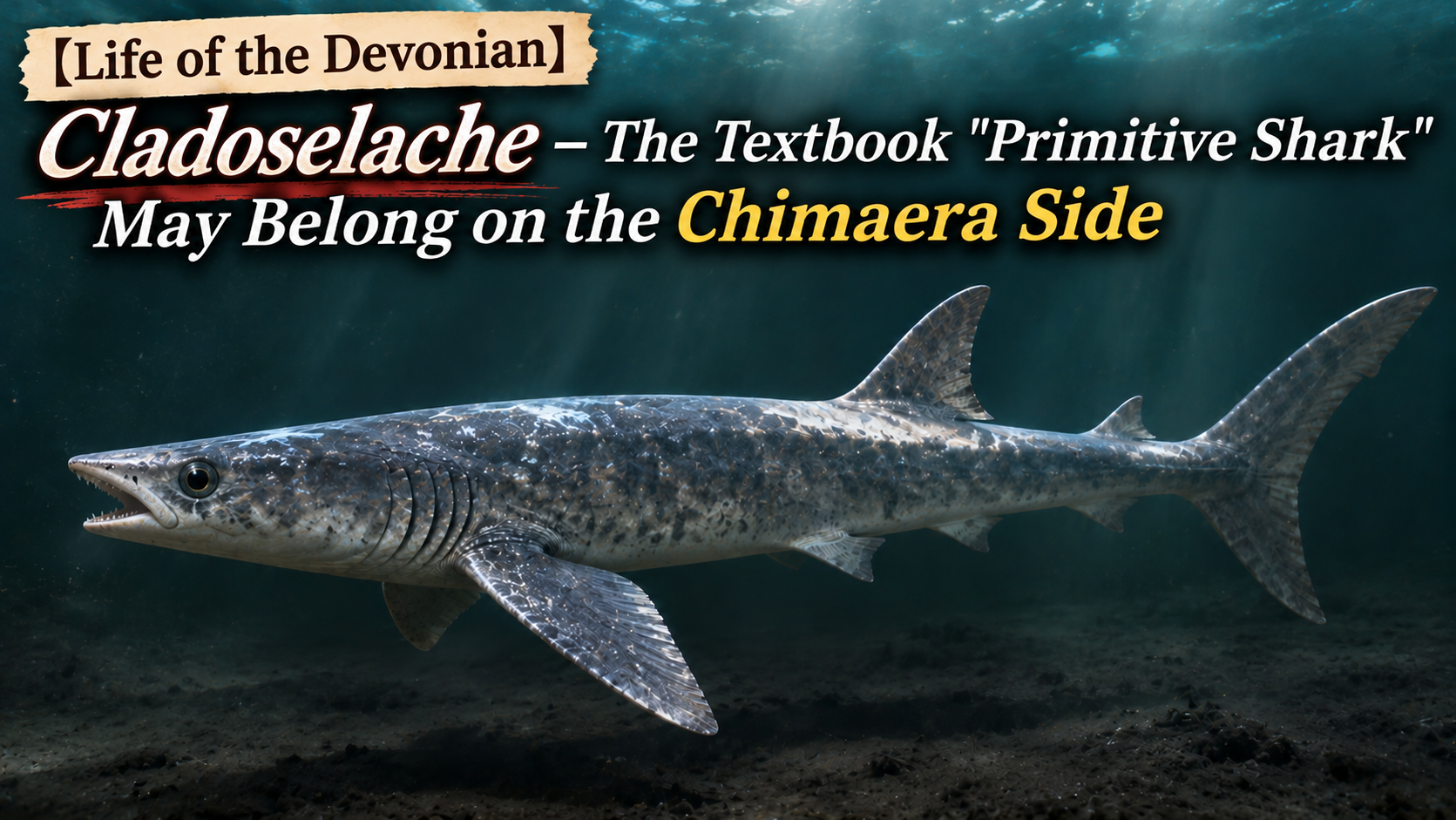
Cladoselache was a cartilaginous fish that lived in the sea at the end of the Devonian, about 360 million years ago. Many of its fossils preserve the whole body outline, and it has long appeared in textbooks as the standard example of a “primitive shark.” Recent studies, however, have placed it closer to the chimaeras than to modern sharks.
Appearance and life
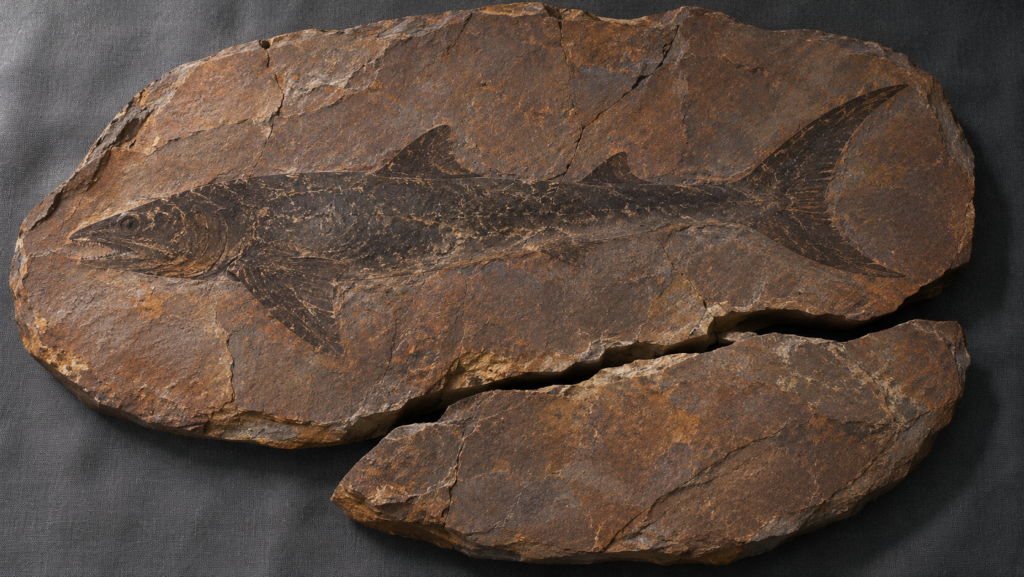
Almost all of its fossils come from the Cleveland Shale, which underlies the area around Cleveland in northern Ohio. This black mudstone forms the top part of the Ohio Shale, and a 2023 study dates it to about 360 to 358.9 million years ago. Most of the fossils are found inside hard lumps of iron carbonate called concretions. Some specimens preserve cartilage, muscle and even skin, so the shape of this boneless fish is known in detail.
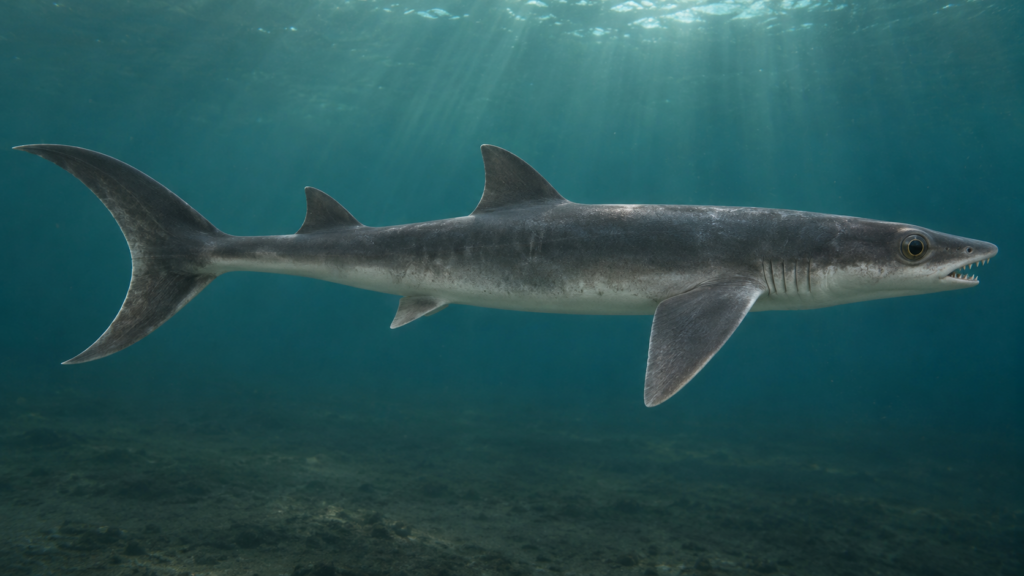
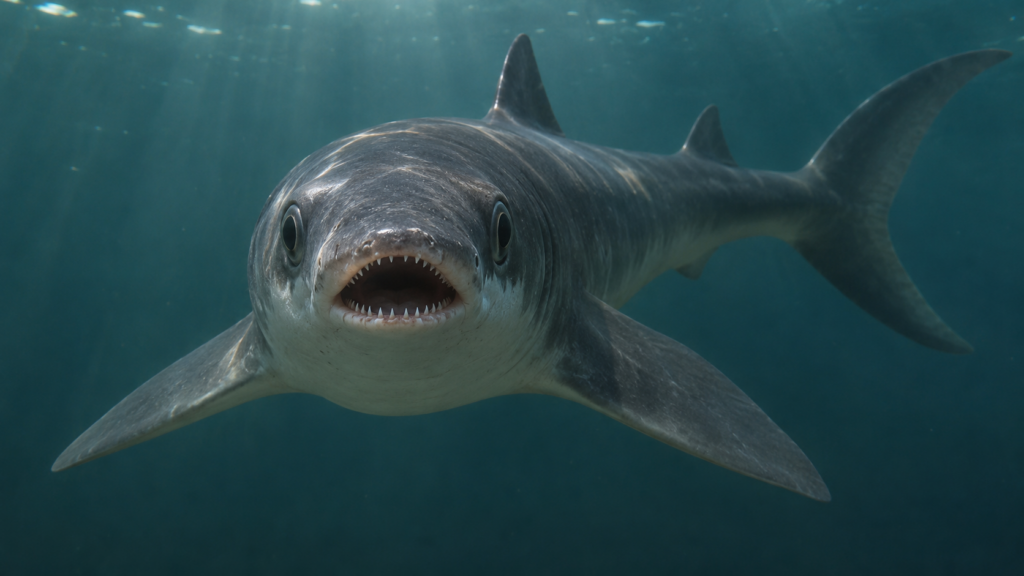
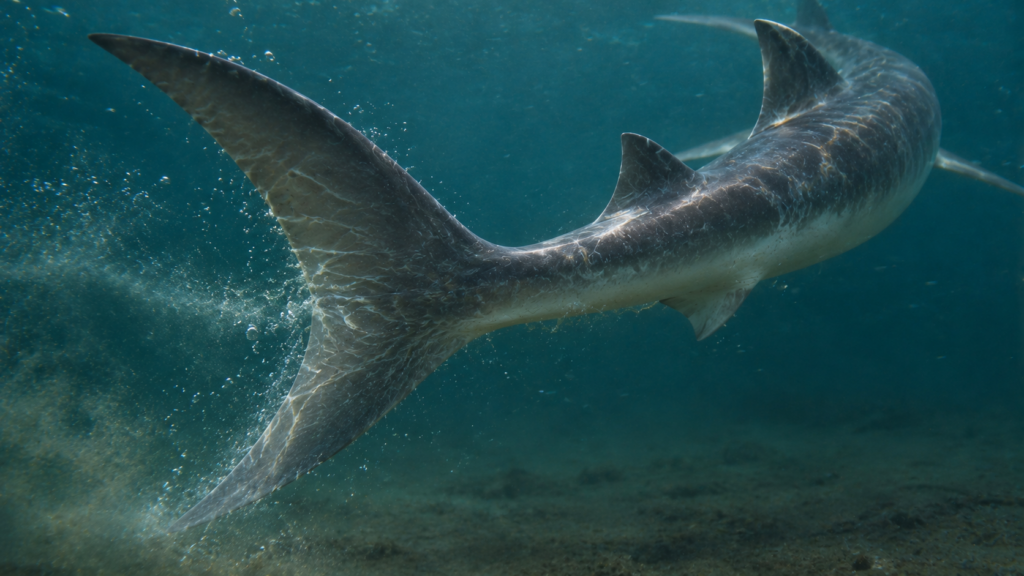
The body was slender and spindle-shaped, and the tail fin was a crescent with upper and lower lobes of almost the same size. The pectoral fins had broad bases and stuck out as triangles. The mouth did not open on the underside of the head, as in modern sharks, but at the very tip of the snout. The average length was about 1 m. A 1938 report from the Cleveland Museum of Natural History describes a specimen measuring 145 cm to the base of the tail, and another whose pectoral fins suggest a total length of more than 2 m.
It also differed from modern sharks in several ways. Its teeth lacked the hard surface layer (enameloid) that covers the teeth of modern sharks, and they were replaced only slowly. Male modern sharks have mating organs called claspers on their pelvic fins. No claspers have been found on any Cladoselache specimen examined so far, and how it reproduced is unknown.
The Cleveland Shale has also yielded many fossils of Dunkleosteus, an armored fish several meters long. Cladoselache swam in the same sea as this large predator.
Was the “primitive shark” on the chimaera side?
For more than a century after it was named as a new genus in the 1890s, Cladoselache was treated as a shark. Its body looked very much like a shark’s and its fossils were well preserved, so it was drawn in encyclopedias and textbooks as a guide to what the ancestors of sharks looked like.
Cartilaginous fishes split into two main lineages: the sharks and rays (elasmobranchs) and the chimaeras (holocephalans). The shift in Cladoselache’s position began with the symmoriiforms, a group of Paleozoic cartilaginous fishes long regarded as its close relatives. In 2017, Michael Coates of the University of Chicago and colleagues used CT scanning to study the skull of Dwykaselachus, a symmoriiform from South Africa, and reported that the cartilage enclosing its brain shared features with the chimaeras. Their conclusion was that the shark-like symmoriiforms were in fact early relatives of the chimaeras.
In 2023, Christian Klug of the University of Zurich, Coates and colleagues described a new cladoselachian from Late Devonian rocks in Morocco. In the family tree drawn in that paper, the cladoselachians sit right next to the symmoriiforms, and both fall on the chimaera (holocephalan) side. The paper calls Cladoselache “the classic primitive shark of older textbooks” and says it likely shows conditions close to the base of the chimaera lineage.
This placement is not settled. Klug and colleagues themselves describe it as contentious. Studies published in 2021 placed Cladoselache at the base of all cartilaginous fishes, or at the base of the sharks and rays. Whichever view is taken, the idea that Cladoselache was a direct ancestor of modern sharks is weaker than it once was.
Related products
You can find books and products related to this article on Amazon.
If you buy through the links above, this blog may earn a commission.
About the images
The images in this article are illustrations created with AI (ChatGPT), and you are welcome to use them. If you do, we would appreciate a link back to this article as the source.
Sources
Klug, C., Coates, M. I., Frey, L. et al. (2023). Broad snouted cladoselachian with sensory specialization at the base of modern chondrichthyans. Swiss Journal of Palaeontology 142, 2. https://doi.org/10.1186/s13358-023-00266-6
Coates, M. I., Gess, R. W., Finarelli, J. A., Criswell, K. E. & Tietjen, K. (2017). A symmoriiform chondrichthyan braincase and the origin of chimaeroid fishes. Nature 541, 208–211. https://doi.org/10.1038/nature20806
Cleveland Museum of Natural History (1938). Scientific Publications of the Cleveland Museum of Natural History 8 (including Harris’s report on Cladoselache). https://archive.org/details/scientificpublic81clev
Babcock, L. E. (2025). Cladoselache: A puzzling ancient shark-like fish. Open Access Government. https://www.openaccessgovernment.org/article/cladoselache-a-puzzling-ancient-shark-like-fish/202090/
Ohio Department of Natural Resources, Division of Geological Survey. GeoFacts No. 4: Ohio Shale. https://dam.assets.ohio.gov/image/upload/ohiodnr.gov/documents/geology/GF4_Hansen_1994.pdf (PDF)
Ohio Department of Natural Resources, Division of Geological Survey. GeoFacts No. 35: Dunkleosteus. https://dam.assets.ohio.gov/image/upload/ohiodnr.gov/documents/geology/GF35_Dunkleosteus_Peter_2025.pdf (PDF)
Carleton University, Hooper Museum. Cladoselache. https://hoopermuseum.earthsci.carleton.ca/sharks/P2-2.htm
コメント