This article contains affiliate links. As an Amazon Associate I earn from qualifying purchases.
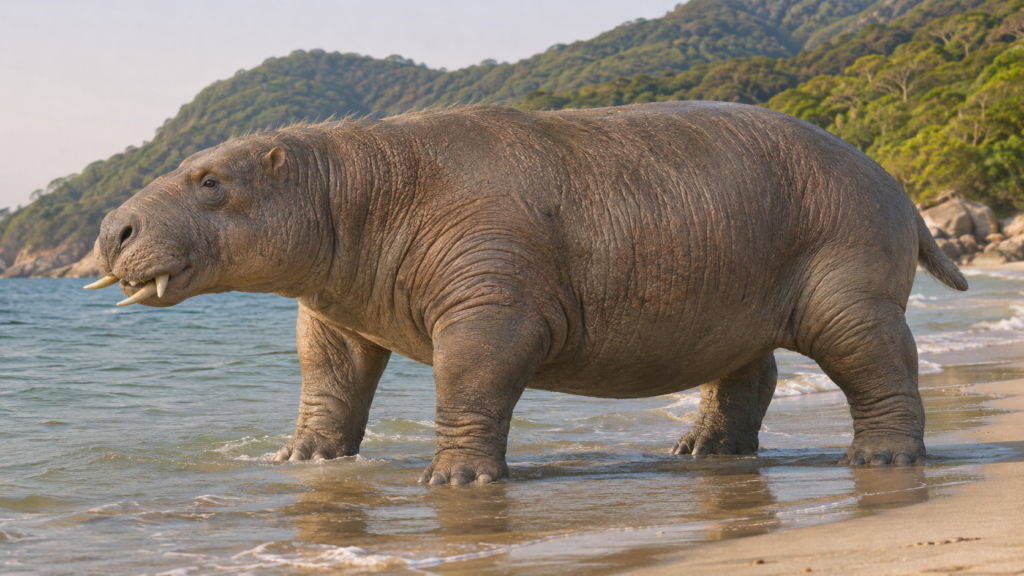
| Name | Paleoparadoxia (Paleoparadoxia; a name combining “ancient” and “paradox”) |
| Classification | Mammalia, Desmostylia, Paleoparadoxiidae |
| Period | Neogene, Miocene (about 20 to 11 million years ago) |
| Found in | Japan (Saitama, Gifu, Niigata and other prefectures); California, USA |
| Length | About 3 m |
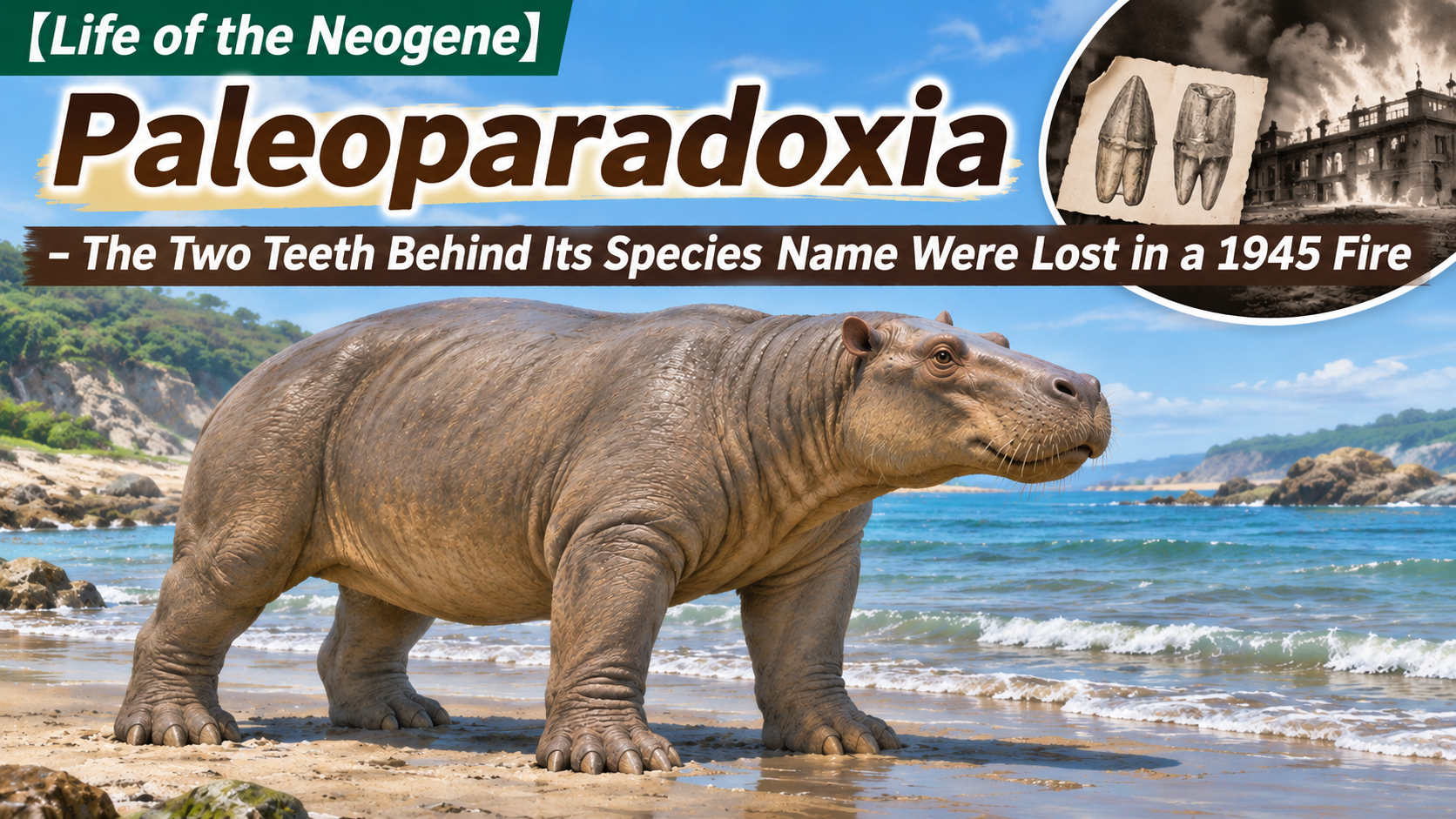
Paleoparadoxia was a desmostylian, a member of an extinct group of mammals, that lived along the coasts of the North Pacific in the Miocene. In Japan, nearly complete skeletons have been found in the Chichibu area of Saitama Prefecture and in Gifu Prefecture. The two teeth on which the species was originally named in Japan, however, were lost in a fire in 1945.
Appearance and Way of Life
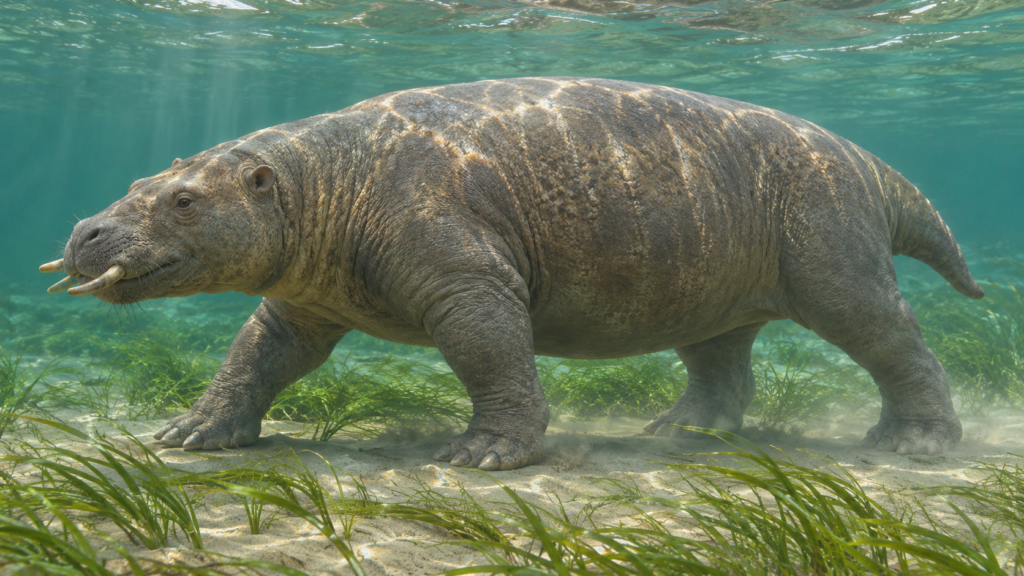
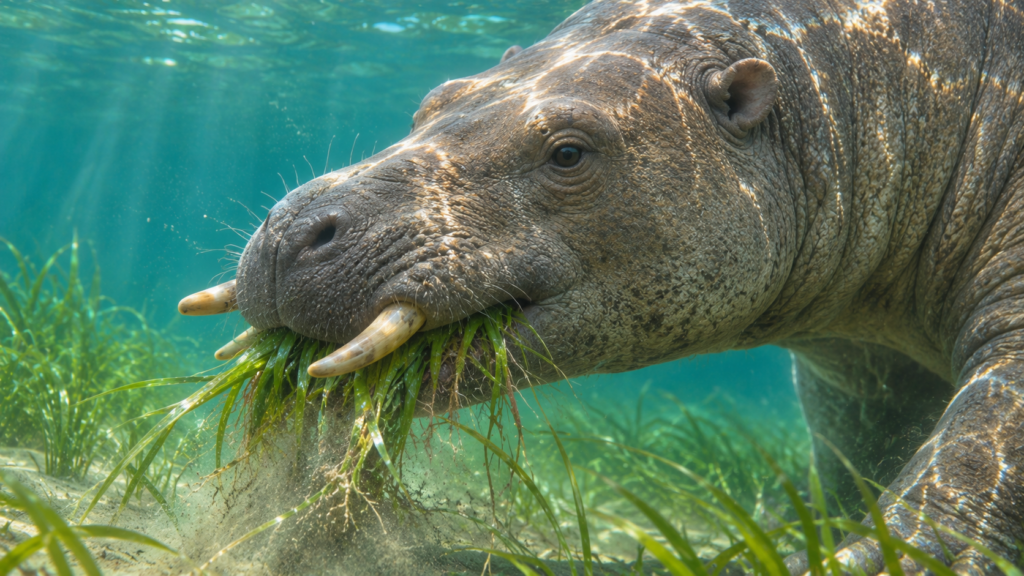
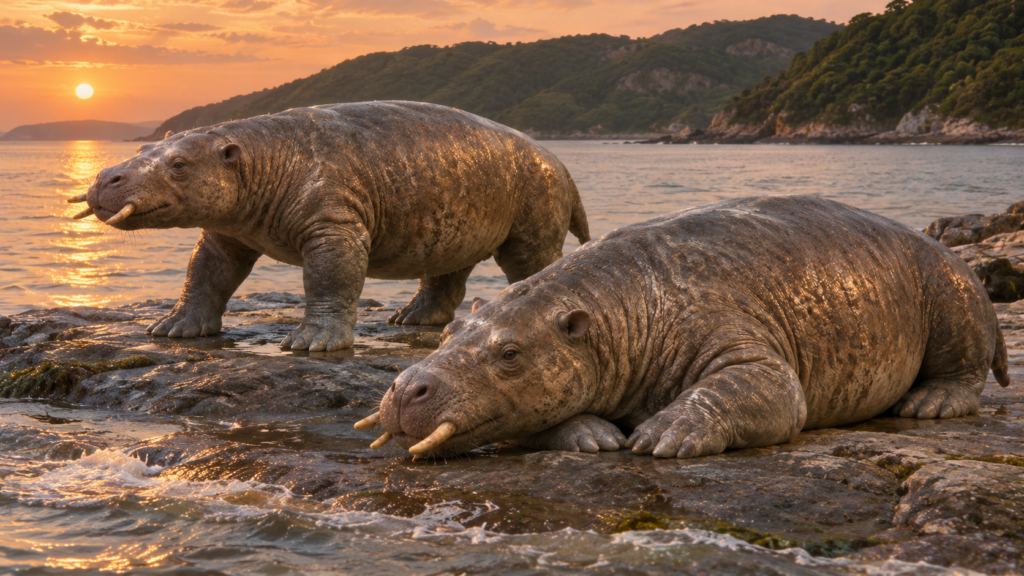
Paleoparadoxia was a heavily built animal about 3 m long, standing on four thick legs. At the front of its mouth were tusks that pointed forward. The name Desmostylia (“bundled pillars”) comes from the molars of its relative Desmostylus, which look like bundles of short columns. Desmostylians died out without descendants, and it is still unsettled what living animals they are related to: some studies place them near elephants and sea cows, others near horses and rhinos.
A 2013 study of the internal structure of the bones found that Paleoparadoxia had dense, heavy bones, and concluded that it lived in shallow water close to shore, either drifting slowly in the water or walking along the seafloor. Its relative Desmostylus, by contrast, had light, spongy bones and is thought to have been a more active swimmer. Most desmostylians are thought to have eaten seagrass.
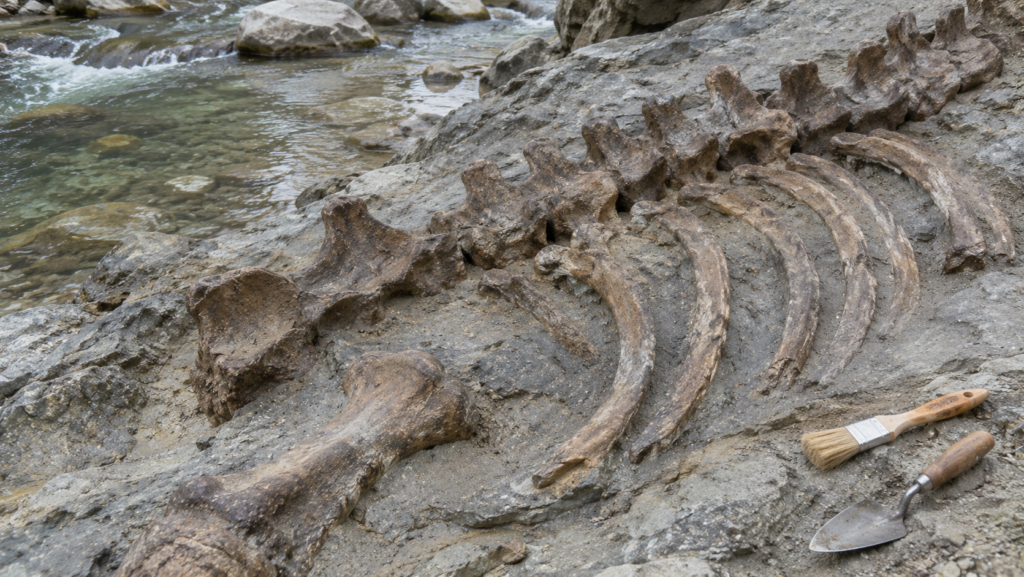
Fossils have been found around the North Pacific, in Japan and in California and elsewhere. Three skeletons are well known in Japan. The first is the Izumi specimen, found in 1950 in Izumi-cho, Toki City, Gifu Prefecture; about 70 percent of the skeleton survives, and it was the first Paleoparadoxia skeleton ever found. It is now held by the National Museum of Nature and Science in Tokyo. The second is the Onohara specimen, found by local high-school students in 1972 at Onohara in Chichibu City, Saitama, and excavated by the Chichibu Museum of Natural Science; it was only the second complete skeleton with a skull to be found anywhere. The third is the Hannya specimen, found in 1981 in a cement company’s quarry at Hannya in Ogano Town, Saitama, which preserves almost everything from the neck to the hips. In 2016 the Onohara and Hannya specimens were designated part of a national Natural Monument, the “Paleo-Chichibu Bay deposits and marine mammal fossils.”
The Teeth Behind the Name Were Lost in a Fire
The species name tabatai was given in 1939 by the geologist Shigeyasu Tokunaga, based on two teeth collected in Niigata Prefecture in 1923. Tokunaga placed the species in the same genus as an American desmostylian, naming it Cornwallius tabatai. In 1959 the American researcher R. H. Reinhart created the new genus Paleoparadoxia and moved the species into it.
On 25 May 1945, the two teeth that served as the name-bearing type were destroyed in a fire at Waseda University in Tokyo, where they were kept. A species name only has a fixed meaning when there is a type specimen showing what it refers to. So in 1966 Tokio Shikama designated the Izumi skeleton from Gifu as a new type specimen, or neotype.
This designation, however, was judged not to have fully met the requirements of the rules of zoological nomenclature. Then in 2005 Norihisa Inuzuka designated a different single tooth, found in a local museum, as the type, and gave the Izumi skeleton a separate species name, media. The same Izumi skeleton was now being treated on one side as the type of tabatai and on the other as a specimen of a different species.
To sort this out, Yoshikazu Hasegawa and Naoki Kohno applied to the International Commission on Zoological Nomenclature in 2007. They asked the Commission to formally recognise the Izumi skeleton as the type of tabatai and to set aside Inuzuka’s tooth and the name media. In 2009, after two rounds of voting, the Commission turned the application down and decided that the existing type fixation would stand. Many of the commissioners who voted against it took the view that Inuzuka’s designation had never been valid in the first place, that Shikama’s designation was sufficient, and that the Commission had no need to take special action.
A 2022 study that examined the status of the Izumi skeleton read the decision as leaving it in place as the type specimen, and recommended that the name media not be used. The first Paleoparadoxia named in Japan began with two teeth that no longer exist, and more than half a century later, which specimen should anchor its name was still being argued over.
Related products
You can find books and products related to this article on Amazon.
If you buy through the links above, this blog may earn a commission.
About the images
The images in this article are illustrations created with AI (ChatGPT), and you are welcome to use them. If you do, we would appreciate a link back to this article as the source.
Sources
Hasegawa, Y. & Kohno, N. (2007). Case 3384. Cornwallius tabatai Tokunaga, 1939 (currently Paleoparadoxia tabatai; Mammalia, Desmostylia): proposed designation of a neotype. Bulletin of Zoological Nomenclature 64, 113–117. https://archive.org/download/biostor-80814/biostor-80814.pdf (PDF)
International Commission on Zoological Nomenclature (2009). Opinion 2232 (Case 3384) Cornwallius tabatai Tokunaga, 1939 (currently Paleoparadoxia tabatai; Mammalia, Desmostylia): proposed designation of a neotype not accepted. Bulletin of Zoological Nomenclature 66, 295–296. https://doi.org/10.21805/bzn.v66i3.a11
Matsui, K., Valenzuela-Toro, A. M. & Pyenson, N. D. (2022). New data from the first discovered paleoparadoxiid (Desmostylia) specimen shed light into the morphological variation of the genus Neoparadoxia. Scientific Reports 12, 14246. https://doi.org/10.1038/s41598-022-18295-5
Hayashi, S. et al. (2013). Bone inner structure suggests increasing aquatic adaptations in Desmostylia (Mammalia, Afrotheria). PLOS ONE 8, e59146. https://doi.org/10.1371/journal.pone.0059146
Cooper, L. N. et al. (2014). Anthracobunids from the Middle Eocene of India and Pakistan are stem perissodactyls. PLOS ONE 9, e109232. https://doi.org/10.1371/journal.pone.0109232
Mizunami Fossil Museum. Paleoparadoxia (on the Izumi specimen; in Japanese). https://www.city.mizunami.lg.jp/kankou_bunka/1004960/kaseki_museum/1003877/1003875/1002255.html
Saitama Museum of Natural History. Paleoparadoxia, Onohara specimen (in Japanese). https://shizen.spec.ed.jp/multidatabases/multidatabase_contents/detail/1258/86f0c169817e4d28f030b4fd6ef6977c?frame_id=1222
Saitama Museum of Natural History. Paleoparadoxia, Hannya specimen (in Japanese). https://shizen.spec.ed.jp/multidatabases/multidatabase_contents/detail/1258/9ddae87c6df0e0386ab2e05fa98ac684?frame_id=1222
Cultural Heritage Online. Paleo-Chichibu Bay deposits and marine mammal fossils (in Japanese). https://online.bunka.go.jp/db/heritages/detail/221637

コメント