| Name | Velociraptor, meaning “swift robber” |
| Classification | Theropoda, Dromaeosauridae |
| Age | Late Cretaceous (about 75 to 71 million years ago) |
| Found in | Gobi Desert, Mongolia; Inner Mongolia, China |
| Length | About 1.5 to 2 m |
| Hip height | About 50 cm |
| Weight | About 15 to 20 kg (estimated) |
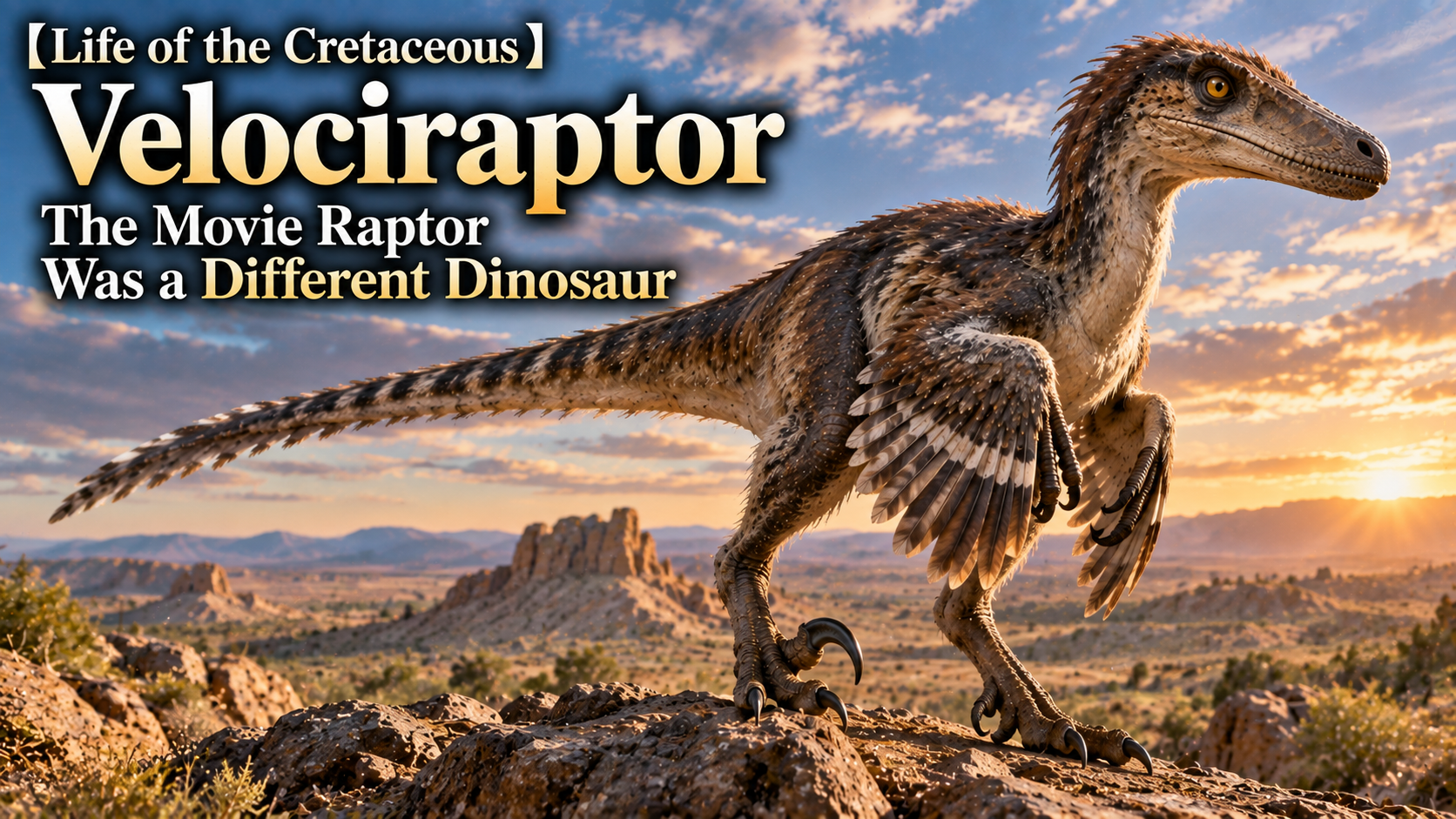
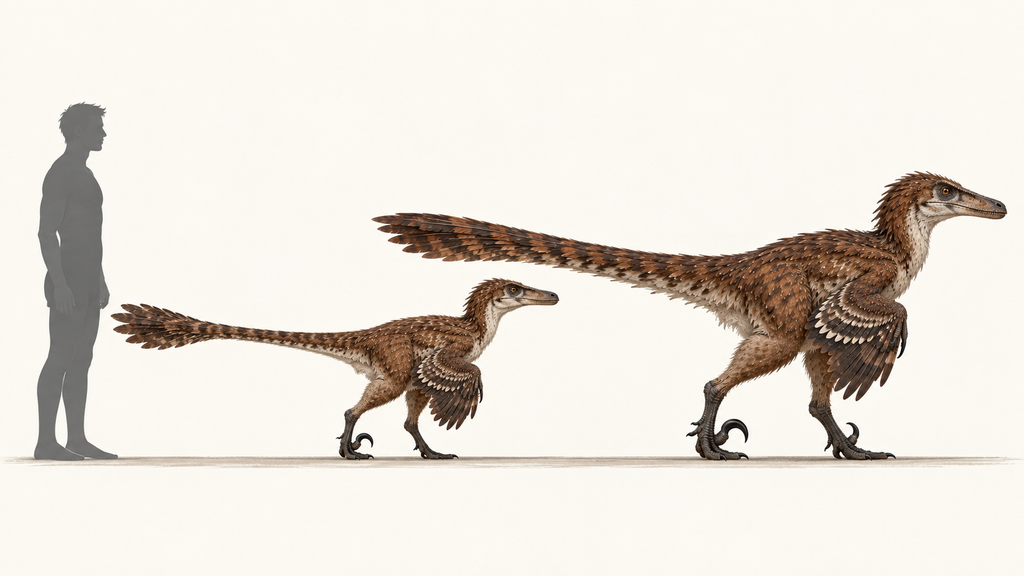
Velociraptor was a small carnivorous dinosaur that lived in Mongolia during the Late Cretaceous. It belonged to the Dromaeosauridae, a family known for the large curved claw on the second toe of each foot, and it had feathers on its forearms. Unlike the human-sized animal seen in the movies, the real Velociraptor was about the size of a large turkey. The movie version was based on a different dinosaur.
Appearance and Lifestyle
An adult measured about 2 m in length, but nearly half of that was the long tail. Hip height was around 50 cm, and body weight is estimated at roughly 15 to 20 kg, lighter than a large dog and about the weight of a medium-sized one. The skull was about 25 cm long, with a long, narrow snout that curved slightly upward. In the closely related Deinonychus and Dromaeosaurus the snout is straight or curves downward, so this upturn is one of the features used to tell the genera apart. The jaws held teeth with serrated edges, and the three fingers of each hand and the toes of each foot bore sharp claws.
The most distinctive feature is the claw on the second toe. About 6.5 cm long and strongly curved like a sickle, it was held off the ground while the animal walked. For a long time this claw was regarded as a weapon for slashing prey. In 2011, however, a study led by Denver Fowler of Montana State University compared it with the feet of living hawks and eagles and proposed a different reading: the claw was used not to slash but to pin prey down and keep it from escaping. This is the same technique a hawk uses when it holds a victim with its feet and begins to feed with its beak. Prey would mostly have been animals the same size as the predator or smaller.
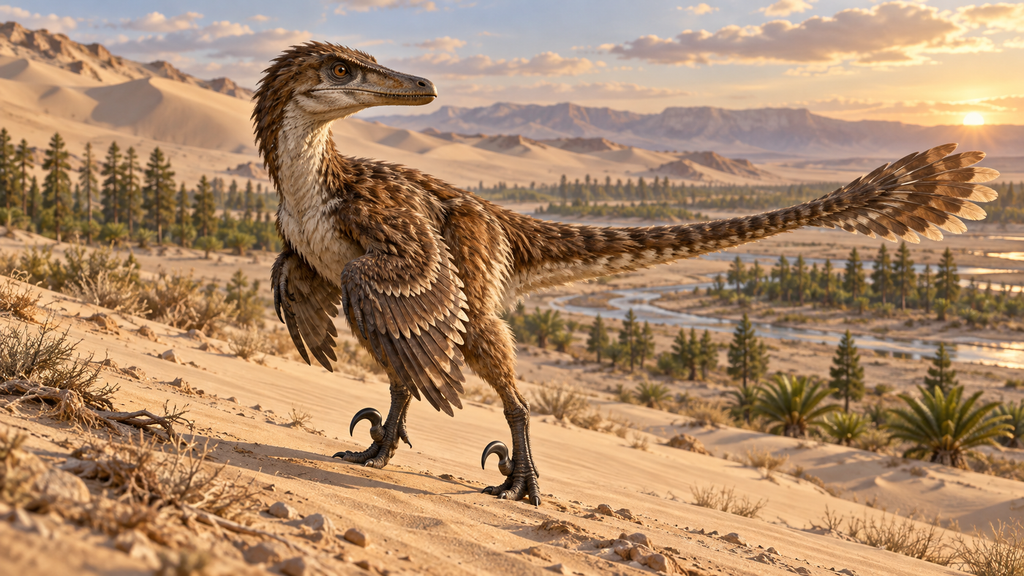
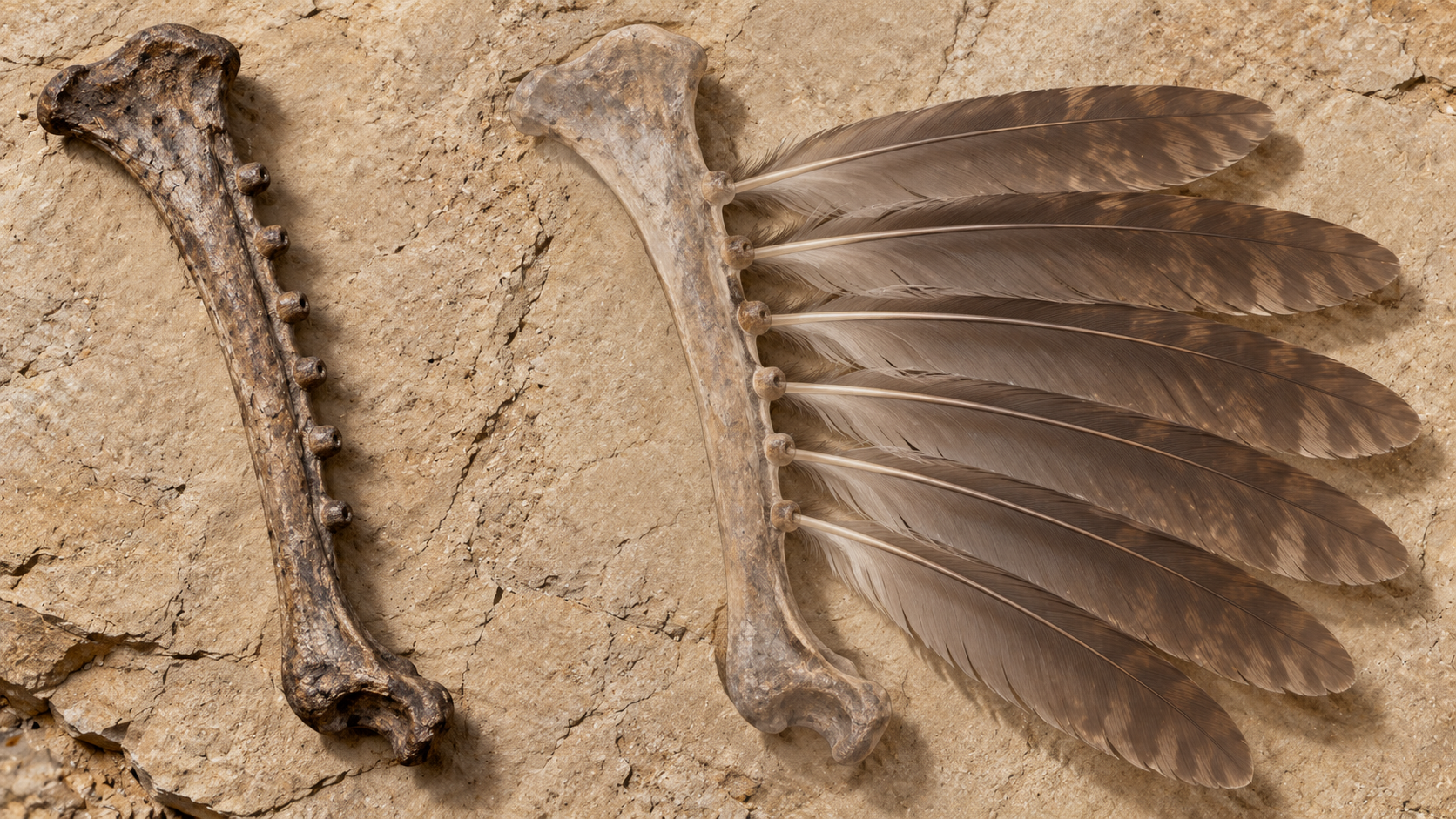
Direct evidence of feathers came in 2007. Alan Turner and Mark Norell of the American Museum of Natural History, together with Peter Makovicky of the Field Museum, examined an ulna (a forearm bone) excavated in Mongolia in 1998 and found six small bumps spaced evenly along its rear edge. These are the same structures as the quill knobs on living birds, the points where the wing feathers are anchored to the bone. Velociraptor therefore carried a row of wing-like feathers on its forearms. With its body size and arm length it could not have flown; the feathers are thought to have served for insulation, for covering eggs during brooding, and for display.
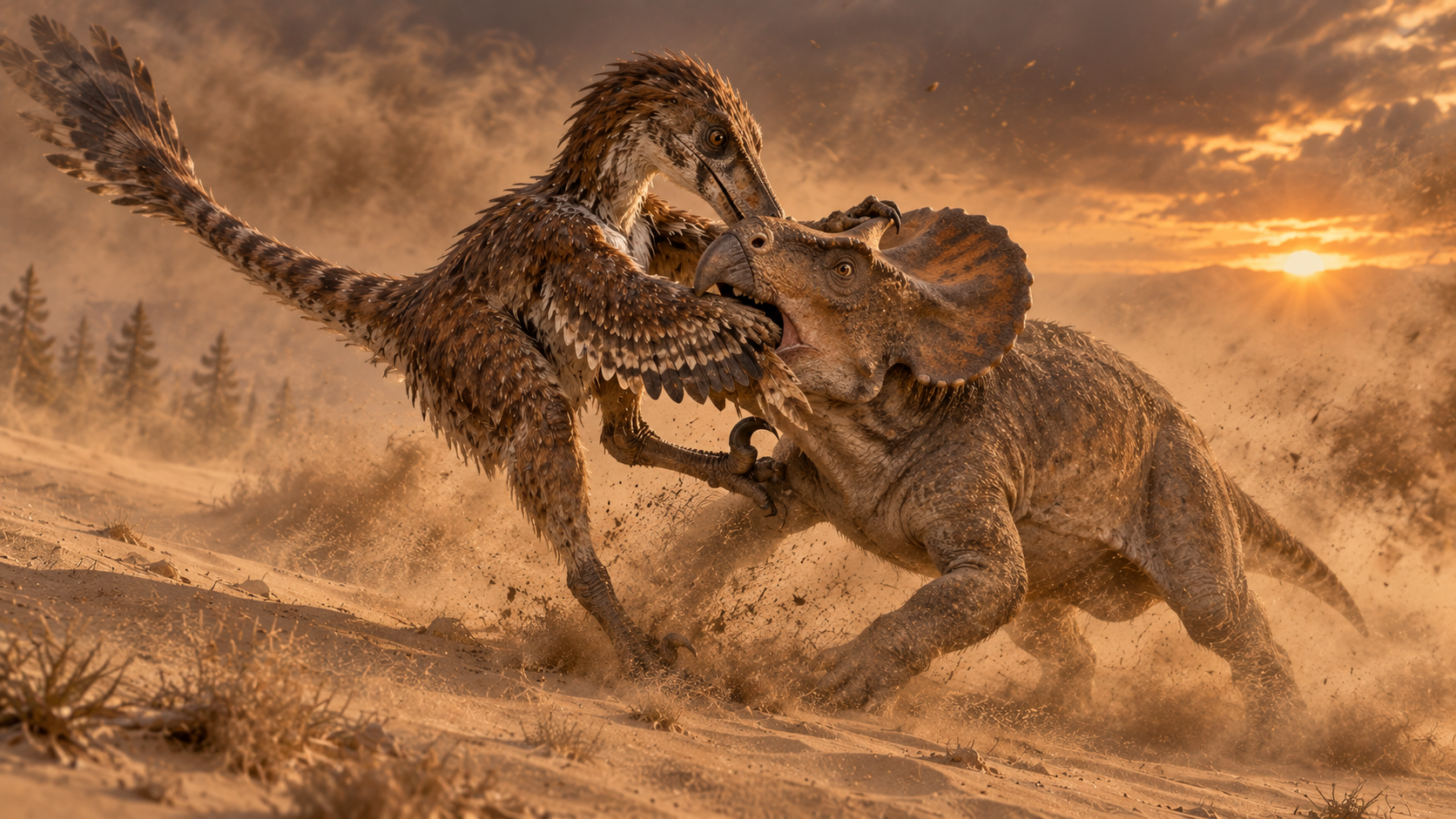
Its home was the dry land that is now the Gobi Desert. Sand dunes spread across the landscape, with vegetation growing where water flowed seasonally. The same rock layers have yielded the sheep-sized horned dinosaur Protoceratops, Oviraptor (long misunderstood as an egg thief), small theropods, primitive mammals and lizards. Protoceratops was especially common and has long been considered the most likely main prey of Velociraptor. The most famous specimen showing this relationship is the “Fighting Dinosaurs,” excavated in 1971 at a site called Tugrikin Shireh by a joint Polish-Mongolian expedition. It preserves the two animals locked together: the Velociraptor has its foot claw driven into the neck of the Protoceratops, while the Protoceratops has the Velociraptor’s right arm clamped in its beak, broken. The pair is thought to have been buried in an instant by a collapsing dune or a sandstorm, and the specimen is designated a national treasure of Mongolia.
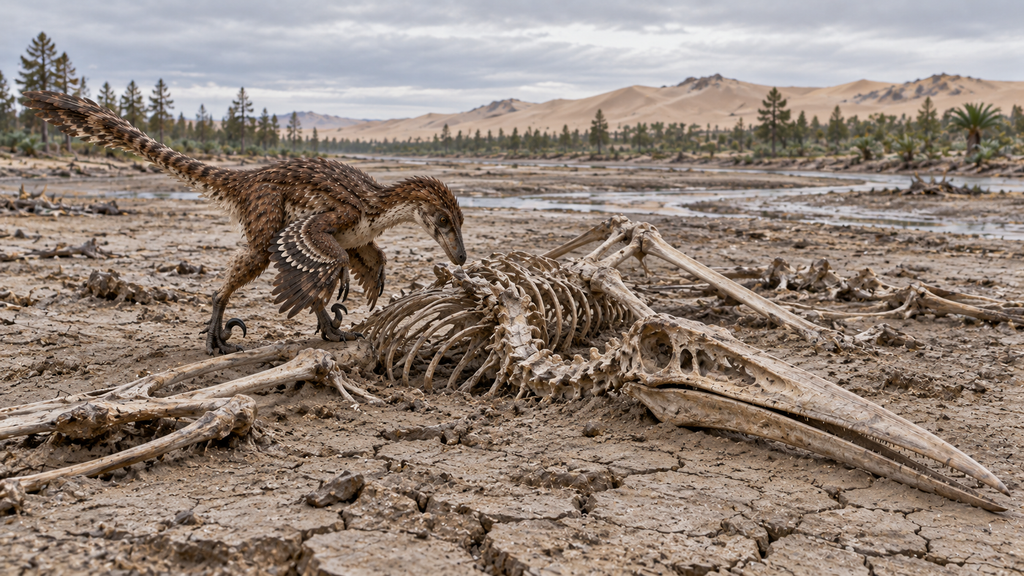
As for diet, Velociraptor is known to have eaten carcasses as well as hunted. A specimen excavated in the Gobi Desert in 1994 died with a 7.5 cm pterosaur bone still in its chest cavity, where the stomach would have been. From the shape of the bone, the pterosaur is identified as an azhdarchid with a wingspan of 2 m or more. A Velociraptor weighing around 15 kg would have had difficulty attacking a living pterosaur of that size, so the animal is thought to have been scavenging a carcass. The same specimen also had a healing fracture in one rib, showing that it died while carrying an injury.
The True Identity of the Movie “Raptor”
The name Velociraptor became known around the world through the 1993 film Jurassic Park. In the film it appeared as a dinosaur taller than a human that could open doors and hunted people in packs. That portrayal differs from the real Velociraptor in both size and appearance.
The model for the film was Deinonychus, a separate genus found in North America. Deinonychus belongs to the same family, Dromaeosauridae, but it exceeded 3 m in length and weighed about 60 to 80 kg, three to four times as much as Velociraptor. It was described in 1969 by John Ostrom of Yale University, and its reconstruction as an active, fast-running predator became a turning point in how dinosaurs were pictured.
The reason the name Velociraptor was used goes back to a book published in 1988: Predatory Dinosaurs of the World, written by the paleoartist Gregory S. Paul. In it, Paul noted how similar the skeletons of the Mongolian Velociraptor and the North American Deinonychus were, and placed the two in a single genus. Under the rules of zoological nomenclature the older name takes priority, so Velociraptor, named in 1924, was kept, and Deinonychus, named in 1969, was renamed “Velociraptor antirrhopus.” The classification was not accepted by researchers, and Paul himself later withdrew it.
Michael Crichton, author of the original novel, used this book as a reference while writing. The “Velociraptor” of the novel is based on Deinonychus in size and form; only the name follows Paul’s classification. When the story was filmed, director Steven Spielberg had the animal enlarged still further. As a result, the movie raptor stands more than twice the height of the real Velociraptor.
Shortly after the film’s release, a real dinosaur close to that size came to light. Utahraptor, excavated in Utah in 1991 and described in 1993, reached 5 to 7 m in length, making it one of the largest dromaeosaurids known. The size of the movie raptor had, by coincidence, been overtaken by reality, and the overlap with the film’s publicity gave the new dinosaur a large boost in public recognition.
The real Velociraptor begins with a crushed skull and a single claw found in 1923 at the Flaming Cliffs (Bayn Dzak) of Mongolia by the Central Asiatic Expeditions of the American Museum of Natural History. The following year, 1924, the museum’s president, Henry Fairfield Osborn, named the specimen Velociraptor mongoliensis. Osborn believed the claw came from the hand; later finds showed it was the claw of the second toe. During the Cold War, when American teams could not enter Mongolia, Soviet and Polish researchers worked alongside Mongolian colleagues to collect specimens. From the 1990s onward, joint expeditions by the American Museum of Natural History and the Mongolian Academy of Sciences recovered a series of well-preserved skeletons, including the forearm with the quill knobs. In 2008 a second species, Velociraptor osmolskae, was described from Inner Mongolia, China.
Current reconstructions show Velociraptor with wing-like feathers on its forearms and a fully feathered body, looking much like a large bird. In the 2007 announcement, Norell remarked that if Velociraptor were alive today, our first impression would be of a very unusual bird. The wide gap between the movie image and the real animal has become a point that comes up almost every time this dinosaur is introduced.
Sources
Turner, A. H., Makovicky, P. J. & Norell, M. A. (2007). Feather Quill Knobs in the Dinosaur Velociraptor. Science, 317(5845), 1721. https://doi.org/10.1126/science.1145076
American Museum of Natural History (2007). Velociraptor Had Feathers. https://www.amnh.org/research/science-news/2007/velociraptor-had-feathers
Fowler, D. W., Freedman, E. A., Scannella, J. B. & Kambic, R. E. (2011). The Predatory Ecology of Deinonychus and the Origin of Flapping in Birds. PLOS ONE, 6(12), e28964. https://doi.org/10.1371/journal.pone.0028964
University College Dublin (2012). Ancient fossil remains reveal Velociraptor’s last meal. https://www.ucd.ie/news/2012/03MAR12/080312-Preserved-bone-of-Pterosaur-in–stomach-of-Velociraptor.html
American Museum of Natural History. The Fighting Dinosaurs (Fighting Dinos exhibition). https://amnh.org/exhibitions/fighting-dinos/the-fighting-dinosaurs
Smithsonian Magazine (2008). You say “Velociraptor,” I say “Deinonychus”. https://www.smithsonianmag.com/science-nature/you-say-velociraptor-i-say-deinonychus-33789870/
コメント