| Name | Ankylosaurus magniventris, meaning “fused lizard” and “great belly” |
| Classification | Ornithischia, Thyreophora, Ankylosauria, Ankylosauridae |
| Age | End of the Cretaceous (about 68 to 66 million years ago) |
| Found in | United States (Montana, Wyoming), Canada (Alberta, Saskatchewan) |
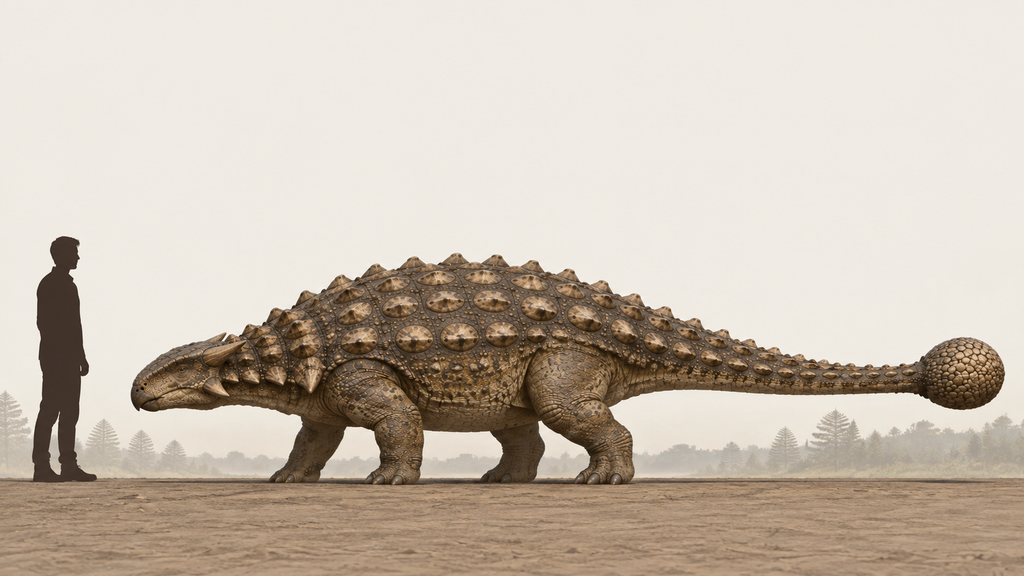
| Length | About 6 to 8 m |
| Weight | About 4.8 t (a small individual) to about 8 t (rough estimate for the largest) |
| Tail knob | 60 cm long, 49 cm wide, 19 cm high (the only known specimen) |
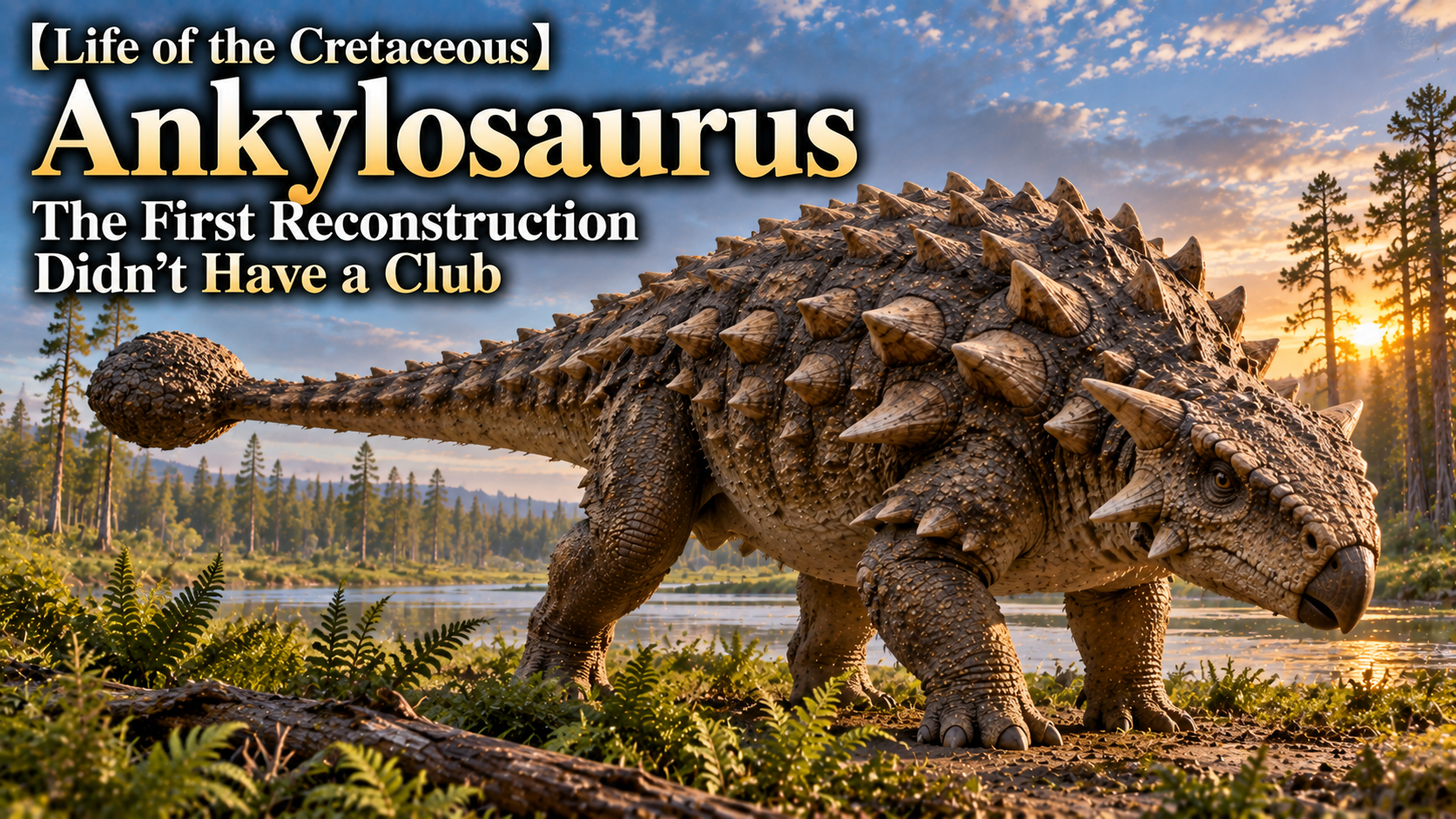
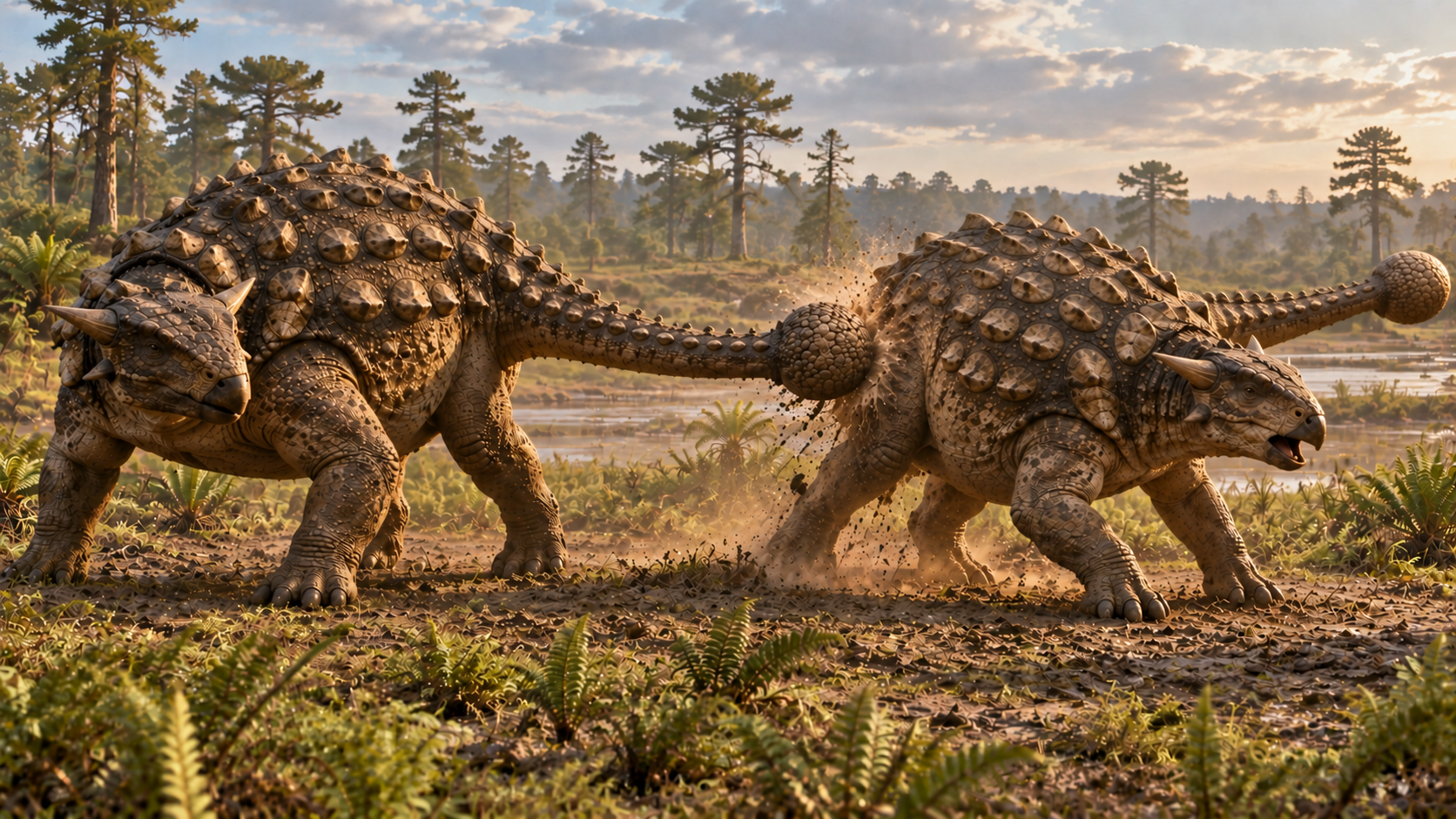
Ankylosaurus was a plant-eating dinosaur of the ankylosaur group, covered from back to tail in bony plates and carrying a knob-shaped club at the end of its tail. It appeared in North America at the very end of the Cretaceous and is found in the same rock layers as Tyrannosaurus and Triceratops. Although it has become the very symbol of the armored dinosaurs, only a handful of fossils are known, and not a single complete skeleton has been found. The tail club is usually pictured as a weapon for driving off predators, but research on healed wounds in a close relative suggests that its main target was other members of its own species.
Appearance and Life
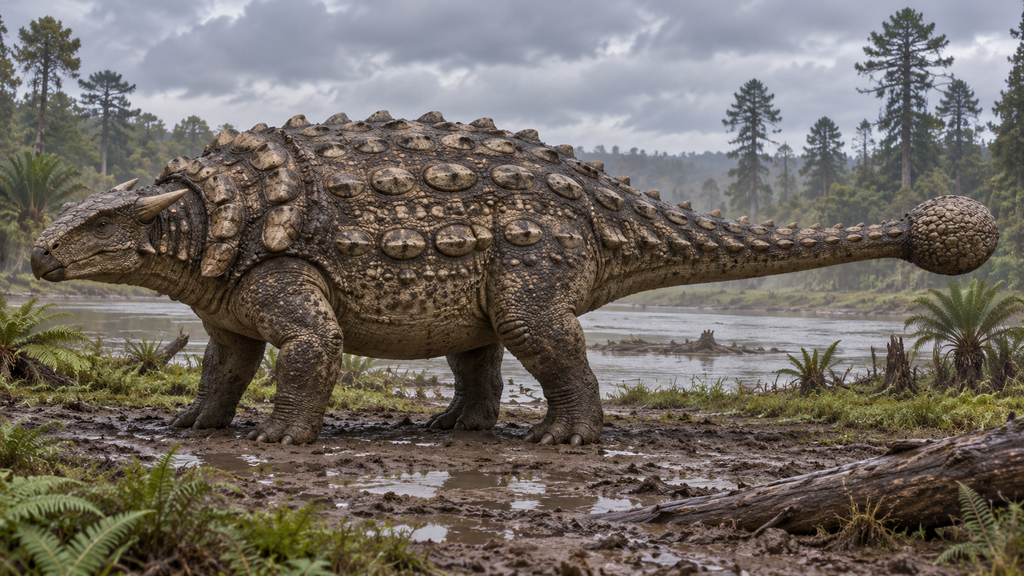
The body was low and wide, standing close to the ground on four stout legs. Against a total length of 6 to 8 m, the shoulders stood only about 1.5 m high, giving the animal a build that was far broader than it was tall. Seen from above, the head was triangular, with a short horn projecting backward from each rear corner, and its surface was paved with polygonal bony plates that gave it a knobbly texture. Over the neck ran two semicircular bands, each carrying six large bony plates, and behind them, from the back to the hips, oval plates with low ridges were arranged in rows running both across and along the body. These plates were bones that grew within the skin, and in life they were covered by a horny sheath.
The face has a feature unique to this genus. The nostrils open not at the front of the snout but on the sides of the head, set well back and facing downward. All ankylosaurs have intricately winding nasal passages, but in Ankylosaurus the nasal bones expanded forward and pushed the position of the nostril itself downward, an arrangement not known in any other dinosaur. The teeth were unusual too: extremely small relative to the size of the head, and correspondingly numerous, with 34 to 36 teeth on each side of the upper jaw alone.
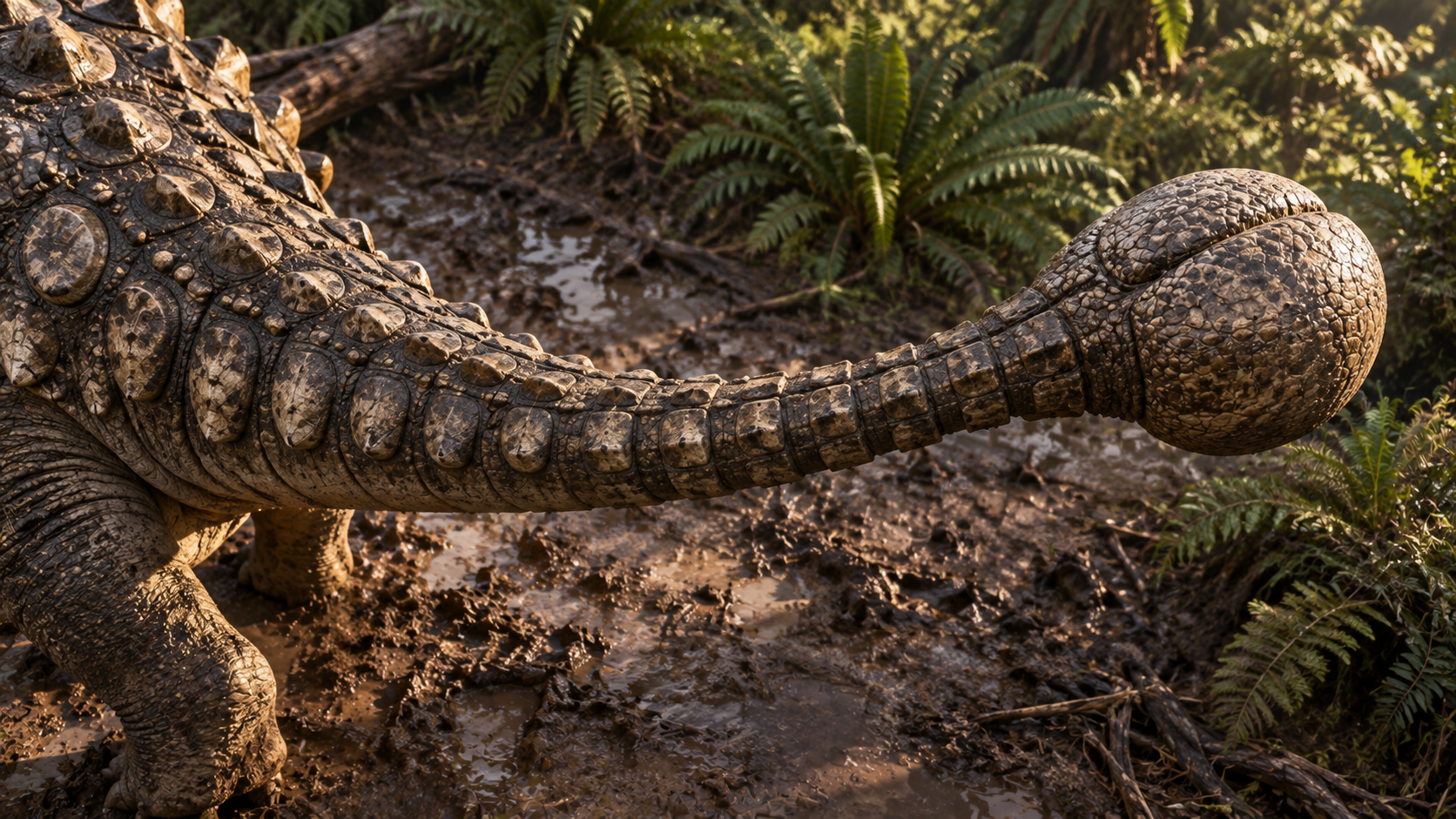
The tail made up nearly half of the total length, and in large individuals it is estimated to have exceeded 3 m. The half nearest the body was flexible, while the rear half was locked into a single rigid rod, each vertebra wrapping its projections around the next. This rod is the “handle,” and the two large bony plates that enclose the tip from either side, together with the smaller plates that stitch them together, form the “knob”; handle and knob together make up the tail club. Only one Ankylosaurus specimen, found in Alberta, preserves a knob, and it measures 60 cm long and 49 cm wide. The handle vertebrae are twice as wide as those of the related Euoplocephalus, another feature found in no other genus.
Its food was low-growing plants. Since raising the head gained it little height, it is thought to have used its broad beak to tear off mouthfuls of ferns and shrub foliage near the ground. The small teeth could do little chewing, so digestion relied on fermentation in the large gut. The species name, meaning “great belly,” refers to this body shape. Because the nostrils open downward and the beak is narrower than in related species, a lifestyle of digging in the ground for roots or small animals has also been considered, though no decisive evidence has been found.
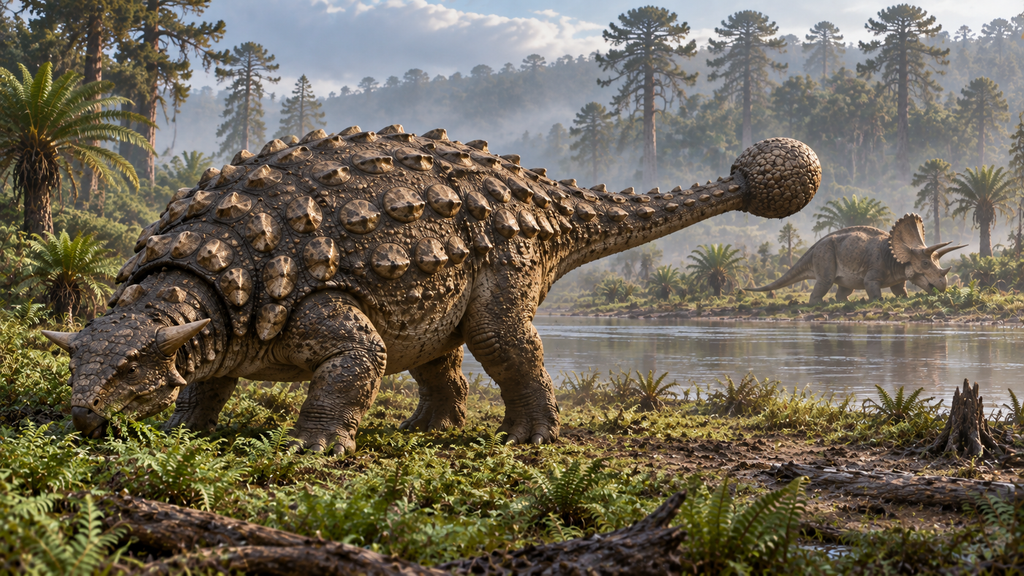
It lived on the plains of rivers, forests, and wetlands that spread along the western shore of the inland sea then running north to south through North America. The Hell Creek Formation, stretching from present-day Montana to South Dakota, is the best-known example, and the same layers have yielded Tyrannosaurus, Triceratops, Edmontosaurus, and Pachycephalosaurus. Ankylosaurus fossils, however, are extremely rare, accounting for less than 0.05% of the dinosaur fossils found there. Whether the animal was simply uncommon, or rarely visited the coastal plains where fossils are most likely to form, remains undecided. The first specimen ever found came from just over 60 m below the boundary that marks the end of the Cretaceous, making Ankylosaurus one of the dinosaurs that lived right up to the asteroid impact.
The First Restoration Had No Tail Club
The first Ankylosaurus fossil was a partial skeleton dug out of the Hell Creek Formation in Montana in 1906 by an expedition from the American Museum of Natural History. It included part of the skull, vertebrae, a shoulder bone, and many bony plates, and was described by Barnum Brown in 1908. Brown placed the dinosaur at the head of a “new family of armored dinosaurs,” creating the name Ankylosauridae at the same time.
Brown’s restoration, however, had no tail club. Ankylosaur fossils were very scarce at the time, and the tail tapered to a thin point like that of any ordinary dinosaur. The bony plates were packed tightly together with no gaps, and the semicircular bands from the neck were interpreted as ornaments of the hips and tail. The tail knob was discovered in 1910, with a second specimen found in Alberta. Pictures from then on included the club, but they also gained large spikes jutting out from the shoulders. These were borrowed by mistake from a different armored dinosaur, Edmontonia, and have been removed from current restorations.
Who the Tail Club Was Aimed At
Whether the tail club could really work as a weapon was not properly calculated until 2009. The Canadian researcher Victoria Arbour used the tails of related species found in Alberta, estimating the weight of each section of the tail and the thickness of its muscles from the dimensions of the vertebrae and plates, and from these worked out the speed and impact force of a swing. The tail could barely move up and down, but could sweep through about 100 degrees from side to side. CT scans showed that the interior of the knob was spongy and light, a structure that made it easier to swing.
The results depend on the size of the knob. Small knobs under 20 cm wide could not produce enough force to break an opponent’s bone. Large knobs over 50 cm wide delivered an impact of 7,000 to 14,000 newtons, and because the striking surface was narrow, the pressure on the target bone far exceeded the strength of living bone; such a blow was calculated to break bone with certainty. The calculations, however, were based not on Ankylosaurus fossils but on the tails of older relatives. The only known Ankylosaurus knob is 49 cm wide, which falls into the “medium” class under this scheme. Scaling from the individual with the largest skull gives a knob width of around 57 cm, about the same as the largest knobs of related species and no larger. There appears to have been an upper limit to the weight that the handle vertebrae could support.
Even at the time of this calculation, Arbour raised a doubt about the club’s use as a weapon. In the related Pinacosaurus, young individuals have no tail knob; it develops only after maturity. If it were a weapon for defense against predators, it makes little sense for it to be useless during childhood, when the animal was most vulnerable to attack. This led to the suggestion that adults used it in contests, striking each other’s flanks, a pattern like that of bovids ramming each other’s sides or giraffes swinging their necks. If so, it was predicted that ankylosaurs should show more healed fractures of ribs and plates than other dinosaurs.
A fossil matching that prediction was reported in 2022. It is the specimen of Zuul crurivastator, found in 2014 in the Judith River Formation of Montana. An ankylosaurid from about 76 million years ago, it preserves the bony plates and skin from back to tail in the positions they held in life. On both sides of this specimen’s hips, several of the long spikes lining the flanks had been broken and then healed into rounded stumps. The injuries were not scattered randomly across the body but concentrated symmetrically, on both sides, at hip height only. A bite from a tyrannosaur would have left tooth marks and would not be confined to one region. Wounds delivered from the side at hip height, appearing identically on both flanks, could be explained as the result of another Zuul swinging its tail sideways into them. Combining this with the fact that knob size varies greatly between individuals of the same species, and that the knob develops only after maturity, the research team concluded that the tail club evolved primarily as a structure for fighting members of its own species.
This study does not claim that the club was never turned against predators. It had the power to break bone, as the calculations show, and swinging it when cornered is entirely plausible. The conclusion is rather that no evidence supports “defense against predators” as the reason the structure evolved, and that contests between members of the same species over territory or mates fit the evidence better. Ankylosaurus itself is not yet known from enough fossils to check for such wounds, and whether the same holds for it depends on future discoveries.
Sources
Arbour, V. M. & Mallon, J. C. (2017). Unusual cranial and postcranial anatomy in the archetypal ankylosaur Ankylosaurus magniventris. FACETS 2: 764–794.
https://doi.org/10.1139/facets-2017-0063
Arbour, V. M. (2009). Estimating impact forces of tail club strikes by ankylosaurid dinosaurs. PLoS ONE 4(8): e6738.
https://doi.org/10.1371/journal.pone.0006738
Arbour, V. M., Zanno, L. E. & Evans, D. C. (2022). Palaeopathological evidence for intraspecific combat in ankylosaurid dinosaurs. Biology Letters 18: 20220404.
https://doi.org/10.1098/rsbl.2022.0404
Royal Ontario Museum (2022). Ankylosaurs battled each other as much as they fought off T. rex (press release)
https://www.rom.on.ca/news-releases/ankylosaurs-battled-each-other-much-they-fought-t-rex

コメント