This article contains affiliate links. As an Amazon Associate I earn from qualifying purchases.
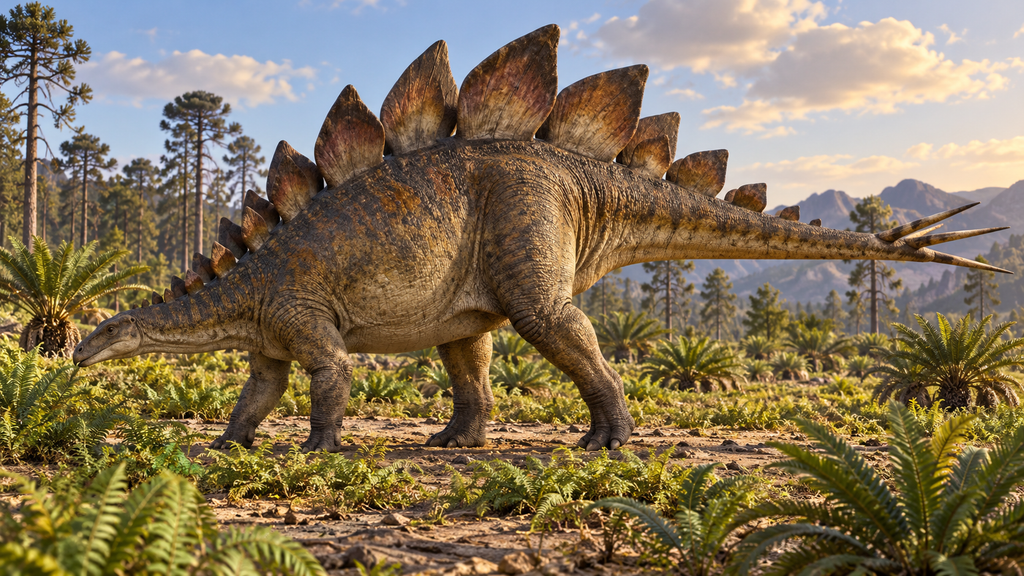
| Name | Stegosaurus (meaning “roofed lizard”) |
| Classification | Ornithischia, Thyreophora, Stegosauria, Stegosauridae |
| Age | Late Jurassic (about 155 to 145 million years ago) |
| Found in | Morrison Formation of the western United States (Colorado, Wyoming, Utah); Portugal |
| Length | About 6.5 m (Stegosaurus stenops) to 7–9 m (Stegosaurus ungulatus) |
| Weight | Estimated at roughly 3.5–5 t (estimates vary by study; “Sophie”, a 5.8 m young adult, is estimated at about 1.6 t) |
| Back plates | 17–22 plates. The largest are about 1 m tall and 60 cm wide |
Stegosaurus is a large stegosaur that lived in North America toward the end of the Jurassic. Known for the bony plates standing along its back and the four spikes at the end of its tail, it is one of the few dinosaurs that almost anyone can name on sight. Its body was longer than a car, yet its brain was tiny, and this small brain gave rise, soon after the animal was first described in the 19th century, to the idea that it carried a “second brain” in its hips. The story was repeated for nearly a hundred years.
Appearance and Way of Life
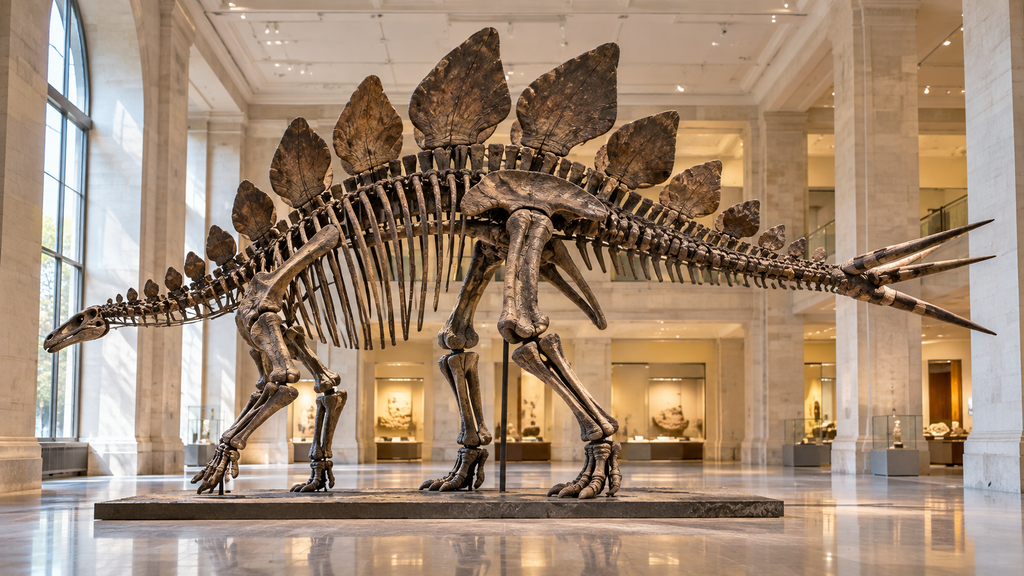
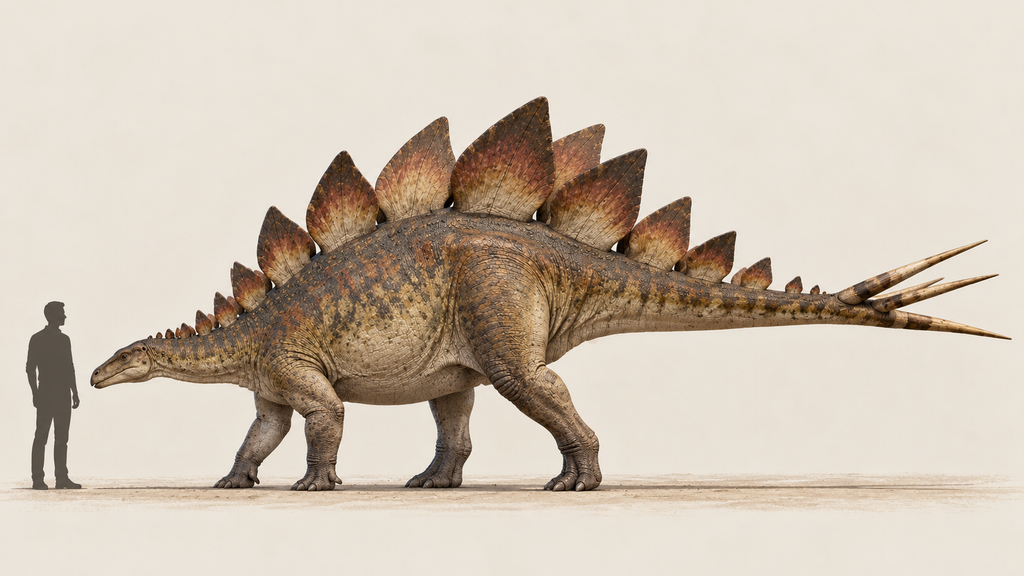
Stegosaurus walked on four legs, with a back that rose like a hill. Because its forelimbs were much shorter than its hind limbs, the hips were the highest point of the body, and the head was carried low, about 1 m above the ground. The tail did not drag; it is thought to have been held straight out behind the body. The hind feet had three toes and the forefeet five. The head was small for the size of the body, a long, narrow skull at the end of a short neck. The underside of the throat was paved with small, pebble-like bones that protected the soft throat.
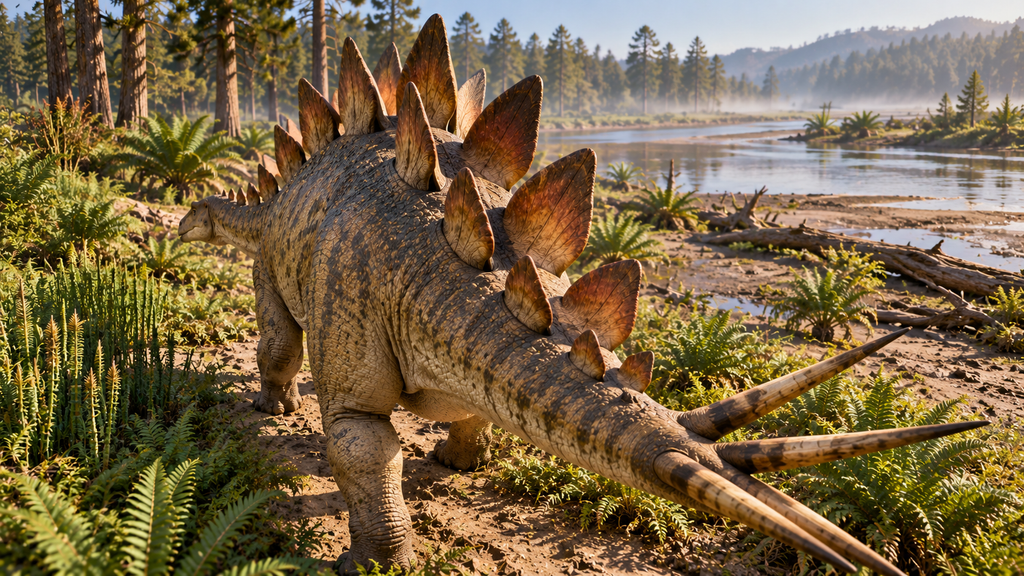
The plates on the back were not part of the skeleton. They were osteoderms, bones that form within the skin, of the same kind as the bony cores of a crocodile’s scales, grown to an enormous size. They ran from the neck to partway down the tail in two rows that alternated left and right. This arrangement is known from specimens of Stegosaurus stenops that were fossilized with the plates still attached to the body. The surface of each plate is scored with grooves left by blood vessels, and skin impressions preserved on the closely related Hesperosaurus show that in life the whole plate was covered by a sheath of horn. At the tip of the tail were two pairs of spikes 60 to 90 cm long, which projected almost horizontally to the sides rather than upward.
Stegosaurus ate plants. The front of the mouth was a toothless beak, behind which sat rows of small triangular teeth. Because the teeth were small and the jaw could only move up and down, Stegosaurus was long regarded as a weak biter. A 2016 study that recalculated the bite using a digital model of the skull, however, put its bite force on a par with cattle and sheep, and concluded that it could have handled tough plants such as cycads. Given how low the head was carried, it probably fed mainly on plants near the ground: ferns, cycads, and the foliage of young conifers. Flowering plants and grasses did not yet exist.
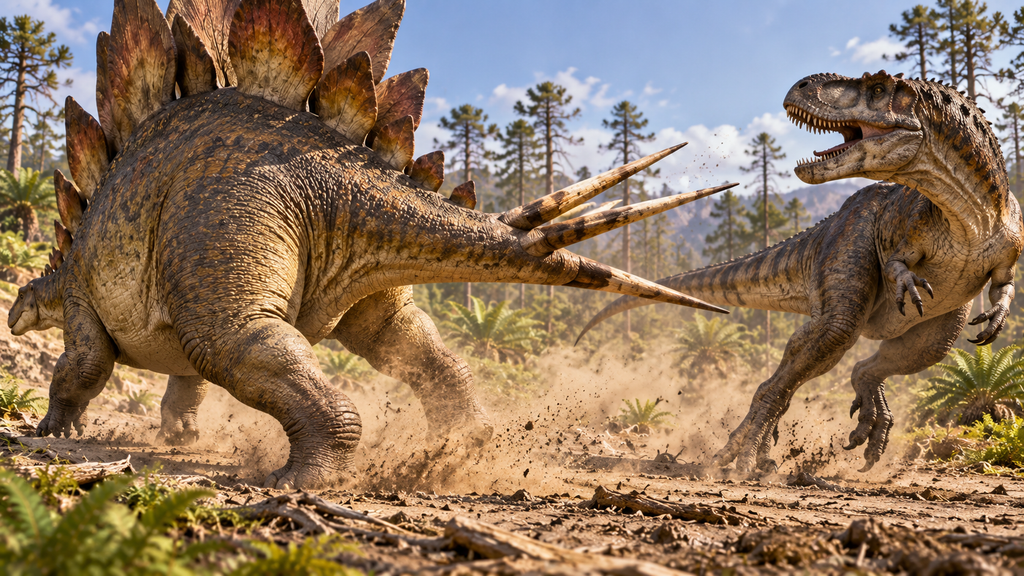
It lived on semi-arid plains with distinct wet and dry seasons. The Morrison Formation, where its fossils are found, is thought to have been a landscape of conifer and tree-fern woodland along the rivers, with fern prairies spreading between them. The same rocks have yielded the long-necked sauropods Apatosaurus, Diplodocus, and Brachiosaurus, the small plant-eater Camptosaurus, and the predator Allosaurus. One Allosaurus tail vertebra has a hole in it that exactly fits a Stegosaurus tail spike, and the wound had begun to heal. On the Stegosaurus side, about one in ten of the spikes examined shows breaks or other damage. The tail spikes were not ornaments; they were used.
What Were the Plates For?
The name “roofed lizard” goes back to Othniel Charles Marsh, who described the dinosaur in 1877 and at first believed the plates lay flat over the back, overlapping like roof tiles. Even after the plates were shown to have stood upright, their purpose was argued over for a long time, with three main proposals: armor for defense, regulation of body temperature, and display.
A 1976 study focused on the traces of blood vessels on the plate surfaces and interpreted the plates as radiators that cooled the blood in the wind. In 1986 the internal tissue of the plates was examined, confirming a dense network of blood vessels in the outer layer. A 2005 study that re-analyzed the tissue, however, argued that these vessels are more naturally explained as supply lines for growing the plates quickly to a large size, and found no evidence that the plates evolved for shedding heat. In 2010, a study that compared Stegosaurus plates with alligator osteoderms using CT scans found a branching system of channels inside and reported that a cooling role could not be ruled out. A horn covering is a disadvantage for losing heat, but living animals such as cattle, with their horns, and ducks, with their bills, do dump heat through horn-covered structures.
The prevailing view today is that the plates served mainly for display, with any cooling effect a secondary role. The plates are thin and positioned so that the animal’s flanks were left wide open, which makes them useless as armor. Seen from the side, on the other hand, they make the animal look far larger, and the outline of the plates differs between species. In 2015, a study noted that Hesperosaurus plates come in two shapes, wide and tall, and proposed that males and females had differently shaped plates.
A Walnut-Sized Brain and the “Second Brain”
Stegosaurus is known for a brain that was extremely small in relation to its body. In the 1880s Marsh made a cast of the brain cavity, an endocast, from a well-preserved skull and recorded it as the smallest brain of any dinosaur then known. Current estimates put the brain at around 80 g, and the encephalization quotient, or EQ, a rough index of intelligence based on brain size, comes out below 0.6. That value is not unusually low for a slow-moving large herbivore, and it is considered well matched to a life spent unhurriedly eating plants.
The “second brain” story grew out of this small brain and a second cavity found in the bones of the hips. The backbone of a vertebrate has a canal that carries the spinal cord, and in the hip region of Stegosaurus, the sacral vertebrae, this canal swells dramatically. In 1881 Marsh pointed out that the cavity was larger than the brain cavity in the skull and called it a “posterior braincase.” Its volume approaches twenty times that of the brain. One of the species he described in 1887 was named Stegosaurus duplex, in reference to this “double” nerve center.
Marsh’s description spread in the form of a claim that a dedicated brain in the hips controlled the hind legs and tail. In 1912 a Chicago newspaper printed a poem about a Stegosaurus that divided its thinking between the brain in its head and the brain in its hips, and through this poem the image of the two-brained dinosaur settled into the popular mind. Barnum Brown of the American Museum of Natural History rejected the idea in the museum’s magazine in 1932, but encyclopedias and popular books went on stating for decades that Stegosaurus had a second brain in its hips.
Researchers now agree that there was no brain in the hip cavity. As for what did occupy it, the strongest lead comes from comparison with birds. The hip bones of birds contain a similar swelling, and inside it sits a mass of cells packed with glycogen, known as the glycogen body. A 1990 study that compared the spinal cavities of dinosaurs and living animals interpreted the Stegosaurus cavity as the space once filled by a glycogen body. The function of the glycogen body in birds itself is still not well understood; one proposal is that it supplies energy to the nervous system, another that it is involved in balance. A comparable hip cavity also occurs in sauropods, so it is not unique to Stegosaurus. Marsh’s phrase “posterior braincase” was a single sentence comparing two sizes, but that one sentence sustained one of the most famous misunderstandings about dinosaurs for a century.
Related products
You can find books and products related to this article on Amazon.
If you buy through the links above, this blog may earn a commission.
Sources
Marsh’s original description (1877): A new order of extinct Reptilia (Stegosauria) from the Jurassic of the Rocky Mountains (American Journal of Science)
Origin of the “second brain” idea and its current interpretation (Smithsonian Magazine): The Double Dinosaur Brain Myth (Smithsonian Magazine)
CT study of the internal structure of the plates (2010): Farlow et al., Internal vascularity of the dermal plates of Stegosaurus (Swiss Journal of Geosciences)
Changes in plate and spike tissue during growth (2012): Hayashi et al., Ontogenetic histology of Stegosaurus plates and spikes (Palaeontology)
Evidence for the horn sheath on the plates (2010): Christiansen & Tschopp, Exceptional stegosaur integument impressions (Swiss Journal of Geosciences)
Two plate shapes and possible sexual dimorphism (2015): Saitta, Evidence for sexual dimorphism in the plated dinosaur Stegosaurus mjosi (PLOS ONE)
Description of “Sophie”, the most complete specimen (2015): Maidment et al., The postcranial skeleton of an exceptionally complete individual of Stegosaurus stenops (PLOS ONE)
Body mass estimate for “Sophie” (2015): Brassey et al., Body mass estimates of an exceptionally complete Stegosaurus (Biology Letters)
Review of Stegosaurus species and the type-species problem (2010): Galton, Species of plated dinosaur Stegosaurus of western USA (Swiss Journal of Geosciences)
The spike wound in an Allosaurus tail vertebra (Smithsonian Magazine): Watch Out For That Thagomizer! (Smithsonian Magazine)


コメント