This article contains affiliate links. As an Amazon Associate I earn from qualifying purchases.

| Name | Halysites, the “chain coral” (from the Greek halysis, “chain”) |
| Classification | Cnidaria, Anthozoa, Tabulata, Halysitidae (extinct) |
| Age | Late Ordovician to Silurian (about 450 to 420 million years ago). Most abundant in the Silurian |
| Found in | North America, Europe, Asia, and Australia. In Japan, Silurian limestones in Ofunato and Sumita in Iwate Prefecture, Mount Yokokura in Ochi, Kochi Prefecture, and Kyushu |
| Colony size | From under 1 cm to several tens of centimeters |
| Individual (polyp) size | Tubes about 1.5 mm across, with thinner tubes under 0.5 mm wedged between them |
| Growth rate | About 6 mm upward per year (measured in specimens from Estonia) |
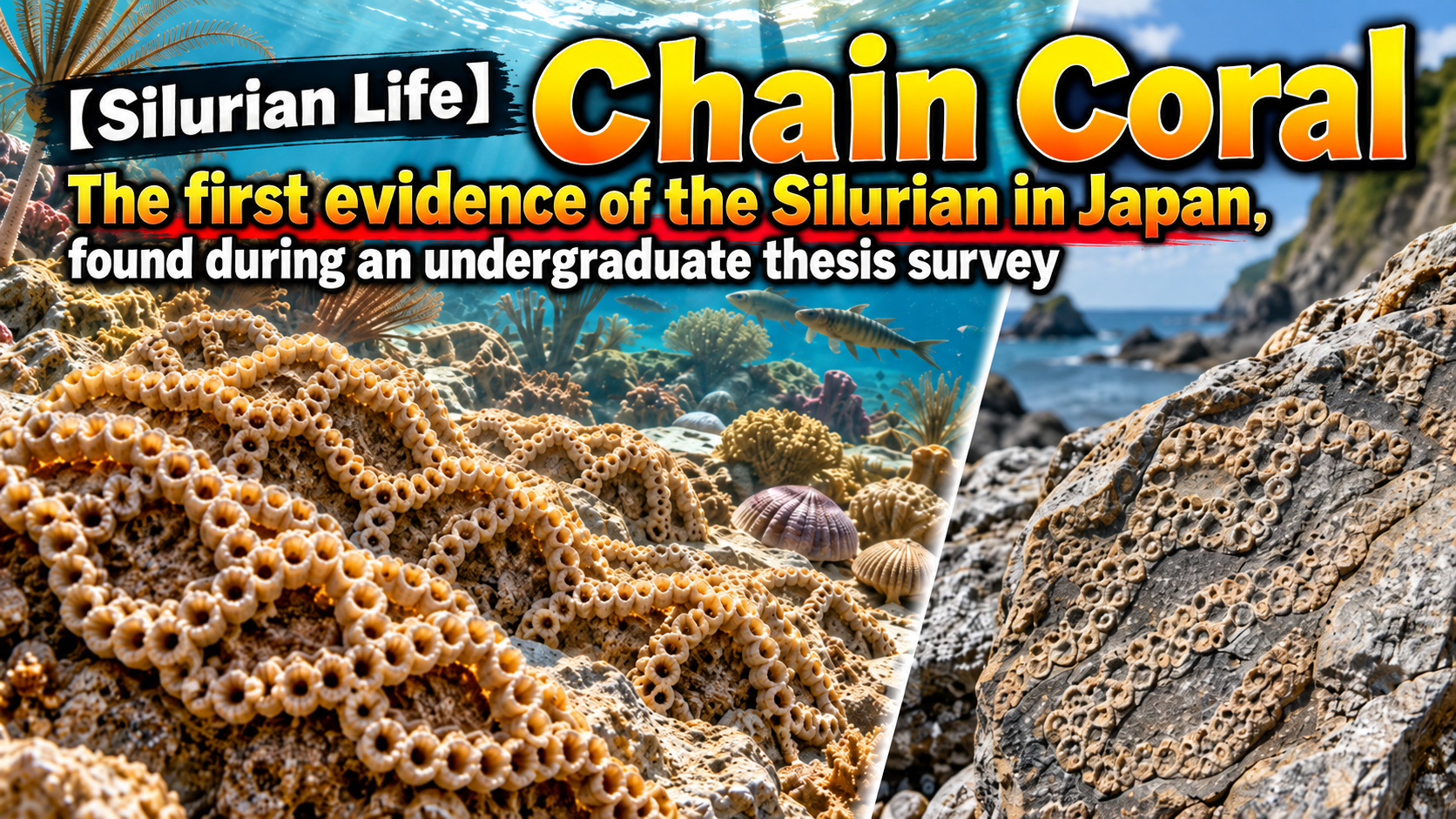
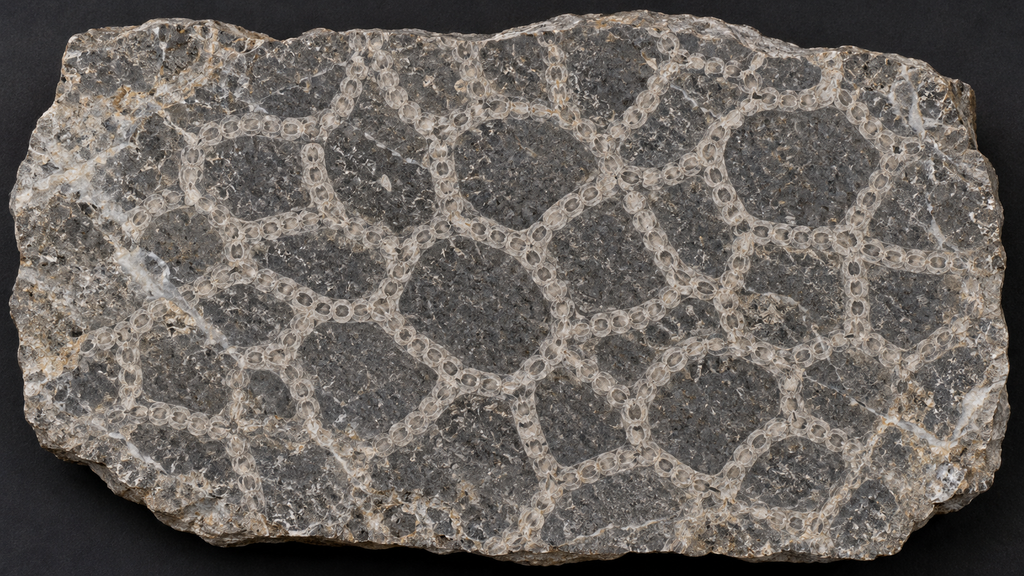
Halysites is a tabulate coral that lived in the seas of the Paleozoic Era. Its thin tubes joined side by side in single rows to form walls, and because those walls wound around and closed up into a mesh, a cross-section shows a pattern like the links of a chain. It was one of the reef builders of the shallow Silurian seas, and in Japan it is among the fossils that first showed the country has Silurian rocks at all.
Appearance and Way of Life
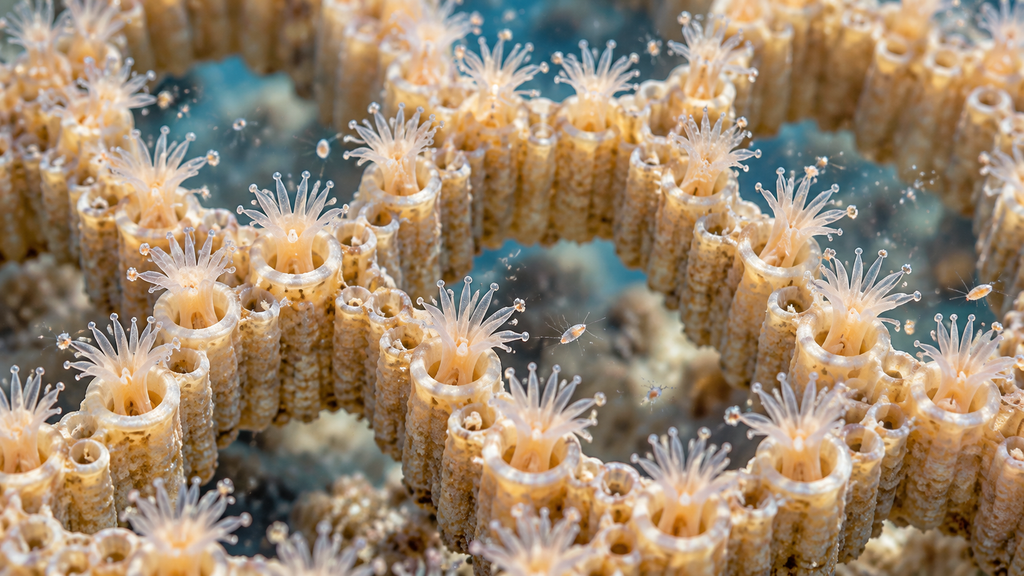
Each tube in the colony housed a single polyp, the individual coral animal, and inside each tube lie many horizontal plates, laid down one after another as the polyp grew upward. These plates, called tabulae, give tabulate corals their name. In Halysites, each tube touches its neighbors at only two points, left and right, so the tubes line up in a single file to form a wall like a palisade. The palisades branch and join one another as they grow, and seen from above the colony looks like a set of small rooms enclosed by walls. These rooms had no skeleton of their own and were simply filled with seawater.
What sets the genus apart is a row of much thinner tubes wedged between the larger ones. Catenipora, thought to be its ancestor, lacks them. A 2019 study that measured Silurian specimens from Estonia found the large tubes to be about 1.5 mm across and the thin ones about 0.2 to 0.5 mm. Treating regular fluctuations in the inner width of the tubes as annual growth marks, the same study estimated that colonies grew upward by an average of about 6 mm a year. A 2024 study that examined Early Silurian specimens from China in three dimensions with micro-CT showed that when a palisade extended sideways, it could split from a single point into several branches at once.
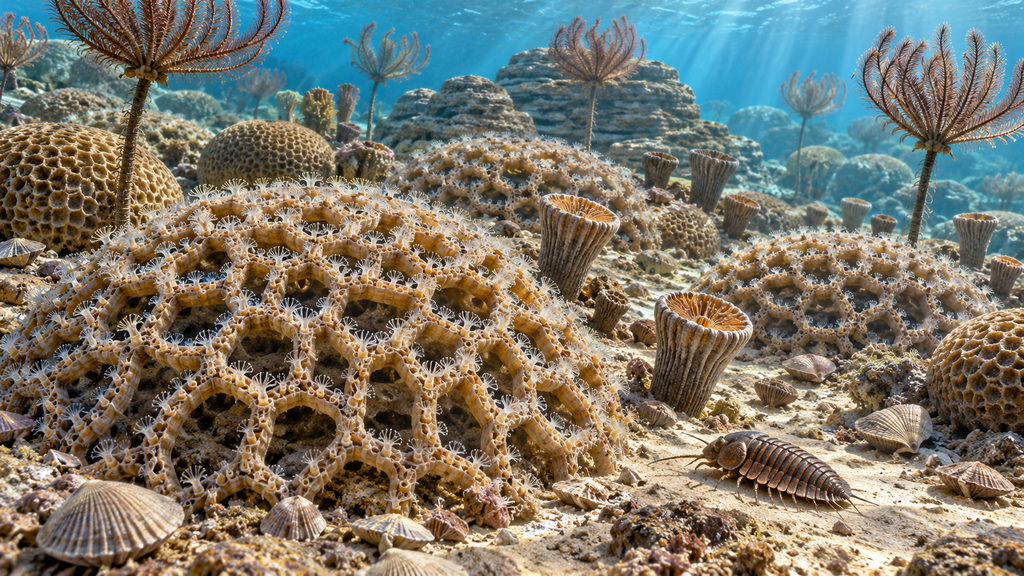
Halysites lived in warm, shallow seas near the equator. Its polyps are thought to have caught plankton with their tentacles. On Silurian reefs it covered the seafloor together with stromatoporoids (a group of sponges), mound-forming honeycomb corals such as Favosites, and horn-shaped rugose corals, while crinoids, brachiopods, and trilobites lived around them. The 2024 study from China found that Halysites reefs were open structures, with coral skeleton making up only about 30 percent of the rock, and the rooms inside the mesh likely gave rugose corals, bryozoans, and other organisms a place to live. On the island of Gotland in Sweden, a bed where Halysites carpeted the seafloor preserves rugose corals that anchored themselves among the chains with root-like outgrowths.
A Chain Pattern That Marks the Age of the Rock
The first person to describe Halysites was the Swedish naturalist Carl Linnaeus, who established the modern system of scientific names. In 1767 he named it Tubipora catenularia and placed it with the organ-pipe coral Tubipora, which still lives in warm seas today. It was later moved to a genus of its own and now goes by the name Halysites.
Chain corals appeared in the Late Ordovician, reached their peak in the Silurian, and disappeared around the end of the Silurian. That is a sharp contrast with Favosites, another tabulate coral, which survived until the Permian. Because their time on Earth is so clearly bounded, and because the chain pattern is easy to recognize even on a broken limestone surface, finding chains in the field is a good sign that the limestone dates from the Ordovician or Silurian.
The Limestone in Ofunato That Revealed Japan’s Silurian
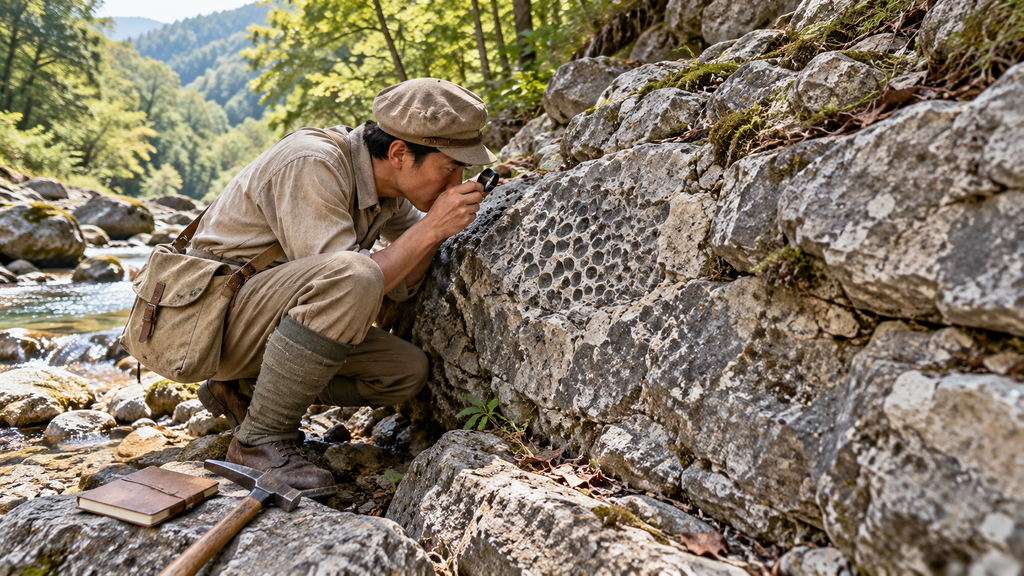
Until the mid-1930s, no Silurian rocks had been confirmed anywhere in the Japanese islands. The person who changed that was Yoshio Onuki, then a student at Tohoku Imperial University. In 1936, while doing geological fieldwork for his graduation thesis, Onuki was walking along the Higuchizawa stream in Kesen District, Iwate Prefecture, in what is now the Hikoroichi area of Ofunato City. There he found coral fossils in the limestone. According to the story that has been handed down, he noticed them in a nearby outcrop after resting following his lunch.
The limestone at Higuchizawa yields tabulate corals such as Halysites and Favosites, along with rugose corals, stromatoporoids, and brachiopods. From this combination of fossils, the limestone was identified as Silurian. Onuki reported the find in 1937 in the Journal of the Geological Society of Japan, in a paper announcing the discovery of “Gotlandian” strata in the Kesen District of the Kitakami Mountains. Gotlandian, named after the island of Gotland, was the name then used for the Silurian. With that report, the known geological history of Japan reached back to the Silurian.
Silurian limestones containing chain corals were later found one after another in Sumita in Iwate Prefecture, at Mount Yokokura in Ochi, Kochi Prefecture, and in Kyushu. In the Kitakami Mountains and at Mount Yokokura, the genus Halysites dominates the lower Silurian beds, while a different genus, Schedohalysites, becomes common in the upper beds. A 1981 review of Japan’s Silurian and Devonian corals concluded that nearly all of them belong to groups found worldwide, and that only the chain corals show any regional character. Schedohalysites is considered a sign of a connection between Japan and Australia during the Silurian. The Kitakami Mountains of that time are thought to have been part of a continent lying near the equator.
In 1957 the Higuchizawa site was designated a Natural Monument of Japan as the “Higuchizawa Gotlandian Fossil Locality,” a name that still carries the term used at the time of the discovery. Chain coral fossils collected at Higuchizawa are on display at the Ofunato City Museum.
Related products
You can find books and products related to this article on Amazon.
If you buy through the links above, this blog may earn a commission.
Sources
fossiilid.info, “Halysites catenularius” (Linnaeus’s original description and measurements)
Sanriku Geopark, “Higuchizawa Gotlandian Fossil Locality” (in Japanese)
Iwate Prefectural Museum, “Tabulate coral fossil Schedohalysites (chain coral)” (in Japanese)
Yokogurayama Natural Forest Museum, Ochi, “Chain coral” (in Japanese)


コメント