This article contains affiliate links. As an Amazon Associate I earn from qualifying purchases.
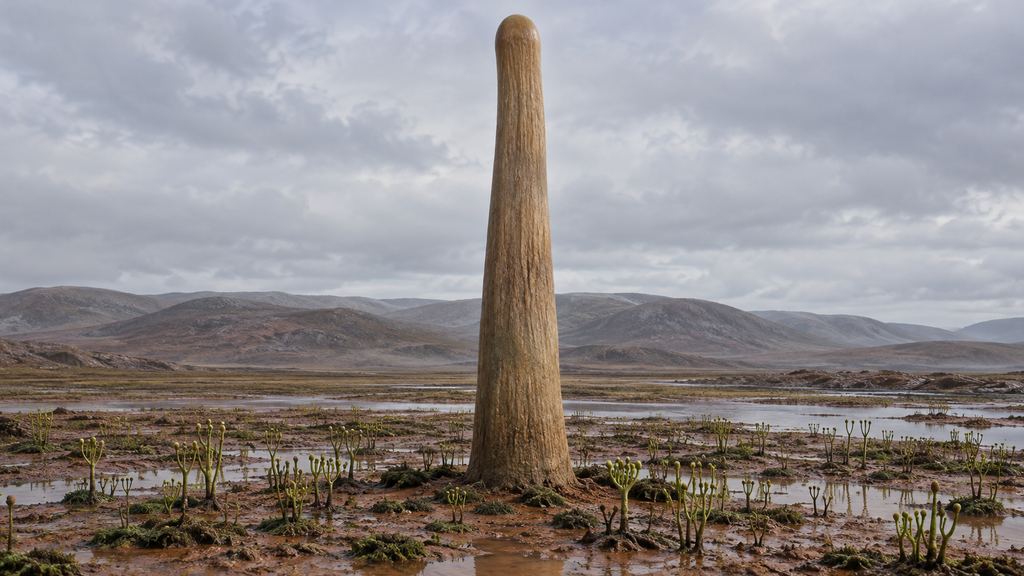
| Name | Prototaxites. The name means “first yew”; it was given in 1859 by a scientist who took the fossil for a conifer. Type species: P. loganii |
| Group | Uncertain. Since 2001 it has mostly been treated as a giant fungus, but a 2026 study of Scottish specimens concluded that it was not a fungus but a separate, wholly extinct lineage |
| Age | Late Silurian to Late Devonian (about 420 to 370 million years ago). The largest specimens, and the ones with cells preserved, are Early Devonian |
| Found in | The Gaspé Peninsula of Quebec, Canada (the first specimens); Rhynie in Scotland; England; the United States; and elsewhere |
| Size | Up to 8 to 8.8 m tall and up to 1 m thick. A column with no branches and no leaves |
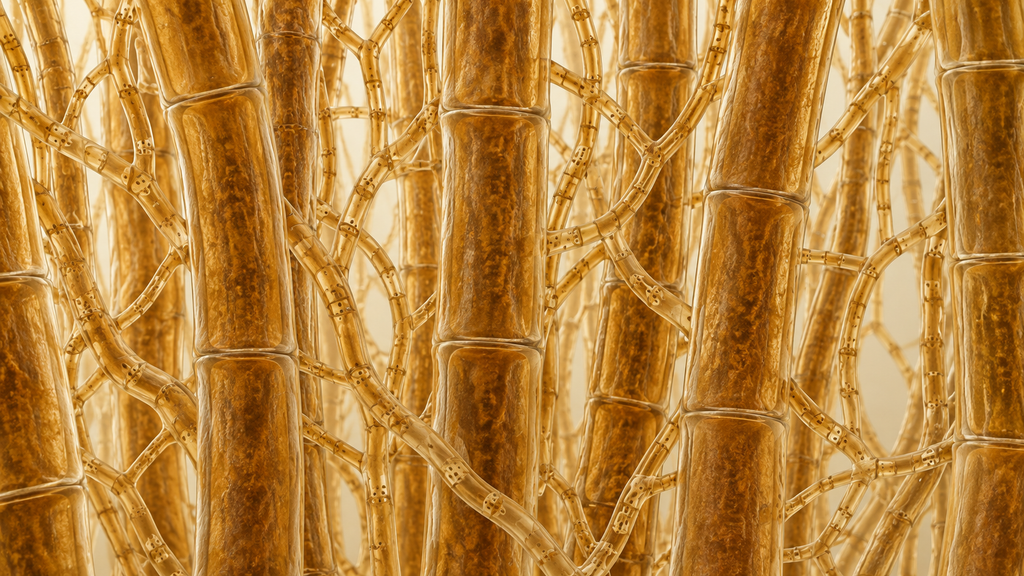
| Inside | Built from bundles of tubes 20 to 50 micrometers across, with much thinner branching threads winding between them |
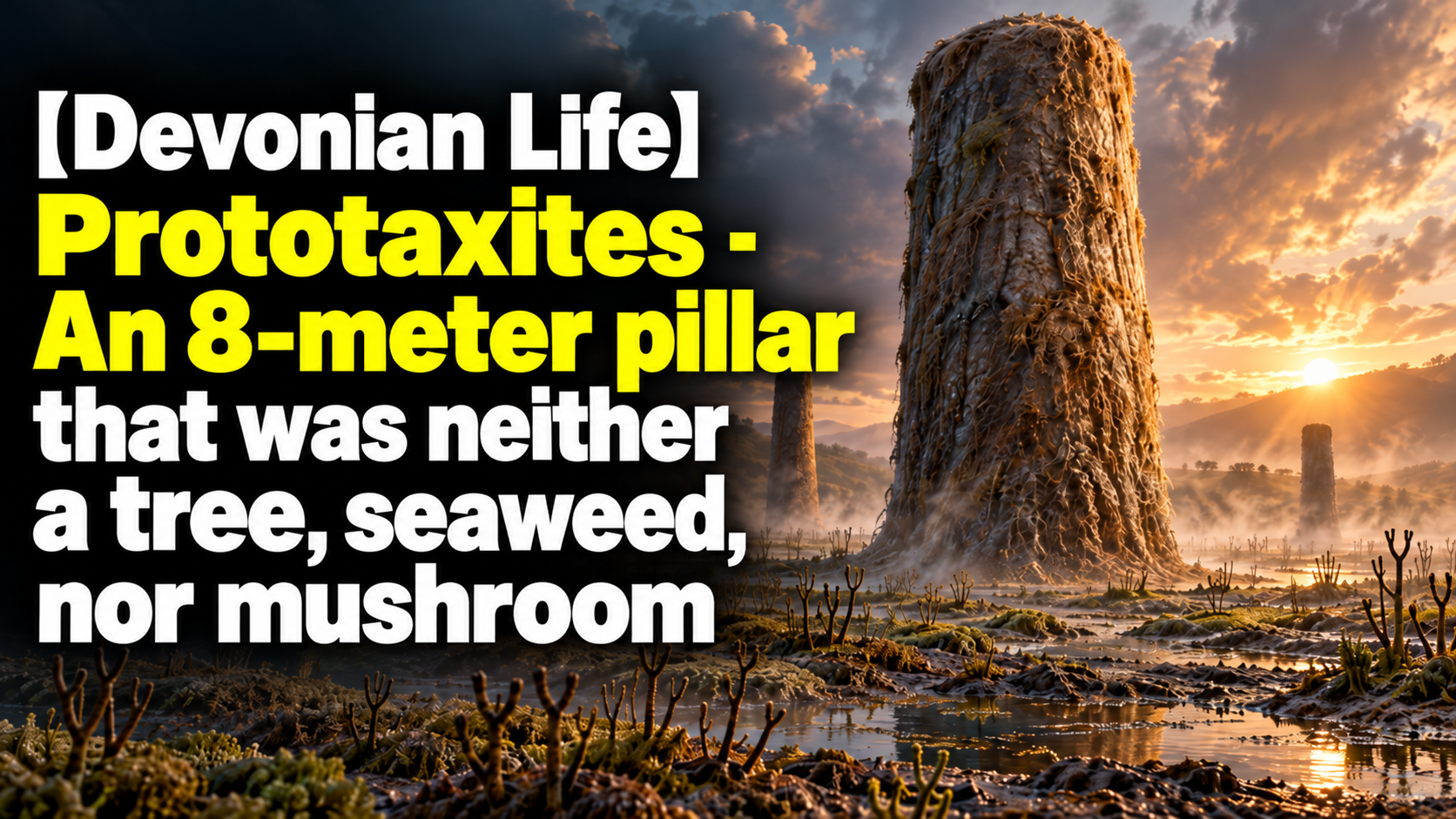
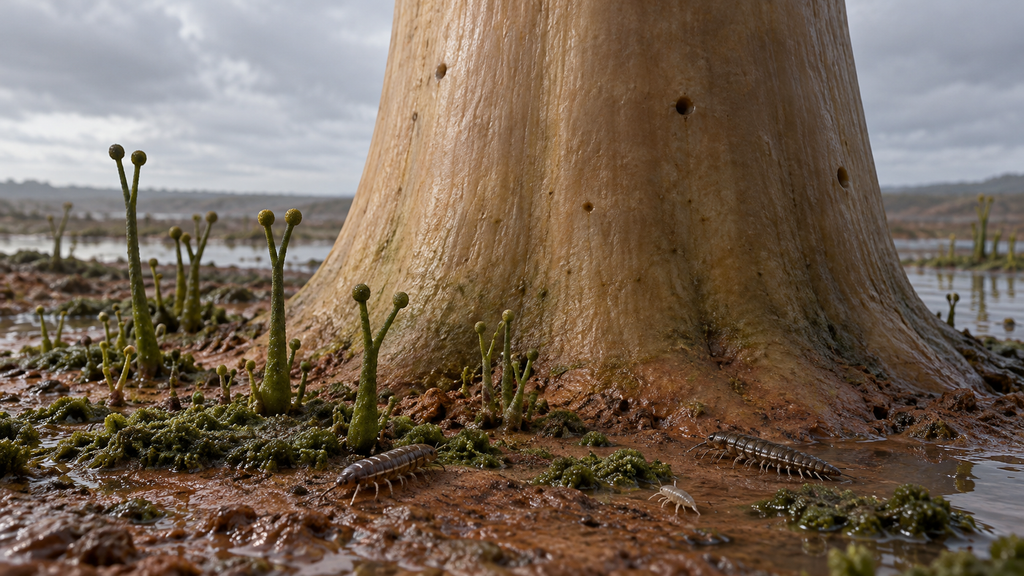
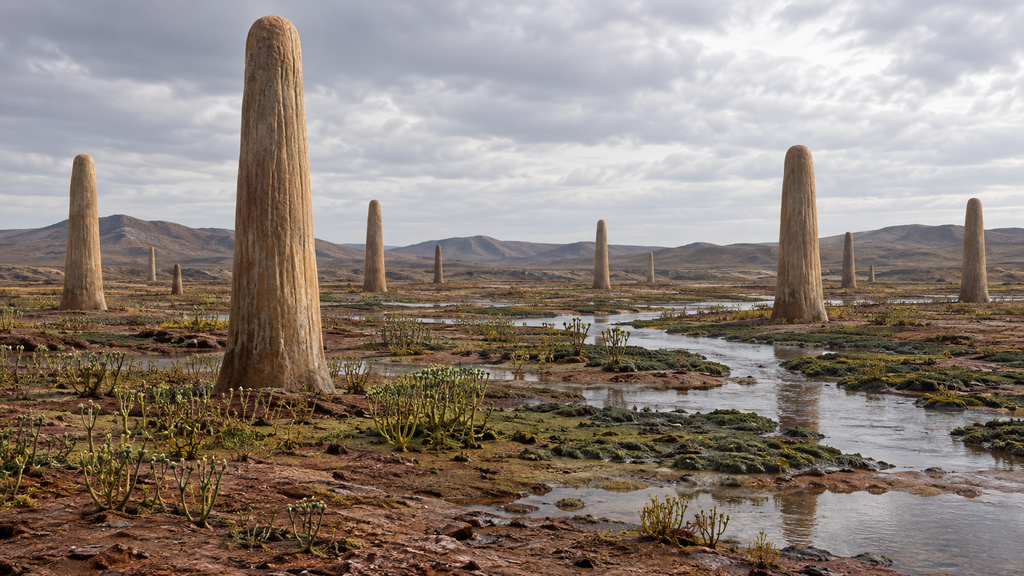
Prototaxites is a columnar organism that stood on land from the late Silurian through the Devonian and reached 8 meters in height. It had no branches and no leaves, and its cross-section shows concentric rings. At a time when most land plants did not reach knee height, it was by far the largest living thing on land. What kind of organism it was has not been settled in the more than 160 years since it was described in 1859.
Appearance and way of life
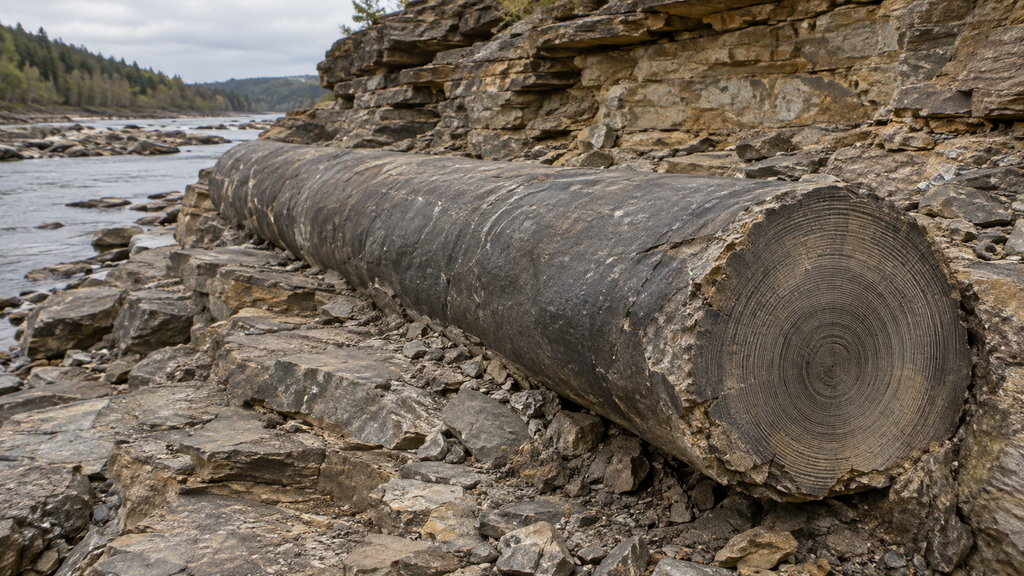
The fossils come out of the rock as log-shaped bodies several meters long and tens of centimeters to a meter thick. The surface is smooth, with no scars where branches or leaves were attached. A polished cross-section shows concentric rings that look like the growth rings of a tree, but there is no wood tissue. Under the microscope, the whole column is made of bundles of thin tubes. These tubes are 20 to 50 micrometers across (a few hundredths of a millimeter), thick-walled, without internal partitions, and aligned along the length of the column. Between them wind much finer threads, 5 to 10 micrometers wide, that branch frequently and have occasional cross-walls pierced by pores.
From the Rhynie chert in Scotland come specimens preserved down to individual cells. This rock formed about 407 million years ago when silica-rich hot-spring water flooded and petrified a marshy landscape, preserving early land plants, fungi and arthropods much as they were in life. The Prototaxites in it (P. taiti) was larger than anything else in the deposit, while the plants around it were leafless stalks a few centimeters to a few tens of centimeters tall.
What it fed on was investigated in 2007 using carbon isotopes. Plants growing by photosynthesis in the same place end up with similar carbon isotope ratios. Prototaxites, by contrast, varied widely from specimen to specimen, over a wider range than the plants in the same beds. This was read as evidence that it did not photosynthesize but took in organic matter from varied sources around it, living in the manner of a fungus. The fossils also carry holes bored by arthropods and traces of animals that lived inside them, so the columns served as food and shelter for small animals as well.
Tree, seaweed, fungus, moss, and none of the above
The first specimens were collected in 1843 on the Gaspé Peninsula in Quebec, Canada. In 1859 the Canadian geologist John William Dawson described them and, judging from the concentric rings and tubular tissue, took them for the half-rotted trunks of conifers. He named the fossil Prototaxites, “first yew”.
In 1872 the British botanist William Carruthers rejected this reading. The tubes were nothing like wood, he argued, and resembled the filaments that make up the body of a seaweed; he proposed that it was a giant marine alga and gave it a new name, Nematophycus. Dawson disputed this but dropped the conifer idea, and in 1888 proposed yet another name himself. Under the rules of naming, the original name took priority and Prototaxites stayed. Even after it became clear that the fossils came from land deposits rather than marine ones, the seaweed interpretation persisted for a long time. In 1919 it was suggested that the organism might be a fungus, but the idea did not catch on.
The turning point came in 2001. Francis Hueber of the Smithsonian’s National Museum of Natural History sectioned specimens from around the world and argued that the combination of thick tubes and fine threads matched the tissue of fungal hyphae. In 2007 Kevin Boyce and colleagues published the carbon isotope analysis described above, and its finding that the organism was not photosynthetic gave the fungus hypothesis further support. The reconstruction of an 8-meter mushroom spread from this period.
The fungus hypothesis did not explain everything, however. In 2010 Linda Graham and colleagues at the University of Wisconsin proposed that the columns were mats of liverworts, like the modern Marchantia, that had been rolled up by wind or water. A rebuttal published the same year argued that this was incompatible with the internal structure of the columns.
In January 2026 Corentin Loron of the University of Edinburgh and colleagues published a direct comparison of the Rhynie chert Prototaxites with the fungi preserved in the same rock. Its organization differed from every known fungus, living or fossil. Infrared spectroscopy of the cell walls found no components derived from chitin, which is present in the cell walls of all fungi; instead it detected components close to those left when plant lignin fossilizes. Loron and colleagues concluded that Prototaxites was not a fungus and is best assigned to a eukaryotic lineage that has no living members at all.
Debate over the interpretation of the spectroscopic results continues. After conifer, seaweed, fungus and liverwort, the current position is that even its closeness to fungi is unresolved. What is certain is that an organism was raising 8-meter columns on land before forests existed, and that it resembles nothing alive on Earth today.
Related products
You can find books and products related to this article on Amazon.
If you buy through the links above, this blog may earn a commission.
Sources
- Hueber, F. M. (2001). Rotted wood–alga–fungus: the history and life of Prototaxites Dawson 1859. Review of Palaeobotany and Palynology 116, 123–158. https://doi.org/10.1016/S0034-6667(01)00058-6
- Boyce, C. K., Hotton, C. L., Fogel, M. L., Cody, G. D. et al. (2007). Devonian landscape heterogeneity recorded by a giant fungus. Geology 35, 399–402. https://doi.org/10.1130/G23384A.1
- Graham, L. E., Cook, M. E., Hanson, D. T. & Pigg, K. B. (2010). Structural, physiological, and stable carbon isotopic evidence that the enigmatic Paleozoic fossil Prototaxites formed from rolled liverwort mats. American Journal of Botany 97, 268–275. https://doi.org/10.3732/ajb.0900322
- Taylor, T. N., Taylor, E. L., Decombeix, A.-L., Schwendemann, A. et al. (2010). The enigmatic Devonian fossil Prototaxites is not a rolled-up liverwort mat: Comment on the paper by Graham et al. American Journal of Botany 97, 1074–1078. https://doi.org/10.3732/ajb.1000047
- Loron, C. C., Cooper, L. M., McMahon, S., Jordan, S. F. et al. (2026). Prototaxites fossils are structurally and chemically distinct from extinct and extant Fungi. Science Advances 12, eaec6277. https://doi.org/10.1126/sciadv.aec6277


コメント