The Permian ran from about 299 million to about 252 million years ago, lasting some 47 million years. It is the last of the six periods making up the Paleozoic Era, with the Carboniferous before it and the Triassic of the Mesozoic after.
The name comes from the Russian city of Perm. In 1841, the British geologist Roderick Murchison grouped the strata of that region, west of the Ural Mountains, as the Permian System. The older Japanese term Nijōki has a different origin: in Germany the strata of this period appear in two divisions — a lower red sandstone and an upper unit containing limestone and rock salt — and were called the Dyas, meaning two layers, a translation that stuck.
Evidence for a single connected landmass
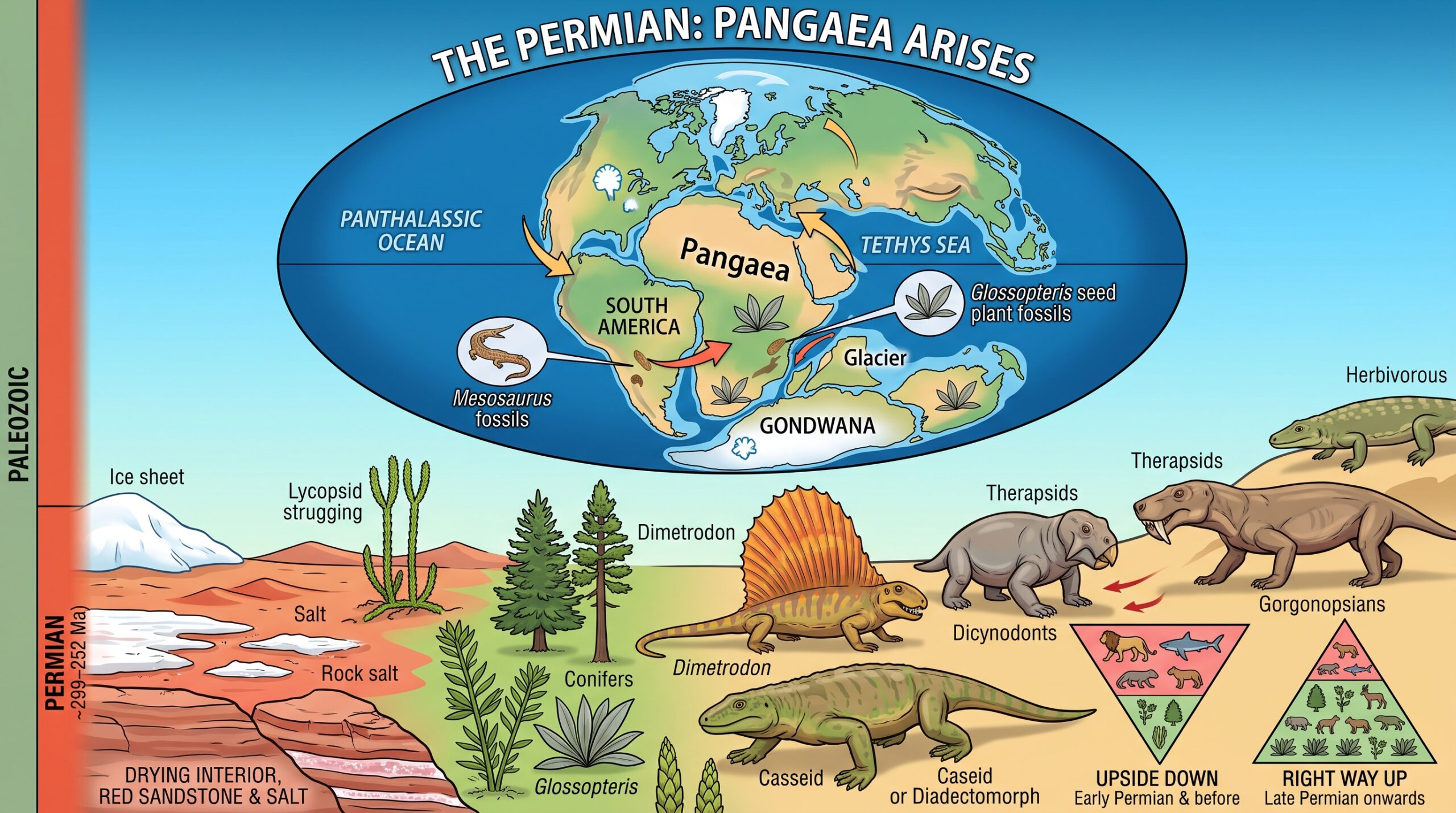
Draw a world map of this period and the land is gathered into essentially one place: the supercontinent Pangaea. Everything else is one continuous ocean, called Panthalassa. From the east, the Tethys Sea cut in with a wide open mouth.
The idea that the continents were once joined was brought before the world, with evidence assembled, by the German meteorologist Alfred Wegener. Among the lines of support he set out in an address in 1912 and a book in 1915, several were Permian organisms.
One was Glossopteris, a seed plant. Fossils of its tongue-shaped leaves turn up in South America, Africa, Madagascar, India, Antarctica and Australia. The seeds are heavy, not the sort of thing wind carries across an ocean. Another was Mesosaurus, a small aquatic reptile that could live only in fresh water, yet whose fossils come solely from southern South America and South Africa. Neither can be explained by putting an ocean in between.
Traces of glaciers point the same way. Early in the Permian, thick ice sheets covered the southern continents. Scratches where ice scoured rock survive today even at locations near the equator. And when their orientations are joined up, they align cleanly once the scattered continents are gathered back together.

Saying that Pangaea was completed in the Permian, though, gets slightly ahead of the facts. The main body formed when the southern continents (Gondwana) collided with the northern landmass during the Carboniferous, and Siberia joined around the same time. But the eastern margin — the North China and South China blocks, in what is now China — was still separate, like islands. Those attached to the main body only in the Triassic. The familiar textbook image of Pangaea is somewhat idealized on its eastern side.
Japan preserves a record of this period’s ocean too. The limestone making up the Akiyoshi Plateau in Yamaguchi Prefecture grew as a coral reef on the summit of a seamount in the middle of the Panthalassic Ocean, from the Early Carboniferous through the Middle Permian. It records some 80 million years of climate and sea-level change, and was later carried by the plate and accreted onto the Japanese archipelago.
The end of the ice, and a drying interior
The Permian began as an age of ice. The Late Paleozoic Ice Age, running since the Late Devonian, peaked from the end of the Carboniferous into the early Permian, with most of Gondwana under ice.
That ice retreated substantially during the Early Permian. The major ice sheets were gone by the Artinskian, around 290 million years ago. A boron isotope record reported in Nature Geoscience in 2025 shows a sharp rise in atmospheric carbon dioxide coinciding with the end of the ice. Mountain glaciers persisted in eastern Gondwana, around present-day Australia, until about 260 million years ago, but as a global ice sheet system this marks the close.
What took its place was aridity. When the land gathers into one place, the interior ends up far from the sea. No sea means no supply of water vapor. In addition, a continent extending far north and south heats very differently in summer and winter, and a vast monsoon with seasonally reversing winds is thought to have developed. Rain concentrated along the continental margins and struggled to reach inland.

The result is preserved in the strata. Rocks of this period yield red sandstone dune deposits and layers of rock salt and gypsum formed by evaporating seawater, at sites around the world. The Zechstein salt beds extending from Germany into Poland are the prime example, and are still mined today.
The plant cast changed as well. The tall lycopsids such as Lepidodendron that had filled Carboniferous swamps can live only where the water table is high. They fared badly in a drying world, and what gained ground in their place were plants that reproduce by seed. In the Northern Hemisphere, conifers, cycad relatives and the cordaites; in Gondwana to the south, the Glossopteris already mentioned formed vast forests. Seeds tolerate drought and travel by wind or animal. They carry no requirement, as spores do, of damp ground to reach the next generation.
The lineage that held the land
The largest animals on land in this period were the synapsids, characterized by a single opening on each side of the skull behind the eye. We mammals sit at the tip of this branch.
One caution about an old label. Synapsids were long called mammal-like reptiles, which is not accurate. Synapsids and the lineage leading to today’s lizards, crocodilians and birds (the sauropsids) had already split during the Carboniferous into separate branches. Synapsids did not emerge from within the reptiles; they stood alongside them from the start. Dimetrodon, with its great sail, is not only not a dinosaur but not a reptile either — it sits near the base of our own branch.

The leads of the Early Permian were groups like Dimetrodon and Edaphosaurus, with limbs sprawling out to the sides. From the Middle Permian onward, the therapsids spread — their legs tucked under the body, apparently capable of more active movement. Dicynodonts with a beak and two tusks; gorgonopsians with saber-like canines. Large herbivores weighing over a ton appeared as well.
Not only synapsids. The pareiasaurs, stocky armored herbivores, also grew large. On the reptile branch, the captorhinids spread worldwide.
A food pyramid standing upside down
Picture a land ecosystem today: many herbivores such as zebras and deer, and a small number of lions and wolves eating them. Wide at the bottom, narrow at the top. That looks like the obvious shape, but in the history of life it came together fairly recently.
From the time vertebrates came onto land until around the first half of the Carboniferous, nearly every terrestrial tetrapod was a carnivore or insectivore, eating fish and arthropods. The source of nutrition, in other words, was in the water, and the animals that had come ashore could not get away from the waterside. Counting bones from the strata, assemblages with more carnivores than herbivores were the norm. The pyramid stood upside down.
Why did they not eat plants? Because they could not. Cellulose, the main component of plant cell walls, cannot be broken down by the digestive enzymes animals produce themselves. Living on it requires assembling several tools at once: teeth that grind tough leaves and stems, and jaws that occlude properly; a large torso and gut able to hold great quantities of low-calorie food for long periods; and above all, residence by microbes that break cellulose down inside the gut.
That whole set came together independently in at least five lineages, from the end of the Carboniferous into the Early Permian: diadectids, edaphosaurids, caseids, bolosaurids and captorhinids. Groups not closely related to one another arrived at it separately at roughly the same time.

By the Late Permian, the same structure we have now was in place: many herbivores eaten by a few carnivores. As Hans-Dieter Sues and Robert Reisz of the University of Toronto summarized in Trends in Ecology & Evolution in 1998, terrestrial ecosystems had taken on a modern form by this point. This was the first time the food pyramid stood the right way up on land.
The origin itself is still being rewritten. A study reported in Nature Ecology & Evolution in February 2026 examined the teeth of a “microsaur” (Tyrannoroter heberti) from Nova Scotia, Canada, by high-resolution CT and confirmed wear from both slicing and grinding motions. The same features can reportedly be traced back to specimens about 318 million years old, raising the possibility that herbivory was not an amniote invention alone. The phylogenetic position of this group, however, is not yet settled.
An ecosystem that left the water’s edge
The significance of animals that could eat plants directly goes beyond a wider menu. It means the terrestrial ecosystem became independent of water.
Until then, nutrition for land animals came from rivers and lakes. Eat fish, eat waterside insects, eat the predators of those. So the assemblages had no choice but to cling to the water’s edge. Once plant-eating animals existed, a food chain beginning with sunlight and soil could be completed entirely on land. Without water, so long as plants grow, an animal community can stand.

That meshed with the stage Pangaea provided, with its dry interior. In the second half of the Permian, dicynodont fossils turn up across nearly the entire continent: South Africa, Antarctica, India, Russia, China. A body able to endure arid country, plants that could be eaten there, and land connected all the way into the continental interior — this was the first period in which all three came together.
Much remains unknown, however. Gut microbes that break down cellulose do not fossilize. Whether the animals of the time really had them can only be inferred from tooth shape, body size and the breadth of the torso. Nor is there yet an explanation for why several transitions to herbivory clustered in the short interval at the end of the Carboniferous. Was climate change the trigger, or did something change on the plant side? The answer lies in fossils still to be dug out.
コメント